
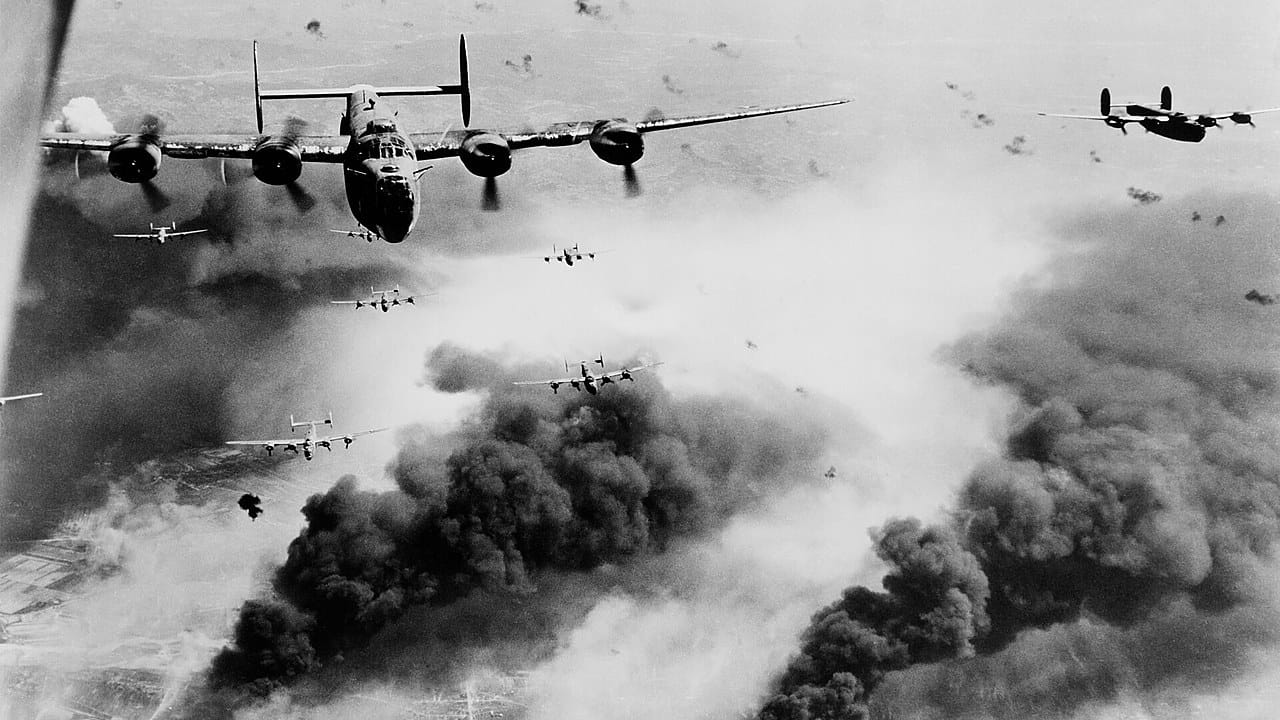
Before dawn on 1 August 1943, the desert around Benghazi coughed itself awake. One hundred and seventy-eight B-24 Liberators, engines scoured half to death by Libyan sand, staggered off the runways with 3,100 US gallons (11,700 litres) of fuel and full bomb bays. More than 1,700 young men went with them. One aircraft, Kickapoo, crashed minutes after takeoff. The other 177 turned north over the Mediterranean, toward Romania, flying low enough to stay under German radar. Most of the crews had been told the defences would be light. The men who planned it knew better.
The target was Ploiești: nine refineries ringing a Romanian city of 100,000, producing roughly a third of the Axis war machine's oil. The plan was to erase much of that in one blow, delivered from treetop height, 2,300 miles (3,700 km) there and back. No escort. No second chance.
Quick Facts
- 1 August 1943: 178 B-24D Liberators launched from airfields around Benghazi, Libya; one crashed on takeoff
- Round trip: roughly 2,300 miles (3,700 km) — flown without fighter escort
- Target: nine refineries around Ploiești, source of roughly one-third of Axis oil
- Attack altitude: down to 30-50 ft (10-15 m) — some aircraft came home with grass stains
- Losses: 53 B-24s destroyed and 55 damaged; 310 airmen killed or missing, 108 captured, 78 interned in Turkey
- Five Medals of Honor — the most ever awarded for a single air action; three posthumous
- Refinery output exceeded pre-raid levels within weeks of repairs
The Oil Problem
The order came from the top — Roosevelt and Churchill settled on Ploiești at Casablanca in January 1943. Nobody asked Ninth Air Force whether it was feasible; Maj. Gen. Lewis Brereton was simply told to do it. His planners ran the numbers on a conventional high-altitude campaign and got an answer nobody liked: about 1,400 heavy bombers needed. They had fewer than 200. Col. Jacob Smart proposed the alternative — go in low, all at once, and trade altitude for surprise and accuracy.
The preparation was serious. Engineers laid out a full-scale replica of the refineries in the desert. Crews memorised sand-table models and target sketches, and flew two full dress rehearsals; on the second, the force destroyed its dummy target in two minutes. Five bomb groups would fly it: the 376th and 98th from the Ninth Air Force, plus the 44th, 93rd and 389th borrowed from England.
What the crews didn't know: Ploiești was the most heavily defended target in Axis Europe outside the Reich itself. Luftwaffe General Alfred Gerstenberg had spent years building a ring of hundreds of guns — 88s in the open, light flak hidden in haystacks and mock buildings, a disguised flak train the Germans called the caterpillar, balloons, smoke generators, and dozens of fighters within range. His signals unit in Athens read the Ninth's radio traffic. The defenders were tracking the "surprise" mission almost from takeoff.
Knowledgia charts how America's boldest low-level raid unravelled over Romania.
The Wrong Turn
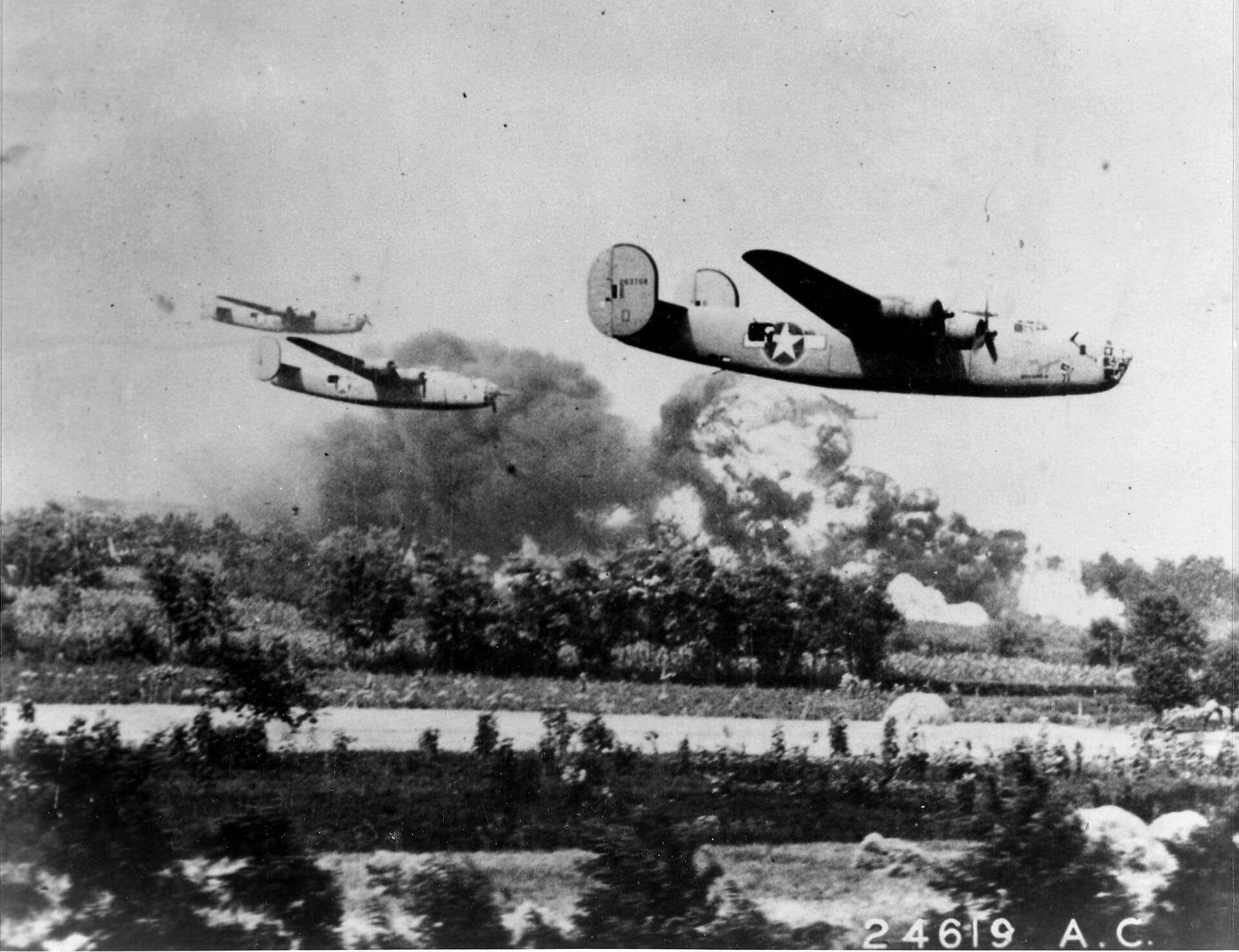
Things went wrong over the sea. The lead group's aircraft Wingo-Wango suddenly porpoised and dove into the Mediterranean, taking a mission navigator with it; its wingman dropped down to search and never caught up. Over the Balkan mountains, the groups split — the two lead formations ran higher power settings and simply pulled away from the rest. Radio silence, kept religiously, prevented anyone from reassembling the plan. The Germans, of course, already knew they were coming.
Then came the mistake that broke the mission. At the small town of Târgoviște, Col. Keith Compton in the lead ship — with mission commander Brig. Gen. Uzal Ent aboard — mistook the town for the final checkpoint at Florești and turned his group down the wrong railway line, heading for Bucharest. Lt. Col. Addison Baker's 93rd followed. Crews down the line saw it, and some broke radio silence to shout the error into the ether. Ent had been fatalistic about the odds from the start.
Baker fixed it the hard way. He swung the 93rd ninety degrees and drove straight at Ploiești — through the thickest of Gerstenberg's guns instead of around them. His B-24, Hell's Wench, hit a balloon cable and took shell after shell; he jettisoned his bombs just to stay airborne, and stayed at the head of the formation anyway. Past the target he traded his last speed for altitude so some of his crew could jump. None survived the fall of the aircraft. Baker and his co-pilot, Maj. John Jerstad — a man who had already finished his combat tour — received posthumous Medals of Honor.
Behind them, Ent ordered the misdirected 376th onto targets of opportunity. In the German fighter-control centre in Bucharest, officers watched the improvised swirl of formations and concluded, admiringly, that it was a masterpiece of American deception.
Through the Caterpillar's Fire
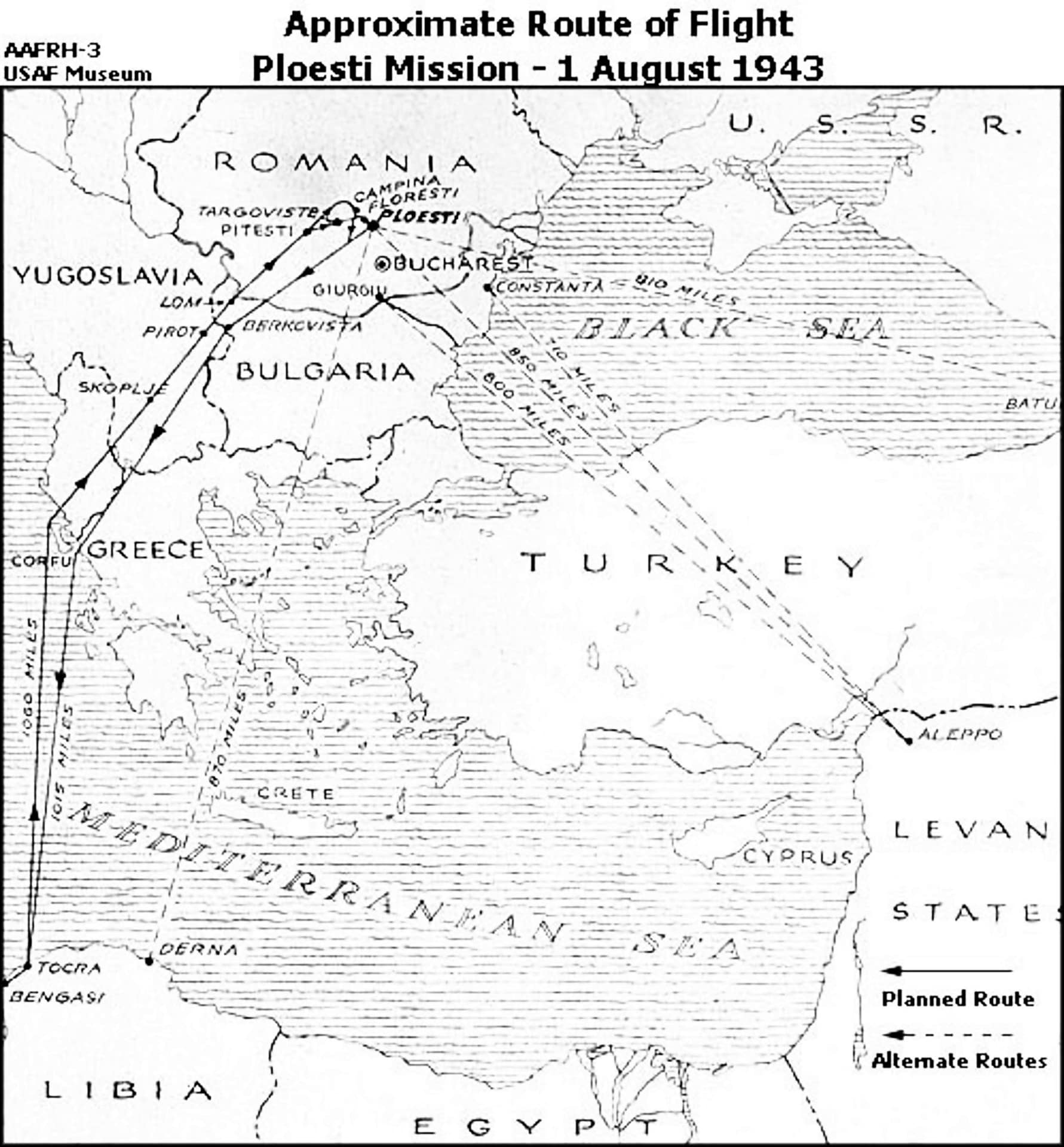
The 98th and 44th, led by Col. John Kane and Col. Leon Johnson, made the correct turn at Florești — and flew their run parallel to a railway on which Gerstenberg's flak train was waiting. The freight cars' false sides dropped, and at 50 feet (15 m) the bombers and the train fought a running gun battle until the B-24s' fifty-calibres killed the locomotive. Then Kane and Johnson took their groups into targets already burning from the 93rd's bombs, through smoke, flame and the blasts of delayed-action fuses. Kane had told his men before takeoff exactly what the mission was worth.
Both colonels came out the other side and both received the Medal of Honor. South of the city, Lt. Col. James Posey's 21 aircraft flattened the Creditul Minier refinery without losing a ship over the target. At Câmpina, Col. Jack Wood's 389th hit Steaua Română exactly as rehearsed. In its second wave, 22-year-old 2nd Lt. Lloyd Hughes ran in below 30 feet with fuel streaming from punctured wing tanks, held course through the flames until his bombs were gone, and died attempting a crash landing. His was the fifth Medal of Honor — the most ever awarded for a single air action, three of them posthumous.
The trip home was its own battle. German, Romanian and Bulgarian fighters hunted the cripples across the Balkans. Some B-24s flew so low their belly antennas came back stained green. Seven aircraft diverted to neutral Turkey and were interned. Of 177 that set out, 88 reached Benghazi that night — 55 of them shot up.
The Arithmetic of Black Sunday
The bill: 53 Liberators destroyed by most official counts, with 55 more damaged. Of roughly 1,750 airmen who flew, 310 were killed or missing, 108 became prisoners of the Axis, 78 sat out the war in Turkey — around 500 men gone in a single afternoon, close to a third of the force. Romanian records add a toll on the ground: 101 civilians killed, many when a falling bomber struck a women's prison in Ploiești. The date entered American memory as Black Sunday, proportionally among the costliest major Allied air raids of the war.
The decorations tell you how the Army Air Forces judged the men, whatever it thought of the plan: five Medals of Honor — Baker, Jerstad and Hughes posthumously; Kane and Johnson surviving to wear theirs — alongside 56 Distinguished Service Crosses.
The Operations Room follows the USAAF into the refineries at fifty feet.
And the refineries? Allied assessors initially credited the raid with destroying about 40 percent of Ploiești's capacity. But Gerstenberg had built his complex with slack and interconnecting pipework, and he had forced labour to spend. Most damage was repaired within weeks; because several plants had been running below capacity, net output soon rose above pre-raid levels. Meanwhile IX Bomber Command counted 33 flyable B-24s and could not go back. As a one-punch knockout, Tidal Wave failed.
Ten weeks later, the same lesson was written over a German ball-bearing town called Schweinfurt: against a defended, repairable industrial system, a single unescorted raid — however brave — buys weeks, not victory. Ploiești was finally ground down in 1944 by month after month of escorted raids from Italy. What 1 August 1943 bought, at fifty feet and full throttle, was harder to measure and easier to remember: proof of what bomber crews would fly through when they were asked.
Sources: Wikipedia, Air Force Magazine (Walter J. Boyne), Air Force Historical Support Division
Related Questions
What was Operation Tidal Wave?
Operation Tidal Wave was the US low-level bombing raid on the Ploiești oil refineries in Romania on 1 August 1943. 178 B-24 Liberators flew roughly 2,300 miles (3,700 km) from Libya without fighter escort to attack refineries that produced about a third of Axis oil.
Why was Ploiești such an important target?
The nine refineries ringing Ploiești produced roughly one-third of the oil for the Axis war machine. Crippling them promised to starve German tanks, aircraft and ships of fuel, which is why Roosevelt and Churchill selected the target at the Casablanca conference in January 1943.
How many aircraft were lost at Ploiești?
The raid was extremely costly: 53 B-24s were destroyed and 55 damaged, with 310 airmen killed or missing, 108 captured, and 78 interned in Turkey. Of the 178 Liberators that launched, many never returned from the 2,300-mile round trip.
How low did the B-24s fly during the Ploiești raid?
The Liberators attacked from as low as 30–50 feet (10–15 m) — some aircraft came home with grass and cornstalk stains on their bellies. The treetop approach was meant to slip under German radar and improve bombing accuracy against the refineries.
How many Medals of Honor were awarded for the Ploiești raid?
Five Medals of Honor were awarded for the single action at Ploiești, the most ever given for one air battle; three were posthumous. Despite the sacrifice, the refineries' output exceeded pre-raid levels within weeks of repairs.
Was the Ploiești raid a success?
Militarily it fell short: refinery output recovered — even exceeding pre-raid levels — within weeks, while the attacking force suffered catastrophic losses. The raid demonstrated the enormous cost and the limits of unescorted low-level heavy bombing.
What aircraft flew the Ploiești raid?
The raid was flown by 178 B-24D Liberators of the Ninth Air Force. The rugged four-engine Liberator served in every theatre; one famously vanished into the Libyan desert on its first mission and was found intact 15 years later.
What other daring precision raids did Allied bombers fly?
Allied crews mounted several audacious pinpoint attacks, such as Operation Jericho in 1944, when Mosquitos bombed the walls of Amiens prison in an attempt to free French Resistance prisoners before their execution.
0 commentaire