
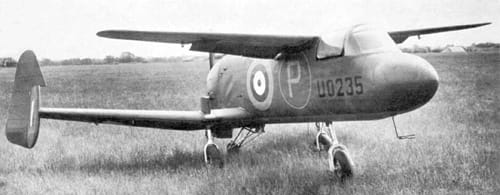
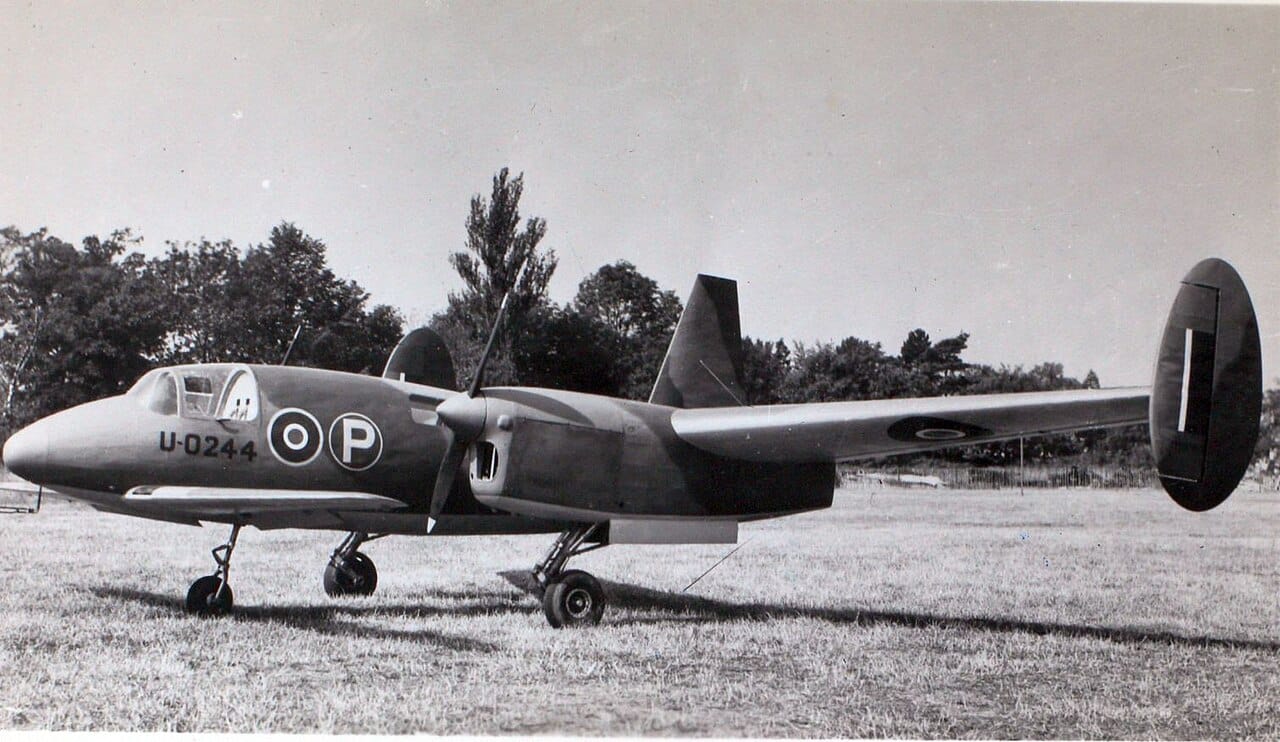
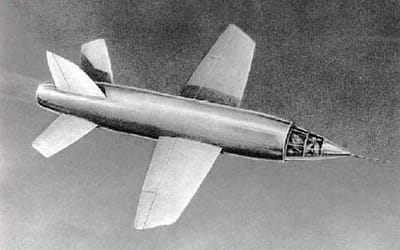
At first glance the little aircraft looks as though someone assembled it from the wrong box of parts. It has a wing at the front and a wing at the back, a propeller facing the wrong way, and a pilot perched right up in the nose. It looks less like a fighter than an insect — which is rather the point. Miles Aircraft named it the Libellula, Latin for dragonfly.
Behind the oddity was a genuinely clever idea. In 1942, a small British firm believed the tandem-wing layout — two wings, one behind the other — could solve one of the deadliest problems in naval aviation. And rather than ask permission, they simply built the thing in secret, in six weeks flat.
The result was one of the strangest-looking aeroplanes of the Second World War, and one of the most quietly ingenious.
• Aircraft: Miles M.35 Libellula — tandem-wing research aircraft (named after the dragonfly)
• Purpose: to prove a tandem-wing naval fighter that fitted carriers without folding wings
• Designer: Ray Bournon, for Miles Aircraft — a private venture built in six weeks
• Layout: front wing, rear wing, pusher propeller, pilot in the nose for a superb landing view
• First flight: 1 May 1942, flown by George Miles himself
• Follow-up: the M.39B, a scale flying model of a tandem-wing bomber, flew on 22 July 1943
• Fate: the layout worked, but the fighter and bomber were both rejected; only the M.35 and M.39B were built
The deadly problem of landing on a carrier
Bringing a fighter down onto a pitching flight deck is one of the hardest things in aviation, and in 1941 the accident rate was frightening. Much of the danger came from simple visibility: a conventional single-engined fighter sat nose-high on approach, its long engine cowling blotting out the deck just when the pilot needed to see it most. Carrier fighters also needed heavy, complex folding wings to fit below decks. Visiting an experimental establishment, George Miles saw a tandem-wing Lysander and had an idea — put a wing at each end, seat the pilot up front, and both problems might vanish at once.
Six weeks, and no permission asked
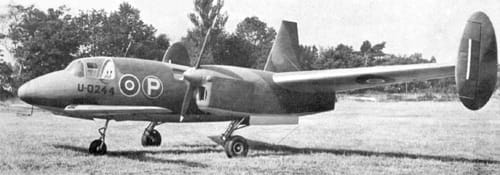
Rather than submit an unorthodox design to the wartime bureaucracy and wait, Miles simply built a proof-of-concept. The designer Ray Bournon drew up a tiny single-seat wooden aircraft, and with nobody from the Ministry looking over their shoulders, the team finished it in six weeks. It had a high front wing, a swept lower rear wing with fins on the tips, a fixed tricycle undercarriage, and a pusher engine tucked behind the cockpit so the pilot could sit right in the nose.
The chief test pilot said no thanks
When it came time to fly the strange little machine, Miles’s own chief test pilot was distinctly reluctant to climb aboard — so George Miles took it up himself. It was not a gentle introduction. The aircraft was oddly unwilling to leave the ground until Miles discovered a trick.
The first flight, on 1 May 1942, was hair-raising — the M.35 was almost uncontrollable because its centre of gravity was in the wrong place — but Miles wrestled it back down in one piece. Once the aircraft was correctly ballasted, later flights went well, and the tandem-wing idea was proven to work. Years later, the great test pilot Eric “Winkle” Brown would fondly title his account of the machine “The Lovelorn Libellula.”
Brilliant — and unforgiven
Miles submitted a naval-fighter proposal built around the layout. But the company had committed a bureaucratic sin: it had designed and flown the M.35 in secret, without official authority. Rather than reward the initiative, the Ministry of Aircraft Production castigated the firm, and it and the Admiralty rejected the fighter. A genuinely promising idea had run headlong into wounded officialdom.
From fighter to bomber
Undeterred, Miles applied the same thinking to a bomber. The full-size design was never built, but the company constructed a scale flying model, the M.39B, which took to the air on 22 July 1943 and explored the tandem-wing layout at larger size. Like its little brother, it flew — and like its little brother, it led nowhere. The mainstream of aircraft design marched on with a single wing and a tail, and the dragonflies were left as one of aviation’s great what-ifs.
Sources: Wikipedia (Miles M.35 Libellula; Miles M.39B Libellula); Don L. Brown, “Miles Aircraft since 1925” (Putnam, 1970); Tony Buttler, “British Secret Projects”; Eric Brown, “The Lovelorn Libellula”, Air Enthusiast (1977).
Related Questions
What was the Miles Libellula?
The Miles Libellula was a British tandem-wing experimental aircraft built by Miles Aircraft in 1942. Named after the Latin word for dragonfly, the M.35 Libellula was a private venture assembled in secret in just six weeks to prove that a tandem-wing naval fighter could fit aircraft carriers without folding wings. Only the M.35 and its follow-up, the M.39B, were ever built.
What is a tandem-wing aircraft?
A tandem-wing aircraft has two full-sized wings mounted one behind the other instead of a single main wing and small tailplane. Both wings generate lift, which allows a shorter fuselage and smaller overall span. The layout appeared on experimental designs like the Miles M.35 Libellula, but it never displaced the conventional configuration in production fighters.
Why was the Miles Libellula designed?
It was designed to solve the deadly problem of landing on aircraft carriers. In 1941 conventional single-engined fighters sat nose-high on approach, their long engine cowlings blocking the pilot's view of the deck, and they needed heavy folding wings to fit below decks. The Libellula put the pilot right in the nose with a pusher propeller behind him, giving a superb landing view.
Who designed the Miles Libellula?
The Libellula was designed by Ray Bournon for Miles Aircraft, the British firm also behind the cancelled supersonic Miles M.52. It was a private venture built without official permission in six weeks flat, reflecting the small company's willingness to gamble on unconventional ideas during the Second World War.
When did the Miles M.35 Libellula first fly?
The Miles M.35 Libellula first flew on 1 May 1942, piloted by George Miles himself after the company's chief test pilot declined to fly it. The first flight was hair-raising — the aircraft was almost uncontrollable because its centre of gravity was in the wrong place — but once correctly ballasted, later flights went well and proved the tandem-wing concept.
What was the Miles M.39B?
The Miles M.39B was a scale flying model of a proposed tandem-wing bomber, the follow-up to the M.35 Libellula. It first flew on 22 July 1943 and demonstrated that the tandem-wing layout worked at larger scale. Despite successful testing, the full-size bomber was rejected and the M.39B remained the last of the Libellula line.
Did the Miles Libellula ever enter production?
No. Although the tandem-wing layout was proven to work in flight testing, both the naval fighter and the bomber proposals were rejected, and only the M.35 and M.39B research aircraft were built. Other unconventional wartime fighters, like the push-pull Dornier Do 335 Pfeil, met similarly dead ends as jets took over.
Why do some aircraft have a pusher propeller?
A pusher propeller is mounted behind the engine and fuselage, pushing the aircraft forward instead of pulling it. The main benefit is an unobstructed nose: on the Miles Libellula the pilot sat right in the front with a perfect view for carrier landings. The trade-offs — cooling difficulties and dangerous bail-outs past the propeller — kept pushers rare in fighters.
0 commentaire