
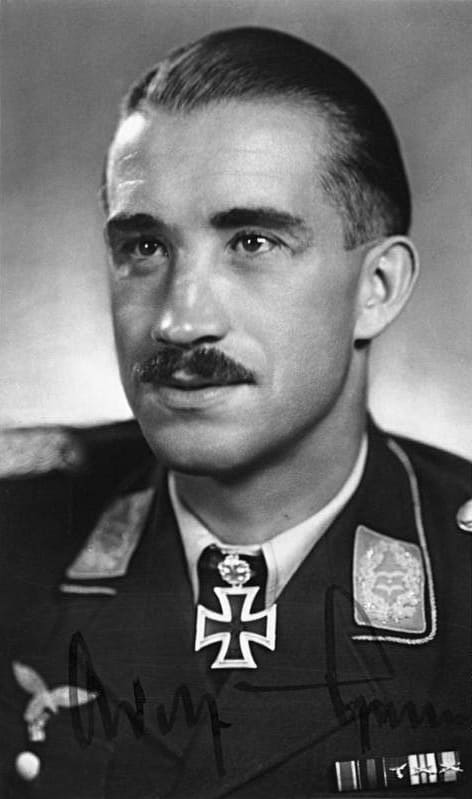
At the height of the Battle of Britain, with his fighter pilots being blamed for the bombers falling out of the sky, a young German ace was asked by the head of the Luftwaffe what he needed to turn things around. Adolf Galland, cigar clenched in his teeth, gave an answer that has echoed for eighty years: he would like, he said, a squadron of Spitfires.
It is one of the most quoted lines in aviation history, and one of the most misunderstood. Galland did not think the Spitfire was the better aeroplane — he preferred his own Messerschmitt for attacking. It was a deliberate insult aimed at Hermann Göring, a protest against tactics that were throwing away the German fighter’s strengths. That was Galland: the finest fighter leader Germany produced, and a man who spent much of the war at open odds with the regime he served.
| Name | Adolf “Dolfo” Galland |
| A vécu | 1912–1996 |
| Service | Luftwaffe — General of the Fighter Arm |
| Victories | 104, all against the Western Allies |
| Famous for | Youngest general of 1941; the Me 262 unit JV 44 |
| Flew | Bf 109; Me 262 jet |
The youngest general
Galland flew 705 combat missions and was credited with 104 aerial victories, every one on the Western Front. He fought through the Battle of France and the Battle of Britain in the Bf 109, and by late 1941, aged just 29, he was made General of the Fighter Arm — the youngest general in the German forces, and, to his fury, forbidden to fly combat. He had inherited a desk.
He was not built for it. As the Allied bomber offensive grew, Galland argued for husbanding his fighters and striking in mass; Göring demanded every raid be met head-on regardless of odds. The two men, once close, came to despise each other.
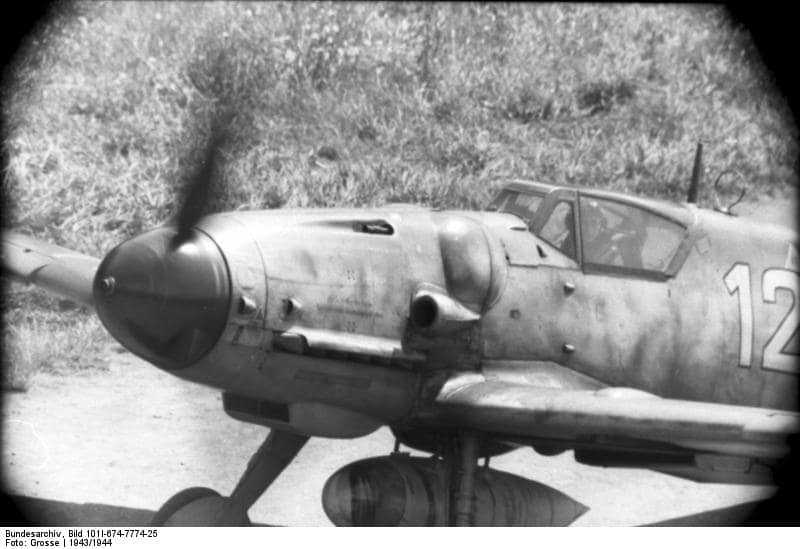
The quote was a jab, not a judgement. What Galland wanted was the freedom to fight the way his aircraft was designed to — on the offensive, hunting — instead of being chained close to the bombers where the Bf 109’s advantages counted for nothing.
The revolt of the aces
By January 1945 the fighter arm was collapsing and its best commanders had had enough. A group of senior aces, loyal to Galland, confronted Göring to demand the fighter force be saved. Göring blamed Galland for the “Fighter Pilots’ Revolt” and relieved him of command. It might have ended at a firing squad. Instead, remarkably, Galland was allowed to go back to war.
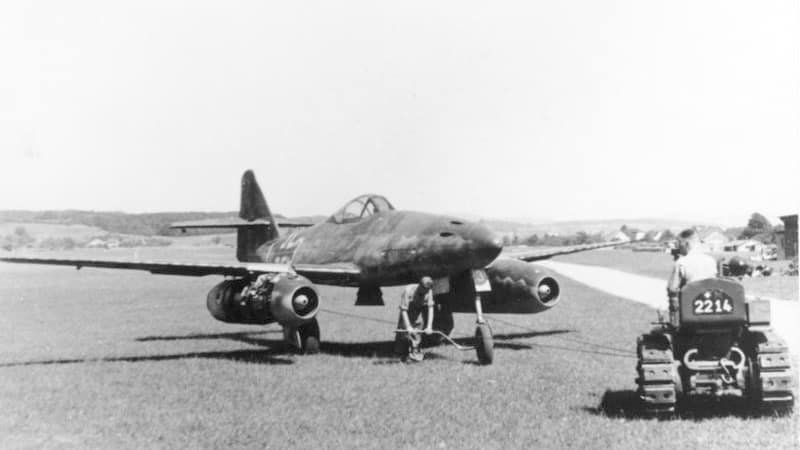
He was given permission to form an elite jet squadron, Jagdverband 44, flying the revolutionary Moi 262 — a “squadron of experts” drawn from Germany’s surviving aces. On 26 April 1945, leading his jets against American bombers, Galland was hit by a P-47, took splinters in the knee and crash-landed his damaged Me 262. It was his last combat mission of the war.
The enemy who became a friend
What lifts Galland’s story above the ledger of victories is what came after — and one episode from during the war. In 1941 the legless RAF ace Douglas Bader was shot down and captured near Galland’s base. Galland hosted him, let him sit in a Bf 109 cockpit, and arranged safe passage for the RAF to air-drop a replacement artificial leg. “Operation Leg,” they called it.
After the war Galland flew for a time in Argentina, wrote a best-selling memoir, and built genuine friendships with the men he had once tried to kill — Bader, Robert Stanford Tuck, Johnnie Johnson. Tuck became godfather to Galland’s son. The fighter pilots, it turned out, had more in common with each other than with the politicians who sent them up.
Sources: Adolf Galland, “The First and the Last” (1954); Imperial War Museum; RAF Benevolent Fund; standard aviation histories.

0 commentaire