
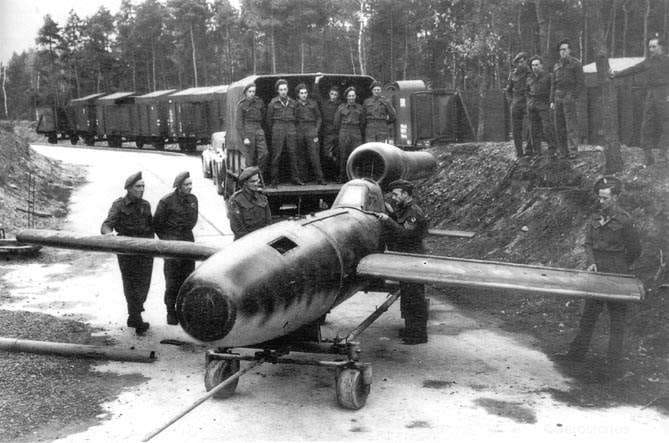
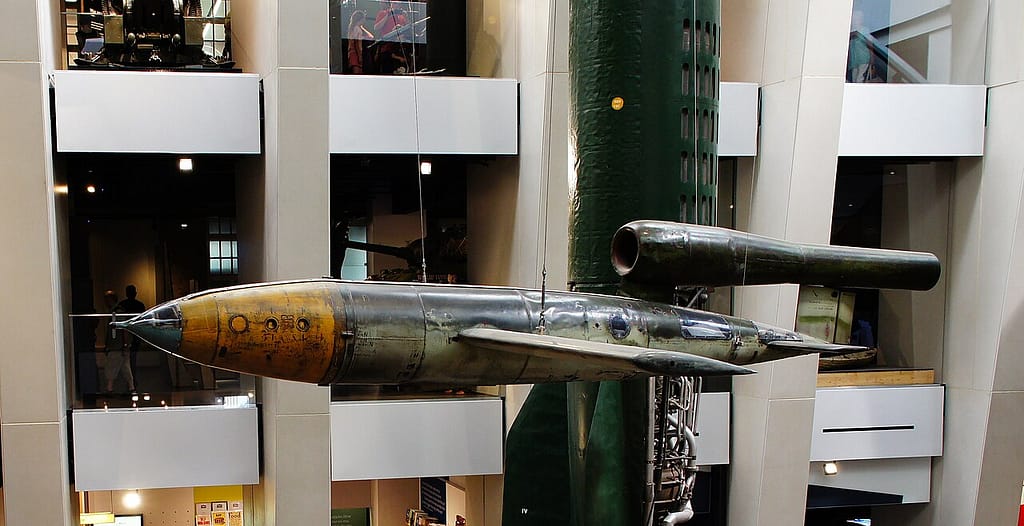
Take a V-1 flying bomb — the pilotless cruise missile that terrorised London in 1944 — and cut a small hole in the fuselage just ahead of the engine. Fit a plywood seat, a single control column, and a handful of basic instruments. Now put a young man inside. That was the Fieseler Fi 103R Reichenberg: Germany’s manned flying bomb, and one of the darkest ideas in the history of aviation.
Officially, the pilot was supposed to steer the weapon onto its target, then bail out at the last moment. In reality, with a roaring pulsejet intake gulping air right behind his head, his chances of getting out alive were estimated at less than one in a hundred. Everyone involved understood what that meant.
Informations clés
- Aéronef: Fieseler Fi 103R “Reichenberg” — a piloted V-1 flying bomb
- Origine: Hanna Reitsch’s “Operation Self-Sacrifice” (Selbstopfer), 1944
- Unité: the Leonidas Squadron, V./KG 200
- Construit: around 175 operational Re-4 airframes at Dannenberg and Pulverhof
- Volunteers: about 70 pilots signed the pledge
- Bail-out survival: estimated under 1% — the cockpit sat in front of the jet intake
- Combat use: none — the programme was cancelled before it flew a mission
Operation Self-Sacrifice
The idea came from one of Germany’s most famous aviators: the test pilot Hanna Reitsch. Convinced that a small band of volunteers could trade their lives to sink ships or smash key targets, she pushed a concept she called “Operation Self-Sacrifice” — in German, Selbstopfer — and pitched it to Hitler himself in early 1944. The programme was soon given the far blander cover-name Reichenberg, and a special unit, the Leonidas Squadron, was formed to fly it.
What is most chilling is that the volunteers knew exactly what they were signing. The pledge left no room for illusion.
A cockpit in front of a jet engine
Turning a cruise missile into a crewed aircraft was brutally simple. The V-1’s guidance gear made way for a cramped cockpit with a plywood bucket seat, set immediately in front of the Argus pulsejet’s air intake. Training gliders and two-seat versions were built to teach pilots to fly the thing; the operational Re-4 kept the V-1’s one-tonne-class warhead. It was to be carried aloft under a Heinkel He 111 bomber and released toward its target at high speed.

Hanna Reitsch never pretended the crews were reckless. In a passage later recalled in Otto Skorzeny’s memoir, she framed their willingness as devotion rather than fanaticism.
The pilots who never flew a mission
Testing fell largely to Reitsch and fellow pilot Heinz Kensche. The Reichenberg proved vicious to fly and prone to crashing; Reitsch survived several accidents that should have killed her. Roughly 175 operational airframes were built at two factories, and around 70 volunteers signed up to fly them.
Even the high command said no
In the end, the Reichenberg never flew a single combat mission. Senior officers — above all Werner Baumbach, who commanded the special-operations wing KG 200 — regarded it as a pointless waste of trained pilots. Together with armaments minister Albert Speer, Baumbach argued to Hitler that deliberate suicide attacks were not part of the German military tradition. On 15 March 1945 the order came down, and the unit was disbanded.
The manned V-1 survives now only as a handful of museum pieces — a plywood seat bolted into a bomb, and a reminder of how close desperation came to sending teenagers to their deaths inside a guided missile.
Sources: Wikipedia; Warfare History Network; HistoryNet; History.com; Otto Skorzeny memoir; Hanna Reitsch, “The Sky My Kingdom.”
0 commentaire