
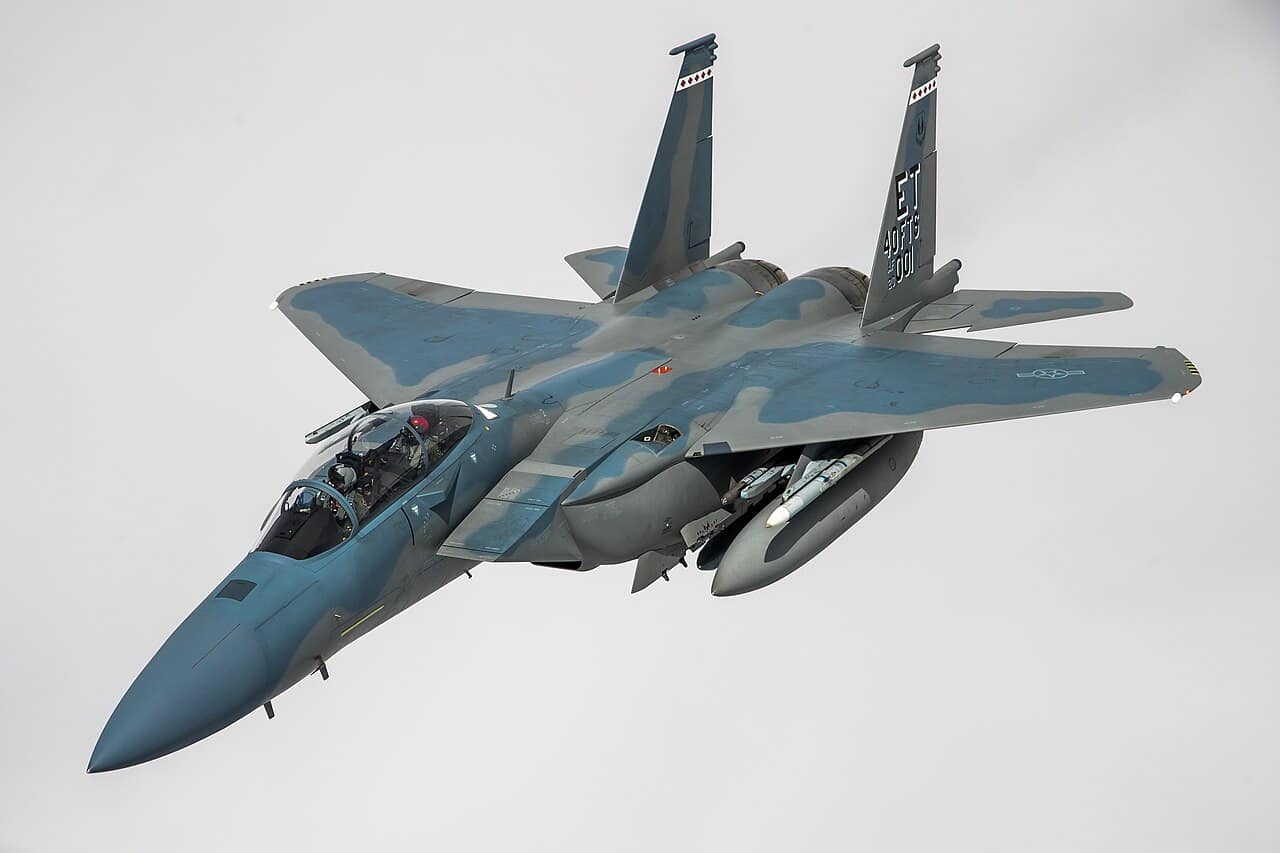
For decades, if you wanted to put an engine in an American F-15 or F-16, you had exactly two phone numbers to call: Pratt & Whitney and GE. That cozy arrangement may be about to end. On August 4 the U.S. Air Force went public with a Request for Information — a formal ask for industry to pitch ideas — that could crack open one of the longest-running duopolies in military aviation.
The service wants to know who could supply engines for the Boeing F-15EX Eagle II and the Lockheed Martin F-16 Fighting Falcon, both for its own jets and for the many allies who buy them through Foreign Military Sales. And it is not doing this because the current engines are bad. It is doing it because it is tired of the way it has to buy them.
Informations clés
- Ce qui s'est passé: USAF issued an RFI (2 Aug–4 Aug 2026) seeking alternative engines for the F-15EX and F-16
- The incumbents: Pratt & Whitney F100 and GE Aerospace F110 — the only two engines these jets have ever used
- Latest F-15EX engine: GE F110, which won a $1.6 billion contract in 2021
- Why now: production delays, quality-control problems, parts obsolescence and material shortages in the current base
- Scale: demand projected at up to 180 engines a year by fiscal 2034
- Deadline: companies have until 28 August 2026 to respond
Breaking a Decades-Old Duopoly
Since the F-15 and F-16 entered service in the 1970s, every single one has flown behind either a Pratt & Whitney F100 or a GE F110. The two firms have traded wins for fifty years, and the newest Eagle, the F-15EX, settled on GE’s F110-129 after a competition Pratt lost in 2021. For a customer, two suppliers is thin. When both are stretched, it is a problem.

And stretched they are. The Air Force is blunt about its motive: it points to production delays, quality-control lapses, obsolete components and shortages of critical materials across the existing engine industrial base. Translated from acquisition-speak, that means the jets it needs are sometimes waiting on engines it cannot get fast enough.
Buying for the Whole Life, Not the Sticker Price
What makes this RFI interesting is not just who might answer it, but what the Air Force says it now values. The document leans hard on lifecycle cost, supply-chain resilience, ease of maintenance and aircraft availability — rather than the lowest bid on day one. It also wants any supplier to prove it can crank up production quickly and keep spare parts flowing for the life of the engine.
That is a pointed wish list. It rewards a company that can be relied on for thirty years over one that simply undercuts on price. The service has not said whether it wants an entirely new engine design or an upgraded version of something that already exists — and with demand forecast to reach 180 engines a year by 2034, the stakes for whoever wins are enormous.
A Familiar Fight, Reopened
None of this guarantees a newcomer. Pratt has spent years pitching its F100 as the “low-risk” choice for export Eagles, and GE will point out, as it always does, that its F110 is already in service and paid for. The most likely outcome of any RFI is that the two incumbents simply sharpen their elbows and fight harder. But by asking the question at all, the Air Force has signaled it no longer wants to be a captive customer.
Responses are due by the end of August. Whether a genuine third name emerges or not, the message to Pratt and GE is clear: the comfortable two-horse race is now being watched by a customer that has had enough of waiting for engines.
Sources: Air Data News; FlightGlobal; Aviation Week; Breaking Defense; GE Aerospace and Pratt & Whitney statements.



0 commentaire