
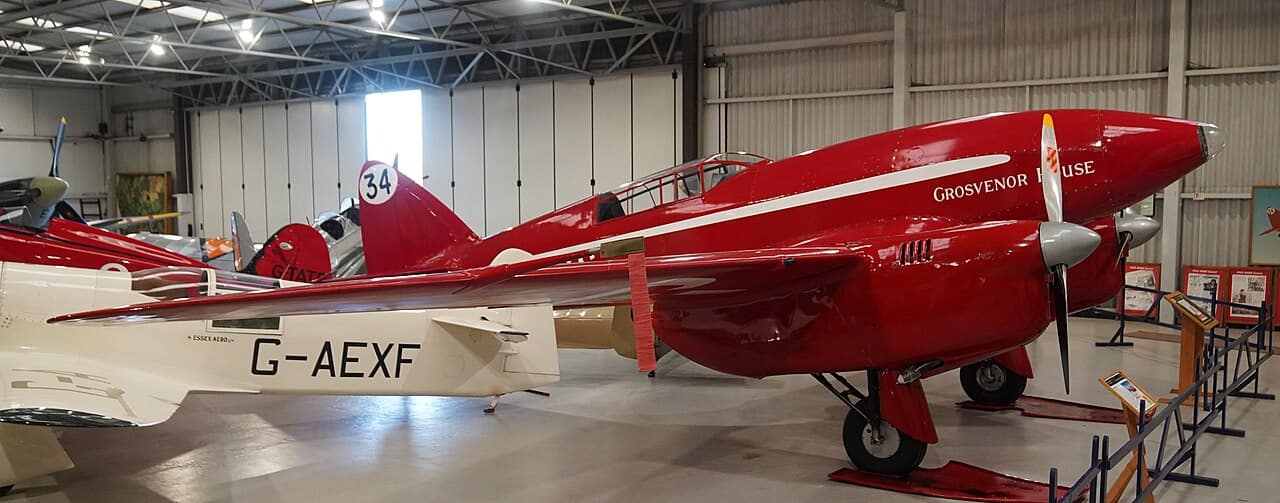
In 1934, an Australian chocolate millionaire offered a fortune to whoever could fly fastest from England to Melbourne — nearly 11,000 miles across deserts, jungles and oceans. Airliners of the day could not come close. So de Havilland built something entirely new for the occasion: a slender, blood-red wooden racer with retractable wheels and just enough room for two brave souls and an enormous tank of fuel.
They called it the Comet. Only three were ever built. And one of them, ‘Grosvenor House’, flew to the far side of the world in under three days — a machine so far ahead of its time that its ideas would soon reappear in one of the greatest warplanes ever built.
Informations clés
- Aéronef: de Havilland DH.88 Comet
- Built for: the 1934 MacRobertson Air Race, England to Australia
- Nombre d'exemplaires construits : just three
- Construction: all-wood, twin-engine, with two seats for pilot and navigator
- Moteurs : two de Havilland Gipsy Six R, turning early variable-pitch propellers
- Winner: G-ACSS ‘Grosvenor House’, flown by C.W.A. Scott and Tom Campbell Black
- Winning time: 70 hours 54 minutes — England to Australia in under three days
- Héritage: its wooden construction pointed the way to the de Havilland Mosquito; the winner still flies today
A race across the world
The contest was the MacRobertson Air Race, staged to mark the centenary of the Australian state of Victoria. Sir Macpherson Robertson, a Melbourne confectioner, put up a gold cup and £10,000 — a colossal sum — for the fastest flight from Mildenhall in England to Melbourne. It captured the world’s imagination, and the great aviation names of the age lined up to compete.
The problem was that no existing aircraft was really built for such a dash. De Havilland stepped in with a bold promise: order one of our new racers, sight unseen, and we will build you something that can win. Three buyers took the gamble.
‘Grosvenor House’, the DH.88 Comet that won the 1934 race, still flying at the Shuttleworth Collection.
Built for one race
The DH.88 Comet was radical. It was built almost entirely of wood — a sleek, stressed-skin structure that kept it light and fast — with the pilot and navigator tucked behind three big fuel tanks that filled the nose. Two specially tuned de Havilland Gipsy Six R engines drove propellers with an early two-position variable pitch, and the undercarriage folded away in flight. In 1934, almost none of that was common.
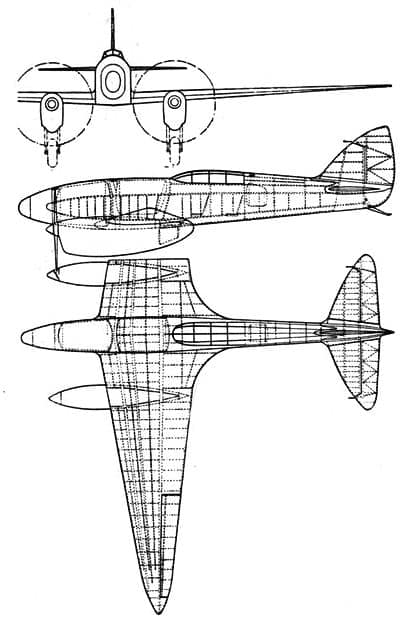
Three Comets lined up at dawn on 20 October 1934: ‘Black Magic’, flown by the celebrated husband-and-wife team Jim and Amy Mollison; a green machine flown by Owen Cathcart-Jones and Ken Waller; and the red ‘Grosvenor House’, entered by a London hotel and flown by C.W.A. Scott and Tom Campbell Black.
Grosvenor House wins
‘Black Magic’ led early, only for engine trouble to force the Mollisons out in India. That left Scott and Campbell Black to press on through exhaustion and darkness, nursing their overheating engines across the last enormous legs to Australia. They landed in Melbourne having covered the whole course in 70 hours and 54 minutes — not quite three days.
Tellingly, the aircraft that came second was not a racer at all but a KLM Douglas DC-2 airliner, carrying passengers and mail; a Boeing 247 came third. The message was unmistakable: the future of long-distance flight belonged to the sleek American airliner — but on this day, in raw speed, the little wooden Comet had beaten them all.
The DH.88 Comet ‘Grosvenor House’ displaying at Old Warden.
The wooden wonder’s legacy
The Comet was more than a one-off stunt. Its light, strong wooden construction and clean aerodynamics fed directly into de Havilland’s later designs — the elegant DH.91 Albatross airliner and, most famously, the DH.98 Mosquito, the “Wooden Wonder” that would become one of the fastest and most versatile aircraft of the Second World War. An idea proven in a chocolate-magnate’s air race helped shape a warplane a decade later.
The survivor
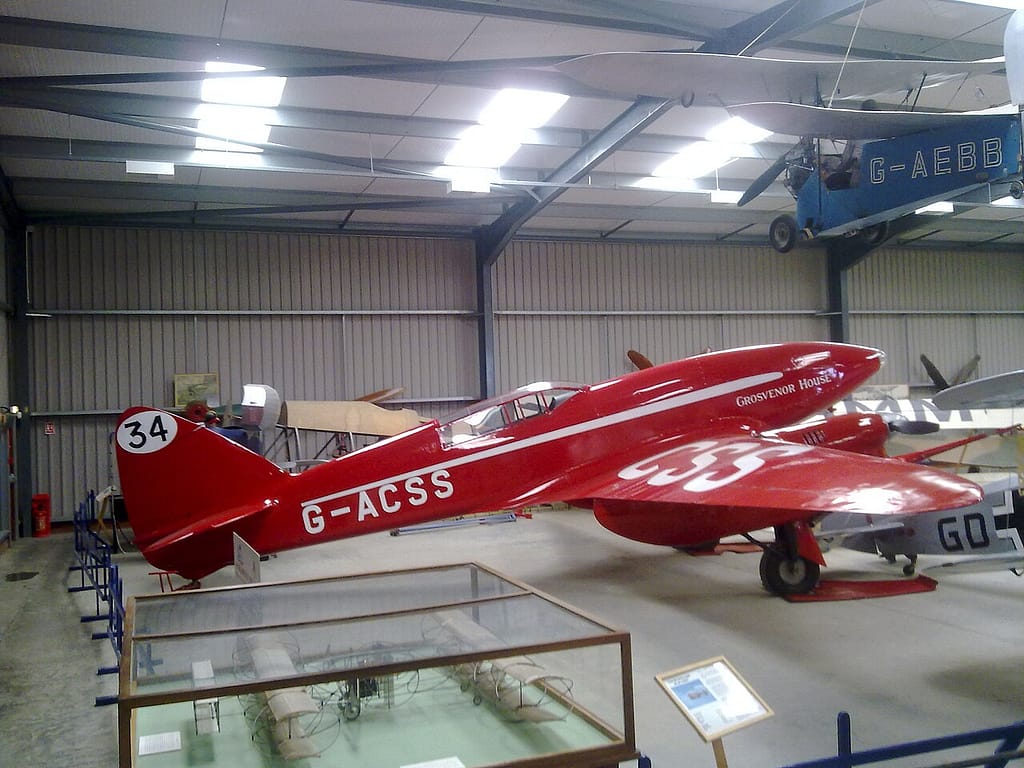
Remarkably, the winning Comet still exists — and still flies. After the race, ‘Grosvenor House’ was tested by the RAF, sold for scrap, rescued, and restored more than once. Renamed ‘The Burberry’, it went on to set long-distance records that stand as a testament to the little racer’s reach.
Today the aircraft lives at the Shuttleworth Collection at Old Warden, lovingly restored to flying condition and still taking to the air at displays — a ninety-year-old wooden racer that once beat the world.
The de Havilland DH.88 Comet at the Shuttleworth Collection.
Sources: The Shuttleworth Collection; BAE Systems Heritage; Wikipedia.


0 commentaire