France has just announced the largest peacetime increase in military spending in its modern history. An additional €36 billion — approximately $42 billion — will flow into the armed forces between 2026 and 2030, targeting the three domains where the war in the Middle East and the conflict in Ukraine have exposed the starkest gaps in Western capability: air defence, munitions stockpiles, and counter-drone systems.
This is not a vague political promise. The French parliament has already cleared the budgetary path. The Defence Ministry will receive an additional €6.7 billion in 2026 alone — a down payment on a programme that President Macron has described as essential to ensuring France can fight a high-intensity war and win.
The numbers, and the speed at which Paris is moving, deserve attention.
Quick Facts
Total Uplift
€36 billion ($42 billion) over 2026–2030
2026 Increase
€6.7 billion above 2025 baseline
Munitions
€8.5 billion — a 54% increase in spending
Drones
€2 billion for military drone programmes
Key Priorities
Ground-based air defence, counter-drone, electronic warfare, space
New Entity
France Munitions — centralised procurement platform
The Lesson of Empty Magazines
The single largest line item tells the story: €8.5 billion for munitions. That represents a 54 percent increase over the previous spending plan and reflects a lesson that every NATO member is now learning — often painfully — from watching two wars unfold simultaneously.
Ukraine demonstrated that a modern high-intensity conflict consumes artillery shells, missiles, and precision-guided munitions at rates that dwarf Cold War-era stockpile assumptions. Operation Epic Fury in the Middle East reinforced the point from the air: the United States alone has fired approximately 850 Tomahawk cruise missiles in thirty days, burning through inventories far faster than the factories can replace them.
France has concluded that it cannot afford to be caught in the same position. The munitions investment covers everything from air-delivered precision weapons and cruise missiles to ground-based interceptors and loitering munitions designed to counter drone swarms.
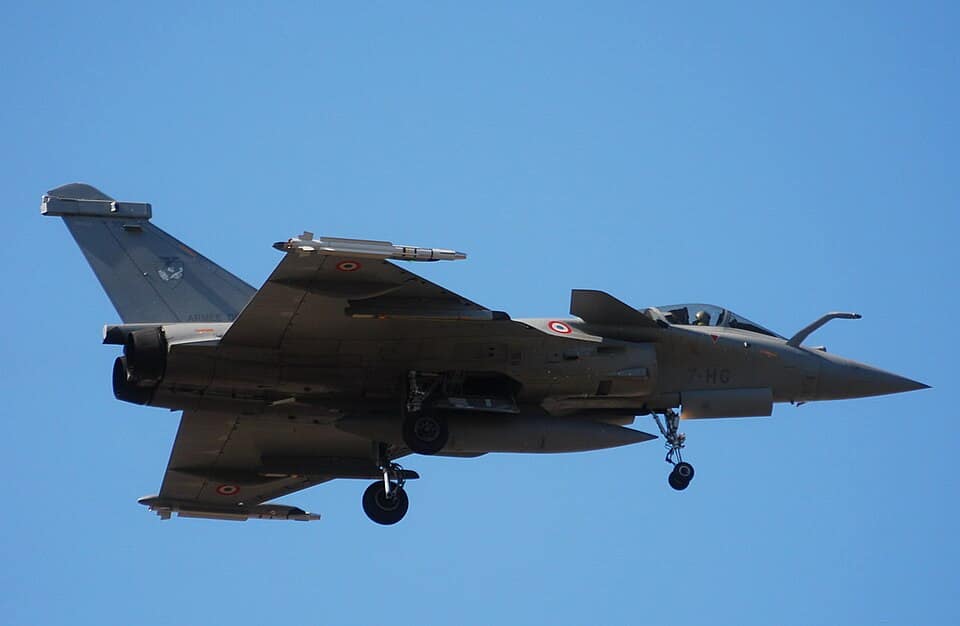
A Dassault Rafale C of the French Air and Space Force. France’s rearmament plan will fund new precision munitions, air defence systems, and counter-drone technologies alongside continued Rafale production. Wikimedia Commons.
Counter-Drone as a National Priority
A separate €2 billion allocation for drones signals that Paris has absorbed the drone revolution not as a theoretical future threat but as a present-day battlefield reality. The investment targets interceptor drones, early-warning unmanned platforms, and loitering munitions — exactly the systems that have defined the character of fighting in both Ukraine and the Persian Gulf.
Ground-based air defence receives particular emphasis. France operates the SAMP/T system — one of Europe’s most capable medium-range air defence platforms — but the current inventory is modest. The spending uplift is designed to expand both the number of launchers and the depth of missile stockpiles, while investing in new electronic warfare capabilities to complement kinetic defences.
The government described the entire package as an “imperative” — not a choice — to rebuild operational readiness across all domains.
France Munitions: A New Industrial Model
Perhaps the most structurally significant element of the plan is the creation of France Munitions, a new centralised procurement and distribution entity designed to aggregate demand across the French military, allied nations, and export customers.
The logic is industrial as much as military. By pooling orders, France Munitions aims to give manufacturers the volume guarantees they need to invest in expanded production lines. It is, in essence, the French answer to a problem that has paralysed Western defence supply chains since 2022: factories cannot scale up production without long-term contracts, and governments cannot sign long-term contracts without legislative approval for multi-year budgets.
Paris has now provided both. The parliamentary vote, the multi-year spending authority, and the creation of a purchasing entity capable of placing bulk orders represent an integrated approach to rearmament that few European nations have matched.
For the broader European defence landscape, the message is clear: France intends to be a producer and an exporter of the munitions that the next war will demand — not merely a consumer scrambling to buy them on the open market.
Sources: Aviation Week, Defense News, Breaking Defense, Bloomberg
From the fjords of northern Norway to the sun-baked runways of southern Spain, NATO is conducting the largest air exercise in Alliance history. Ramstein Flag 2026, which began on 8 June and runs through 19 June, has assembled more than 200 aircraft from 18 nations...
The numbers arrived in Brussels like a cold shower. US fighter jets allocated to NATO: cut from 150 to 100. KC-46 aerial refuelling tankers: all eight withdrawn. Maritime patrol aircraft: slashed from 26 to 15. One carrier strike group, one cruise-missile submarine,...
Forget everything you think you know about how military drones get made. Lockheed Martin's legendary Skunk Works division — the outfit that gave us the U-2, the SR-71 Blackbird, and the F-117 Nighthawk — just showed off an unmanned aircraft that was designed,...



 English
0 Comments