
The man strapped into the tiny capsule atop the Redstone rocket had been lying on his back for over four hours. He had been awake since one in the morning. He needed to pee — badly — and Mission Control had no plan for that. So Alan Bartlett Shepard Jr., naval aviator, test pilot, and about to become the first American in space, urinated in his silver pressure suit and waited for someone to light the candle.
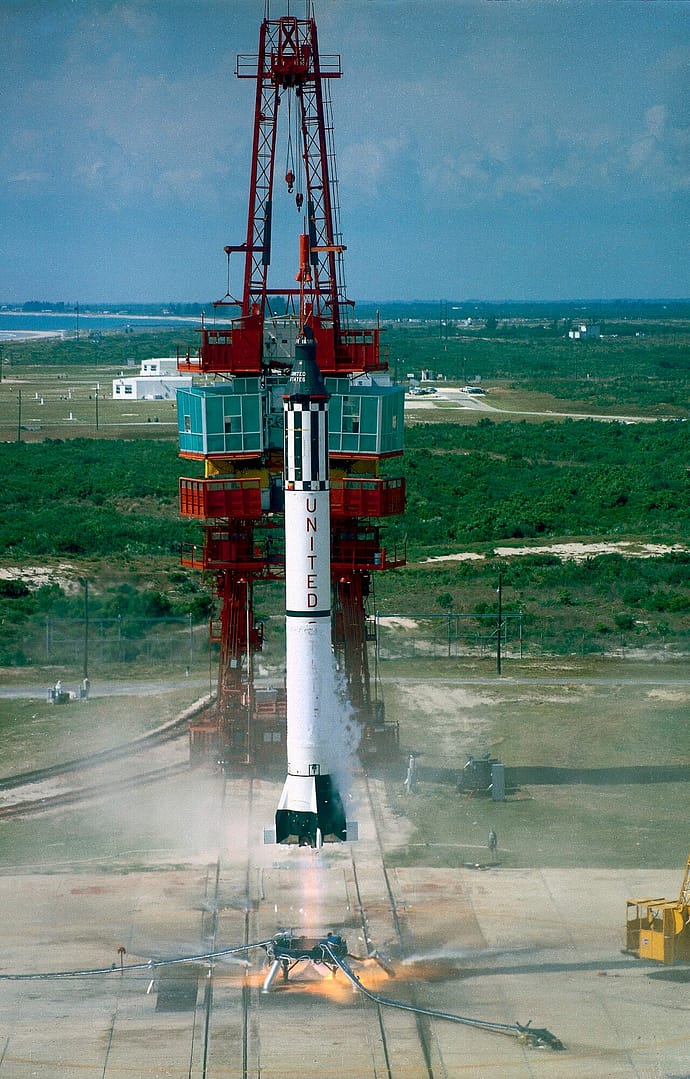
At 9:34 a.m. on 5 May 1961, the Redstone’s engine ignited. Fifteen minutes and twenty-eight seconds later, it was over. Shepard had flown 187 kilometres high and 486 kilometres downrange, pulled 6 g’s on the way up, 11 g’s on the way down, and splashed into the Atlantic Ocean. America was in the space race.
Sixty-five years ago today, Freedom 7 proved that the United States could put a human being above the atmosphere and bring him home alive. It was not the first — Yuri Gagarin had orbited the Earth twenty-three days earlier. But it was the spark that lit everything that came after.
Quick Facts
Mission: Mercury-Redstone 3 / Freedom 7
Pilot: Commander Alan B. Shepard Jr., USN
Date: 5 May 1961, 09:34 EST
Duration: 15 minutes, 28 seconds
Altitude: 187.5 km (116.5 miles) — suborbital
Range: 486 km (302 miles) downrange from Cape Canaveral
Max speed: 8,340 km/h (5,180 mph)
G-forces: 6.3 g on ascent, 11.6 g on re-entry
Spacecraft: Mercury capsule #7, built by McDonnell Aircraft — 1.9 m wide, 3.3 m tall
Recovery: USS Lake Champlain, Atlantic Ocean
Twenty-Three Days Behind
The context matters. On 12 April 1961, Soviet cosmonaut Yuri Gagarin had completed a full orbit of the Earth aboard Vostok 1, spending 108 minutes in space. The achievement stunned the world and humiliated Washington. The Soviets had beaten America to every major space milestone: first satellite (Sputnik, 1957), first animal in orbit (Laika, 1957), first lunar probe (Luna 2, 1959). Now first human in space. The Cold War scorecard was lopsided.
NASA had been planning Shepard’s flight since late 1960, but delays, technical problems, and an abundance of caution had pushed the date back repeatedly. Wernher von Braun, the Redstone rocket’s designer, insisted on an additional unmanned test flight in March 1961 — a decision that many at NASA later believed cost America the chance to beat Gagarin into space.
By May, the pressure was enormous. President Kennedy needed a win. NASA needed to prove that Project Mercury worked. And Shepard — chosen from the original seven Mercury astronauts — needed to prove that an American pilot could handle spaceflight. Not as a passive passenger, as Gagarin had been (the Vostok was fully automated), but as a pilot who actually flew the spacecraft.

Fifteen Minutes That Changed America
Freedom 7 launched from Cape Canaveral’s Launch Complex 5 at 9:34 a.m. Eastern Time. Unlike Gagarin’s flight, the launch was broadcast live on national television. Forty-five million Americans watched. If the rocket exploded — and Redstones had exploded before — they would see it happen in real time.
The Redstone performed flawlessly. Shepard reported the ride was smoother than expected. Two minutes and twenty-two seconds after liftoff, the engine cut off. The escape tower jettisoned. Shepard was weightless, coasting upward on a ballistic arc toward a peak altitude of 187 kilometres. He looked out the periscope and saw the coast of Florida, the Bahamas, Lake Okeechobee. He could see cloud patterns across the entire Eastern Seaboard.
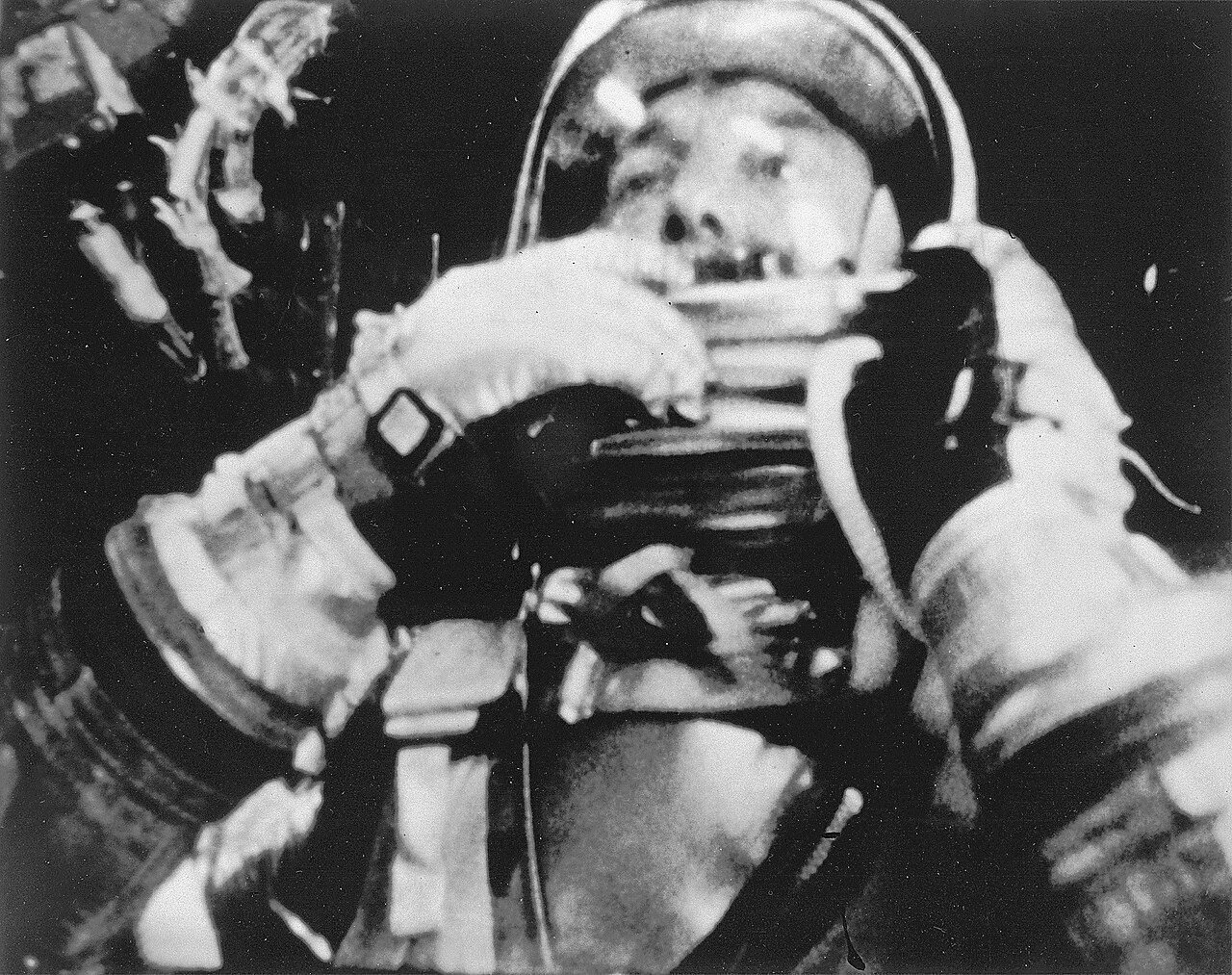
Then he went to work. Shepard manually controlled the capsule’s attitude using a hand controller — pitching, yawing, and rolling the spacecraft to test the reaction control system. He was the first astronaut to demonstrate that a human could effectively pilot a spacecraft in the space environment. It was exactly the kind of stick-and-rudder test-pilot validation that NASA needed.
Re-entry hit hard. The retrorockets fired, the heat shield took the brunt of atmospheric friction, and Shepard endured 11.6 g’s — his vision greying at the edges. The drogue chute deployed at 6,700 metres, the main chute at 3,000 metres, and Freedom 7 splashed down in the Atlantic 486 kilometres from the launch pad. A Marine helicopter had Shepard on the deck of the USS Lake Champlain within eleven minutes.
The Ripple Effect
The national reaction was electric. Shepard was paraded through Washington, received the Distinguished Service Medal from President Kennedy, and became an instant celebrity. But the real consequence of Freedom 7 came twenty days later, on 25 May 1961, when Kennedy stood before a joint session of Congress and declared that the United States would land a man on the Moon before the decade was out.
That speech — perhaps the most consequential presidential address of the twentieth century — would not have happened without Freedom 7. Kennedy needed proof that American space technology worked before he could commit the nation to something as audacious as a lunar landing. Shepard’s fifteen minutes gave him that proof.
The Mercury programme continued with five more crewed flights, culminating in Gordon Cooper’s 34-hour orbital mission in May 1963. Then came Gemini, then Apollo. Eight years and two months after Shepard’s suborbital hop, Neil Armstrong stepped onto the Moon. And in February 1971, Shepard himself walked on the lunar surface as commander of Apollo 14 — becoming the fifth person to set foot on another world. He was 47 years old, the oldest Moon-walker in the programme, and he hit two golf balls across the Fra Mauro highlands with a six-iron taped to a soil sampler. Because of course he did.
The Capsule and the Legacy
Freedom 7 is on permanent display at the John F. Kennedy Presidential Library and Museum in Boston. The capsule is tiny — just 1.9 metres across at its widest point. Standing next to it, it is almost impossible to believe that a grown man strapped himself inside, rode a modified ballistic missile into space, and came home alive. The courage required was not abstract. It was physical, measurable, and terrifying.
Shepard died of leukaemia in 1998 at the age of 74. He never talked much about fear. When asked what he thought about sitting on top of the Redstone, he reportedly said he reflected on the fact that the rocket was built by the lowest bidder. It is the most perfectly Alan Shepard answer imaginable.
Sixty-five years on, Freedom 7 remains what it was on that May morning in 1961: proof that showing up late to the race does not mean you cannot win it.
Sources: NASA, National Air and Space Museum, JFK Presidential Library

 English
0 Comments