
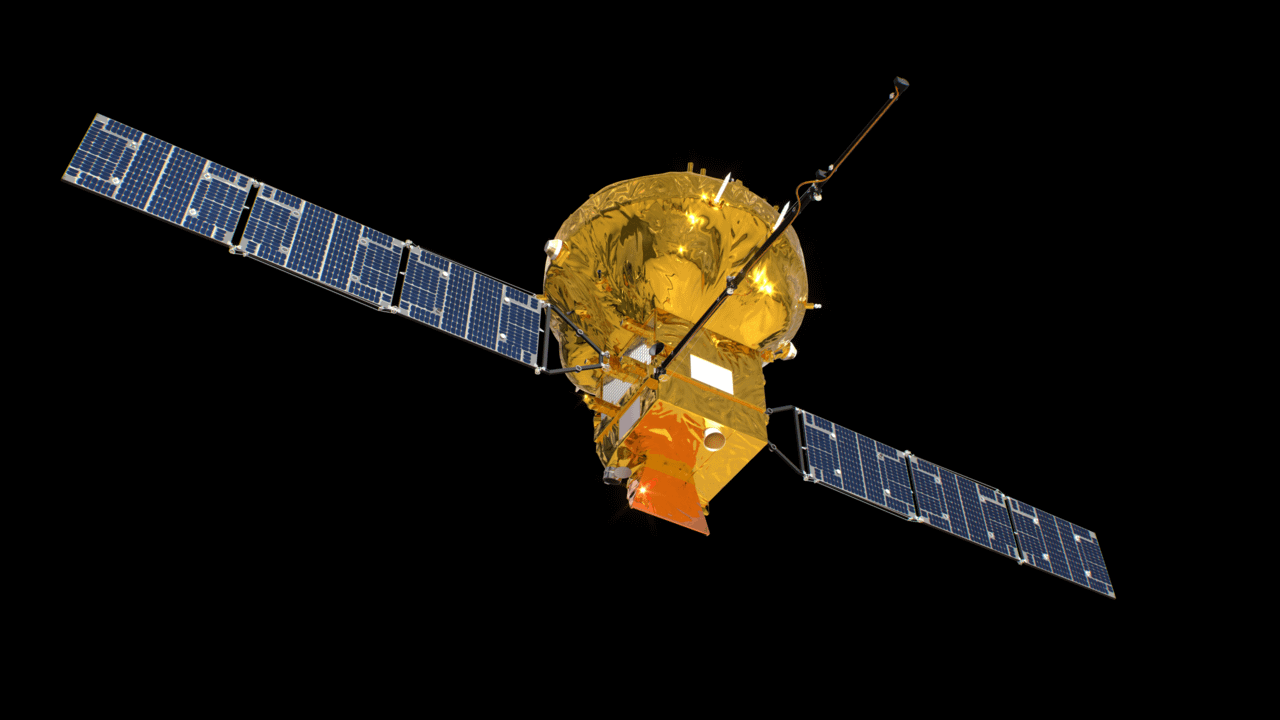
In less than two weeks, a Vega-C rocket will lift off from French Guiana carrying one of the most ambitious space science payloads in years. Its cargo: SMILE, the Solar wind Magnetosphere Ionosphere Link Explorer — a spacecraft built to photograph Earth’s invisible magnetic shield for the very first time.
The mission, scheduled for 19 May 2026, represents something equally rare in geopolitics: a full partnership between the European Space Agency and the Chinese Academy of Sciences. Jointly designed, jointly built, jointly operated. In an era of decoupling and export controls, SMILE is a reminder that some scientific questions are too big for borders.
What makes this spacecraft special is not raw power or speed. It is vision — literally. SMILE carries an X-ray camera capable of imaging the magnetopause, the boundary where the solar wind slams into Earth’s magnetic field. No mission has ever done this before. Until now, we have studied the magnetosphere the way a blind person studies an elephant: one piece at a time.
Quick Facts
Mission: SMILE (Solar wind Magnetosphere Ionosphere Link Explorer)
Partners: ESA + Chinese Academy of Sciences — first joint mission ever between the two agencies
Launch: 19 May 2026, Vega-C rocket, Kourou, French Guiana
Mass: 2,300 kg (including 1,580 kg propellant)
Orbit: Highly elliptical, reaching 121,000 km above the North Pole — one-third of the way to the Moon
Duration: 3 years nominal
Instruments: SXI (Soft X-ray Imager), UVI (UV Aurora Imager), LIA (Light Ion Analyser), MAG (Magnetometer)
Key first: First X-ray images of Earth’s magnetosphere; first 45-hour continuous aurora monitoring
What SMILE Will Actually See
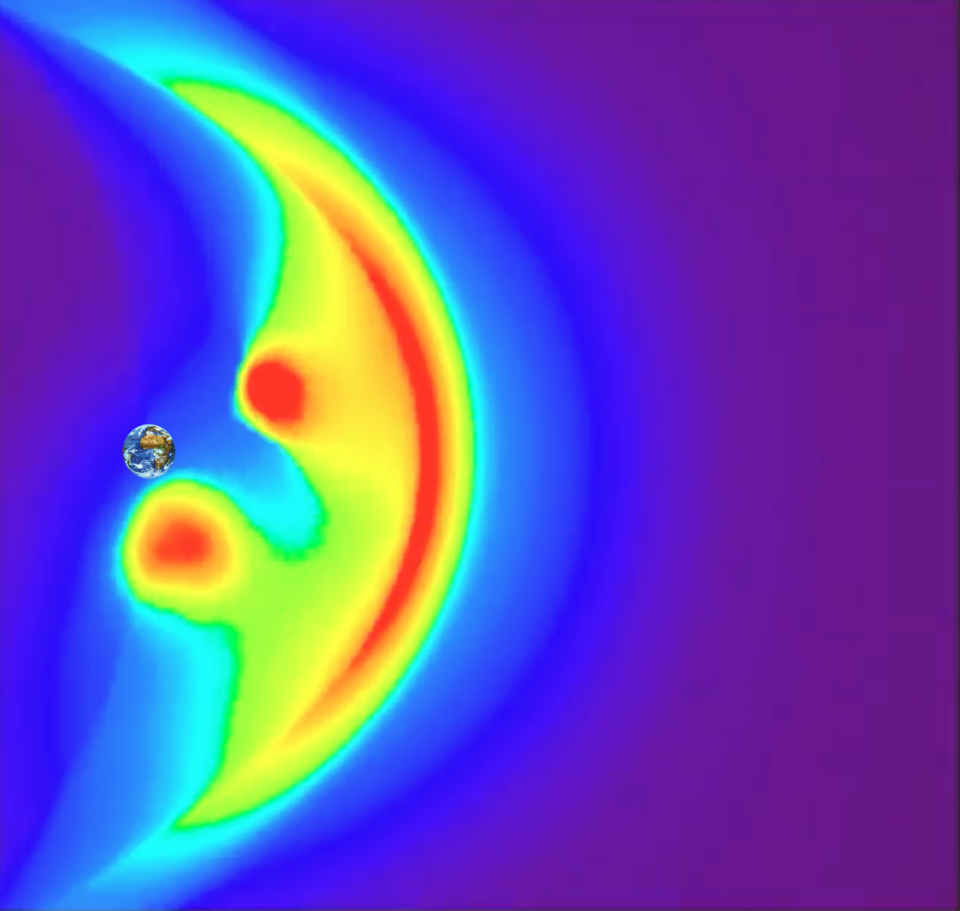
Earth’s magnetosphere is enormous — stretching tens of thousands of kilometres into space on the sunward side and millions of kilometres in the tail pointing away from the Sun. It deflects the solar wind, a relentless stream of charged particles travelling at 400 to 800 kilometres per second. Without it, our atmosphere would have been stripped away billions of years ago, much like what happened on Mars.
Previous missions like ESA’s Cluster constellation and NASA’s MMS have studied the magnetosphere by flying through it, measuring local magnetic fields and particle densities at specific points. Invaluable data, but fundamentally limited — like trying to understand weather by reading a single thermometer.
SMILE changes the game. Its Soft X-ray Imager will photograph a phenomenon called solar wind charge exchange. When charged particles from the Sun collide with neutral atoms in Earth’s upper atmosphere, they emit X-rays. These X-rays trace the exact shape of the magnetopause in real time. For the first time, scientists will see the entire boundary — and watch it ripple, compress, and reform as solar storms hit.
45 Hours of Unbroken Aurora
The second instrument that makes SMILE unique is its ultraviolet aurora imager. Auroras — the northern and southern lights — are not just pretty. They are a direct readout of what the magnetosphere is doing. When the solar wind punches through, charged particles funnel down magnetic field lines toward the poles and light up the upper atmosphere.
SMILE’s highly elliptical orbit, soaring up to 121,000 kilometres above the North Pole, gives it an unobstructed view of the entire auroral oval for 45 consecutive hours. No spacecraft has done this since NASA’s IMAGE satellite went silent in 2005. That is a gap of more than two decades.
Combining the X-ray view of the magnetopause with the UV view of the aurora will let scientists, for the first time, watch cause and effect simultaneously. A coronal mass ejection hits the magnetopause — the X-ray camera sees the boundary compress. Minutes later, the UV camera catches the aurora flaring. The whole chain, from solar impact to polar light show, captured in one dataset.

Europe and China — An Unlikely Partnership
SMILE is the first space mission ever jointly designed, built, launched and operated by ESA and the Chinese Academy of Sciences. The partnership dates back to a 2015 call for proposals — when 13 candidate missions were reviewed, and SMILE emerged as the winner.
ESA built the payload module (led by Airbus Defence and Space) and provides the Vega-C launch vehicle. China’s CAS built the spacecraft platform and three of the four instruments. The Soft X-ray Imager, SMILE’s signature instrument, was built by the University of Leicester under ESA contract. Over 250 scientists from both continents form the research consortium.
Assembly and integration took place at ESTEC, ESA’s technical centre in the Netherlands. Once in orbit, the mission will be operated jointly, with science data downlinked to both the O’Higgins Antarctic ground station (run by the German Aerospace Center, DLR) and the Sanya ground station in southern China.
At a time when US-China space cooperation remains prohibited by law (the Wolf Amendment has been in effect since 2011), and the European Space Agency faces its own political pressures to limit technology transfer, SMILE stands out. It proves that multilateral science missions are still possible — if the science case is compelling enough.
Why Space Weather Matters
This is not abstract science. Space weather — the effect of solar activity on Earth’s technological infrastructure — is a growing operational concern. A severe geomagnetic storm can knock out power grids, disrupt GPS navigation, damage satellites, and endanger astronauts. The 1989 Quebec blackout, caused by a geomagnetic storm, left six million people without power for nine hours. The 2003 Halloween storms caused transformer failures across South Africa and Sweden.
Current space weather forecasting is roughly where terrestrial weather forecasting was in the 1960s: we know a storm is coming, but predicting its exact timing and severity remains difficult. SMILE will not solve this problem alone, but it will fill a critical gap. By revealing how the magnetosphere responds globally to incoming solar material, it provides the kind of system-level data that forecasting models desperately need.
The three questions SMILE is designed to answer cut to the heart of the problem: What happens where the solar wind meets Earth’s magnetic shield? What triggers magnetic disturbances on Earth’s night side? And can we predict the most dangerous storms earlier?
Launch Day Approaches
The mission was originally scheduled for 9 April 2026 but was postponed due to a technical issue with the Vega-C launcher. The new date — 19 May 2026 — is now confirmed, and the spacecraft is undergoing final preparations at Europe’s Spaceport in Kourou.
If all goes well, SMILE will spend its first months using its 490-newton main engine to climb from the initial parking orbit to its operational ellipse. Once there, it will begin a three-year campaign to photograph Earth’s magnetic shield in ways no human eye — and no instrument — has ever seen.
Two hundred and fifty scientists across two continents are waiting. The magnetosphere is ready for its close-up.
Sources: ESA, CGTN, Space.com



 English
0 Comments