Every military aircraft, ship, and guided weapon in the American arsenal depends on GPS. And every adversary with a $50,000 jammer can degrade or deny that signal across an entire operational area. This vulnerability — demonstrated by Iran during Operation Epic Fury, exploited by Russia in Ukraine, and tested by China in the South China Sea — is the single most dangerous technological dependency in modern warfare.
The answer is M-code: a military-exclusive GPS signal that is encrypted, directional, and orders of magnitude harder to jam. It is being broadcast by the latest GPS III satellites, received by new-generation navigation systems like the EGI-M just delivered for the F-22, and is quietly revolutionising how military forces navigate, target, and fight. Here is how it works.
Quick Facts
M-code: Military GPS signal (Military Code), broadcast on L1 and L2 frequencies
Broadcast by: GPS III satellites (first launched 2018, constellation growing)
Anti-jam advantage: Orders of magnitude stronger than civilian GPS signal in target area
Receiver: EGI-M (LN-351) by Northrop Grumman — now entering service on F-22 and E-2D
Backup: Fibre-optic gyro inertial navigation for complete GPS denial scenarios
Operational need: Iran, Russia, and China have all demonstrated GPS jamming capability
The GPS Vulnerability
Standard GPS signals arrive at ground level with extraordinarily low power. The satellites orbit at 20,200 kilometres altitude, and by the time their signals reach a receiver on an aircraft or a guided bomb, the power level has dropped to roughly 10⁻¹⁶ watts — about one hundred-billionth the power of a standard light bulb. This is the fundamental vulnerability. Jamming such a weak signal requires surprisingly little energy.
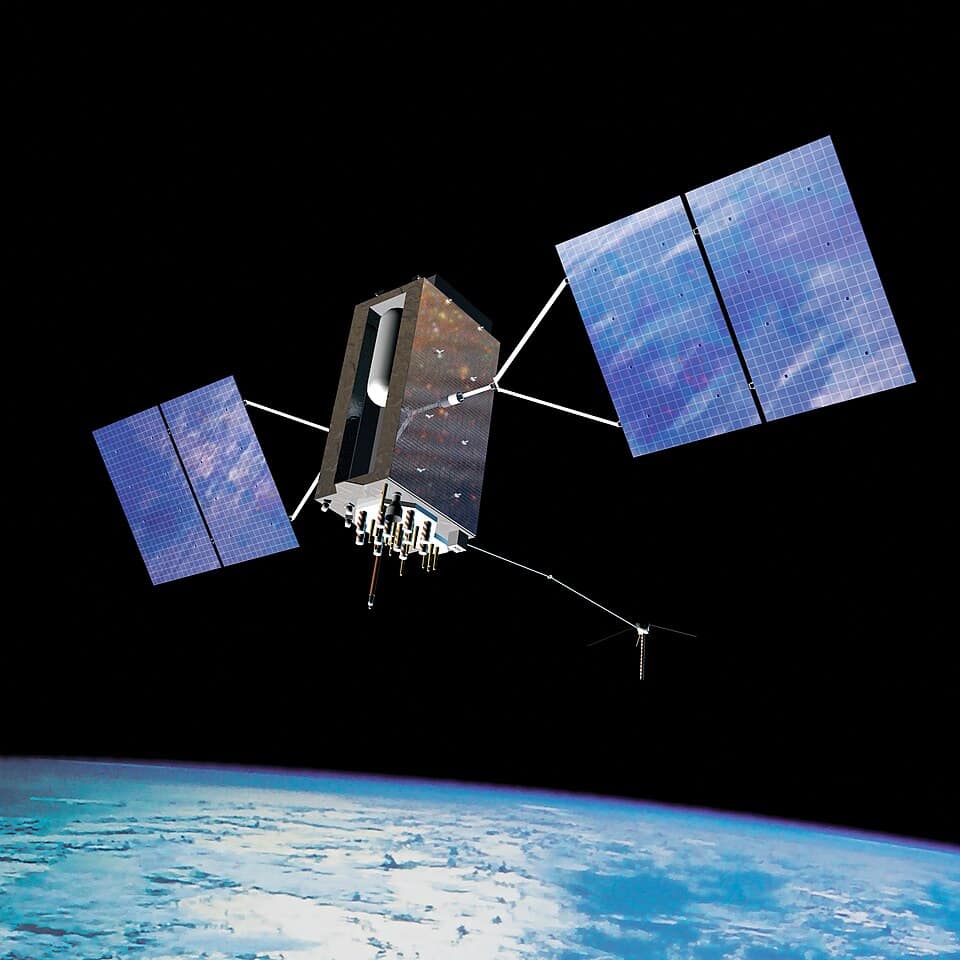
The GPS satellite constellation — the new GPS III satellites broadcast M-code, a military-exclusive signal that is far harder to jam than standard GPS. Wikimedia Commons / NOAA
A ground-based jammer costing a few hundred thousand dollars can broadcast noise on the GPS frequencies at power levels that overwhelm the satellite signal across hundreds of square kilometres. More sophisticated jammers can spoof the signal — broadcasting fake GPS data that makes receivers calculate incorrect positions, causing guided weapons to miss their targets by hundreds of metres or aircraft to fly to the wrong coordinates.
Iran demonstrated this capability during Epic Fury. GPS-guided munitions experienced degraded accuracy in several engagements. Russian forces in Ukraine have used GPS jamming extensively since 2022. China has deployed powerful jamming systems on artificial islands in the South China Sea. The threat is global, proven, and growing.
What Makes M-Code Different
M-code addresses the jamming problem through three interlocking technologies.
**Spread-spectrum encryption.** M-code uses a wideband, encrypted signal that spreads its energy across a broader frequency range than civilian GPS. A jammer must either spread its power across the same wide band — dramatically reducing its effectiveness — or concentrate on a narrow band and miss most of the M-code signal. The encryption ensures that only receivers with the correct cryptographic keys can decode the signal, preventing spoofing.
A GPS III satellite — these next-generation satellites broadcast the M-code signal through high-gain directional antennas that are far harder to jam. Lockheed Martin / Wikimedia Commons
**High-gain directional antennas.** GPS III satellites carry a new antenna system that can focus the M-code signal into a concentrated beam aimed at a specific region of the Earth’s surface, rather than broadcasting it uniformly in all directions. This “spot beam” capability dramatically increases the signal strength in the target area — making it much harder for ground-based jammers to overpower. Think of it as the difference between a floodlight and a spotlight: the spotlight puts far more energy on the target.
**Separate signal chain.** M-code operates on the same L1 and L2 frequencies as civilian GPS but uses a completely independent signal structure. Military receivers can process M-code even when the civilian signal on the same frequency is completely jammed. The two signals coexist on the same frequencies but are invisible to each other’s receivers.
Fibre-Optic Gyros: The Belt to M-Code’s Suspenders
Even the most robust GPS signal can be denied in extreme scenarios — a powerful jammer at close range, operation inside a building or underground, or a GPS satellite constellation degraded by anti-satellite weapons. For these situations, the EGI-M pairs its M-code receiver with a fibre-optic gyro inertial navigation system.
Fibre-optic gyros work by splitting a laser beam and sending it in opposite directions through a coil of optical fibre. When the coil rotates, the two beams experience slightly different path lengths, creating an interference pattern that can be measured with extreme precision. By combining three gyros (one for each axis) with three accelerometers, the system can calculate position, velocity, and attitude without any external signal — no GPS, no radio, nothing from outside the aircraft.
The trade-off is drift. All inertial systems accumulate errors over time — small measurement inaccuracies compound with each passing second, and the calculated position gradually diverges from reality. Modern fibre-optic gyros drift slowly enough to maintain usable accuracy for extended periods, but they cannot match GPS precision over long flights. The EGI-M’s blended mode continuously corrects inertial drift using M-code GPS when available, and falls back to pure inertial when GPS is denied — providing the best available accuracy in any environment.
The Race Is On
M-code is not yet fully operational across the entire GPS constellation. As of 2026, a growing number of GPS III satellites are broadcasting M-code, but the full constellation will take several more years to complete. Receivers are being fielded on priority platforms — the F-22 and E-2D first, with Global Hawk, Triton, P-8, and other aircraft to follow.
The urgency is driven by the likelihood that the next major air campaign — wherever it occurs — will feature GPS jamming as a standard adversary tactic, not an exception. M-code and fibre-optic gyro navigation together ensure that American aircraft can navigate, target, and fight regardless of what the electromagnetic environment looks like.
The era of taking GPS for granted in combat is over. M-code is the answer. And for every adversary that has invested in GPS jamming, the message is clear: the signal just got a lot harder to kill.
Sources: Northrop Grumman, US Space Force, GPS.gov, Air & Space Forces Magazine
Every fighter pilot trains for it. Most pray they'll never experience it. The moment a jet engine — the machine that keeps you flying at 500 knots and 30,000 feet — stops working. Whether it's a compressor stall that sounds like a cannon going off behind your seat, a...
Luca Parmitano has lived two lives that most people only dream about. In the first, he was a fighter pilot — flying AMX Ghibli attack jets for the Italian Air Force, deployed to Afghanistan, trained to fly low and fast into hostile territory. In the second, he became...
Before the Rafale, before the Mirage 2000, before the Mirage F1 — there was the Mirage III. Dassault's first supersonic fighter was a revelation when it entered service in 1961: a sleek, tailless delta that could break Mach 2, carry a nuclear bomb, and outfight...



 English
0 Comments