
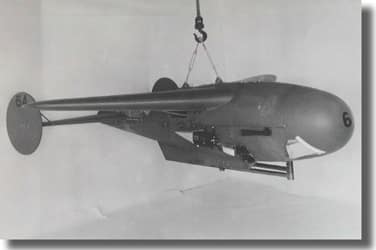
In the middle of the Second World War, one of the most famous psychologists in America proposed a guidance system for bombs that used no radar, no gyroscopes, and no vacuum tubes. It used pigeons. Live ones. Riding inside the nose of the bomb.
The astonishing part is not that B. F. Skinner suggested it. The astonishing part is that it worked — and that the US government paid to find out.
This is the story of Project Pigeon: the pecking, feathered guidance computer that was decades ahead of its time and far too strange to ever go to war.
Informazioni rapide
| Progetto | Project Pigeon — later “Project Orcon” |
| Mastermind | B. F. Skinner, behavioral psychologist |
| Idea | Pigeons peck a screen to steer a glide bomb |
| Testbed | The “Pelican” glide bomb |
| Equipaggio | 1 to 3 pigeons per nose cone |
| Funding | $25,000 from the NDRC |
| Annullato | 8 October 1944; revived as Orcon 1948–1953 |
| Postscript | Won the 2024 Ig Nobel Peace Prize |
The bird in the bomb
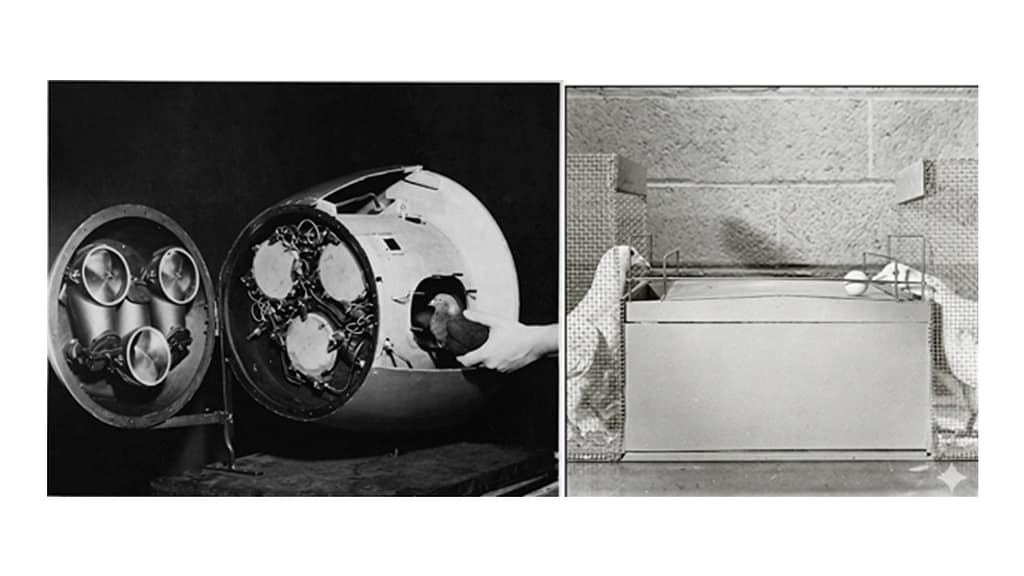
The concept was elegant. Three lenses in the nose of a glide bomb projected an image of the ground ahead onto a small translucent screen. A pigeon sat facing that screen. When it saw the target — a ship, a building — it pecked at it. The screen was mounted on pivots, so each peck nudged it, and sensors translated that movement into commands for the bomb’s control surfaces.
Keep the target centred and the bomb flew straight. Let it drift, and the image slid to the edge of the screen; the pigeon chased it with its beak, and the bomb corrected. A living creature had become the seeker head of a guided weapon.
The BBC explains the whole improbable machine in the clip below.
Skinner’s pecking pilots
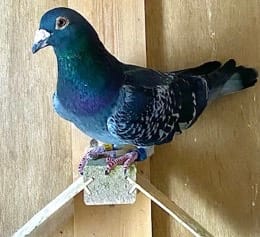
Skinner was the pioneer of operant conditioning, and training pigeons was his life’s work. He taught the birds to peck at a target image, demanding faster and faster pecking for each reward of grain. The pigeons were tireless: one bird pecked more than 10,000 times in 45 minutes without a break.
He even built in redundancy. With up to three pigeons voting on the target at once, a majority would keep the bomb honest even if one bird was distracted. In his own dry words, a dissenting pigeon that pecked the wrong target would be “punished for his minority opinion.”
To Skinner, who had trained pigeons to do far stranger things, steering a bomb was almost trivial. The obstacle was never the birds.

Too strange to fund
The National Defense Research Committee thought the idea eccentric and impractical, but was intrigued enough to hand over $25,000. Skinner delivered working demonstrations. It did not matter. On 8 October 1944 the project was cancelled, the military concluding that pressing on would only delay other weapons with “more immediate promise of combat application.”
The idea refused to die. The Navy revived it in 1948 as Project Orcon — short for “organic control” — and kept testing until 1953, when electronic guidance finally became reliable enough to make a pigeon unnecessary. Skinner’s birds had, in a sense, simply been waiting for the transistor to catch up.
Vindicated by an Ig Nobel
Eighty years on, the pigeon bomb finally got its due. In 2024 Skinner was posthumously awarded the Ig Nobel Peace Prize for the work. His daughter, Julie Vargas, accepted on his behalf with exactly the deadpan the project deserved.
Project Pigeon never dropped in anger. But it was never really a joke, either. Skinner had built a working precision-guidance system out of a bird and a box — a glimpse of the smart weapons to come, arriving a decade too early and wearing feathers.
Sources: Project Pigeon (Wikipedia); B. F. Skinner, “Pigeons in a Pelican,” American Psychologist (1960); Smithsonian National Museum of American History; TIME; Improbable Research (Ig Nobel).



0 Commenti