
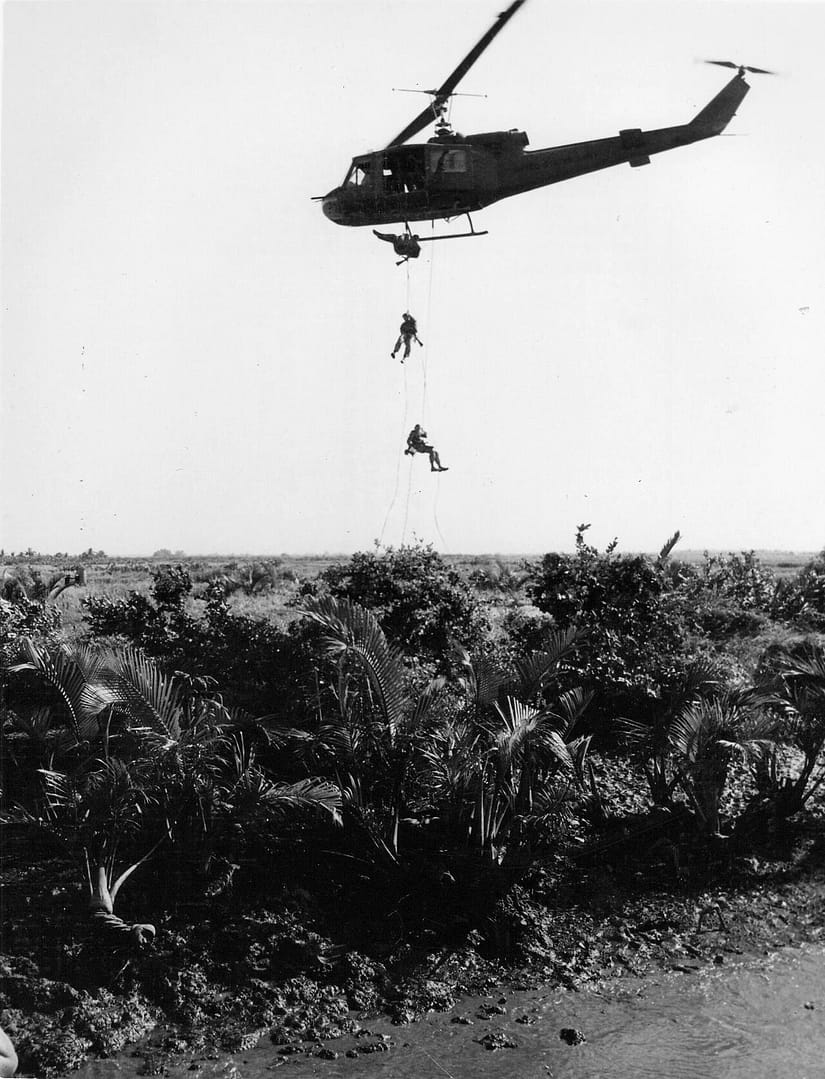
Ask anyone who served in Vietnam what the war sounded like, and many will give you the same answer: a rhythmic, chopping whop-whop-whop rolling in over the trees. It was the sound of the Bell UH-1 — the Huey — and depending on which end of it you were on, it meant reinforcements, resupply, or rescue. For a soldier bleeding out in the elephant grass, no sound on Earth was more welcome.
More than 16,000 Hueys were built, and they did everything: carried troops into battle, hosed down tree lines as gunships, and lifted the wounded out under fire. No machine is more bound up with the memory of Vietnam. This is the story of how a humble utility helicopter became the beating heart — and the soundtrack — of a war.
Informazioni rapide
- Tipo: Bell UH-1 Iroquois - universally known as the "Huey"
- Primo volo: 1956 (as the XH-40); in US Army service from 1959
- Name origin: its early designation HU-1 gave rise to "Huey"; redesignated UH-1 in 1962
- Energia: a single Lycoming T53 turboshaft - light, powerful, and reliable
- Costruito: more than 16,000 between 1955 and 1976
- Vietnam: around 7,000 served; over 3,300 were lost to enemy action and accidents
From "HU-1" to a household name
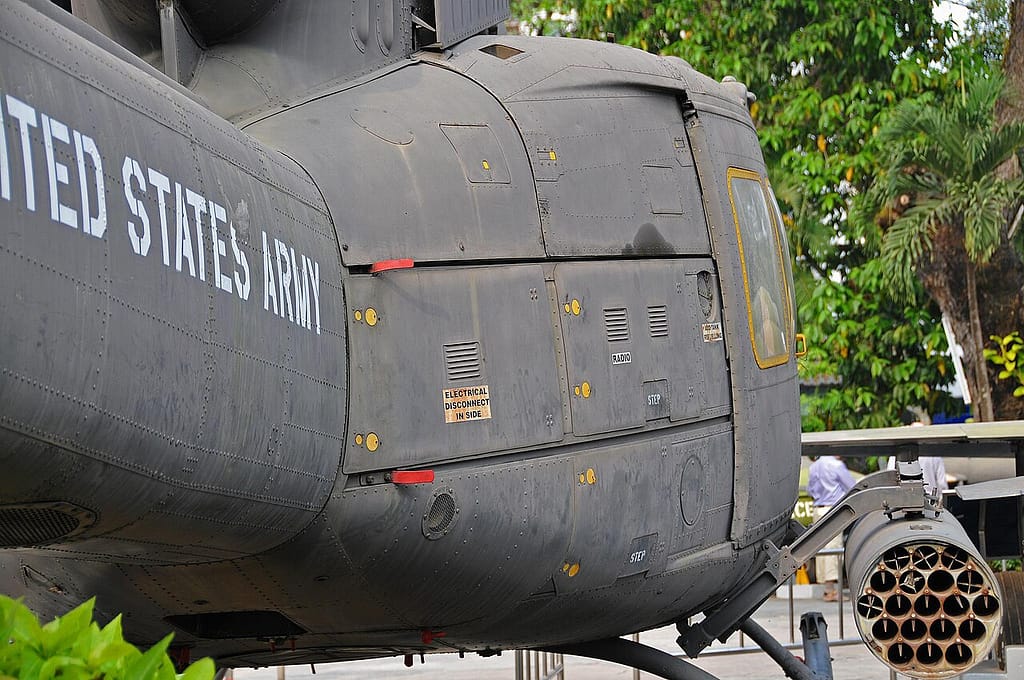
The Huey began as an answer to a simple Army request: replace the piston-engined medevac helicopters of the Korean War with something turbine-powered. Bell's design first flew in 1956 and entered service in 1959. Its official name was Iroquois — the Army traditionally names its helicopters for Native American peoples — but almost nobody used it. Its original designation, HU-1, was stencilled on the airframe, and soldiers simply read it aloud: "Huey." The name stuck so firmly that Bell eventually cast it into the anti-torque pedals.
What made it revolutionary was the turbine. A single Lycoming T53 gave the Huey the power-to-weight and reliability that piston helicopters lacked, and suddenly a helicopter could lift a useful load of men and cargo in the heat and humidity of Southeast Asia, day after day.
The air-cavalry revolution
The Huey didn't just support the ground war — it rewrote it. For the first time, whole units could be lifted over jungle and mountains and set down exactly where they were needed, a concept the US Army called airmobility. The bloody proving ground was the Battle of the Ia Drang in November 1965, where Major Bruce Crandall repeatedly flew his Huey into a landing zone raked by enemy fire to bring in ammunition and carry out the wounded — work that later earned him the Medal of Honor.
For the men on the ground, the arithmetic was simple and merciless: how fast could a Huey reach them, and how fast could it get them to a surgeon. The helicopter compressed the distance between wound and hospital from days to minutes.
Dustoff: angels with rotor blades
Nowhere was the Huey more revered than in the medevac role, whose radio call sign gave it a name of its own: "Dustoff." Unarmed and often flying into hot landing zones without escort, Dustoff crews took appalling risks to pull out the wounded. The most famous of them, Chief Warrant Officer Michael Novosel, flew 2,543 missions and helped evacuate nearly 5,600 people. On one day in October 1969 he made 15 extractions under intense fire to save 29 men — and, at 48, became the oldest man to earn the Medal of Honor. He had already flown bombers in World War II.
The bonds ran deep enough to become legend: when Novosel's son, also a Huey pilot, was shot down, the father heard the Mayday call; a week later the son flew to rescue his own downed father. The Huey made those stories possible.
The sound that never fades
The cost was staggering. Of roughly 7,000 Hueys that served in Vietnam, more than 3,300 were lost. But the design was so good that it never really went away: Hueys and their descendants still fly with military and civilian operators around the world, fighting fires, rescuing climbers, and hauling cargo six decades after the first one lifted off.
For the generation that fought in Vietnam, though, the Huey will always belong to the jungle. Play a veteran a recording of those rotor blades and watch his face change. It is the sound of the worst day of some men's lives — and, for many of them, the sound of the day they were saved.
Sources: Smithsonian National Air and Space Museum, U.S. Army, Warfare History Network, DUSTOFF Association, Army Times. Quotes from Bruce Crandall (as reported) and Michael Novosel's memoir "Dustoff."
0 Commenti