
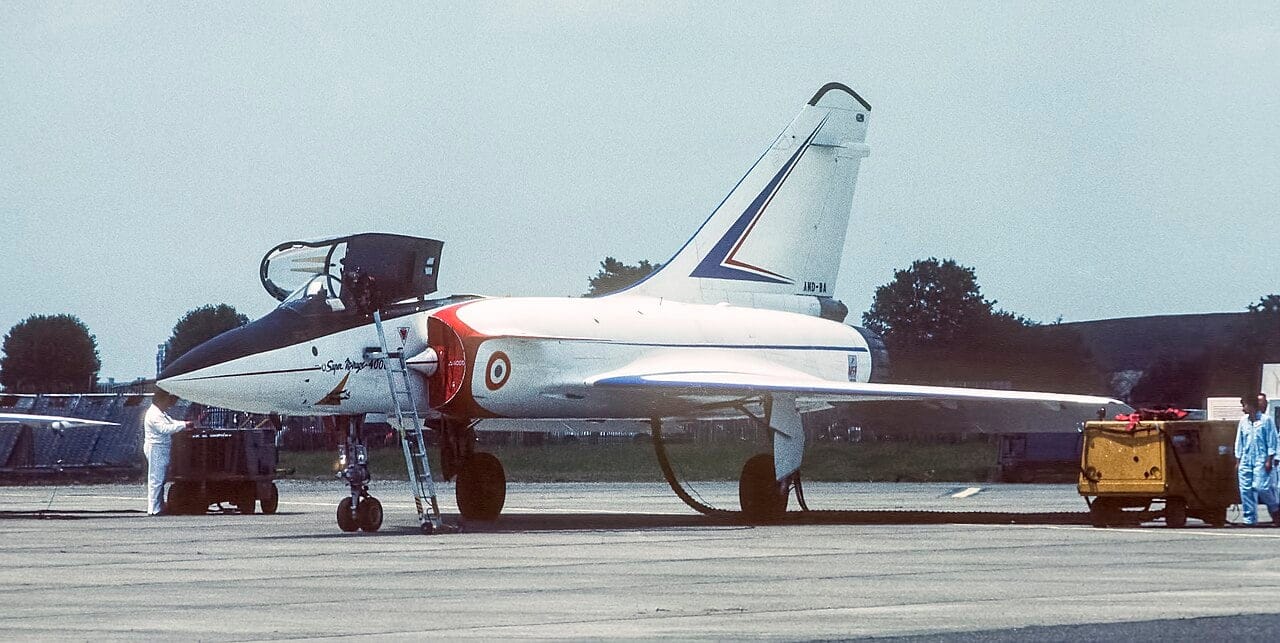
It was, by common consent, one of the most beautiful fighters ever built, and one of the most complete. Bigger, faster and longer-legged than the Mirage 2000 it grew from, the Dassault Mirage 4000 was France's bid to build a true heavyweight, a twin-engine air-superiority fighter to stand beside the American F-15 Eagle, owing nothing to Washington or Moscow. It flew brilliantly. It sold not a single copy.
Marcel Dassault's company paid for it themselves, gambling that sheer excellence would summon its own buyers. The gamble failed, and the loveliest French fighter of its generation ended its days as a museum piece. And yet its story does not end in a hangar, because almost everything the 4000 taught Dassault was poured, a few years later, into the Rafale.
Informazioni rapide
| Aeromobili | Dassault Mirage 4000 (Super Mirage 4000) |
| Tipo | Single-seat twin-engine air-superiority prototype |
| Primo volo | 9 March 1979 |
| Motori | Two SNECMA M53 turbofans |
| Velocità massima | Around Mach 2.2 |
| Costruito | One prototype |
| Test flights | 336, the last in January 1988 |
| Funding | Private venture, financed by Dassault |
| Now | Preserved at the Musée de l’Air et de l’Espace, Le Bourget |
A Gamble Paid For in Private
By the late 1970s Dassault had a winner in the compact, single-engine Mirage 2000. But the company's engineers wanted something larger, a fighter with the range, radar and payload to play in the same league as the F-15. The French air force was not asking for it. Rather than wait, Dassault built it anyway, financing the whole thing as a private venture and betting that performance would create its own demand.
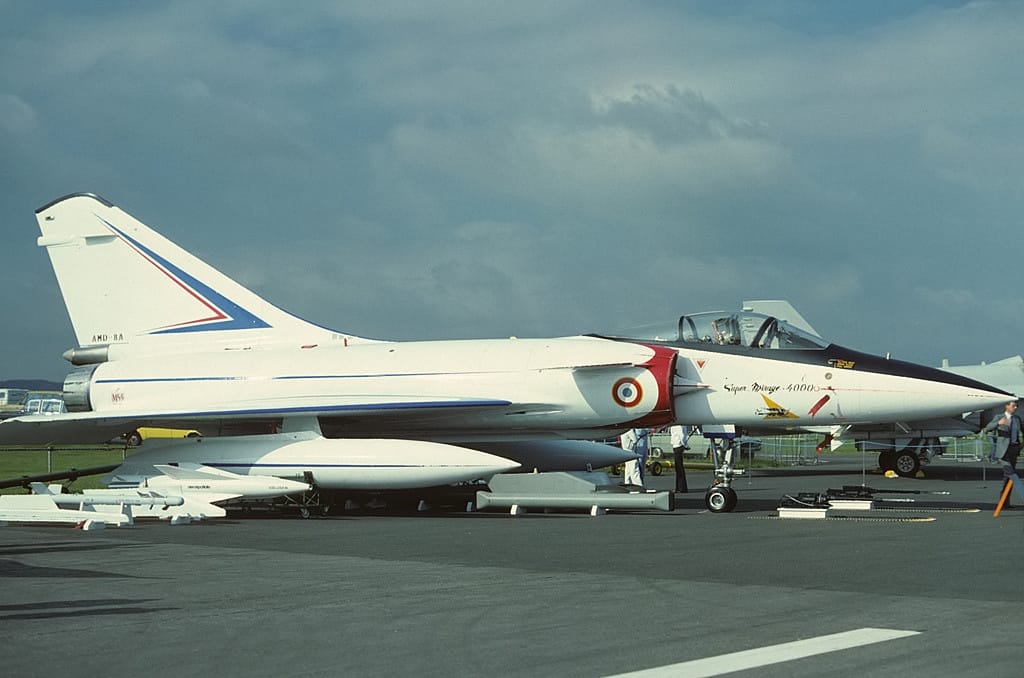
The result first flew on 9 March 1979. It kept the familiar Dassault delta, but everything was scaled up: a wider fuselage, two SNECMA M53 turbofans in place of the 2000's single engine, and small canard foreplanes near the intakes that sharpened its handling and gave it a purposeful, muscular look. Extensive use of composite materials kept the weight down. In testing it climbed hard, flew high, and carried the fuel and weapons of a genuine long-range fighter.
Audiences at Farnborough and Le Bourget saw a jet that could clearly out-turn, out-climb and out-range most of what was flying. The problem was never the aircraft.
A Heavyweight Nobody Would Buy
Dassault pitched the 4000 hard on the export market, above all to the wealthy air forces of the Gulf, where a big, capable interceptor made obvious sense. But the customers Dassault courted, Saudi Arabia chief among them, spent their money elsewhere, on American F-15s and, later, the European Tornado di Panavia. Without a launch customer, and with the French state committed to the cheaper Mirage 2000, the sums never added up.
By the early 1980s the writing was on the wall. Dassault wound the programme down, though the single prototype kept flying test and research sorties for years afterward. It completed 336 flights in all, the last in January 1988, before being quietly retired.
The Fighter That Became the Rafale
Here is the twist that rescues the Mirage 4000 from being a mere footnote. When France finally committed to a new-generation fighter in the 1980s, the demonstrator it built, the ACX that became the Rafale, drew directly on the 4000's hard-won lessons in aerodynamics, composites, canard-delta control and twin-engine layout. The heavyweight that never sold quietly fathered the fighter that now flies from French carriers and has won export orders across the world.
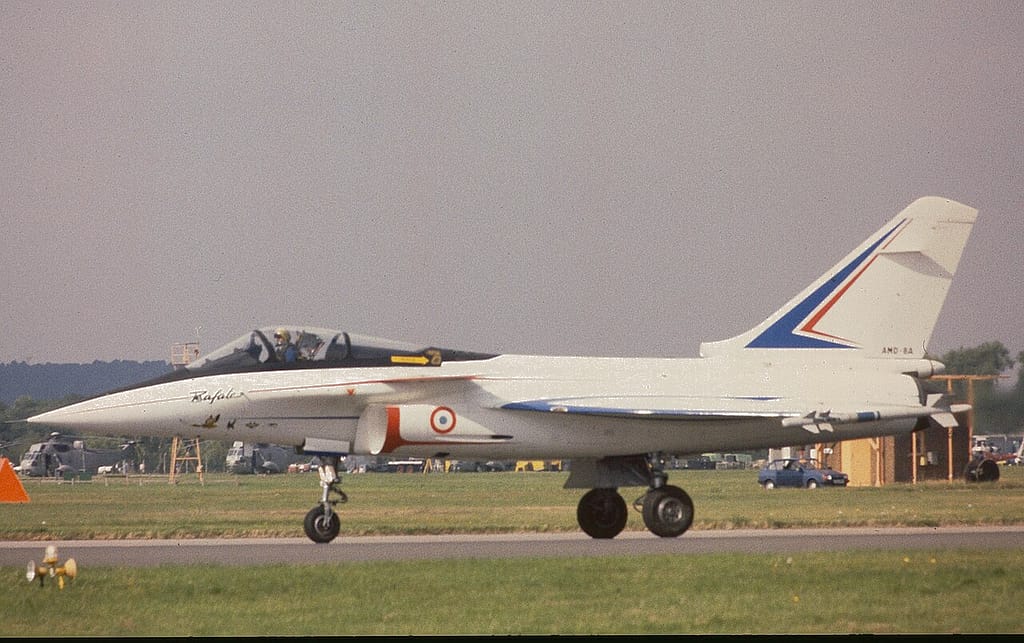
The sole Mirage 4000 survives today at the Musée de l’Air et de l’Espace at Le Bourget, still striking, still faintly futuristic. Watch it fly in period footage and the waste seems almost criminal.
It is tempting to call the Mirage 4000 a failure. It is fairer to call it a fighter born a decade early, in a market with no room for it, whose real success was measured not in sales but in the aircraft it made possible. A beautiful machine that flew well, exactly as Marcel Dassault would have wanted, and still lost.
Sources: Vintage Aviation News; Dassault Aviation; The National Interest; Wikipedia. Marcel Dassault quotation as widely documented.
0 Commenti