
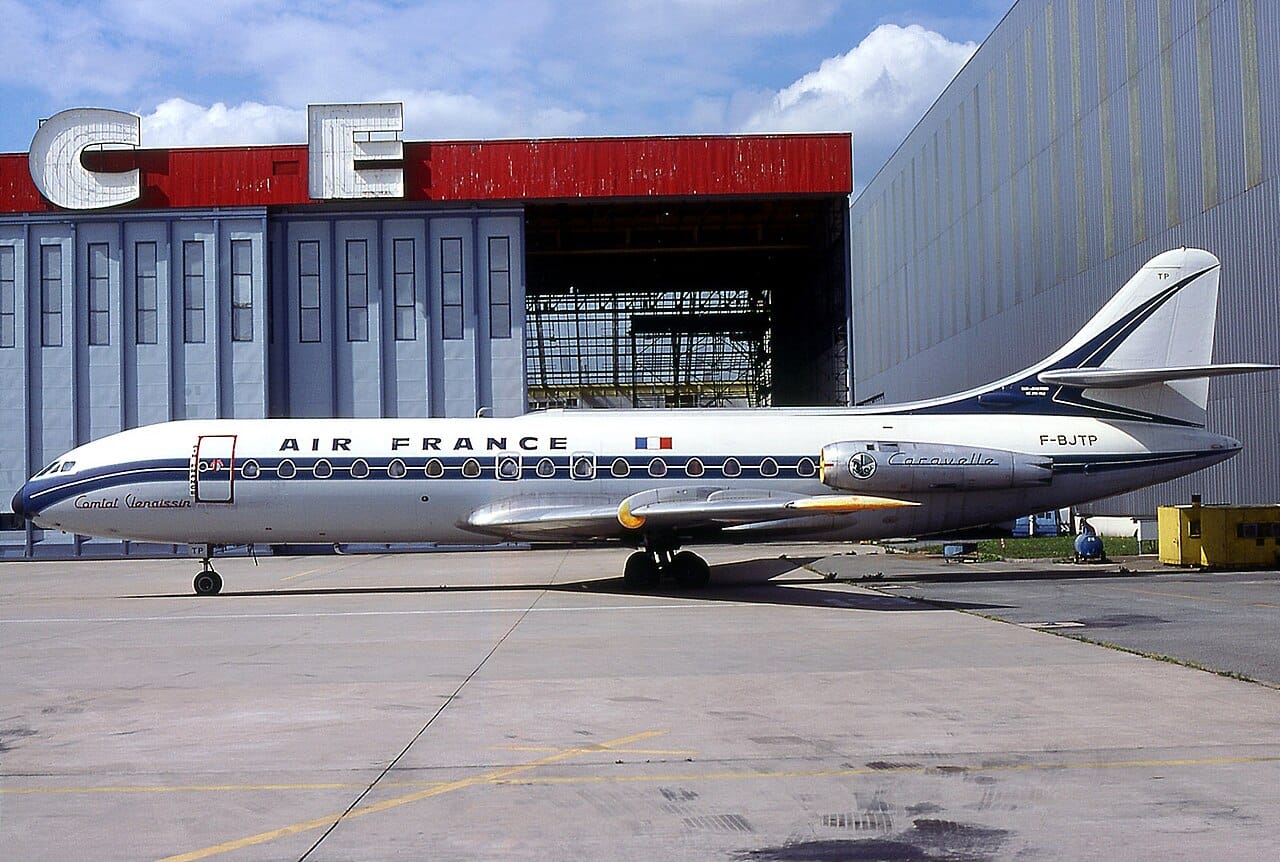
Look at almost any small jet airliner of the 1960s and 1970s, the Douglas DC-9, the Boeing 727, the BAC One-Eleven, the Fokker F28, and you will see the same clever idea: the engines mounted at the tail, leaving the wing clean and the cabin quiet. That idea did not come from Seattle or Long Beach. It came from Toulouse, and from a graceful French aircraft called the Caravelle.
The Sud Aviation Caravelle was the world's first successful short- and medium-haul jetliner, and it introduced a layout so sensible that half the industry copied it. France, which had spent the early jet age watching Britain and America lead, suddenly found itself setting the template.
Informazioni rapide
| Aeromobili | Sud Aviation SE 210 Caravelle |
| Primo volo | 27 May 1955, from Toulouse |
| Entered service | 1959, with Air France and SAS |
| Rivendicazioni di fama | First short/medium-haul jet airliner; first with rear-mounted engines |
| Motori | Two Rolls-Royce Avon turbojets, mounted at the tail |
| A borrowed nose | Its cockpit and nose were taken from the de Havilland Comet |
| Costruito | 282 (1958 to 1972) |
| Eredità | The rear-engine layout was adopted by the DC-9, 727, F28 and One-Eleven |
A Clean Idea
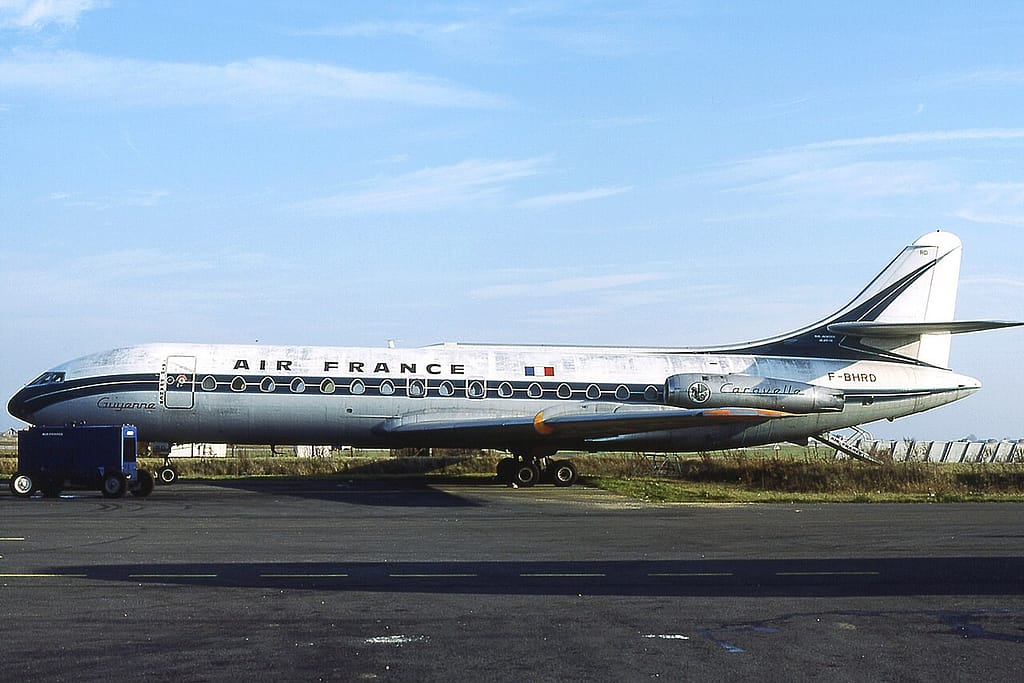
When Sud Aviation set out to build a jet for shorter routes, it made a bold choice. Instead of hanging engines under the wing, as the Comet and the 707 did, it bolted two Rolls-Royce Avon turbojets to the rear fuselage, either side of the tail. The payoff was elegant: an aerodynamically clean wing that could be optimised purely for lift, a quieter cabin well forward of the engines, and a tidy, balanced silhouette.
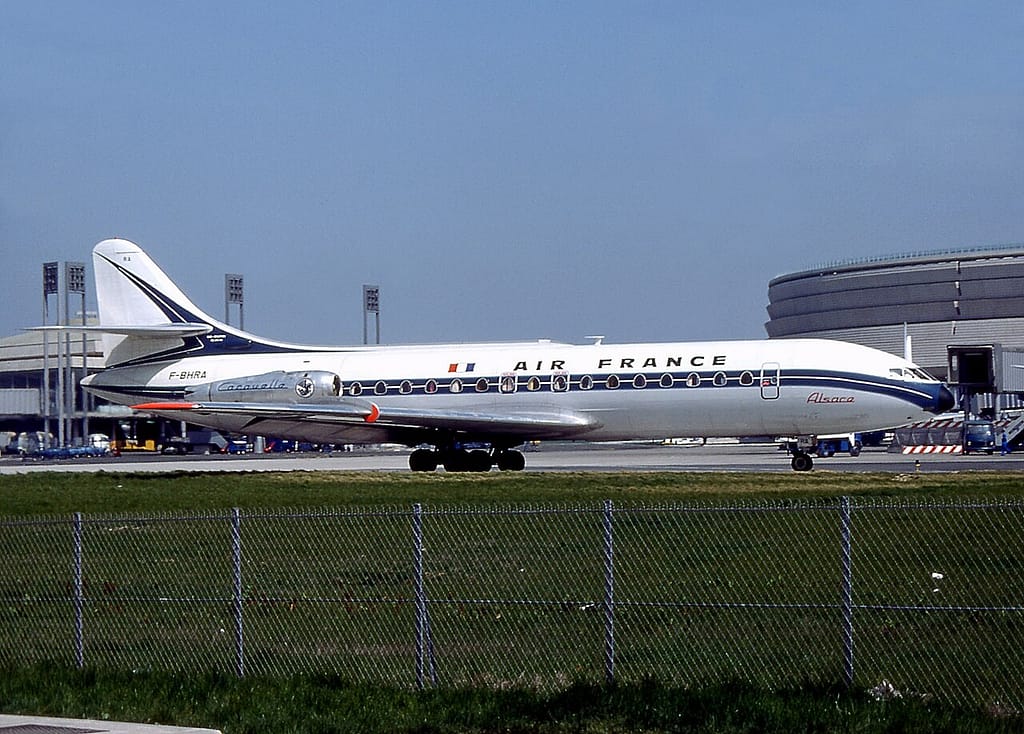
There was a very French pragmatism to the rest of it, too. Rather than design a new nose and cockpit from scratch, Sud Aviation simply licensed the ones from Britain's de Havilland Comet, the pioneering jetliner whose own tragic story was unfolding at the same time. The Caravelle wore the Comet's face on a body all its own.
A Star of the Jet Age
First flown on 27 May 1955 and in service by 1959 with Air France and SAS, the Caravelle was an immediate hit. Passengers loved its smoothness and its distinctive triangular windows; airlines loved that it made jet travel viable on routes too short for the big four-engine machines. It sold across Europe, into Africa and South America, and even to the United States, where United Airlines flew it.
The Template France Left Behind
In all, 282 Caravelles were built before production ended in 1972. That is a modest number beside the thousands of 727s and DC-9s that followed. But the Caravelle's true output cannot be counted in airframes. It is measured in every rear-engined jet that came after, each one quietly acknowledging that the French had got there first.
Today the Caravelle is a museum piece, its triangular windows and tail-mounted engines a little dated to modern eyes. Yet it deserves to be remembered as one of the most influential airliners ever built: elegant, clever, and quietly revolutionary. Not bad for a jet that borrowed its nose.
Sources: Wikipedia; National Air and Space Museum; Curbside Classic; SlashGear; Suren Ratwatte (Medium).


0 Commenti