
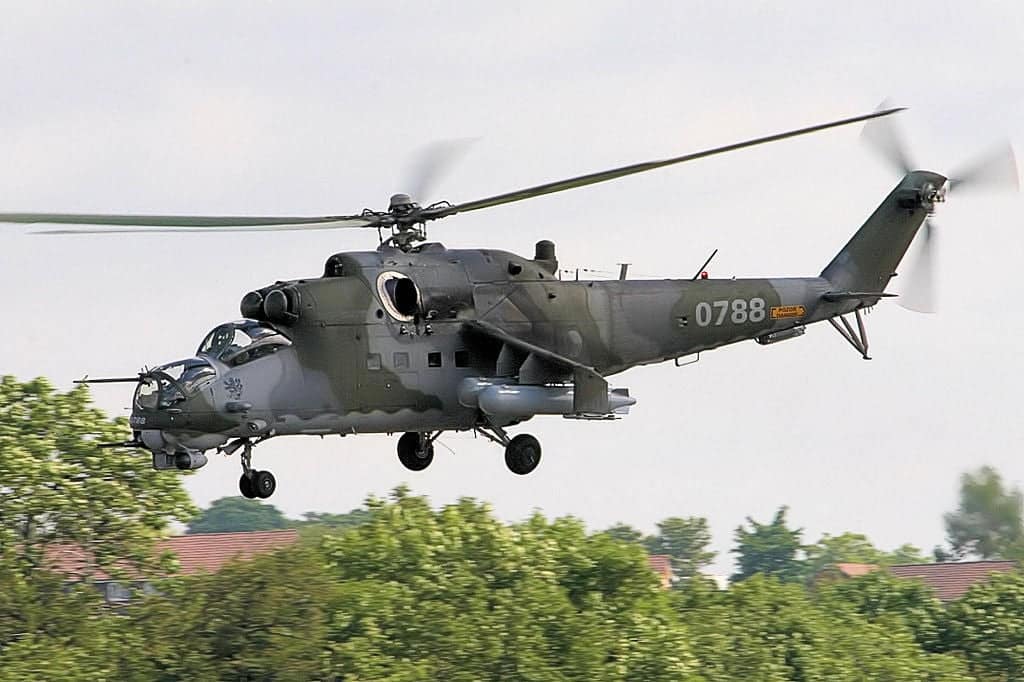
In the California desert this month, U.S. Marines rehearsed an attack under fire from an unlikely enemy: a Soviet gunship built to kill NATO troops. The Mi-24 Hind was not captured, and it was not a mock-up. It was the real thing, flying for the other side on purpose.
The helicopter took part in Adversary Force Exercise (AFX) 4-26 at the Marine Corps Air-Ground Combat Center in Twentynine Palms, with official images taken on 1 August 2026. It is the latest appearance of one of the U.S. military’s most curious assets: a small stable of genuine Russian-designed Hinds kept flying to make training feel like the real war.
Informazioni rapide
- Che cosa: a Mil Mi-24D Hind flying as an “adversary” in Adversary Force Exercise 4-26
- Dove: Marine Corps Air-Ground Combat Center, Twentynine Palms, California
- Quando: imagery dated 1 August 2026
- The airframes: two ex-Bulgarian Hinds, tail numbers ‘118’ and ‘120’, flying U.S. threat-replication since 2020
- Also in the fleet: an estimated 30 Mi-17/Mi-171 operated by the CIA and U.S. Army
Red Air, for real
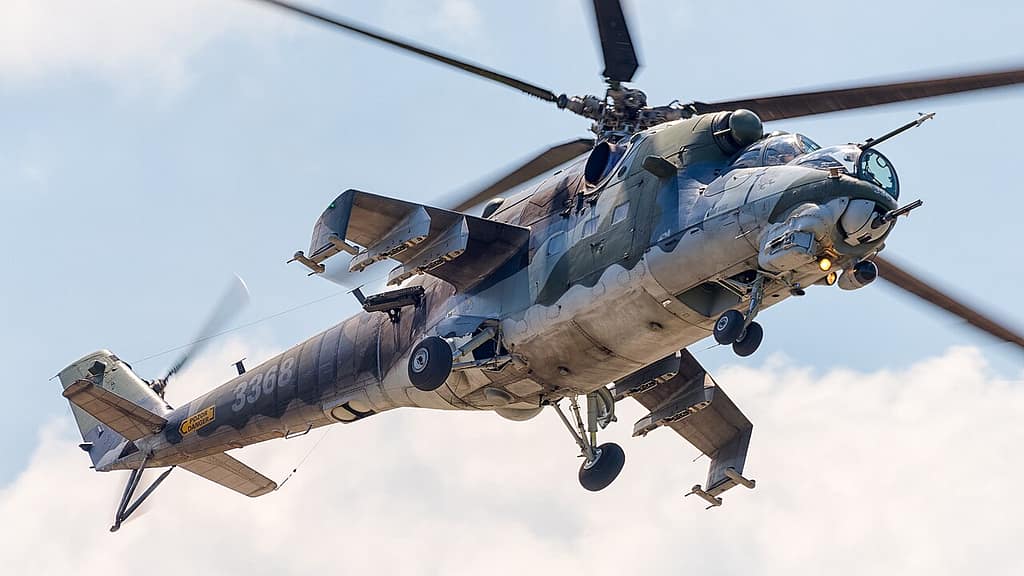
The idea is called dissimilar training: instead of pretending a friendly helicopter is the enemy, you fly the actual enemy machine. Since 2020, two Mi-24Ds — ‘118’ and ‘120’, their numbers stenciled by the exhausts — have played the villain for the Marines, the Army and the Air Force, dogfighting Pave Hawks and Black Hawks and strafing Marines on the ground.
From museum piece to menace
The two Hinds have Bulgarian roots. They were displayed at the Cold War Air Museum until it closed in 2017, then went under contract to replicate threats for the U.S. military. The captions on the newest photos suggest the Marine Corps itself now runs them, assigned to Marine Aviation Weapons and Tactics Squadron One.
Why fly the enemy’s helicopter
Because nothing else looks or moves quite like it. The rotor disc, the stub wings, the way a Hind accelerates and turns — a Pave Hawk pretending to be one can only approximate it. Put aircrew in front of the genuine article and the lessons land harder.
The flying tank
The Mi-24 earns the fascination. It is the only heavyweight attack helicopter that is also a troop carrier, with a cabin that once hauled eight soldiers into battle over Afghanistan. Soviet crews nicknamed it the “crocodile.” Half a century after its debut, upgraded Hinds still fight — Ukrainian crews now use them to hunt Russian attack drones, one airframe reportedly wearing 98 drone-kill marks. In the American desert, the same design has found a stranger second career: teaching the West how to beat itself.
Sources: The Aviationist; U.S. Marine Corps / DVIDS imagery (AFX 4-26, 1 Aug 2026); Vertical Magazine. Quote via U.S. Air Force / The Aviationist.


0 Commenti