

Ninety seconds before he put an Airbus A320 into a river, Chesley Sullenberger said something entirely ordinary. It was 3:26 in the afternoon on 15 January 2009, the aircraft was climbing away from LaGuardia, and he looked left out of the window.
Thirty-four seconds later, at 2,818 feet, US Airways 1549 flew into a flock of Canada geese and both engines died.
Everything that made this famous happened in the next three and a half minutes.
Informazioni rapide
| Data | 15 January 2009 |
| Volo | US Airways 1549, LaGuardia to Charlotte, callsign “Cactus 1549” |
| Aeromobili | Airbus A320-214, registration N106US, two CFM56-5B4/P turbofans |
| Equipaggio | Capt Chesley Sullenberger (19,663 hrs), FO Jeffrey Skiles (15,643 hrs, 37 on type); cabin crew Sheila Dail, Donna Dent, Doreen Welsh |
| A bordo | 155 — 150 passengers and 5 crew |
| Risultato | All 155 survived; 100 injured, 5 seriously |
| Bird strike | 15:27:11 at 2,818 ft, Canada geese confirmed by DNA testing |
| Ditching | 15:30, roughly opposite West 50th Street; water 41 °F (5 °C), air 19 °F (−7 °C) |
| NTSB probable cause | Ingestion of large birds into each engine, causing almost total loss of thrust in both |
Two Engines, Gone
Skiles was flying. It was his first trip as pilot flying on the A320 — he had 37 hours on the type against nearly 16,000 in his career, which tells you he was an experienced airman on an unfamiliar aeroplane.
The geese went into both engines at once. There were bangs, flame from the intakes, then something worse than noise: near silence, and the smell of unburned fuel. Canada geese routinely weigh more than jet engines are certified to swallow.
The aircraft kept climbing on momentum for another nineteen seconds, topping out around 3,060 feet, then began to sink. Sullenberger took control. Skiles went straight into the engine restart checklist — a document written on the assumption that an aircraft losing both engines would be at cruise altitude with half an hour to work the problem. They had about three minutes.
The NTSB animation of the flight, synchronised to the actual radio and cockpit audio.
“Unable”
At 15:27:33 Sullenberger called New York TRACON. In the stress of the moment he gave the wrong callsign — a small human detail that has survived in every transcript since.
The controller was Patrick Harten. He stopped every departure at LaGuardia and offered Sullenberger runway 13. The reply was one word.
“Unable.”
Harten offered Teterboro in New Jersey, runway 1. Sullenberger said yes, then almost immediately reconsidered, and transmitted the sentence that named the event.
They crossed above the George Washington Bridge with less than 900 feet to spare. Sullenberger keyed the cabin address and said three words: brace for impact. Behind him, Dail, Dent and Welsh began chanting the brace commands that every cabin crew rehearses and almost none ever uses.
125 Knots, Nose Up
At 15:30 the A320 touched the water heading south at about 125 knots, nose up 9.5 degrees, descending at 750 feet per minute. The flight attendants described it afterwards as one impact, no bounce, then a long deceleration.
Sullenberger has always been careful not to call it perfect. He has pointed out that the A320’s flight-control computers, which held the aircraft inside its safe envelope all the way down, also prevented him from pulling the final flare he wanted — the last-moment nose-up that would have softened the touchdown. The rear fuselage took the impact hard, and flight attendant Doreen Welsh, seated at the back, suffered a deep laceration to her leg.
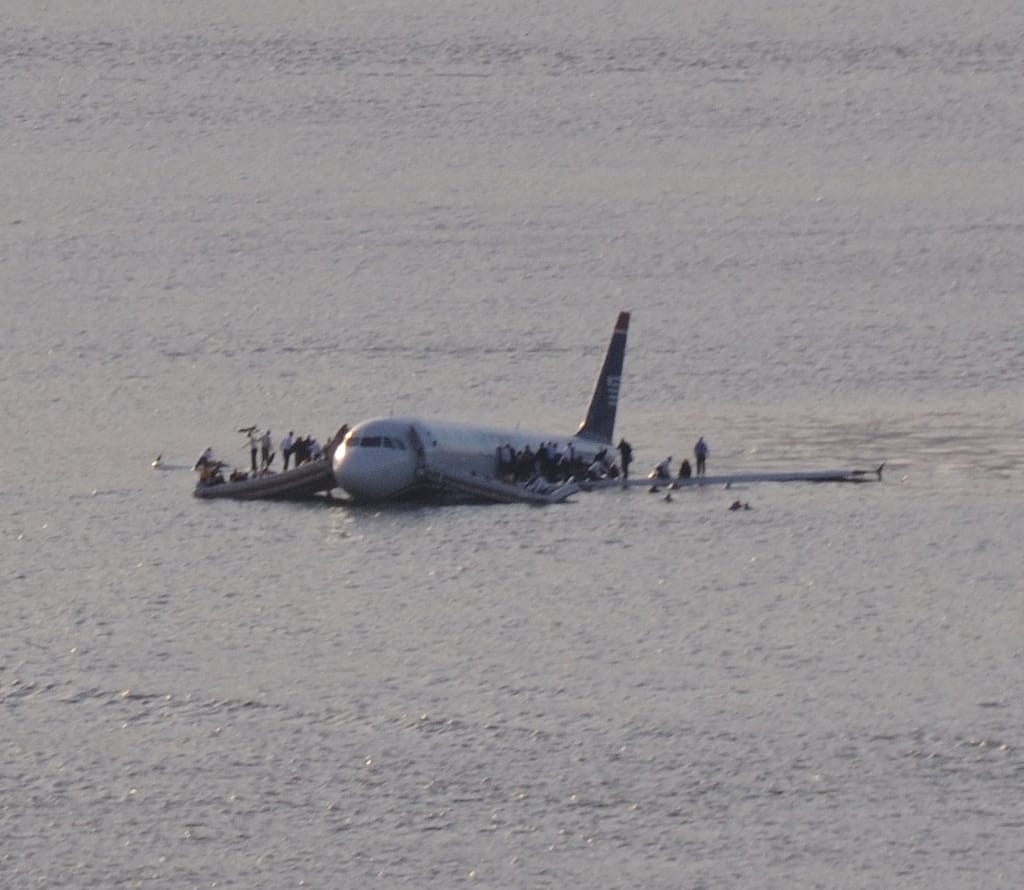
Then came the part people forget. The aeroplane was sinking, in January, in a tidal river, in the middle of the largest city in the United States.
Passengers went out through the four overwing exits and the front right door. The front left slide failed to deploy and had to be inflated by hand. Someone opened the rear left door — the sources still disagree on whether it was a crew member or a passenger — and the river came in behind them. Sullenberger walked the length of the cabin twice, in water, to make certain it was empty before he left.
The Boats
Two NY Waterway ferries were alongside within minutes, followed by Coast Guard vessels and a swarm of working boats. Ferry crews used a Jason’s cradle to lift people out of the water. Sullenberger told them to take the people standing on the wings first — the slide-rafts had detached and were functioning as designed; the wings had no such margin.
About 140 New York firefighters converged on the docks. The last person came off the aircraft at 15:55. Seventy-eight people needed medical treatment, mostly for minor injuries and hypothermia.
The original air traffic control audio. What stands out is how ordinary both voices sound.
Could They Have Made It Back?
This is the part that matters, and the part the film dramatised heavily. The NTSB did run the numbers.
In simulator recreations, pilots who turned immediately for LaGuardia made it 7 times out of 13. Teterboro succeeded once in two attempts. On paper, that looks like Sullenberger threw away a runway.
The Board did not accept the comparison, and said so directly.
Investigators then re-ran the simulation with a 35-second delay inserted — a realistic allowance for a human being to understand what has just happened and choose what to do about it. That aircraft crashed.
The NTSB ruled that Sullenberger made the correct decision. It credited the outcome to four things: the crew’s decision-making and teamwork, including starting the auxiliary power unit immediately; the fact that this particular A320 was certified for extended overwater flying and therefore carried life vests and extra rafts it was not required to have on a domestic route; the cabin crew’s handling of the evacuation; and the sheer luck of ditching in a stretch of water full of working boats.
The final report ran to 34 safety recommendations — on bird-strike testing at low speeds, on checklists designed for low-altitude engine failure, on life vests for every flight regardless of route, on how to make passengers actually listen to the safety briefing.
The full ATC recording of the bird strike and the controlled ditching, start to finish.
Afterwards
The crew received the Guild of Air Pilots and Air Navigators Master’s Medal a week later, and the keys to New York City from Mayor Bloomberg — who also replaced the library book Sullenberger lost in the river. It was Sidney Dekker’s Just Culture: Balancing Safety and Accountability, which is the single most improbable detail in the entire story.
Harten, the controller, had the worst of it emotionally. He spent the rest of that shift believing he had listened to 155 people die, and later described the moment it was over as the hardest part of the whole event.
Sullenberger retired in March 2010. Asked by a magazine how he had managed a near-perfect water landing, he gave the answer that explains the whole thing better than any accident report.
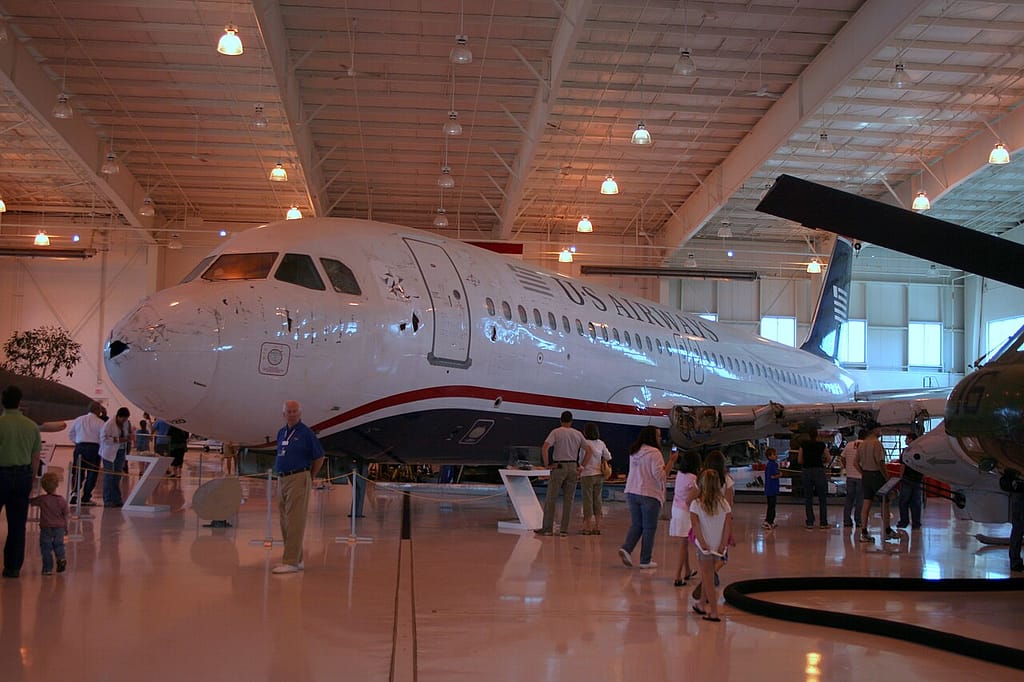
N106US was bought by the museum in Charlotte and sits there today with the engines that failed. And an unnamed NTSB board member gave the ditching the verdict that stuck: the most successful in aviation history, because these people knew what they were supposed to do, and they did it.
Sources: NTSB Accident Report AAR-10/03 (4 May 2010); cockpit voice recorder and ATC transcripts; Guild of Air Pilots and Air Navigators citation; AARP: The Magazine; Sullenberger Aviation Museum.

0 Commenti