
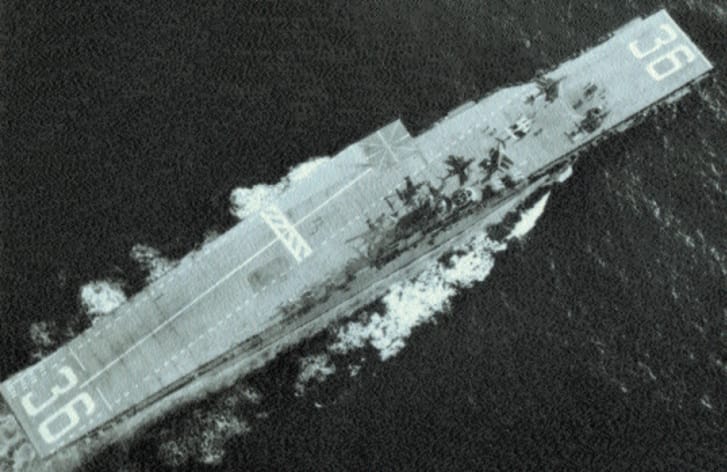
Every modern aircraft carrier shares one strange feature: the landing runway is skewed off to one side, pointing away from the ship's centreline. It looks like an afterthought. It is actually one of the most important safety inventions in aviation history — and it came from a British officer with a simple, brilliant idea.
Informazioni rapide
- Invenzione: The angled (canted) carrier flight deck
- Credited to: Royal Navy Captain Dennis Cambell and the RAE's Lewis Boddington
- First test: Painted angled deck on HMS Triumph, 1952
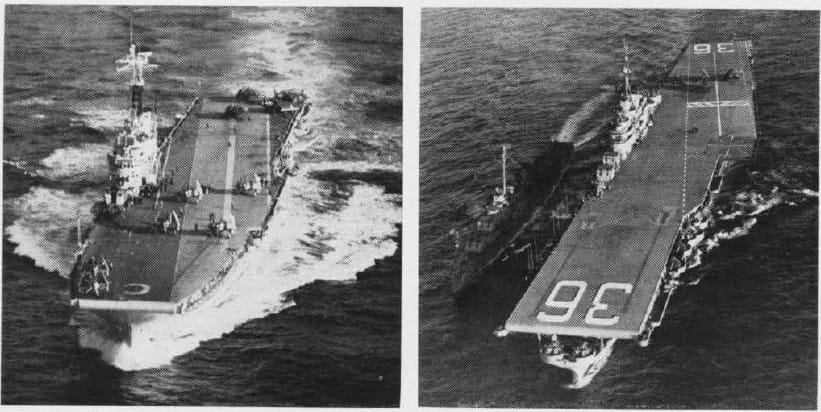
- First true angled-deck carrier: USS Antietam (CV-36), converted December 1952
- The angle: Landing area canted roughly 5–10 degrees off the ship's axis
- Perché è importante: Made safe, high-volume jet carrier operations possible
The problem with a straight deck
On the old straight-deck carriers, landing was terrifyingly binary. Aircraft came in over the stern and had to catch an arresting wire. Parked aircraft and a crash barrier sat directly ahead. If a pilot missed the wires, there was nowhere to go — the jet slammed into the barrier or, worse, into the aircraft parked forward. As propeller planes gave way to faster, heavier jets in the 1950s, this margin for error shrank to almost nothing.
The Royal Navy had seen it coming. As early as the mid-1940s, its planners recognised that the jet age would demand a fundamentally different flight deck.
One simple twist
Captain Dennis Cambell, working with Lewis Boddington of the Royal Aircraft Establishment, proposed something elegant: angle the landing area a few degrees off the ship's centreline, pointing out over the port side. Now a pilot who missed the wires simply flew off the angled deck, added power, and went around for another try — a “bolter” instead of a crash. Just as importantly, the forward deck was freed up to park and launch aircraft at the same time, because landing traffic no longer aimed straight at it.
The idea was first tested in 1952 with an angled outline painted onto the deck of HMS Triumph, where pilots flew touch-and-go passes aligned about five and a half degrees to port. It worked. The Americans quickly ran their own trials.
The invention that made the jet carrier
The US Navy committed fast. It converted the Essex-class carrier USS Antietam with a true angled deck, completed in December 1952, and by early 1953 the ship was proving the concept with full arrested landings. The results were transformative — landing accidents plummeted, and carriers could recover and launch jets far more safely and efficiently.
Together with two other British inventions of the same era — the steam catapult and the mirror landing aid — the angled deck turned the aircraft carrier into the machine we know today. It is the rare stroke of genius so effective that it became invisible: every supercarrier afloat carries Dennis Cambell's idea, and almost no passenger who sees one ever wonders why the deck points the wrong way.
Sources: Wikipedia (Dennis Cambell; Flight deck); History on the Net; AvGeekery; denniscambell.org.uk.
Post correlati

0 Commenti