
A fighter has a fixed number of places to hang things. Wings, fuselage, wingtips. Every pylon you fill with a bomb is a pylon you cannot fill with fuel, a targeting pod, or a missile to defend yourself with. That arithmetic has constrained air campaigns since the 1950s.
The GBU-39/B Small Diameter Bomb was designed to break it. And the imagery U.S. Air Forces Central has been releasing from the Middle East this month shows why it matters.
Informazioni rapide
| Arma | GBU-39/B Small Diameter Bomb |
| Classe | 250-pound class, GPS/INS guided glide bomb |
| Allineare | More than 40 nautical miles (U.S. Air Force figure) |
| Costo unitario | Approximately $40,000 |
| Carriage | BRU-61/A pneumatic rack, four weapons on a single store station |
| Appaltatore principale | Adile |
| In servizio | Limited production April 2005; delivered to warfighters August 2006 |
| Seen on | F-16CM Fighting Falcon, U.S. Central Command area of responsibility, 2026 |
| Typical companions | LITENING targeting pod, AN/ASQ-213 HTS, external tanks, AIM-120 and AIM-9 |
Four Weapons, One Station
The trick is not the bomb, it is the rack. The BRU-61/A is a smart pneumatic carriage that mounts four SDBs on a single MIL-STD-1760 store station. One pylon, four independently targetable aimpoints.
The Air Force fact sheet is unsentimental about the consequence: the weapon’s small size “allows increased aircraft loadout to achieve multiple kills per sortie and inherently reduces the probability of collateral damage.” A Viper that could previously service two targets can service considerably more, while keeping its tanks, its pods and its air-to-air missiles.
At roughly $40,000 a weapon and more than 40 nautical miles of standoff, it is also cheap enough to use in quantity and long-legged enough to be launched from outside a lot of air defence envelopes.
What the CENTCOM Imagery Shows
On 7 August 2026, AFCENT photographed F-16s refuelling from a KC-135 somewhere in the Central Command area of responsibility. The images were released through DVIDS under a deliberately vague caption: an F-16 receiving fuel at an undisclosed location. No weapon is named anywhere in the official caption.

Army Recognition, analysing the released frames, reported an aircraft carrying eight GBU-39/Bs across two BRU-61/A racks alongside a LITENING pod, an HTS pod, two tanks and four air-to-air missiles. We could not independently reproduce that count from the same imagery, and a separate read of the higher-resolution files suggested a different configuration and a different tail code. So treat the eight-bomb figure as one outlet’s visual analysis, not as a CENTCOM statement. It is not one.
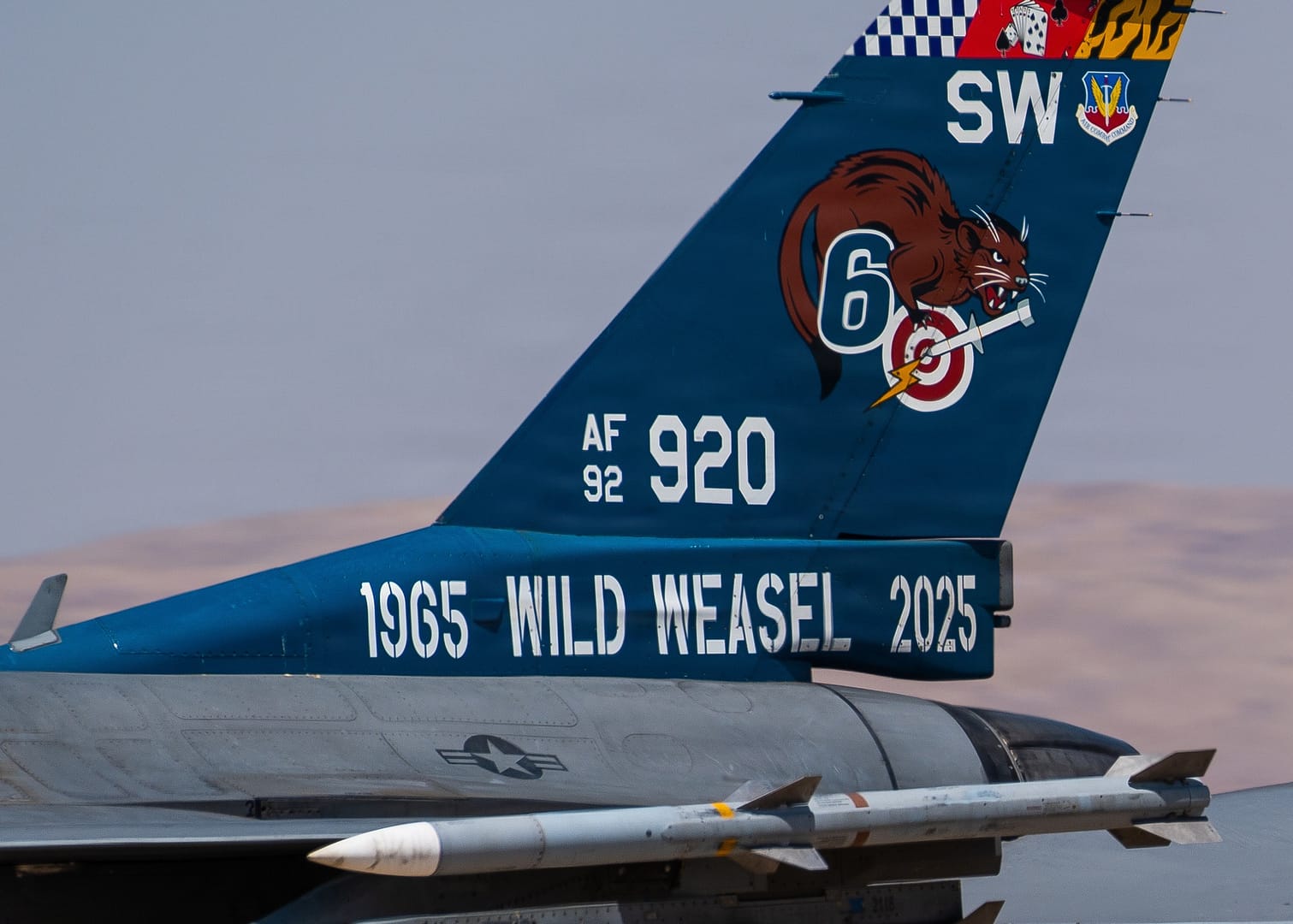
What is not in dispute is that Shaw-based Wild Weasel jets are in theatre. Frames released on 10 August clearly show the 20th Fighter Wing’s “1965 WILD WEASEL 2025” tail art, marking sixty years of the mission.
Why a Weasel Carries a Bomb That Cannot Home on Radar
Here is the part that makes the loadout interesting rather than merely full. The F-16CM is the Air Force’s dedicated suppression-of-enemy-air-defences aircraft. Its HTS pod detects, identifies and geolocates hostile radars, cueing the AGM-88 HARM, which flies down the radar beam.
The GBU-39/B does none of that. It cannot home on an emitter. What it can do is destroy the parts of an air defence complex that do not radiate: the control shelters, the generators, the communications relays, the hardened command posts. HARM makes a radar stop transmitting for a few minutes. An SDB through the command bunker makes it stop permanently.
That is the difference between suppression and destruction, and carrying both weapons on one jet means a single aircraft can do the whole job without waiting for a second wave.
The Crews Behind the Photographs
In May 2026, six airmen from Shaw received the Distinguished Flying Cross for Operation Midnight Hammer, the strike in which F-16s cleared a corridor through Iranian air defences for the B-2s that followed.
A twenty-year-old glide bomb on a forty-year-old airframe is not a headline. But the combination is why a single Viper over the Middle East in 2026 represents more delivered precision than a package of four aircraft did a generation ago. The rack did that.
Sources: U.S. Air Force GBU-39B fact sheet; DVIDS imagery, U.S. Air Forces Central, 7 and 10 August 2026; Air & Space Forces Magazine, 11 May 2026; Army Recognition, 16, 18 and 24 July–August 2026. Weapon-count identifications from released imagery are third-party visual analysis and are attributed as such.


0 Commenti