
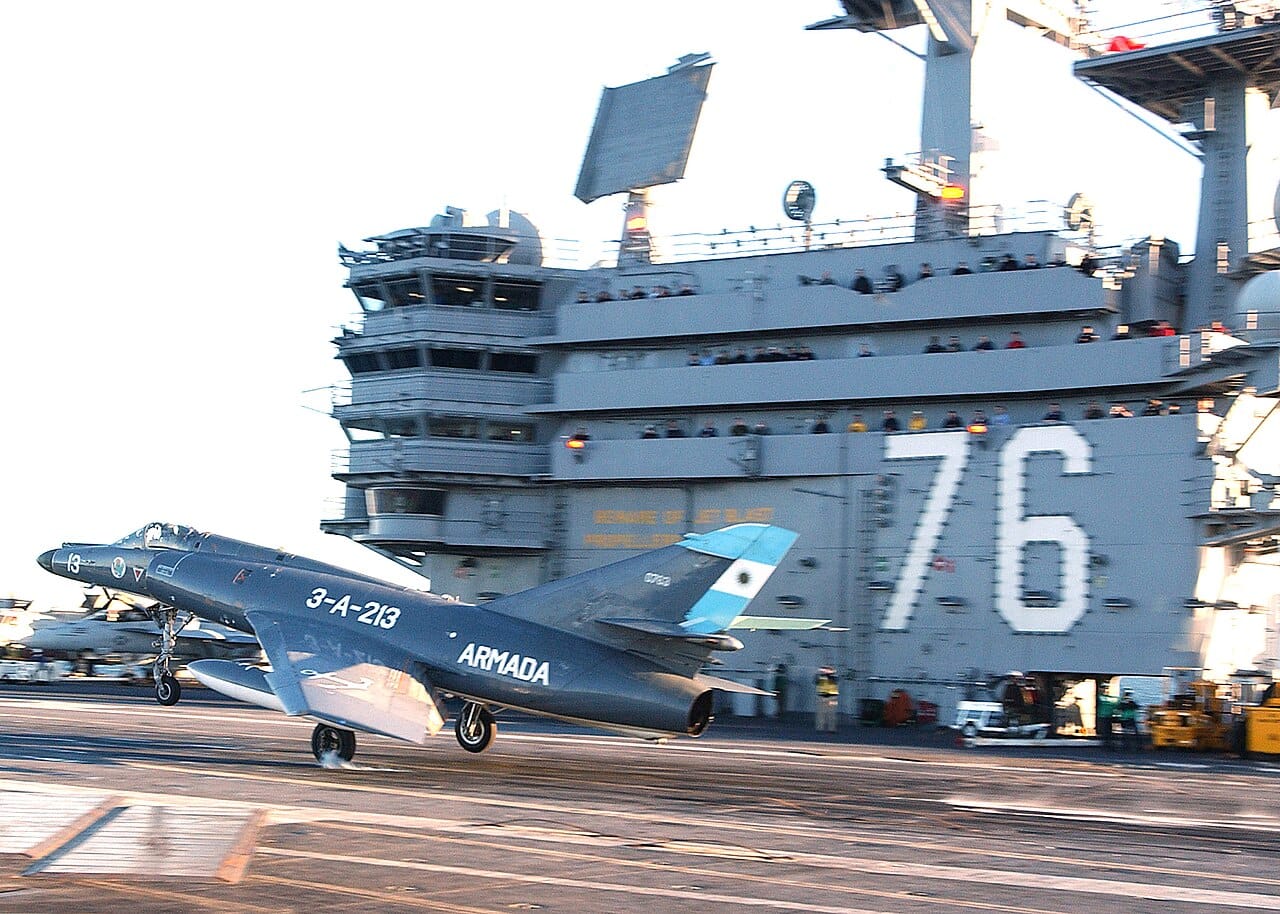
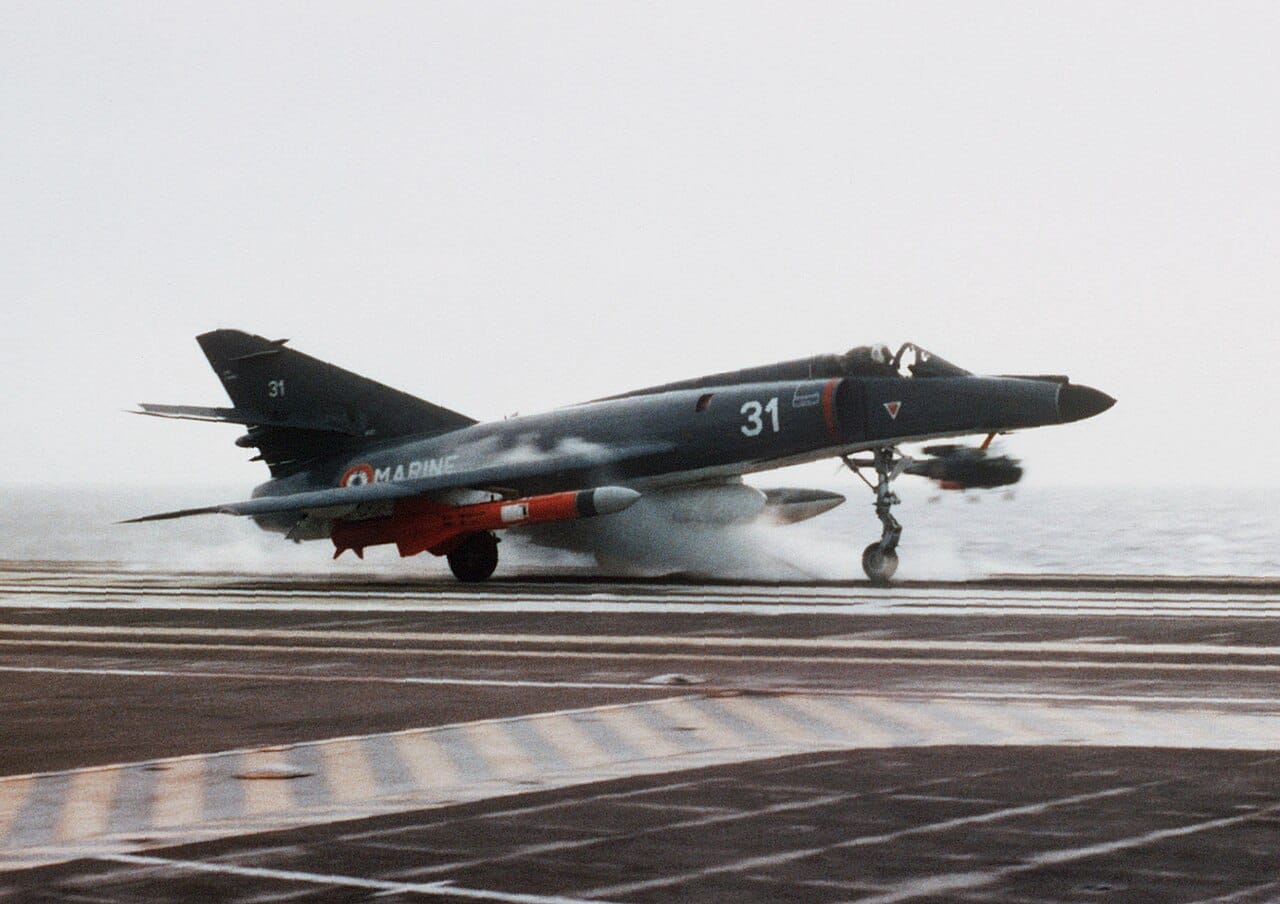
Argentina went to war in the Falklands in April 1982 with five air-launched Exocet missiles. Five. That was the entire stock — France had delivered the AM39 variant along with a handful of Super Étendard strike fighters just months before the conflict began, and the arms embargo imposed after the invasion meant no more were coming. Five missiles to take on the Royal Navy. Three of them hit ships. The other two missed or malfunctioned. And those three hits changed the way every navy on Earth thought about anti-ship warfare.
The First Shot: HMS Sheffield, May 4
The Type 42 destroyer HMS Sheffield was on radar picket duty, positioned ahead of the British carrier group to provide early warning of air attack. She never got the chance. Two Super Étendards of Argentina's 2nd Naval Fighter/Attack Squadron launched from Río Grande air base in Tierra del Fuego, refuelled from a KC-130 Hercules tanker, and descended to wave-top altitude for the attack run. Their targeting data came from a Neptune maritime patrol aircraft that had detected the British fleet on radar.
At roughly 20 nautical miles, the lead pilot popped up, acquired Sheffield on radar, and fired. The Exocet skimmed the waves at Mach 0.9 and struck the destroyer amidships on the starboard side, punching through the hull and igniting a fire fed by the ship's own fuel and electrical cabling. Whether the missile's warhead actually detonated remains debated — the damage was caused largely by unburned rocket propellant and the kinetic energy of a 660-kilogram missile hitting a lightly armoured warship at near-sonic speed. Twenty men died. Sheffield burned for five days and sank under tow on May 10.
 HMS Sheffield ablaze after an Exocet strike on May 4, 1982. She sank under tow six days later. Royal Navy photo.
The Second Strike: Atlantic Conveyor, May 25
Three weeks later, on Argentina's national day, two more Exocets were fired at the British carrier group. This time the frigates screening the carriers detected the incoming missiles and fired chaff — clouds of metallic strips designed to seduce radar-guided weapons away from their targets. It worked, partially. The Exocets lost lock on the warships. But the chaff deflected them toward a larger radar return behind the screen: the 15,000-ton container ship Atlantic Conveyor, requisitioned as a transport for helicopters, supplies, and engineering equipment.
Both missiles struck the merchantman. Twelve crew died, including her master, Captain Ian North. The material loss was devastating: three Chinook and six Wessex helicopters, runway matting for a forward operating base, tents, water purification equipment, and cluster bombs. The loss of the Chinooks alone forced the Royal Marines and Paras to march the 56 miles from San Carlos to Stanley on foot — the legendary "yomp" that defined the land campaign. One missile strike against a support ship changed the entire ground war.
The Third Hit: HMS Glamorgan, June 12
The final Exocet attack was the most improvised. Argentina had no air-launched missiles left. So naval engineers removed two MM38 ship-launched Exocets from the destroyer ARA Seguí, mounted them on a flatbed trailer, and rigged a makeshift launcher on the coast near Stanley. On the night of June 12, as the County-class destroyer HMS Glamorgan was providing naval gunfire support for the final British assault on the mountains above Stanley, the improvised battery fired.
Glamorgan detected the incoming missile and turned hard to present her stern — the narrowest possible profile. The Exocet struck the ship's helicopter hangar aft, destroying the Wessex helicopter inside and killing thirteen crew. But because the missile hit at an oblique angle and the ship was already turning away, the damage was contained. Glamorgan survived, fought through the rest of the war, and sailed home under her own power.
Five Missiles, Forever Changed
Argentina fired five Exocets. Three hit ships. Two ships sank. Thirteen men died on Glamorgan, twenty on Sheffield, twelve on Atlantic Conveyor. The total cost of five French-made missiles — each worth roughly $200,000 in 1982 dollars — was one destroyer, one container ship, nine helicopters, and forty-five lives. Against ships worth hundreds of millions.
The Falklands proved what theorists had warned about for a decade: that a single relatively cheap missile, launched from beyond visual range, could kill a modern warship. Every navy drew the same conclusion. Anti-ship missile defence — close-in weapons systems, electronic countermeasures, chaff, decoys — became the defining obsession of naval architecture for the next forty years. The Phalanx CIWS, the RAM missile, Aegis — all are, in some sense, answers to the question the Exocet asked in 1982.
The Super Étendard pilots who flew those missions became legends in Argentine naval aviation. The Royal Navy never forgot the lessons. And the Exocet — a French missile, sold to Argentina, fired at British ships, in a war France officially stayed neutral in — became the most famous anti-ship weapon of the twentieth century.
0 Commenti