
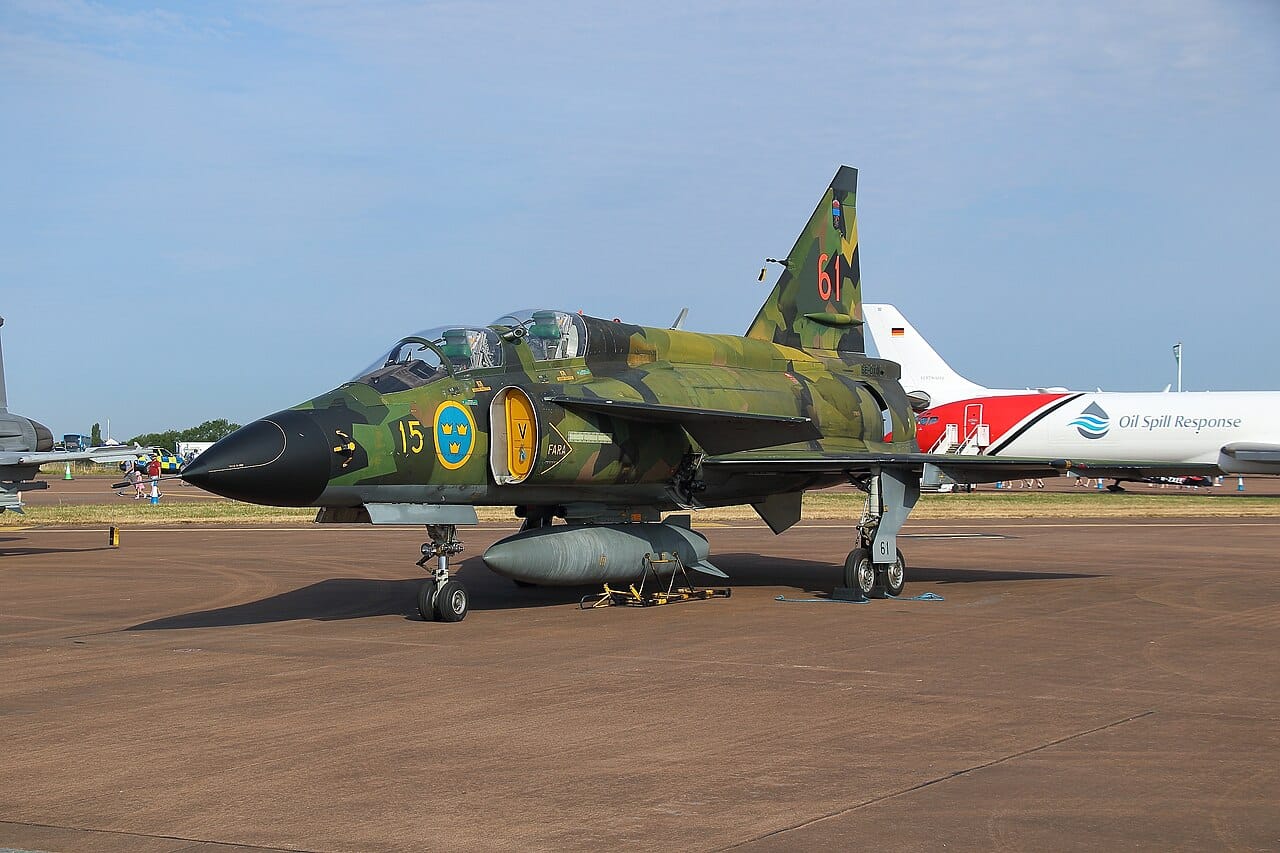
Sweden entered the Cold War with a problem no amount of money could simply solve. A neutral nation of modest size, sitting beside the Soviet Union, it knew that in any war its handful of big airbases would be cratered by missiles and bombs in the opening hours. The Swedish answer was not to build more airbases. It was to build a fighter that did not need them — one that could scatter to the country’s roads and fight from a stretch of highway. That aircraft was the Saab 37 Viggen.
To do it, Saab built one of the most advanced and idiosyncratic combat aircraft of its era: a canard delta that could land in 500 metres, stop like a car, and hide in the forest between sorties.
Quick Facts
| Aircraft | Saab 37 Viggen (“Thunderbolt”), Swedish Air Force |
| First flight | 1967; in service from 1971 |
| Design job | Operate from short, dispersed road bases under Sweden’s Bas 90 system |
| Firsts | The first canard-delta built in quantity, and one of the first fighters with a digital central computer |
| Party trick | A thrust reverser — the first on a production fighter — for very short landings |
| Engine | Volvo Flygmotor RM8 afterburning turbofan |
A Fighter for the Highways
Everything unusual about the Viggen traces back to the road. Sweden’s Bas 90 doctrine dispersed its air force across dozens of camouflaged wartime strips — ordinary stretches of motorway pre-surveyed and fitted so that fighters could operate from them, refuelled and re-armed by small conscript teams and melted back into the treeline. A fighter built for that had to take off and land in a few hundred metres, on a strip with no arrestor gear, and be rugged and simple enough to service in the open.
The Viggen’s close-coupled canard-delta layout was chosen precisely for that: the foreplanes gave it the low-speed lift and control to make a steep, no-flare carrier-style approach onto a short road strip while still cruising at Mach 2 when it needed to.
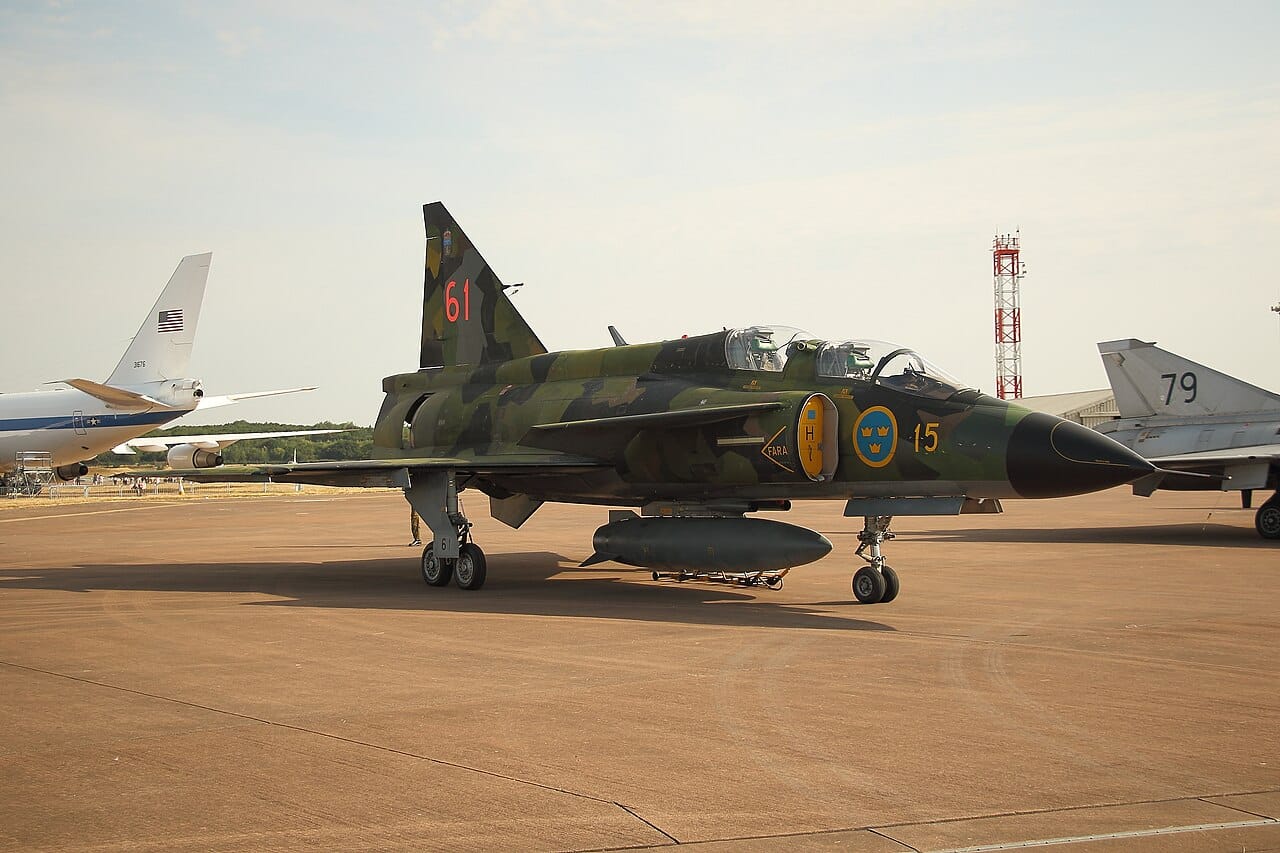
How Sweden engineered a supersonic fighter around the need to fight from the roads.
Reverse Gear
The most famous trick was the one no other fighter had. To stop in the shortest possible distance, the Viggen carried a thrust reverser — petals that folded into the exhaust and threw the engine’s blast forward. It was the first production fighter in the world to have one, and pilots quickly discovered it did more than shorten the landing roll.
On the ground it turned the aircraft into something between a jet and a stunt machine.
A Viggen demonstrates the thrust-reverser landing and short take-off that made road operations possible.
Ahead of Its Time
For all its short-field party tricks, the Viggen was genuinely cutting-edge. It was the first canard aircraft produced in numbers, and it carried one of the first airborne digital central computers built around integrated circuits — a system that automated navigation and attack tasks a generation before most rivals, and that Saab argued made it the most modern combat aircraft in Europe when it entered service. It came in a family of specialised versions: the AJ 37 attack jet, the JA 37 interceptor, dedicated reconnaissance variants, and a two-seat trainer.
It was fast and capable enough that, in one celebrated Cold War episode, Swedish Viggens intercepted and escorted a crippled American SR-71 Blackbird through hostile Baltic skies — a story worth telling on its own.
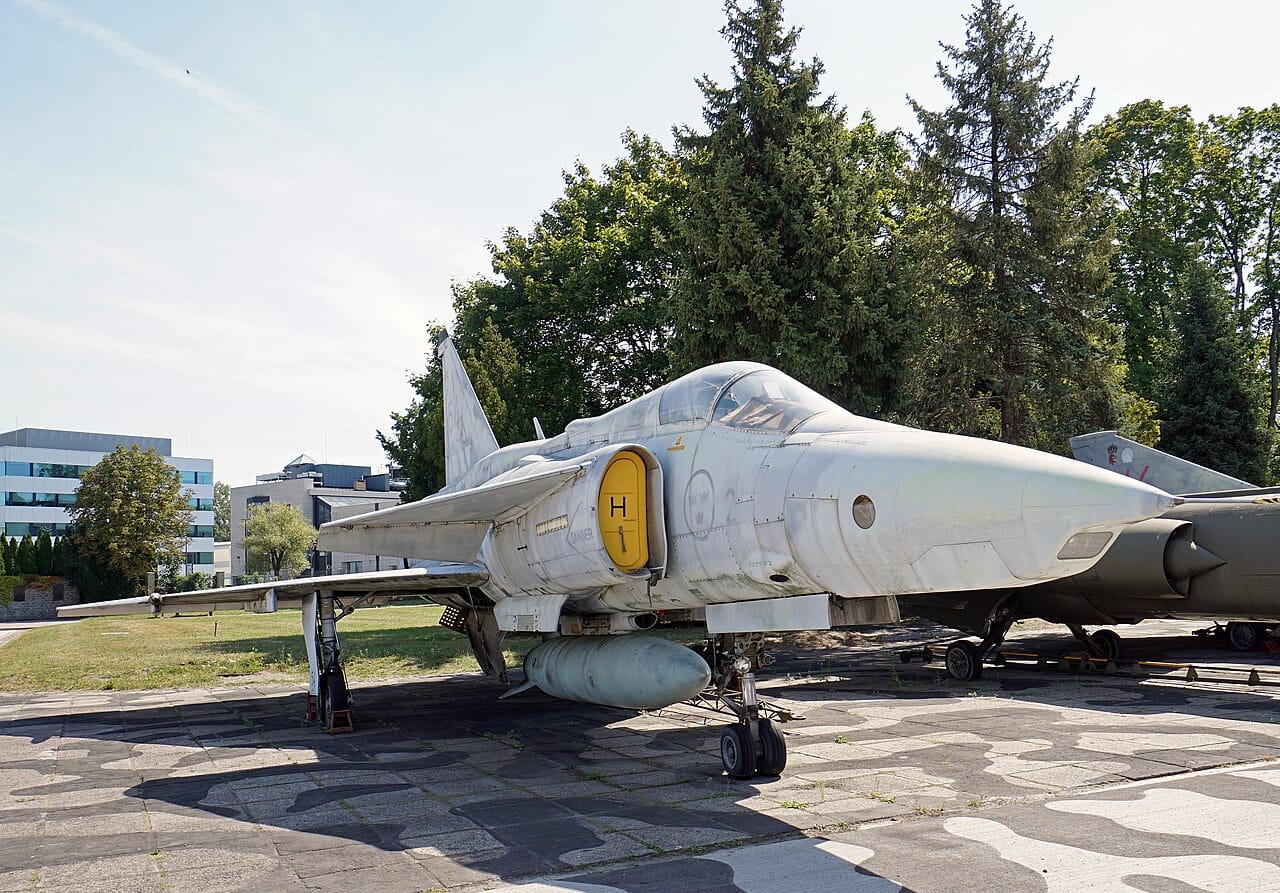
A profile of the Viggen’s attack role and its place in Swedish defence.
The Doctrine That Outlived the Jet
The Viggen bowed out in the 2000s, replaced by the smaller, cheaper Saab Gripen — which inherited its road-base DNA wholesale and can still operate from a highway with a handful of conscripts. For years that looked like a Swedish eccentricity. It does not any more. As long-range precision missiles make big, fixed airbases dangerously vulnerable, air forces from the Pacific to NATO are rediscovering exactly the idea the Viggen was built around half a century ago: that the best way to protect your aircraft is not to keep them in one place. Sweden’s odd, beautiful highway fighter turned out to be ahead of its time in more ways than one.
Sources: Saab; The Aviation Geek Club; FlightGlobal; Swedish Air Force history.
Related Questions
What was the Saab 37 Viggen?
The Saab 37 Viggen was a Swedish single-seat, canard-delta fighter that first flew in 1967 and entered service in 1971. Saab designed it to operate from short, dispersed road bases under Sweden's Bas 90 doctrine, landing in about 500 metres without arrestor gear. It was one of the first fighters with a digital central computer.
Why could the Saab Viggen take off and land on roads?
Sweden's Bas 90 doctrine dispersed its air force across camouflaged highway strips so its airbases could not be wiped out in a first strike. The Viggen was engineered around this: a close-coupled canard-delta gave the low-speed lift for a steep, no-flare, carrier-style approach onto a 500-metre road strip.
What was special about the Viggen thrust reverser?
The Viggen was the first production fighter in the world fitted with a thrust reverser — petals that folded into the exhaust and threw the engine's blast forward to shorten its landing roll. Pilots discovered it could even taxi the aircraft backwards on the ground, like a car.
What does the name Viggen mean?
Viggen translates roughly as Thunderbolt. It was the Swedish Air Force designation for the Saab 37, a canard-delta built in the 1960s to defend neutral Sweden from short, dispersed road bases rather than from a handful of vulnerable main airfields.
What engine powered the Saab Viggen?
The Viggen was powered by the Volvo Flygmotor RM8, an afterburning turbofan. It let the aircraft cruise at up to Mach 2 while remaining controllable enough for the short, steep, road-strip landings that Sweden's dispersed-basing concept demanded.
Why do some fighters have canards?
Canards are small foreplanes mounted ahead of the main wing that improve lift and control, especially at low speed and high angles of attack. The Viggen was the first canard-delta built in quantity. Here is why other fighters wear canards.
When did the Saab Viggen enter and leave service?
The Viggen first flew in 1967 and entered Swedish Air Force service from 1971, serving in fighter, attack and reconnaissance versions through the Cold War. Saab eventually replaced it with the multirole Gripen.
0 Commenti