
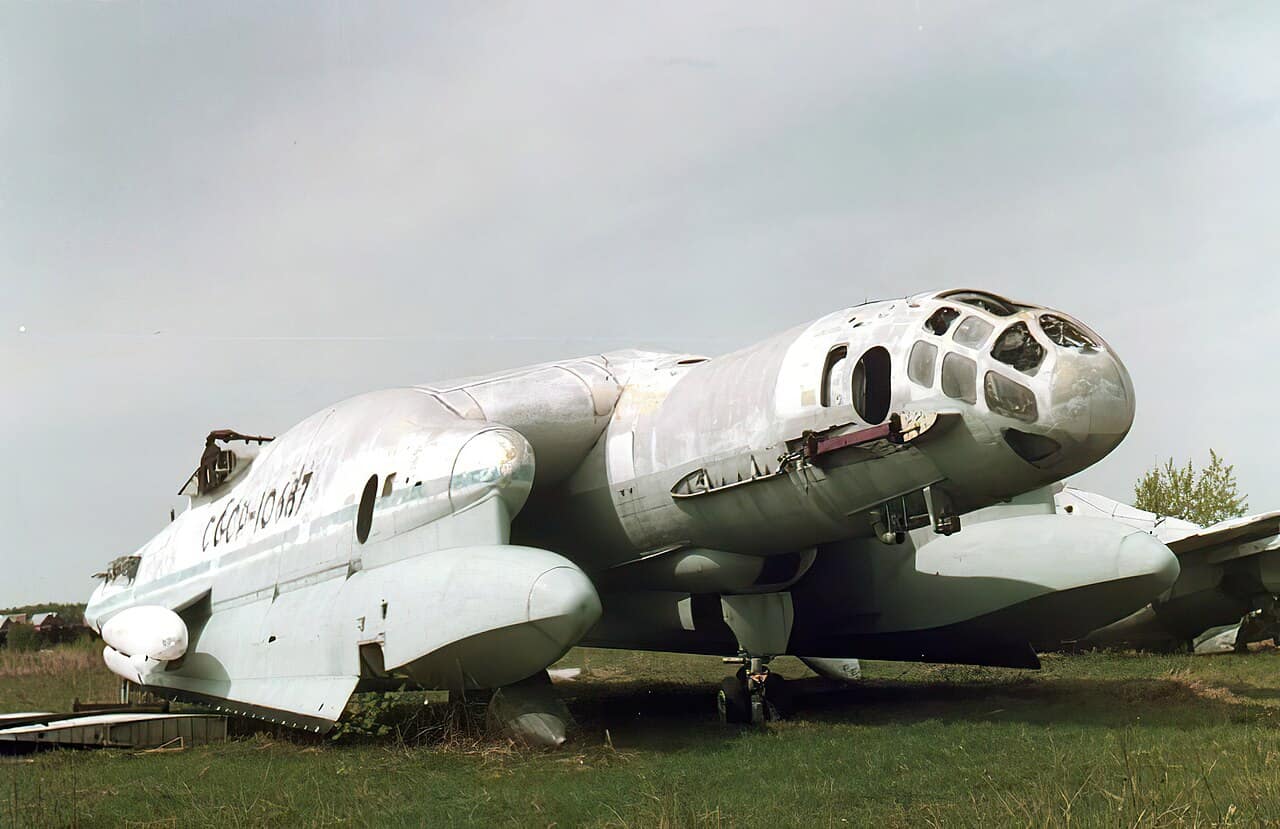
Some Cold War weapons were terrifying. A few were beautiful. And then there was the Bartini Beriev VVA-14 — a machine that looked like a flying saucer had mated with a submarine, and was built, in all seriousness, to stalk and kill American nuclear missile boats. It skimmed the waves, promised to leap vertically off the sea, and today lies wingless and rusting in a field outside Moscow.
It is one of the strangest aircraft the twentieth century ever produced, and the mind behind it was every bit as unusual as the machine. Its designer, Robert Bartini, was an Italian aristocrat turned Soviet aviation visionary whom colleagues half-jokingly called an alien. The VVA-14 was his masterpiece of odd engineering — a plane that was supposed to do everything at once, and ended up doing almost none of it.
This is the story of the Soviet Union’s three-headed dragon: what it was meant to be, why it never got there, and how one battered survivor ended up as scrap metal in the world’s largest collection of Soviet aircraft.
• What it was: Bartini Beriev VVA-14 — a vertical take-off amphibious aircraft
• Designer: Robert Bartini, with the Beriev Design Bureau
• Mission: hunt and destroy US Navy Polaris missile submarines
• First flight: 4 September 1972, from a conventional runway
• Built: 2 prototypes — only one ever flew
• Power: 2 cruise engines + 12 vertical-lift engines = 14 (the lift engines were never fitted)
• Flights: 107 flights, ~103 hours total
• Fate: retired 1987; sole survivor sits dismantled and wingless at Monino
A Sub-Hunter Born From Cold War Panic
The VVA-14 was an answer to a very specific nightmare. In 1961 the United States began arming its submarine fleet with Polaris ballistic missiles — a nuclear deterrent that could lurk unseen anywhere in the world’s oceans. The Soviet Union needed something that could find those boats and kill them, fast, over huge stretches of open sea.
Enter Robert Bartini. Conceived in the 1960s and developed into hardware in the early 1970s, his amphibious machine was designed to take off from anywhere without a runway, cruise long distances at altitude, and — crucially — skim just above the water using aerodynamic ground effect to sneak up on its prey. In collaboration with the Beriev Design Bureau, famous for its flying boats, Bartini planned the aircraft in escalating phases, culminating in a fully armed sub-hunter with a magnetic anomaly detector.
Fourteen Engines and a Trick Called Ground Effect
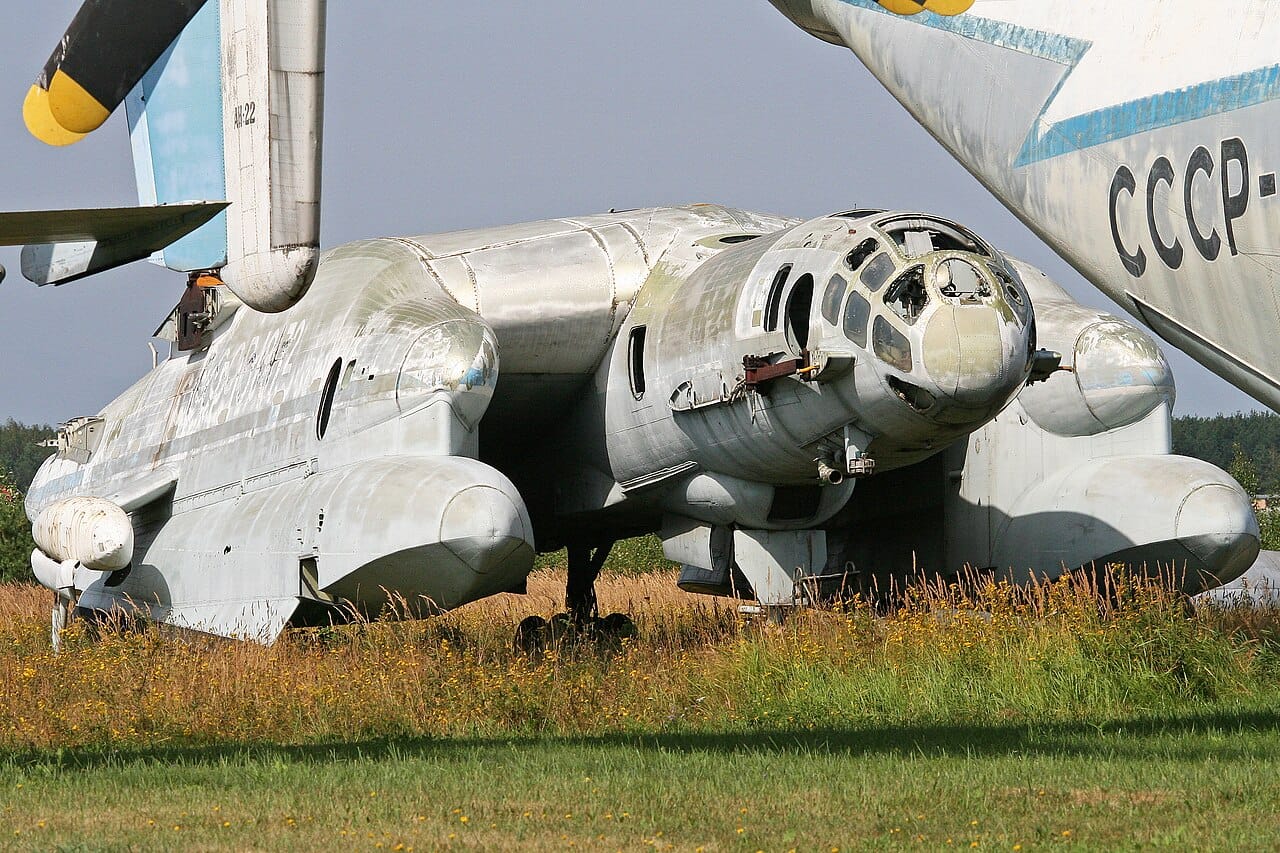
The name tells you almost everything. “VVA” stands for vertical take-off amphibious aircraft, and the 14 was the number of engines: two large turbofans for normal cruising flight, plus a battery of twelve smaller lift engines meant to punch the whole machine straight up off the water. The central fuselage looked like a submarine that had grown stubby wings, flanked by two long pontoon-like hulls.
Its party trick was ground effect: the cushion of high-pressure air trapped between a wing and a surface just below it. Flying a few metres above the waves, the VVA-14 could travel fast and low, hard to spot on radar, before climbing away to conventional altitude when it needed to. To keep the whole programme secret, engineers even painted the prototype in civilian Aeroflot colours so it would not be mistaken for a military machine.
Mustard tells the full story of the Soviet Union’s VVA-14, one of the strangest aircraft ever built.
The first prototype was completed in 1972 and made its maiden flight from a runway on 4 September that year. In 1974 inflatable pontoons were bolted on for water trials — a system that caused endless trouble — and flotation and taxi tests led to the first flights of the amphibious version in June 1975.
The Vertical Takeoff That Never Came
Here is where the dream ran into physics and Soviet supply chains. The whole VTOL concept depended on that cluster of twelve RD-36-35PR lift engines. The bureau responsible for supplying them never delivered, which made vertical-takeoff testing flatly impossible. The machine that was supposed to spring off the sea like a startled bird never once left the ground vertically.
As the aviation historian Andrii Sovenko later explained, the flying prototype was a stripped-down testbed — it carried neither lift engines nor any submarine-hunting equipment, and existed only to study horizontal flight and test the aircraft’s systems. From 1972 to 1975 it logged 107 flights and just over 103 hours — respectable for an experimental oddity, but a long way from an operational sub-hunter.
Then the project lost its heart. Robert Bartini died in 1974, and the programme died with him. Only two of the planned prototypes were ever built, and the second — the one meant to receive the lift engines — was eventually dismantled because a suitable engine was never developed.
Not the Caspian Sea Monster
The VVA-14 is often lumped in with the Soviet Union’s more famous wave-skimmer, the enormous KM — the “Caspian Sea Monster” — but they are different beasts. The Caspian Sea Monster was a pure ekranoplan, a ground-effect ship that could only fly in the cushion of air near a surface. The VVA-14, by contrast, was meant to be a true aircraft that could also take off vertically, float like a boat, and climb to altitude like an ordinary plane. Ground effect was just one item on its impossibly long wish list.
Ironically, after Bartini’s death the surviving airframe was reworked toward ground-effect flying in a variant known as the 14M1P, with rigid pontoons and a lengthened fuselage. Those tests fed into the wider Soviet ekranoplan effort — so the VVA-14 left a fingerprint on the very family of aircraft it is so often confused with.
A Dragon Rusting in a Field
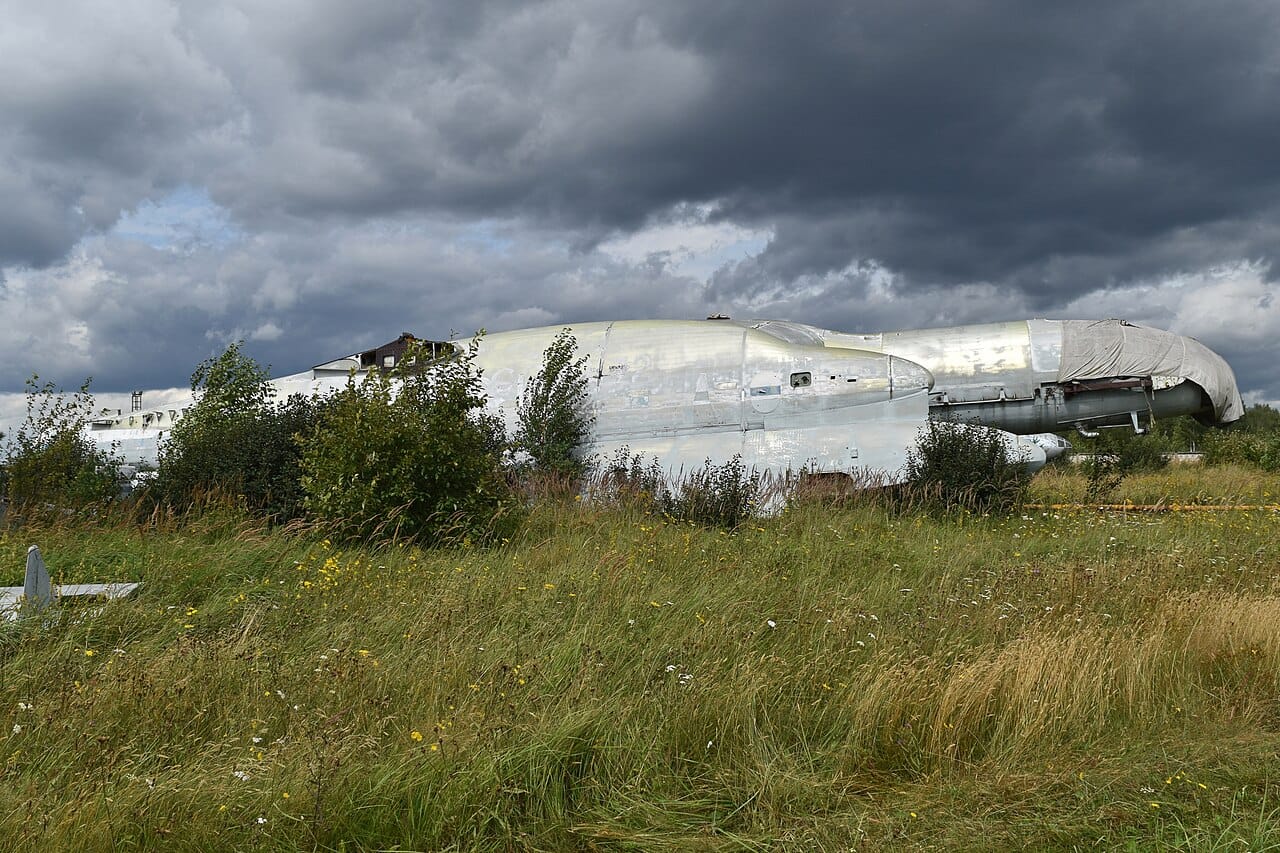
The single surviving VVA-14 has had a miserable retirement. In 1987 it was shipped from Taganrog toward the Central Air Force Museum near Moscow. Something went badly wrong in transit: unloaded and left unattended, it was looted and damaged, and it has never been repaired. Today it sits in the open air at Monino, conspicuously missing its wings — fragments of them lying in the grass beside it. It still wears its old Soviet registration and faded Aeroflot markings.
Museum staff have put the cost of restoring it at well over a million dollars, money that has never materialised. So the machine that was meant to hover over the Atlantic and hunt nuclear submarines instead squats quietly in a Russian field, slowly returning to scrap — a monument to one of the boldest, weirdest ideas the Cold War ever dared to build.
And yet there is something magnificent about it. The VVA-14 tried to be a boat, a plane, a helicopter and a submarine hunter all at once. It failed at nearly all of them. But as a piece of pure imagination cast in aluminium, it remains unmatched — proof that the strangest engineering is sometimes the most human.
Sources: Wikipedia (Bartini Beriev VVA-14); Jacopo Prisco, CNN Travel, 26 January 2021; Simple Flying, 24 September 2023.
Related Questions
What was the Bartini Beriev VVA-14?
The Bartini Beriev VVA-14 was a Soviet vertical-take-off amphibious aircraft designed to hunt and destroy US Navy Polaris missile submarines. Conceived by Robert Bartini with the Beriev Design Bureau, it looked like a cross between a flying saucer and a seaplane. Only two prototypes were built, and just one ever flew.
Who designed the VVA-14?
The VVA-14 was designed by Robert Bartini, an Italian aristocrat who became a Soviet aviation visionary and whom colleagues half-jokingly called "an alien." Working with the Beriev Design Bureau, he intended the machine to take off vertically from the sea and skim the waves — a plane meant to do everything at once.
What was the VVA-14 designed to do?
The VVA-14 was built to find and sink US Navy submarines armed with Polaris ballistic missiles. From 1961 those submarines gave America a nuclear deterrent that could lurk unseen in the world's oceans, and the Soviet Union needed something able to cover huge stretches of open sea quickly to hunt them down.
Did the VVA-14 ever fly?
Yes. The VVA-14 made its first flight on 4 September 1972, taking off from a conventional runway. Over its career the sole flying prototype logged 107 flights totalling around 103 hours. However, its 12 vertical-lift engines were never fitted, so the vertical-take-off capability at the heart of its design was never realised.
Why is it called the VVA-14?
The "14" reflects the aircraft's planned 14 engines — two cruise engines plus twelve dedicated vertical-lift engines. In practice the lift engines were never installed, leaving the amphibious machine unable to perform the vertical take-off from water that had justified its extraordinary configuration.
What happened to the VVA-14?
The VVA-14 was retired in 1987, and its sole surviving airframe now sits dismantled and wingless at the Central Air Force Museum in Monino, near Moscow. Once envisioned as a wave-skimming submarine hunter, it ended up as one of aviation's strangest relics — a Cold War idea that never quite arrived.
0 Commenti