
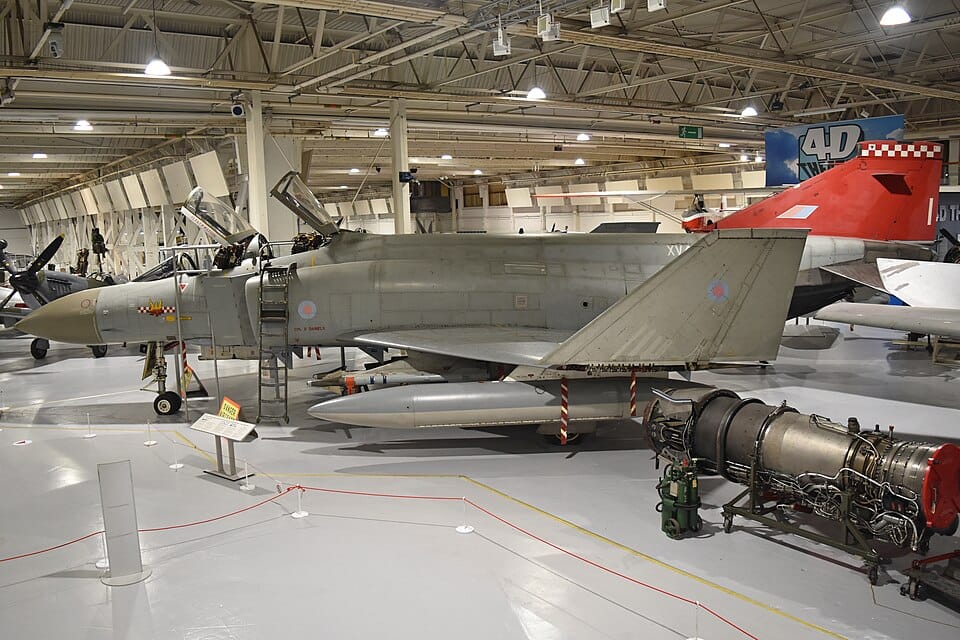
The standard British Quick Reaction Alert intercept, in the Cold War era, went something like this. NATO radar would call out an unidentified contact entering the United Kingdom Air Defence Region. Two RAF Phantom FGR.2s, held at ten minutes’ readiness around the clock, would be scrambled. They would close on the contact, identify it visually, photograph it, and shadow it until it left British airspace. The contact would almost always be a Soviet Tu-95 Bear bomber. Both sides would log the encounter in their respective files. Everybody went home.
Once in a while, however, the contact wasn't what it seemed.
One former RAF Phantom pilot has recounted, decades after the event, an interception of a four-engined airliner with Aeroflot markings — an Ilyushin Il-62 — that turned out to be something rather different. The civil-aviation paint job was, as the crew would discover at close range, a cover.
Informazioni rapide
Aircraft (RAF): McDonnell Douglas Phantom FGR.2
Aircraft (Soviet): Ilyushin Il-62 (NATO: Classic)
RAF squadrons (QRA Phantom): 43 Sqn, 111 Sqn (Leuchars); 23 Sqn, 56 Sqn (Wattisham)
QRA readiness: Crews held at ten minutes’ readiness, day and night
Typical Cold War intercept: Tu-95 Bear, several per month
This one: An Il-62 in Aeroflot livery, doing something it shouldn't
Why airliners flew where airliners shouldn't
The Soviet Union, like every other major power during the Cold War, used its national airline as a cover for intelligence collection. Aeroflot's flag-carrier flights to Western capitals were, on paper, civilian operations. In practice, a meaningful fraction of them carried KGB and GRU officers, deviated subtly from filed flight plans to overfly things they shouldn't, and occasionally flew aircraft that were, structurally, far more than the brochure suggested.
The Il-62 was a long-range four-engined airliner — the Soviet rough equivalent of the Boeing 707 or the VC10 — and it was the workhorse of Aeroflot's intercontinental fleet. By the standards of the day it was a perfectly civilised passenger aircraft. It also had, in certain examples, internal volume and electrical capacity that could be used for things other than carrying tourists. Some Il-62s were configured with reconnaissance equipment, signals-intelligence gear, and modified communication systems that civilian airliners did not need.

The intercept
The story, as it has been told, goes like this. A Phantom crew was already airborne — on combat air patrol east of the Shetland Islands during a naval exercise — when ground radar vectored them onto a contact that was off-track and not answering air traffic control. The Phantom closed on the contact at around 35,000 feet.
The pilot, on visual identification, found himself looking at an Aeroflot Il-62 in fully civilian livery. That was unusual but not unprecedented. Aeroflot did fly Il-62s to and from London Heathrow and other Western hubs. The catch, in this case, was that the aircraft was flying a heading and an altitude profile that did not match any filed civilian flight plan. It was, in plain terms, where it shouldn't have been — and heading straight for the ships taking part in the naval exercise.
The Phantom pilot did what he was trained to do. He took up station alongside and called in the contact — and then, as he has recounted it, a large panel on the Il-62's belly slid open to reveal camera lenses, pointed at the warships below. The Phantom crew tucked in a few dozen feet beneath the jet to block the cameras' view, and stayed there. The Phantom shadowed it until the airliner exited UK airspace heading east, presumably home to the Soviet Union, and broke off the intercept.

Why the Aeroflot livery mattered
The reason this kind of mission existed was a quirk of Cold War rules of engagement. Western air-defence pilots could legally engage a clearly military Soviet aircraft that violated their airspace. They could not, without enormous political risk, shoot down an aircraft in civilian markings carrying paying passengers. The Aeroflot livery was, in effect, a passive defence against missiles. As long as the Il-62 looked like an airliner from the cockpit of a Phantom, it was safe.
The Soviets exploited this. So, for that matter, did Western intelligence — Cold War U.S. and British signals-intelligence aircraft sometimes carried civilian-airline-style markings for the same reason. The blurred line between civilian and military aviation in the late twentieth century had less to do with civilian airline expansion and more to do with both sides wanting plausible deniability when their reconnaissance aircraft got too close to someone else's airspace.
An education in the cockpit
The pilot who tells the story has said that the lesson of the intercept stayed with him for the rest of his career. The contact you intercept is not always the contact you expect. The radio call says "unidentified". The visual identification, when you finally pull alongside, sometimes reveals an airliner. Sometimes the airliner is exactly what it claims to be. Sometimes it is not.
Either way, you take the photographs. You stay calm. You log the encounter. And you let the analysts, somewhere in a windowless room, work out what the Soviets were really up to.
For the RAF Phantom community, the Cold War was thousands of routine intercepts and a handful of stories like this one. The Il-62 in Aeroflot paint, flying a route no airline ever filed, is one of them.
Sources: The Aviation Geek Club, RAF Historical Society, Royal Air Force Museum oral history archive.
Domande correlate
What is Quick Reaction Alert?
Quick Reaction Alert (QRA) is a standing air-defence posture in which armed fighters are kept ready to scramble at short notice to intercept unidentified aircraft. During the Cold War, RAF crews sat at ten minutes' readiness day and night, ready to launch Phantom fighters to identify, photograph and shadow intruders near British airspace.
What was the RAF Phantom FGR.2?
The McDonnell Douglas Phantom FGR.2 was a British version of the F-4 Phantom used by the RAF as an interceptor and strike aircraft. Squadrons including 43 and 111 at Leuchars and 23 and 56 at Wattisham flew it on Quick Reaction Alert, intercepting Soviet aircraft probing UK airspace throughout the Cold War.
Did the Soviet Union use airliners for spying?
Yes. Like other major powers, the Soviet Union used its national airline, Aeroflot, as a cover for intelligence collection. Some flights carried KGB or GRU officers, deviated from filed flight plans to overfly sensitive sites, and a handful of aircraft were fitted with reconnaissance and signals-intelligence equipment that ordinary airliners did not need.
What was the Ilyushin Il-62?
The Ilyushin Il-62 (NATO reporting name "Classic") was a long-range, four-engined Soviet jet airliner, roughly the equivalent of the Boeing 707. Most were ordinary passenger aircraft, but some examples were modified with signals-intelligence gear and flew routes that took them unusually close to NATO airspace.
What did RAF fighters usually intercept during the Cold War?
The most common intruder was the Soviet Tu-95 "Bear," a large four-engined turboprop bomber that probed the UK Air Defence Region several times a month. Catching such bombers was the job envisioned for Cold War interceptors like Canada's cancelled Avro Arrow; RAF crews would identify, photograph and shadow the Bear until it left.
What is a NATO reporting name?
A NATO reporting name is a codename NATO assigned to Soviet and other aircraft whose official designations were often unknown in the West. Bombers received names starting with "B" (such as "Bear" for the Tu-95), and the Il-62 airliner was called "Classic." The system gave a clear, pronounceable label for each type.
Where did RAF Phantoms intercept Soviet aircraft?
Interceptions typically happened over the seas around the UK, including north of Scotland near the Shetland Islands, where Soviet aircraft entered the UK Air Defence Region. In the recounted Il-62 incident, a Phantom on patrol east of the Shetlands was vectored onto an off-track contact at around 35,000 feet.
Post correlati
Ferret Missions: The Cold War Spy Flights Nobody Was Supposed to Know About
NATO Scrambles Six Nations Against Russian Bombers Over Baltic
F-16 decollano in fretta dall'Alaska ghiacciata dopo le sonde russe
0 Commenti