
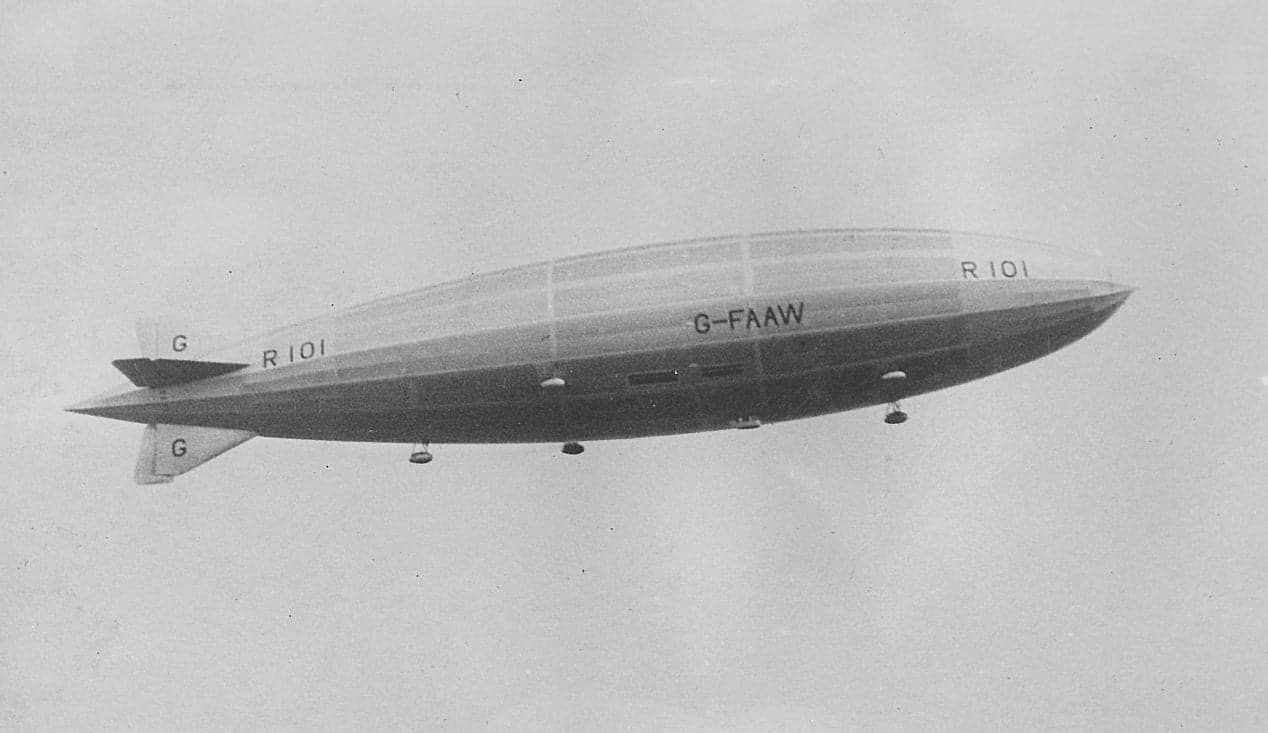
On the evening of 4 October 1930, the largest flying object the world had ever built slipped its mooring mast at Cardington and turned south for India. The R101 was 777 feet long, more than seven storeys tall, and carried a government minister who had staked his career on proving that Britain could bind its empire together with airships. Seven hours later she was a field of burning wreckage on a hillside in northern France, and 48 of the 54 people aboard were dead.
The R101 killed more people than the Hindenburg would seven years later. It ended Britain’s airship programme in a single night. And unlike most disasters, this one had been predicted — loudly, repeatedly, and in writing — by the engineers who watched it being rushed into the sky.
Quick Facts: The R101
- Lunghezza: 777 ft (237 m) — the largest flying craft in the world at the time
- Lifting gas: Hydrogen (highly flammable)
- Maiden overseas flight: Departed Cardington, England, evening of 4 October 1930, bound for Karachi, India
- Crash: ~2:00 a.m., 5 October 1930, into a low ridge near Beauvais, France
- Death toll: 48 of 54 aboard, including Air Minister Lord Thomson
- Eredità: Britain abandoned rigid-airship development; the rival R100 was scrapped
A ship built by politics, not physics
The R101 was the government half of a strange experiment. In the 1920s Britain funded two competing airships to decide how best to build them: the privately designed R100, built by a Vickers team that included a young stress engineer named Nevil Shute Norway, and the state-designed R101, built by the Air Ministry’s own Royal Airship Works at Cardington. The R100 was nicknamed the “capitalist ship,” the R101 the “socialist ship,” and the rivalry between the two teams was openly hostile.
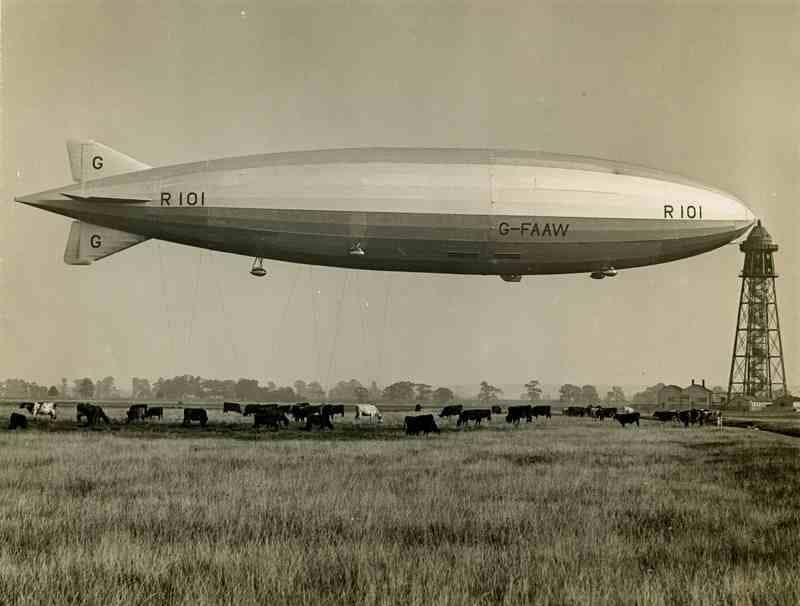
The R101 emerged from its shed far heavier than planned, with diesel engines that were roughly twice as heavy and half as powerful as intended. Its innovative gasbag harness was let out to squeeze in more lifting gas, which allowed the bags to chafe against the frame and leak. To buy lift, the entire ship was later cut in half and a new bay inserted. Yet the pressure to fly to India — in time for an Imperial Conference, and to satisfy the ambitions of Air Minister Lord Christopher Thomson — never eased.
BFI newsreel: the R101, “Britain’s Million-Pound Monster,” over London in 1929, the year before the disaster.
“As safe as a house”
Lord Thomson was the disaster’s driving force and, ultimately, one of its victims. He had championed the airship scheme, insisted on the India flight, and even loaded the ship with crates of silverware, china and a rolled carpet for a ceremonial reception. Publicly, he radiated confidence about the ship’s safety right up to departure.
“She is as safe as a house — except for the millionth chance.”
Lord Christopher Thomson — Secretary of State for Air, 1930
The engineers were far less sure. Nevil Shute, who had watched the R100 pass every independent design check, was appalled by how little of that scrutiny the R101 received. In his memoir Slide Rule he set down a verdict on the whole enterprise that has never been bettered.
“Under this ménage practically every principle of safety in the air was abandoned, perhaps unconsciously.”
Nevil Shute Norway — R100 stress engineer, author of “Slide Rule”
Seven hours to Beauvais
The R101 had never been flown at full speed, on all engines, or in bad weather. On the night of 4 October she was sent into a known storm. She struggled to hold altitude over England and the Channel, wallowing low over the French coast. Near the town of Beauvais, in wind and rain, the deteriorating fabric at the nose gave way, gasbags tore, and the great ship settled almost gently into a low ridge. The impact was survivable. The hydrogen was not — within minutes the wreck was an inferno.
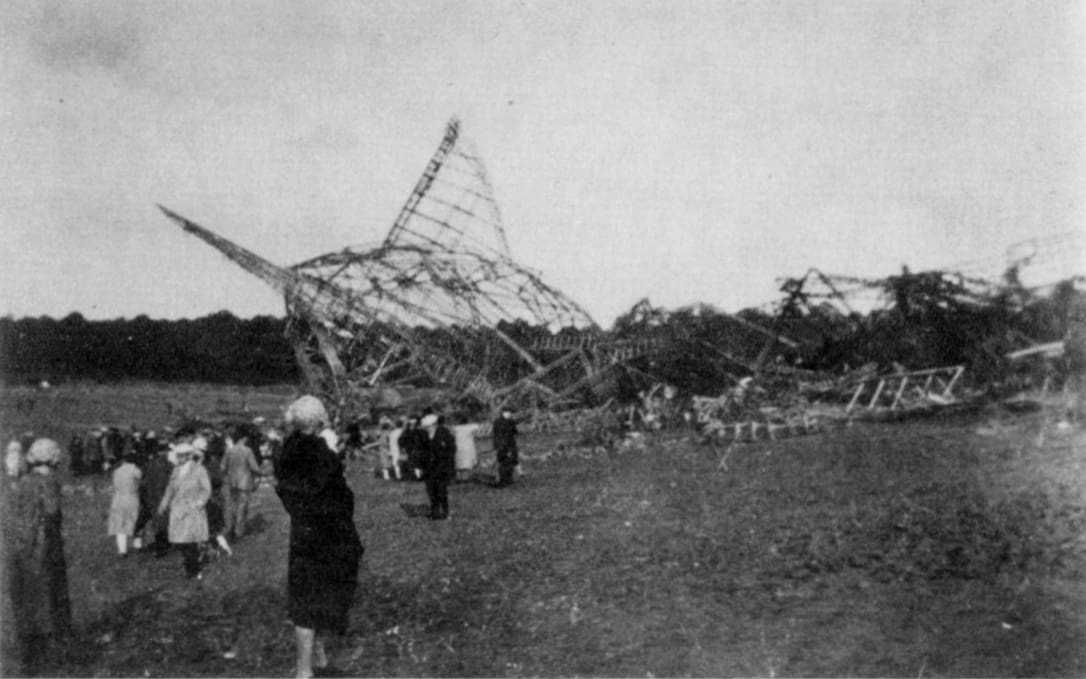
Six men survived, all crew. Among the dead were Lord Thomson, the airship’s designers, senior Air Ministry officials, and most of the crew. The bodies were returned to England and buried in a mass grave at Cardington, near the shed where the ship had been built.
Huntley Film Archives footage of the R101 and the aftermath of the 1930 crash.
The end of the airship dream
The public inquiry that followed criticised the rush to fly and the ship’s unresolved defects. The reaction was swift and final: the R100 — the ship that had actually crossed the Atlantic and back without incident — was deflated, broken up and sold for scrap. Britain never built another rigid airship. The future of the passenger airship passed to Germany, at least until the Hindenburg burned at Lakehurst in 1937 and closed the era for good.
The R101 is remembered less as a technical failure than as a political one: a sound experimental idea pushed past its limits by deadlines, ego and national pride, against the explicit warnings of the people who understood it best.
A concise modern retelling of the R101 story from the Fascinating Horror channel.
Sources: Nevil Shute Norway, Slide Rule (1954); Dan Grossman, Airships.net; the R101 Court of Inquiry (1931); contemporary press accounts. This article touches on a fatal disaster; it is presented as aviation history.


0 Commenti