
You have almost certainly seen this crash, even if you have never heard of the aircraft. A stubby, wingless machine tumbles end over end across a desert lakebed, throwing up a cloud of dust, and comes to rest upside down. For millions of people, that few seconds of film was the opening of a 1970s television show. For NASA, it was a very real accident that a very real test pilot barely survived.
The aircraft was the Northrop M2-F2, one of the strangest research craft ever flown — a plane with no wings at all. And the story behind that famous footage is far more remarkable than the fiction it inspired.
Quick Facts
- Aircraft: Northrop M2-F2, a wingless “lifting body” research craft
- Operator: NASA and the U.S. Air Force, flown from Edwards, California
- Purpose: prove a wingless craft could glide home from space — a step toward the Space Shuttle
- How it flew: air-launched from a B-52 at 45,000 feet; it was a glider, with one chance to land
- The crash: 10 May 1967, pilot Bruce Peterson; it rolled six times across a dry lakebed
- The pilot: survived, lost his right eye — and returned to test flying
- The fame: the crash footage opened the 1970s TV series The Six Million Dollar Man
A plane with no wings
In the 1960s, NASA faced a hard question: how do you bring a spacecraft home from orbit and land it gently on a runway? Wings would help it glide — but wings also create drag, and at the blistering speeds of atmospheric reentry, drag means heat, enough to burn a wing clean off. The radical answer was to get rid of the wings entirely.
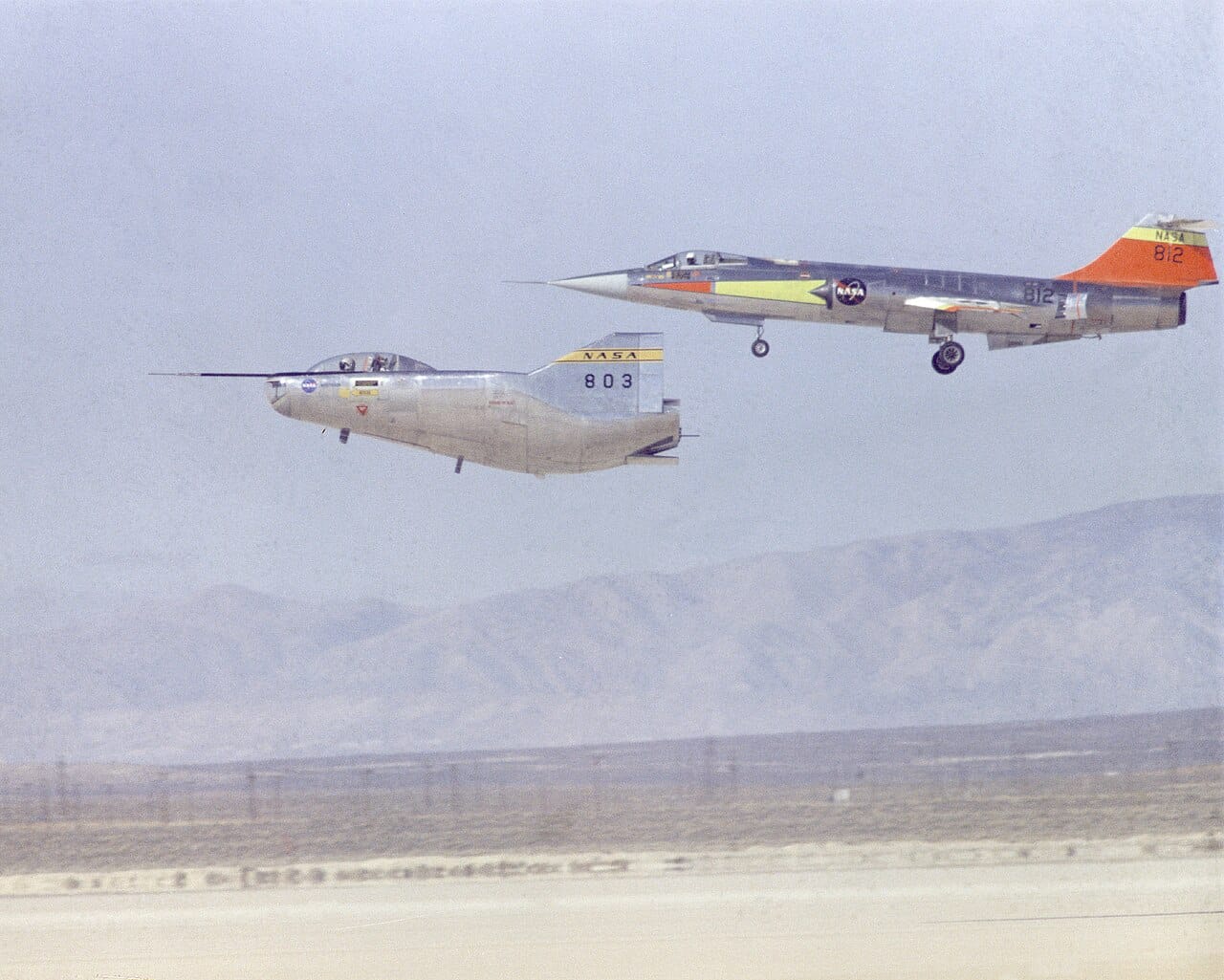
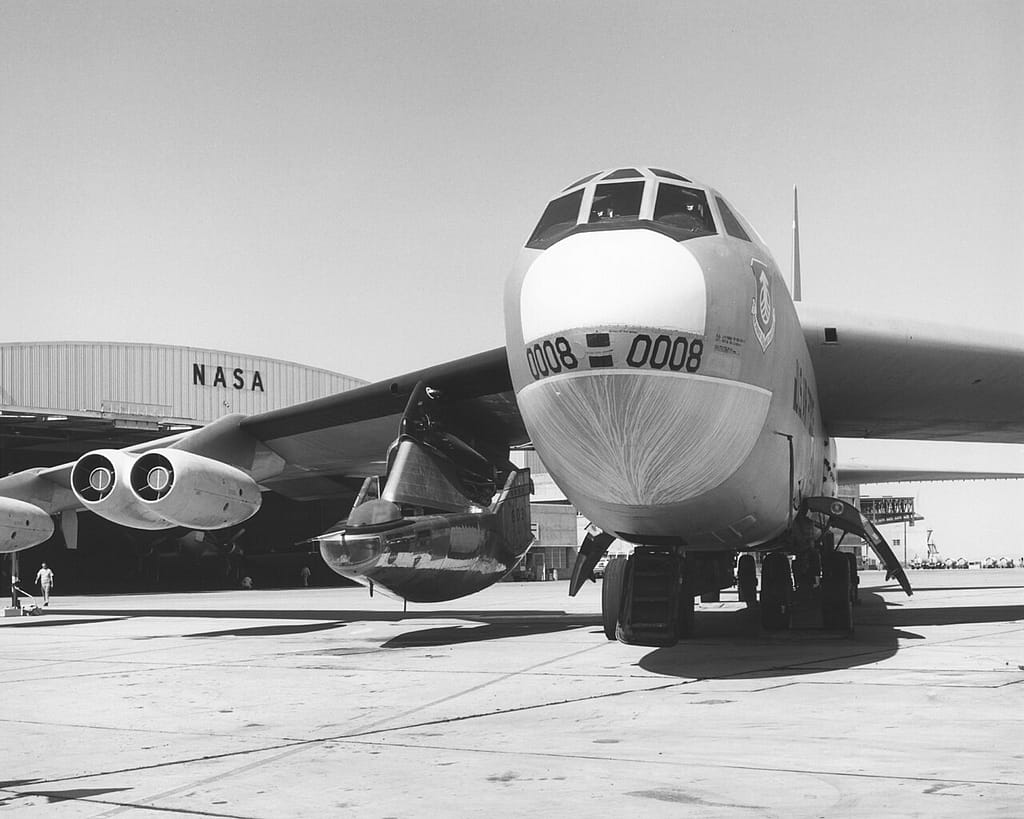
A “lifting body” generates its small amount of lift from the shape of its fuselage itself — a half-cone modelled on the blunt reentry capsules of Mercury, Gemini and Apollo. The M2-F2 was exactly that: a wingless, blunt-nosed wedge with fins, air-launched from beneath the wing of a B-52 at 45,000 feet. It was, in the end, a glider — and a brutal one. It plunged at around 15,000 feet per minute, and the pilot got precisely one attempt at landing. There was no going around.
NASA’s wingless lifting bodies — the M2-F2, HL-10 and M2-F3 — in flight over the California desert.
The flight that went wrong
The M2-F2 had a known vice: a violent side-to-side rolling oscillation that appeared when the nose was lowered. Milt Thompson had met it first and managed it; an Air Force pilot, Jerauld Gentry, had met it next and nearly died. On 10 May 1967, Bruce Peterson’s job was to fly straight into that danger zone and study it.
A crosswind pushed him off line right after launch. As he pushed the nose over on final approach, the oscillation returned with a fury.
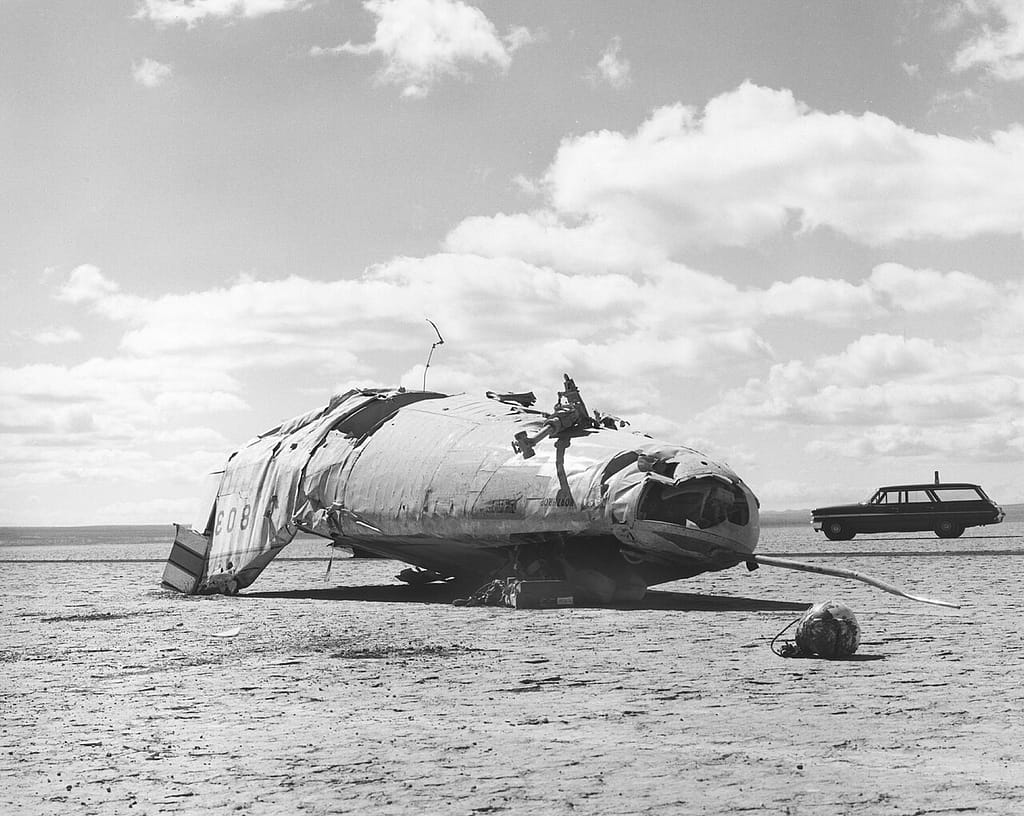
Peterson wrestled it back under control, but he had drifted away from the marked landing zone onto a featureless expanse of white salt with no visual cues for height. Then a rescue helicopter loomed directly in his path. Dodging it, distracted, robbed of his altitude references, he struck the lakebed at more than 200 miles per hour — a split second before his landing gear had fully locked down. The M2-F2 reared up, slammed down again, and rolled six times before sliding to a halt on its back. The canopy was torn away; only the absence of any fuel on board prevented a fire.
The man who lived
Peterson should not have survived. He suffered a fractured skull, lost the sight in his right eye to a later infection, and spent months in reconstructive surgery. What saved him was, of all things, the tumbling itself.
Then came the strangest twist of all. In 1973, television producers building a series about a rebuilt-superhuman test pilot reached for real NASA footage to open the show. They chose the M2-F2 crash. And so, week after week, audiences around the world watched Bruce Peterson’s worst day as the title sequence of The Six Million Dollar Man — while Peterson himself, very much not bionic, simply went back to work.
The actual NASA crash film that became the opening of The Six Million Dollar Man.
The wingless idea that reached orbit
Peterson kept flying for NASA — with a black eye patch and a dry sense of humour about it.
The M2-F2 was rebuilt with an extra fin as the M2-F3 and flew 27 more times, many of its profiles echoing what the Space Shuttle would later do. The wingless lifting bodies proved the point they had been built to make: a craft with almost no wings really could be flown down through the atmosphere and landed on a runway. Every Shuttle that glided home, and every winged spaceplane since, owes something to a handful of oddly-shaped gliders — and to the pilot whose crash the whole world watched without knowing his name.
Archive film of the Northrop M2-F2 lifting-body programme.
Sources: NASA Armstrong Flight Research Center; Nigel Macknight interview with Bruce Peterson (Spaceflight News); Smithsonian National Air and Space Museum; R. Dale Reed, “Wingless Flight” (NASA).
0 Comments