
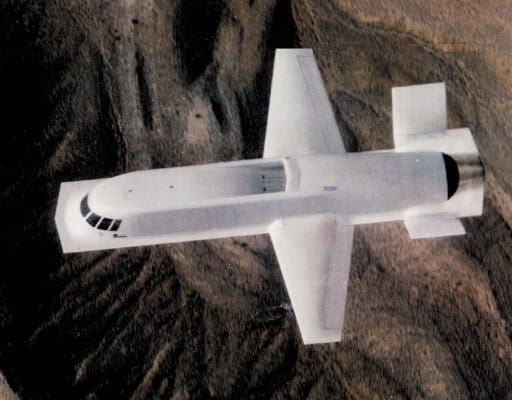
At a secret airfield in the Nevada desert in the early 1980s, a test pilot lined up one of the ugliest aircraft ever built and pushed the throttles forward. It looked less like a jet than a flying shipping container — deep-bodied, boxy, with a curved back and a strange V-tail. Engineers called it “the Whale.” Almost nobody outside the programme knew it existed. And it was about to help make one of the most beautiful aircraft in history possible.
Its real name was Tacit Blue, and for fourteen years it was one of America’s best-kept secrets.
QUICK FACTS
| Aircraft | Northrop Tacit Blue — “the Whale” |
| Role | Stealth technology demonstrator |
| First flight | February 1982 |
| Flights | About 135, through 1985 |
| Built | One aircraft, two turbofans |
| Legacy | Proved curved surfaces could be stealthy — key to the B-2 |
A spy that could hide in plain sight
Tacit Blue was built by Northrop to answer a hard question: could a stealthy aircraft loiter close to a battlefield, sweeping enemy forces with a radar, without being shot out of the sky? Such an aircraft would need to be nearly invisible while radiating from its own sensor — a brutal combination. Between February 1982 and 1985 the single Whale flew about 135 times to prove it could be done.
The mission it pioneered — watching ground forces from a survivable, sensor-carrying aircraft — helped shape how the US military thinks about battlefield surveillance to this day.
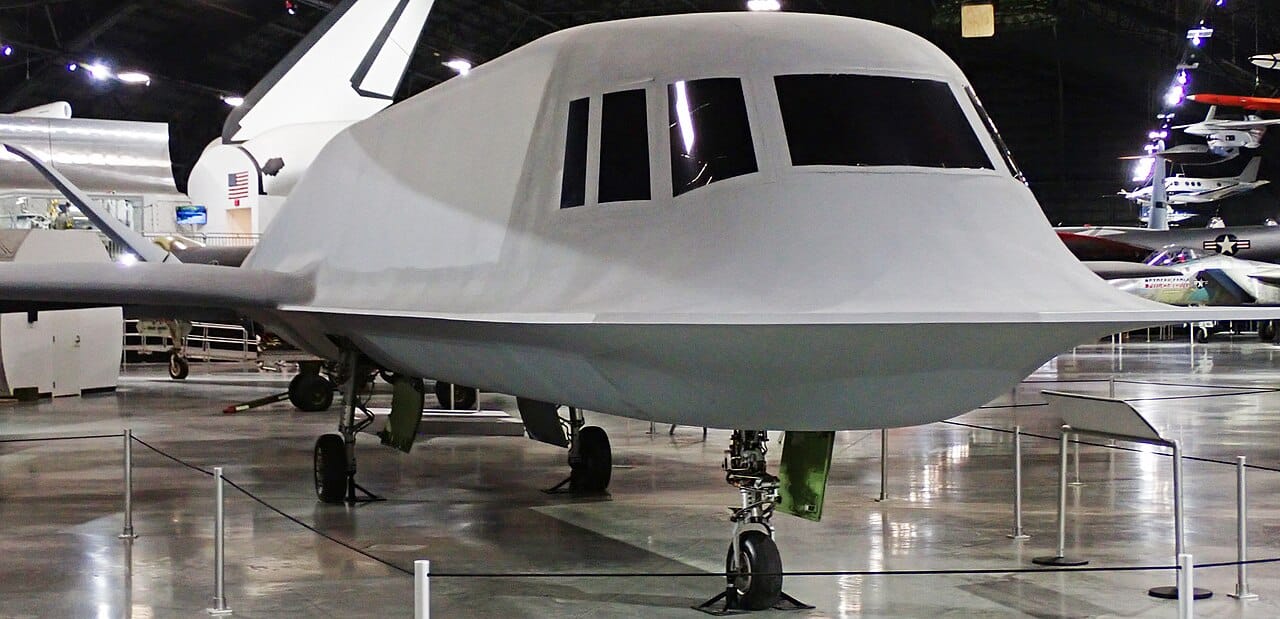
The breakthrough hiding in the ugliness
Here is why the Whale matters far beyond its own mission. The first stealth aircraft, the F-117, achieved invisibility with dozens of flat facets — which is why it looks so angular. Flat panels were easier for 1970s computers to model. But flat panels make for a terrible aeroplane. Tacit Blue proved something revolutionary: that smoothly curved surfaces could also defeat radar, if you shaped them correctly.
That single insight unlocked the future. Without it, the Northrop B-2 Spirit — with its graceful, continuously curved flying wing — could not exist. The Whale was ungainly precisely so that its descendants could be elegant.
From secret to museum piece
Tacit Blue stayed classified until 1996, when the Air Force finally rolled it into the light. Today the one and only Whale sits in the National Museum of the US Air Force near Dayton, Ohio, where anyone can walk up and marvel at how something so awkward could matter so much.
It never carried a weapon or flew a combat mission. It did something arguably more important: it proved an idea. And that idea is still flying today, in every curved, radar-swallowing surface of America’s stealth fleet.
Sources: National Museum of the U.S. Air Force; Northrop Grumman; Air and Space Forces Magazine.
Related Questions
What was Northrop Tacit Blue?
Tacit Blue was a secret American stealth technology demonstrator flown between 1982 and 1985. Its job was to prove that a stealthy aircraft could loiter near a battlefield using a radar to watch enemy forces without being detected. Nicknamed “the Whale” for its bulbous shape, only one was built.
Why is Tacit Blue important?
It proved that smoothly curved surfaces — not just the flat facets of the F-117 — could defeat radar. That breakthrough was essential to the Northrop B-2 Spirit, whose graceful, curved flying-wing shape would not have been possible without the lessons learned from the Whale.
Why was Tacit Blue called “the Whale”?
Because it looked like one. Instead of a sleek jet, Tacit Blue was a boxy, deep-bodied aircraft with a flat bottom, curved top and a V-tail — one of the least graceful shapes ever to fly. Crews and engineers took one look and the nickname stuck.
Was Tacit Blue hard to fly?
Very. Its unusual shape made it aerodynamically unstable, so it relied on a computerised fly-by-wire system to stay controllable — pilots described it as a demanding aircraft. It flew about 135 times from a secret test site without a major mishap, which was an achievement in itself.
Where is Tacit Blue now?
The single Tacit Blue aircraft was declassified in 1996 and is on public display at the National Museum of the United States Air Force near Dayton, Ohio, where visitors can finally see the once top-secret “Whale” up close.
0 Comments