
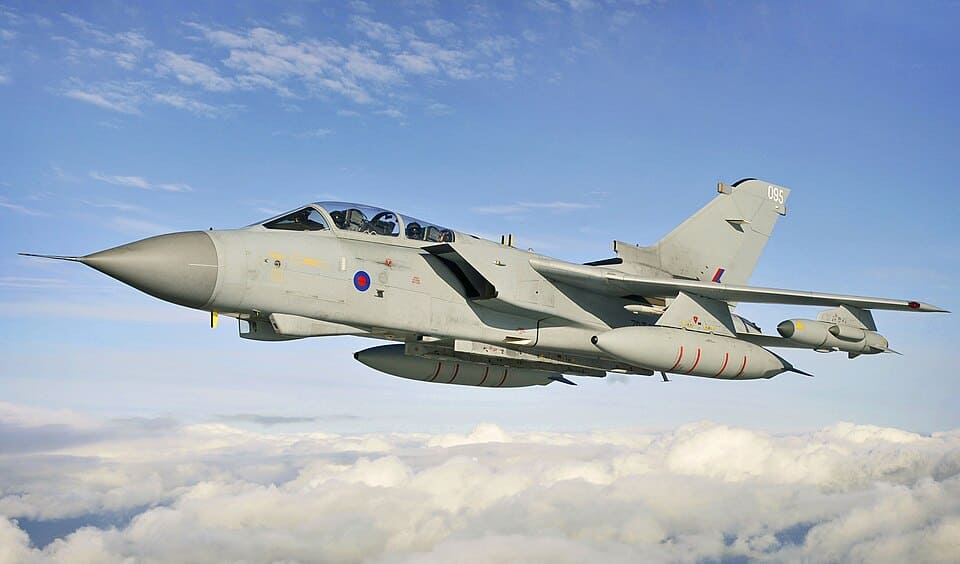
On the night of 17 January 1991, RAF Tornado GR1s crossed the Iraqi border at sixty metres above the desert floor, wings swept back to 67 degrees, delivering JP233 runway-denial munitions onto airfields that Saddam Hussein believed were untouchable. Six Tornados were lost during Desert Storm — the highest toll of any coalition type — yet no commander questioned the airframe. The Tornado was doing exactly what it had been designed to do: fly lower, faster, and more precisely than anything else in NATO’s inventory.
What makes that scene remarkable is not the bravery of the crews or the violence of the mission. It is the fact that this aircraft existed at all. The Panavia Tornado was built by three countries — Britain, West Germany, and Italy — that had spent centuries fighting one another. They agreed on a single airframe, a single engine, and a single avionics suite at a time when every national aerospace industry wanted its own programme. In an era when the Franco-German-Spanish FCAS programme has just collapsed under the weight of exactly those rivalries, the Tornado stands as living proof that multinational fighter programmes can work — if the partners are willing to compromise.
Nine hundred and ninety-two Tornados were built. Three major variants entered service. The type flew combat missions in six different wars across four decades. This is the story of how Europe’s rivals built one of the Cold War’s most effective strike aircraft.
Quick Facts
- First flight: 14 August 1974
- Total built: 992 aircraft
- Partner nations: United Kingdom, West Germany, Italy
- Variants: IDS (interdictor/strike), ADV (air defence), ECR (electronic combat/reconnaissance)
- Top speed: Mach 2.2 (2,400 km/h)
- Wing sweep range: 25° to 67°
- Combat record: Desert Storm, Kosovo, Afghanistan, Libya, Iraq, Syria
- Engines: Two Turbo-Union RB199 afterburning turbofans
Three Nations, One Impossible Brief
By the mid-1960s, Britain, West Germany, and Italy all needed the same thing: a low-level strike aircraft that could survive in the Central European theatre against massed Soviet air defences. Britain had just killed the TSR-2 and abandoned the F-111K purchase. Germany needed a replacement for the F-104 Starfighter, whose crash rate had become a national scandal. Italy was flying the ageing F-104S and could not afford to develop a successor alone.
In 1968, the three governments formed Panavia Aircraft GmbH, a consortium with ownership split between British Aircraft Corporation (42.5%), Messerschmitt-Bölkow-Blohm (42.5%), and Aeritalia (15%). A parallel company, Turbo-Union, was created to develop the RB199 engine. Work was divided across national lines: fuselage sections in Germany, wings and tail in Britain, the centre fuselage in Italy. Each nation’s assembly line produced its own aircraft from shared components.
The arrangement was radical. No previous combat aircraft had been designed, built, and operated by three sovereign nations simultaneously. The political friction was immense — every design decision required consensus across three air staffs with different doctrines, different threat assessments, and different industrial lobbies. Yet the programme held together, in large part because each partner had a genuine operational need that no national programme could fulfil at acceptable cost.
The Swing-Wing Solution
The Tornado’s most distinctive feature is its variable-geometry wing, which sweeps from 25 degrees for take-off and landing to 67 degrees for high-speed, low-level penetration. This was not a fashionable choice — it was a functional one. The Central European war scenario demanded an aircraft that could operate from short, possibly bomb-damaged runways, fly at very low level to avoid Soviet radar, and then accelerate to supersonic speeds for the final attack run. Fixed-wing designs could not satisfy all three requirements simultaneously.
The swing-wing mechanism added weight and mechanical complexity, but it gave the Tornado something no fixed-wing competitor could match: genuine multi-role flexibility without compromising low-level performance. At full sweep, the Tornado could maintain stable flight at 200 feet above the ground in any weather, guided by its terrain-following radar — a capability that proved decisive in Gulf War operations.
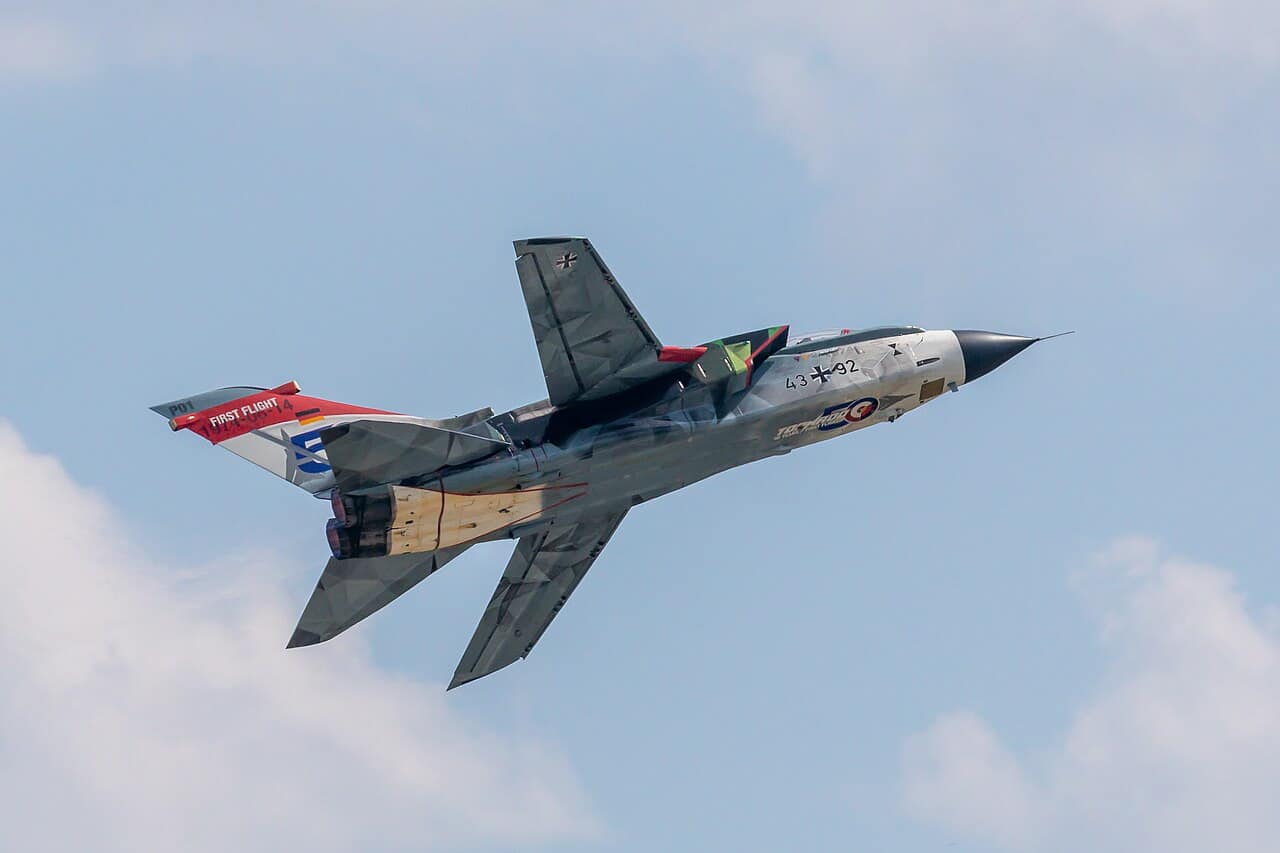
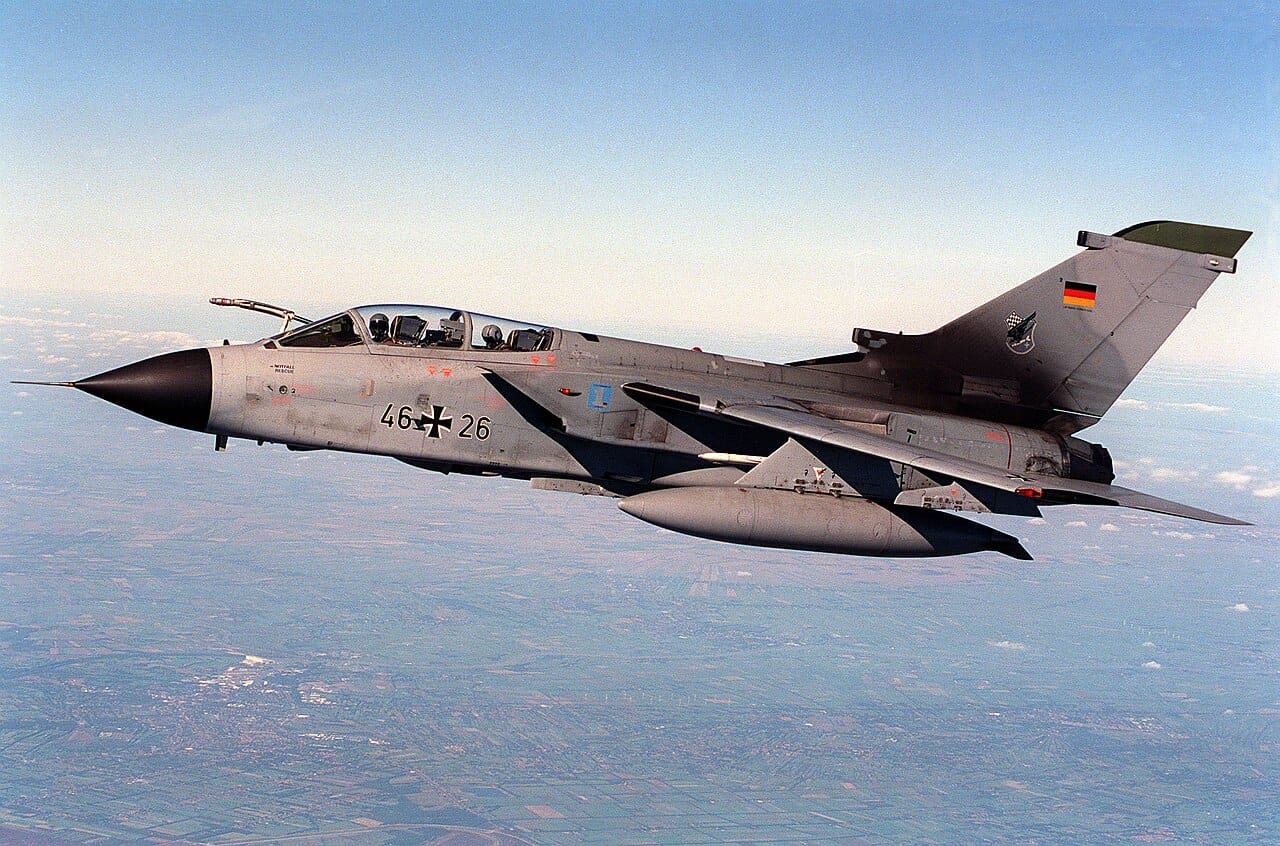
Three distinct variants emerged from the basic airframe. The IDS (Interdictor/Strike) was the original low-level bomber, carrying conventional and nuclear weapons. The ADV (Air Defence Variant), developed exclusively for the RAF, stretched the fuselage to carry four Sky Flash missiles and served as Britain’s primary interceptor through the 1990s. The ECR (Electronic Combat/Reconnaissance), operated by Germany and Italy, specialised in suppression of enemy air defences using AGM-88 HARM missiles.
From Desert Storm to Syria: Four Decades of Combat
The Tornado’s combat début during Operation Desert Storm in January 1991 was costly but instructive. RAF and Italian Tornados flew ultra-low-level attacks against Iraqi airfields, and six British aircraft were lost in the first week. The losses forced a doctrinal shift: subsequent missions were flown at medium altitude using precision-guided munitions, a change that shaped Tornado operations for the next quarter-century.
Over Kosovo in 1999, Tornados delivered ALARM anti-radiation missiles against Serbian air defences. In Afghanistan from 2001, the type flew reconnaissance and close air support missions using the RAPTOR pod. During the 2011 Libya campaign, RAF Tornado GR4s flew 3,000-mile round trips from Marham in Norfolk to deliver Storm Shadow cruise missiles. In Iraq and Syria from 2014, Tornados provided the backbone of the RAF’s strike capability against Islamic State targets using Brimstone and Paveway IV munitions.
The FCAS Lesson: Why the Tornado Worked and Others Failed
In 2025, the Future Combat Air System (FCAS) — a Franco-German-Spanish programme intended to produce Europe’s next-generation fighter — effectively collapsed. France and Germany could not agree on workshare, intellectual property, or export rights. Spain was caught in the middle. The programme that was supposed to replace the Rafale and the Eurofighter died of the same disease that the Tornado had survived: industrial nationalism.
The Tornado succeeded where FCAS failed for three reasons. First, all three partner nations had an urgent and genuine operational requirement — not a vague aspiration for a future capability, but an immediate gap in their order of battle. Second, the workshare formula was agreed early and defended politically. No partner could claim the programme for its own industry. Third, the design was driven by a specific operational scenario — low-level strike in Central Europe — rather than by an attempt to build a do-everything platform for an undefined future threat.
As Europe debates the path forward for GCAP, Tempest, and whatever emerges from the FCAS wreckage, the Tornado’s legacy is not just the aircraft itself — it is the proof that multinational cooperation in combat aviation is possible. It requires political will, industrial discipline, and an honest answer to a simple question: what do we actually need this aircraft to do?
Retirement and Legacy
The RAF retired its last Tornado GR4s in March 2019 after 40 years of service, replacing them with the Eurofighter Typhoon and F-35B Lightning. Germany continues to fly the Tornado ECR and IDS variants, though these are scheduled for replacement by the F-35A from 2027. Italy retired its Tornados in 2023. Saudi Arabia remains the last major operator.
The Tornado was never the fastest, the stealthiest, or the most agile fighter of its era. It was something more valuable: the right aircraft for the right mission, delivered on time and within budget by three nations that chose pragmatism over pride. In a European defence landscape littered with failed programmes and broken promises, that remains its most remarkable achievement.
Sources: Panavia Aircraft GmbH official records, RAF Historical Branch, Bundeswehr archives, Bill Gunston “Tornado” (Ian Allan Publishing), Greg Baughen “The RAF in the Battle of France and the Battle of Britain”


 English
0 Comments