
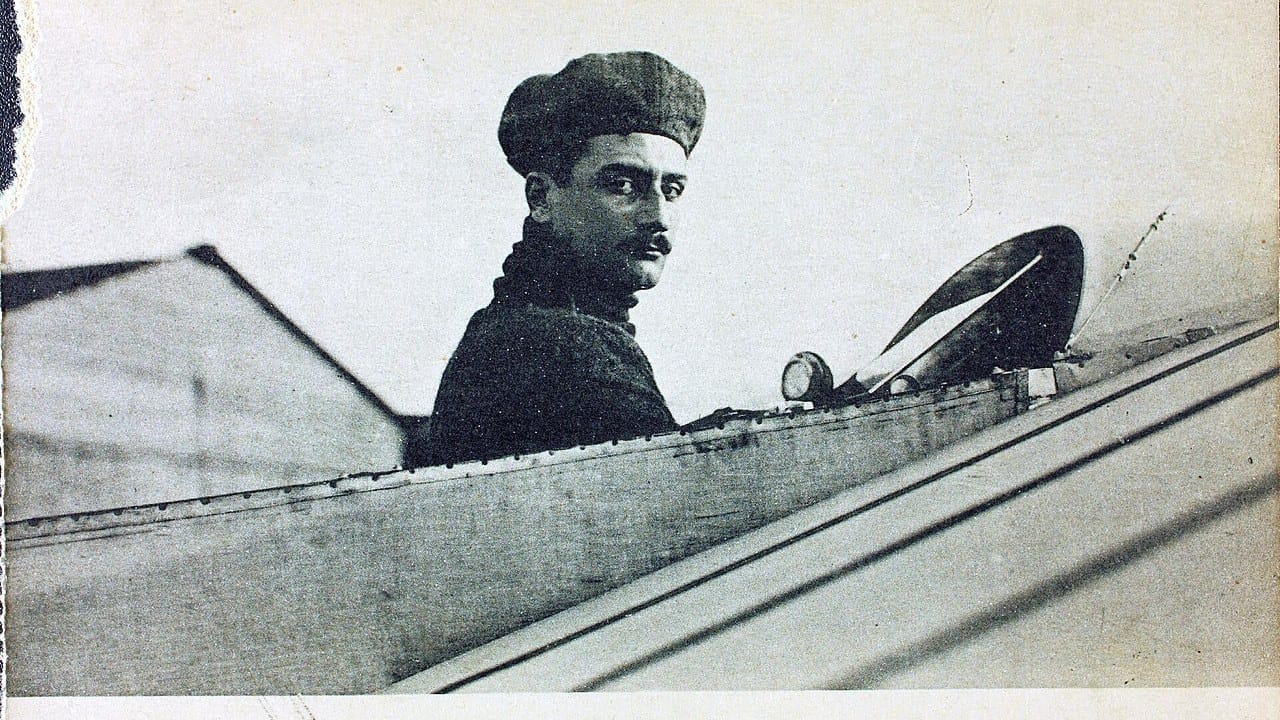
Fréjus, on the Côte d'Azur, 23 September 1913, 5:47 in the morning. The sea is still grey, the air smells of salt and the burnt castor oil that every rotary engine of the era coughs over its pilot. A small, dark-eyed man settles into a Morane-Saulnier G — a monoplane of ash and fabric, wings warped by wires, its cockpit furnished with exactly three instruments: a tachometer, a barograph, a compass.
Ahead of Roland Garros lies open water all the way to Africa. He carries some 200 litres of fuel — enough, in theory, for eight hours aloft. The crossing should take just under that. There is no radio, no life raft worth the name. The government offered him a naval escort; he declined it, with a shrug one can only call French, though the navy quietly posted torpedo boats along his route anyway.
Seven hours and fifty-three minutes later, having nursed his engine through two malfunctions above the Mediterranean, he lands at Bizerte, Tunisia, at 1:40 in the afternoon. By the contemporary accounts, roughly five litres of fuel remain in his tanks. La traversée is done — the first time an aeroplane has crossed the Mediterranean — and Roland Garros, twenty-four years old, is the most celebrated airman in France.
Quick Facts
- Born 6 October 1888 in Saint-Denis, Réunion; killed in action 5 October 1918 — one day before his 30th birthday
- Self-taught pilot; earned Aéro-Club de France licence no. 147 in July 1910 after starting on a Santos-Dumont Demoiselle
- Set world altitude records of 3,950 m (1911) and 5,610 m (1912)
- First non-stop aerial crossing of the Mediterranean, 23 September 1913: Fréjus to Bizerte in 7 h 53 min
- Scored three victories in April 1915 firing through his propeller, protected by steel deflector wedges — the birth of the fighter pilot
- Captured 18 April 1915; escaped from a German POW camp in February 1918 disguised as a German officer
- The Stade Roland Garros in Paris was named for him in 1928; the French Open officially carries his name
Moments in History on the world's first fighter pilot, April 1915.
The Dandy Who Taught Himself to Fly
He was born far from Paris, on 6 October 1888 in Saint-Denis on the island of Réunion, in the Indian Ocean. Pneumonia at twelve sent him to Cannes to recover; he took up cycling to rebuild his lungs and promptly won an inter-school championship. He studied at the Lycée Janson de Sailly and then HEC, the great business school, and at twenty-one opened a car dealership near the Arc de Triomphe. He ran with the fast set — a close friend of Ettore Bugatti, and the first owner of the Bugatti Type 18 later christened "Black Bess."
Then, in August 1909, on summer holiday near Reims, he watched the Grande Semaine d'Aviation de la Champagne — the world's first great flying meeting — and was lost to the automobile forever. He acquired a Santos-Dumont Demoiselle, a dragonfly of a machine that flew properly only for the smallest of pilots, taught himself to fly it, and in July 1910 received licence number 147 of the Aéro-Club de France.
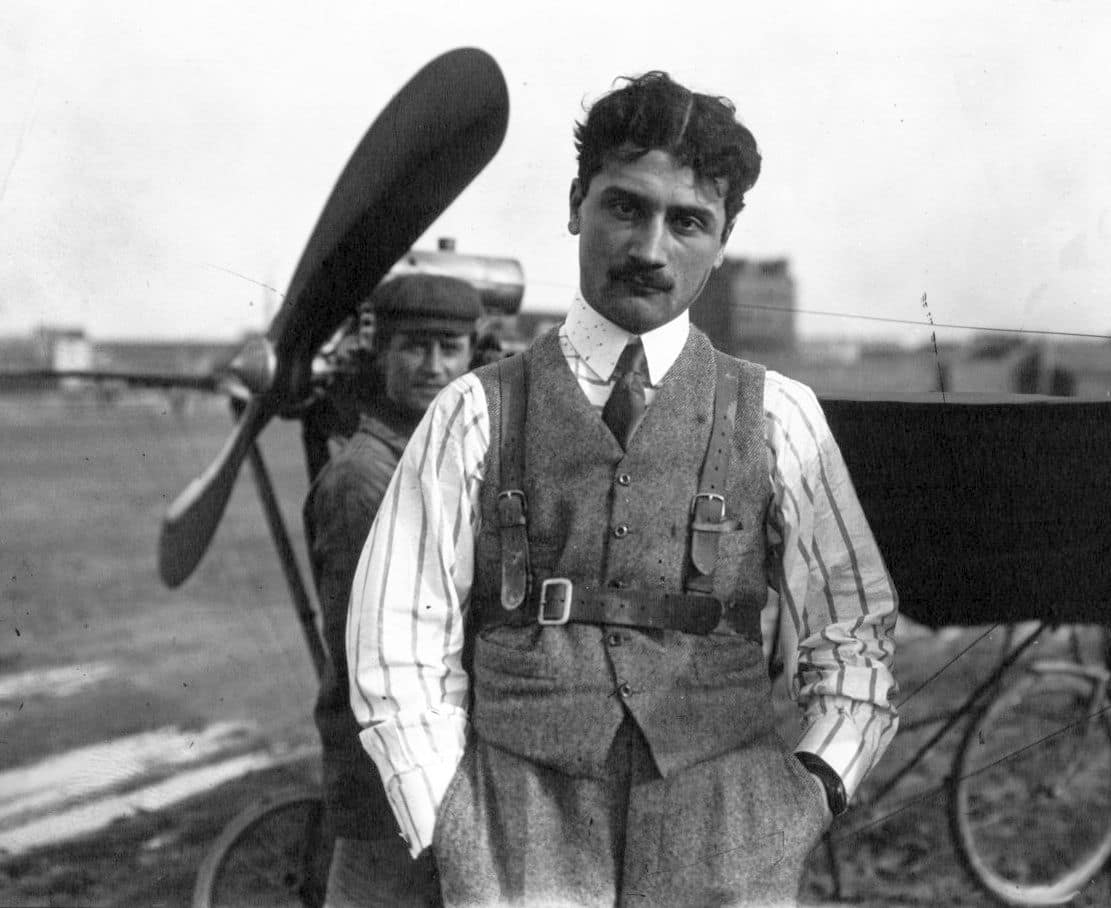
What followed was a career of pure Belle Époque panache. He graduated to the Blériot XI, raced from Paris towards Madrid in 1911, finished second in the Circuit of Europe, and went hunting altitude: 3,950 metres in September 1911, then 5,610 metres in September 1912 — heights flown in an open cockpit, without oxygen, in a machine of wood and doped linen.
In those years, France adored its aviators the way it would later adore its film stars. The crossing of the Mediterranean made Garros something more: a national possession. On 15 October 1913 he was appointed Chevalier de la Légion d'honneur. In Bizerte today, a plaza still marks the spot where he landed.
La Traversée and the Coming Storm
The margin of that flight deserves a moment's contemplation. His Morane-Saulnier averaged barely 96 kilometres per hour; fuel had to be pumped by hand from a reserve tank in the cockpit to the main tank near the engine. A single sustained failure of that temperamental Gnome rotary and the story of the French Open would carry a different name entirely.
Less than a year later, in August 1914, the war came. Garros joined the Aéronautique Militaire as a reconnaissance pilot with Escadrille MS26. Military aviation in 1914 was an unarmed affair — pilots of opposing sides sometimes waved to one another before the shooting began, and Garros's own early attempts to bring down German aircraft with a hand-held carbine came to nothing.
The problem was elegant and maddening: the most natural place to aim a machine gun was straight ahead, along the line of flight. And straight ahead sat one's own propeller.
Firing Through the Hélice
The engineer Raymond Saulnier had patented a synchronisation gear — timing the gun to the propeller's rotation — as early as April 1914, but the available Hotchkiss gun fired at too irregular a rate to trust it. So in the winter of 1914-15, Garros and Saulnier settled on something cruder and, for the moment, effective: steel deflector wedges bolted to slightly narrowed propeller blades, fitted with the help of Garros's mechanic Jules Hue. Most rounds passed cleanly between the blades; the unlucky few glanced off the armour.
On 1 April 1915, Garros attacked a German aircraft while firing forward through his spinning propeller — and brought it down. Nothing of the kind had ever been done. Two more victories followed on 15 and 18 April. The Smithsonian's curator of First World War aviation, Christopher Moore, states it plainly: Garros is "considered the first person to shoot down another aircraft with a gun firing forward between the propeller." In three weeks, one man had sketched the entire future of air combat.
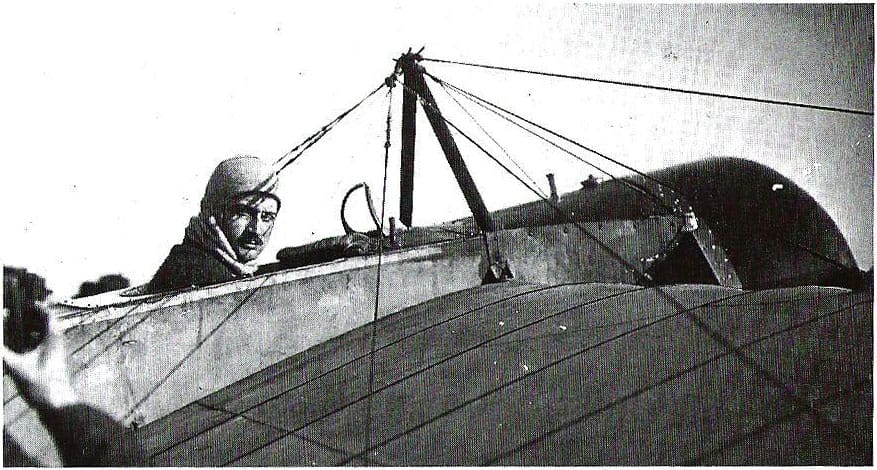
Legend adds that the newspapers crowned him l'as — the ace — and legend, here, deserves a footnote. The word did catch on in the French wartime press, but the official criterion became five victories, and the first man to meet it was Adolphe Pégoud. Garros would finish with four. He was not the first ace; he was something rarer — the first fighter pilot.
The triumph lasted eighteen days. On 18 April 1915, a clogged fuel line brought his Morane down behind German lines, and infantrymen seized both the pilot and, crucially, his intact machine. The propeller and gun were rushed to the Dutch designer Anthony Fokker, who dismissed the wedges and built a true interrupter gear for his Fokker E.I monoplane. The "Fokker Scourge" that followed handed Germany the sky for the better part of a year. Rarely has a single forced landing cost one side so much.
Prisoner, Escapee, Airman Again
Garros spent nearly three years in German prison camps, at Küstrin and Mainz among others, his health and eyesight fading. On 14 February 1918, he and fellow aviator Anselme Marchal walked out disguised in German officers' uniforms they had fashioned in secret, and made their way through the Netherlands to London and finally to Paris, where they were received as men returned from the dead. The government pressed him to accept a staff post. He refused.
He retrained on the SPAD S.XIII with his old Escadrille 26 — aviation had leapt a generation while he sat behind wire — and on 2 October 1918 claimed two victories, one confirmed: his fourth. Three days later, on 5 October 1918, he was shot down and killed near Vouziers in the Ardennes, most probably by Hermann Habich of Jasta 49, flying a Fokker D.VII — a descendant, if you like, of the very technology his capture had gifted the enemy. He died one day before his thirtieth birthday, five weeks before the Armistice.
On his propellers, Garros had inscribed a maxim attributed to Napoleon: "Victory belongs to the most persevering." It reads now like a self-portrait.
Who was Roland Garros? The tennis world remembers the airman behind the name.
Why a Stadium Bears His Name
A decade later, France had a sporting emergency of the happiest kind. The Four Musketeers — Lacoste, Borotra, Cochet, Brugnon — had seized the Davis Cup from the Americans in 1927, and the 1928 defence required a stadium worthy of it. Land was found at the Porte d'Auteuil, and Émile Lesieur, president of the Stade Français and Garros's old classmate from HEC, backed the project on one non-negotiable condition: the new arena would carry the name of his fallen friend.
And so it does. The tournament the world calls the French Open is officially Les Internationaux de France de Roland-Garros; the airport of Réunion bears his name as well. Every spring, champions grind through five sets on the red clay and commentators speak the name of a man who never seriously held a racquet. One suspects he would have found it all tremendously amusing — and entirely fitting. On that ochre dust, as over the Mediterranean in 1913, victory still belongs to the most persevering.
Sources: Wikipedia, NPR, FAI, This Day in Aviation, Flight (27 September 1913), Tennis Majors
Related Questions
Who was Roland Garros?
Roland Garros (1888–1918) was a pioneering French aviator, born on Réunion, who made the first non-stop flight across the Mediterranean in 1913 and became one of the first true fighter pilots in 1915. The Paris tennis stadium and the French Open are named in his honour.
Why is the French Open named after Roland Garros?
The tournament is played at the Stade Roland Garros in Paris, a stadium named in 1928 after the aviator Roland Garros. He was a national hero for his 1913 Mediterranean crossing and his wartime exploits — he was not a tennis player at all.
What did Roland Garros achieve in aviation?
Garros was a self-taught pilot who set world altitude records of 3,950 m in 1911 and 5,610 m in 1912, then made the first non-stop aerial crossing of the Mediterranean on 23 September 1913, flying from Fréjus to Bizerte in 7 hours 53 minutes.
How did Roland Garros help invent air combat?
In April 1915 Garros scored three victories by firing a machine gun straight through his propeller, whose blades were protected by steel deflector wedges. This crude fix for shooting forward helped give birth to the fighter pilot.
When did Roland Garros cross the Mediterranean?
He crossed on 23 September 1913, flying a Morane-Saulnier monoplane from Fréjus on the French Riviera to Bizerte in Tunisia — about 7 hours 53 minutes over open water, carrying roughly 200 litres of fuel and almost no safety equipment.
How did Roland Garros die?
Garros was killed in action on 5 October 1918, one day before his 30th birthday. He had been captured in April 1915 but escaped a German POW camp in February 1918, reportedly disguised as a German officer, and returned to combat flying.
How did early pilots fire through the propeller?
Before true synchronization gear existed, pilots like Roland Garros fitted steel deflector plates to their propeller blades so that bullets striking the blades were knocked aside. This stopgap marked the dawn of aerial combat in the First World War.
0 Comments