

A Tu-22M3 Backfire smashed into a field near Svirsk, Irkutsk Oblast, on June 15 — and all four crew members walked away. That sounds like good news. It is not. It is the third Backfire hull loss in two years, and Russia has almost none left to lose.
The bomber was assigned to Belaya Air Base, a Long Range Aviation facility roughly 500 km northwest of Lake Baikal. Eyewitness footage captured the aircraft trailing smoke before the crew ejected. Governor Igor Kobzev confirmed all four were recovered alive, with injuries. The airframe is a total loss.
What makes this crash significant is not the incident itself — it is what it reveals about the state of Russia’s once-feared supersonic bomber fleet. Open-source tracking and Ukrainian intelligence estimates suggest the Backfire force has lost roughly 70 percent of its operational strength since the full-scale invasion began. The fleet that once threatened NATO carrier groups across the North Atlantic may now number fewer than ten flyable aircraft.
Quick Facts
- Aircraft: Tupolev Tu-22M3 “Backfire-C”
- Crash date: 15 June 2026, near Svirsk, Irkutsk Oblast
- Base: Belaya Air Base (Long Range Aviation)
- Crew: 4 — all ejected safely, injuries reported
- Fleet before invasion (est.): ~60 operational Tu-22M3/M3M
- Confirmed combat/operational losses since 2022: 24+
- Estimated remaining (June 2026): Fewer than 20 airframes, possibly 9 flyable
- Production: Ended 1993 — no replacements being built
Three Crashes, Two Years, Zero Replacements
This is not the first time a Tu-22M3 has gone down in the Irkutsk region. In August 2024, a Tu-22M3 crashed in the Cheremkhovsky district of the Irkutsk region; all four crew ejected and survived. In April 2025, another Tu-22M3 went down in the Usolsky district of the same region, killing one of the four crew when the aircraft struck a power line during its descent.
The pattern is unmistakable. The Tu-22M3 fleet is old — the youngest airframes date from the early 1990s — and the maintenance pipeline that kept them flying has been gutted by sanctions, parts shortages, and the relentless demand of combat operations over Ukraine. Tupolev’s Kazan plant, which once built these bombers, has been redirected entirely toward Tu-160M2 production and Tu-22M3M modernisation — a program that has produced a handful of upgraded aircraft at best.
The raw footage circulated by OSINT analysts shows the bomber trailing smoke well before the crew punched out. Whether the cause was mechanical failure, engine fire, or something else remains under investigation. But the Russian Ministry of Defence has said almost nothing publicly — a pattern that has become standard for embarrassing losses.
The Numbers: A Fleet in Freefall
Before Russia’s full-scale invasion of Ukraine in February 2022, the Russian Aerospace Forces (VKS) operated an estimated 60 Tu-22M3 and Tu-22M3M bombers across several regiments. That number has collapsed.
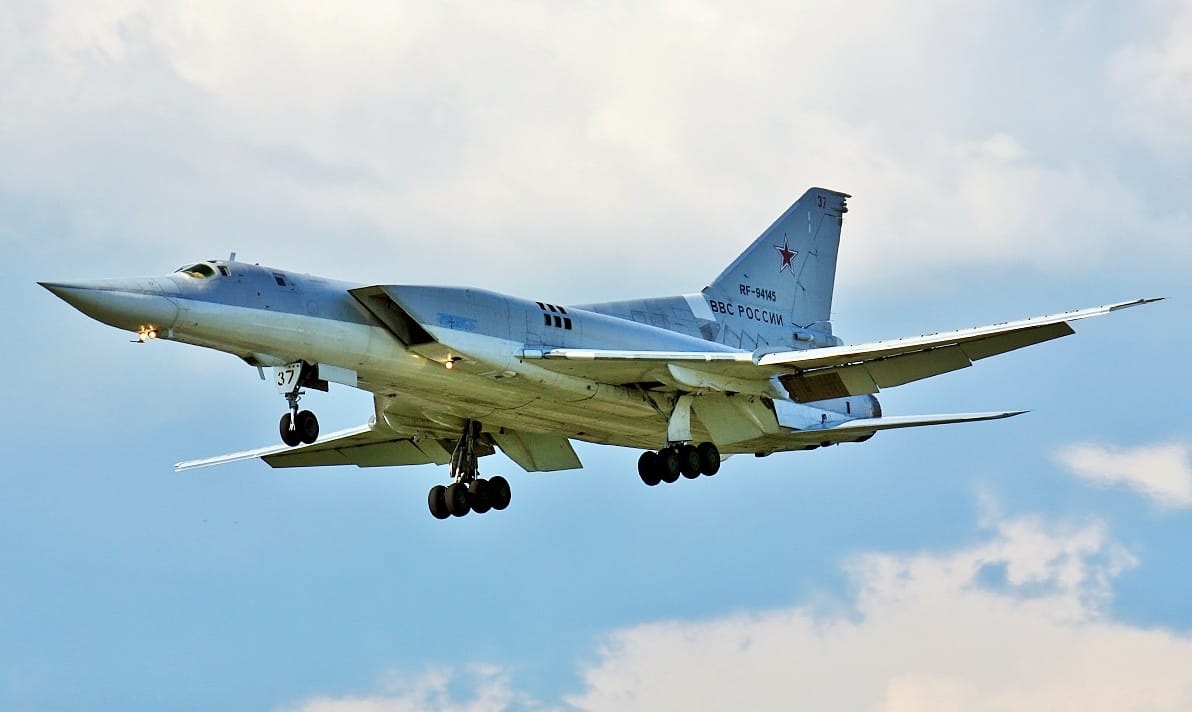
Ukraine’s defense intelligence directorate (HUR) and independent tracking by Defense Express have documented at least 24 confirmed Tu-22M3 losses since 2022 — a mix of combat shootdowns, Ukrainian drone strikes on airbases, and operational accidents. Several more are believed to have been damaged beyond economical repair.
Defense Express estimates the fleet has lost roughly 70 percent of its pre-war operational strength. Defense Express counts 24 Backfires destroyed or damaged since 2022 — including the 12 hit in Ukraine’s June 2025 Operation Spiderweb — and, working from a combat-ready force of roughly 33 to 34 aircraft before the war, estimates that perhaps only 9 to 10 remain operational today. The most pessimistic Western estimates put the number of mission-capable Backfires in single digits.
Cold War Carrier Killer, Modern-Day Liability
The Tu-22M3 was designed for one job: killing NATO aircraft carriers. Armed with Kh-22 supersonic anti-ship missiles — each capable of carrying a nuclear warhead — the Backfire was the centrepiece of Soviet naval aviation’s strike doctrine. A regiment of Backfires launching from Arctic bases could saturate a carrier battle group’s defences before the escorts could react.

In the Ukraine war, the Backfire has been repurposed as a cruise missile truck, lobbing Kh-22 and newer Kh-32 missiles at Ukrainian cities and infrastructure from standoff distances. It is a role the aircraft can perform, but one that exposes it to an air defence environment far more lethal than anything its designers anticipated. Ukrainian forces have shot down multiple Backfires using a combination of long-range SAMs and, increasingly, drone strikes against the bombers’ home airfields.
What Comes Next
Nothing good, from Moscow’s perspective. The Tu-22M3 production line at the Kazan Aviation Plant closed in 1993. The tooling, the supplier base, and the institutional knowledge required to build new Backfires are gone. Russia’s Tu-22M3M modernisation programme — intended to extend the type’s service life with new avionics and the ability to carry Kh-32 missiles — has delivered only a handful of upgraded aircraft, and sanctions have further slowed the effort.
The Tu-160M2 White Swan programme is nominally the successor, but it is years behind schedule and astronomically expensive. Russia has no realistic path to replacing the Backfire force within this decade.
For a bomber that once made NATO admirals lose sleep, the Tu-22M3’s story is ending not with a bang, but with a slow, grinding attrition that Russia can do nothing to stop. Every crash, every shootdown, every drone strike on a parking ramp brings the fleet closer to functional extinction. The Svirsk crash was the latest subtraction from a force that cannot afford to lose another airframe. It will not be the last.
Sources: The War Zone, Defense Express, TASS, Governor of Irkutsk Oblast official statement, Ukrainian defense intelligence (HUR), Oryx open-source loss tracking, OSINT Technical


 English
0 Comments