
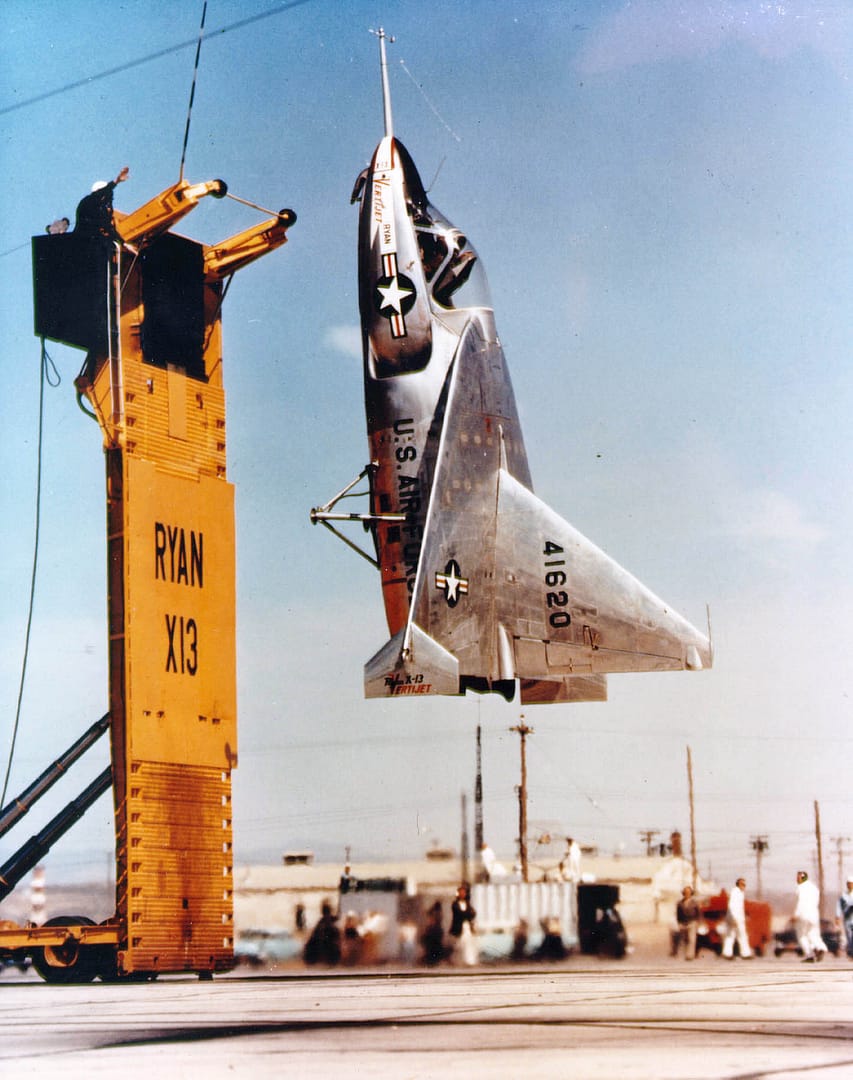
Picture a flatbed trailer tilting slowly skyward in the California desert until it stands almost vertical, and clinging to it nose-up like a wasp on a windowpane, a stubby silver dart of an aircraft. There is no runway in sight. There is no landing gear worth the name. The whole machine hangs from a single hook beneath its nose, caught on a steel cable strung between two arms. The pilot, lying half on his back, opens the throttle. The little jet shudders, lifts itself off the cable, hovers for a moment on a column of its own exhaust, then tips its nose down and roars away into level flight as if nothing strange had happened at all.
That was the Ryan X-13 Vertijet, and in 1957 it did something no pure jet had ever done before: it took off vertically, flew like a normal aeroplane, and then came back to stand on its tail again. This is the story of how Ryan Aeronautical tried to delete the runway from aviation entirely.
Quick Facts
| Aircraft | Ryan X-13 Vertijet (Model 69) |
| Powerplant | 1× Rolls-Royce Avon turbojet, 10,000 lbf thrust |
| Built | 2 prototypes (54-1619, 54-1620) |
| First full cycle | 11 April 1957, Edwards AFB, California |
| Test pilots | Peter F. “Pete” Girard (chief), W. L. Everett |
| Fate | No operational requirement; both survive in museums |
A jet that didn't need a runway
The idea was born out of Cold War paranoia and a barroom-style hunch. Just after World War II, Ryan engineers reportedly wondered aloud whether their FR-1 Fireball — which had a thrust-to-weight ratio of roughly one-to-one when light on fuel — could simply point its nose at the sky and climb straight up. In 1947 the U.S. Navy's Bureau of Aeronautics turned the daydream into a contract, hoping a vertically launched jet fighter might one day operate from submarines and small ships, far from runways the Soviets could crater with a single bomb.
The Navy money eventually dried up after the Korean War, but the Air Force picked up the torch. In 1954 it ordered two tail-sitting demonstrators under the designation X-13, designed under chief engineer Curtiss Bates. The brief was beautifully simple and fiendishly hard: prove that a jet could take off vertically, transition to forward flight, and land vertically again. No airfield required.
Period test-flight footage of the Ryan X-13 Vertijet, circa 1957.
The aircraft they built was tiny — just 23 feet 5 inches long with a 21-foot delta wing capped by flat endplates. Into that airframe Ryan crammed a single Rolls-Royce Avon turbojet making 10,000 pounds of thrust, more than the loaded aircraft weighed. With a thrust-to-weight ratio of about 1.48, the X-13 could quite literally hang in the air on its engine.

The trapeze act
The genius — and the madness — of the X-13 lived in its trailer. The same flatbed that hauled the jet down the road tilted vertical on hydraulic rams to become the launch pad. The Vertijet hung from a cable by a hook under its nose; to take off, the pilot simply throttled up until the hook lifted free, backed away, and pitched over into level flight. To land, he reversed the whole thing and tried to snag the cable again with the hook.
That landing was the hard part, and everyone knew it. With the nose pointed at the sky, the pilot couldn't see the trailer he was aiming for. Ryan pivoted the seat to help, mounted a long graduated pole on the trailer so the pilot could judge his distance, and stationed a ground controller to talk him in by radio. It was, in effect, parallel parking a fighter jet vertically, blind, on the end of its own thrust.

Pete Girard and the day it all came together
Most of the flying fell to Ryan's chief test pilot, Peter F. "Pete" Girard, backed by fellow test pilot W. L. "Lou" Everett. Girard was no stranger to standing a jet on its tail — years earlier he had hovered Ryan's unmanned research rig, a contraption built from a B-47 fuel tank that engineers fondly called the "beast in the back yard," making what the Smithsonian records as the first manned hovering flight in a jet aircraft back in November 1953.
The X-13 itself flew conventionally first, on 10 December 1955, fitted with temporary tricycle gear to check its ordinary handling. Vertical hovering followed in May 1956, then full transitions at altitude. The pieces were all there; they just had to be strung together into one continuous flight.
That happened on 11 April 1957 at Edwards Air Force Base. Using the second prototype, Girard took off vertically straight from the raised trailer, transitioned to level flight, flew his maneuvers, then pitched back to a hover and settled gently down until his nose hook caught the cable. It was the first full vertical-to-horizontal-to-vertical cycle ever flown by a jet — the complete mission profile, runway-free, start to finish.

A show at the Pentagon, then silence
Ryan knew showmanship sold programs, and the X-13 was made for theatre. In late July 1957 the Vertijet was hauled to Washington, D.C., where it crossed the Potomac and performed for an audience of more than 3,000 military officers and journalists at the Pentagon itself — taking off, flying, and landing back on its trailer in front of the brass it most wanted to impress.
It impressed them, and it convinced nobody to buy it. The blind, fiddly vertical landing was a genuine operational headache, the little jet's range and performance were modest, and the Air Force simply had no firm requirement for a runway-less fighter. The X-13 flew for the last time on 30 September 1957, and the program quietly ended.
A modern deep-dive on the world’s first full-cycle VTOL jet (Rex’s Hangar).
And yet the Vertijet was not a dead end so much as a seed planted early. The vectored-thrust trick at the heart of the X-13 — pointing the engine's exhaust to steer the aircraft in the hover — is exactly the principle that later made the Harrier and, decades on, the F-35B work. The X-13 did everything it was asked to do; the world just wasn't ready for the answer. Two of them survive today, one at the San Diego Air & Space Museum's annex and the other at the National Museum of the U.S. Air Force — small, strange monuments to the day a jet learned to land by hanging itself on a hook.
Sources: Wikipedia (Ryan X-13 Vertijet); Smithsonian National Air and Space Museum; White Eagle Aerospace.
Related Questions
What was the Ryan X-13 Vertijet?
The Ryan X-13 Vertijet was an experimental American jet of the 1950s built to take off and land vertically. A tailsitter, it stood on its tail, rose straight up on jet thrust, then tilted to fly horizontally — proving a jet could operate with no runway at all.
How did the X-13 Vertijet take off and land?
It hung nose-up from a hook on a mobile trailer, lifted off vertically on its Rolls-Royce Avon turbojet, transitioned to level flight, then returned to a hover and caught the hook tail-first to land. The pilot's seat tilted to keep him upright through the cycle.
When did the X-13 first complete a full flight?
The X-13 flew its first complete cycle — vertical takeoff, transition to horizontal flight, and vertical landing — on 11 April 1957 at Edwards Air Force Base, California, flown by chief test pilot Pete Girard.
Why was the X-13 Vertijet never produced?
There was no operational requirement for it. While it proved vertical jet flight was possible, the concept was impractical for everyday military use, and the program ended after two prototypes.
How many X-13s were built?
Only two prototypes were built. Both still exist in museum collections, preserved as pioneers of vertical-takeoff jet flight.
Related Posts
0 Comments