
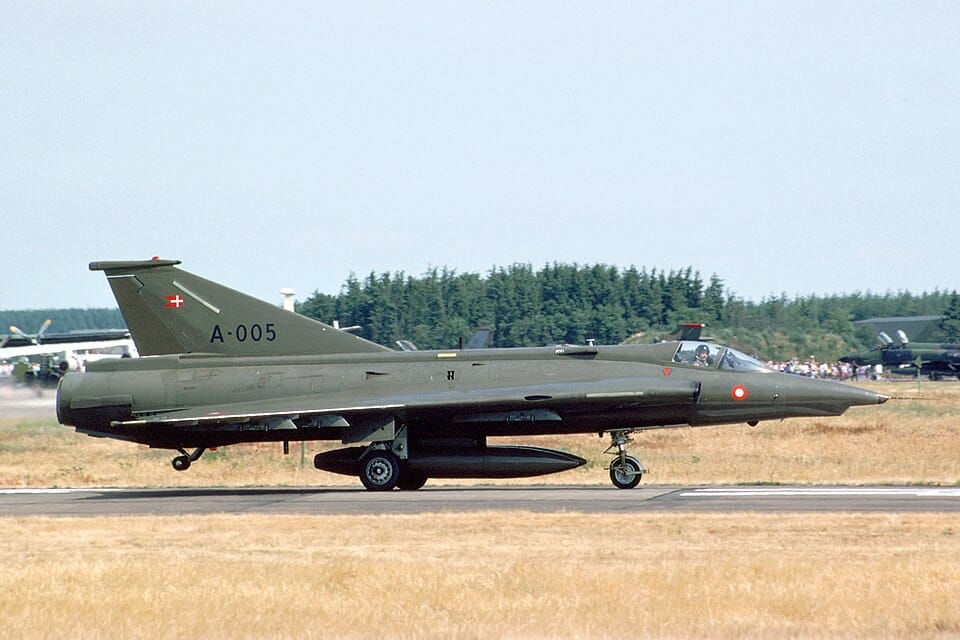
In the early 1950s, Sweden’s military planners faced a terrifying arithmetic problem. The Soviet Union could, in theory, send hundreds of bombers across the Baltic toward Stockholm in a matter of minutes. Sweden was neutral, vastly outnumbered, and could not count on NATO to intervene. Whatever interceptor the Swedish Air Force fielded next would need to scramble in under sixty seconds, accelerate past the speed of sound, climb to bomber altitude, fire its weapons, and return — all within roughly fifteen minutes. And because Swedish airfields would be among the first targets hit, this aircraft would also need to land and take off from ordinary public roads.
The aircraft that emerged from these impossible requirements was the Saab 35 Draken — “the Dragon.” First flown in October 1955, the Draken was the world’s first production aircraft to feature a double-delta wing planform. It was radical, beautiful, and far ahead of its time. It could exceed Mach 2, operate from 500-metre strips of highway, and be rearmed and refuelled in under ten minutes by a crew of conscripts. No other Western fighter of its generation could match that combination of performance and operational flexibility.
Quick Facts
Type: Interceptor / multirole fighter
Manufacturer: Saab AB, Linköping, Sweden
First Flight: 25 October 1955
Top Speed: Mach 2.0 (2,450 km/h / 1,524 mph)
Engine: 1 x Svenska Flygmotor RM 6C (Rolls-Royce Avon)
Wing Design: Double-delta
Operators: Sweden, Denmark, Finland, Austria
Total Built: 651
The Double-Delta Breakthrough
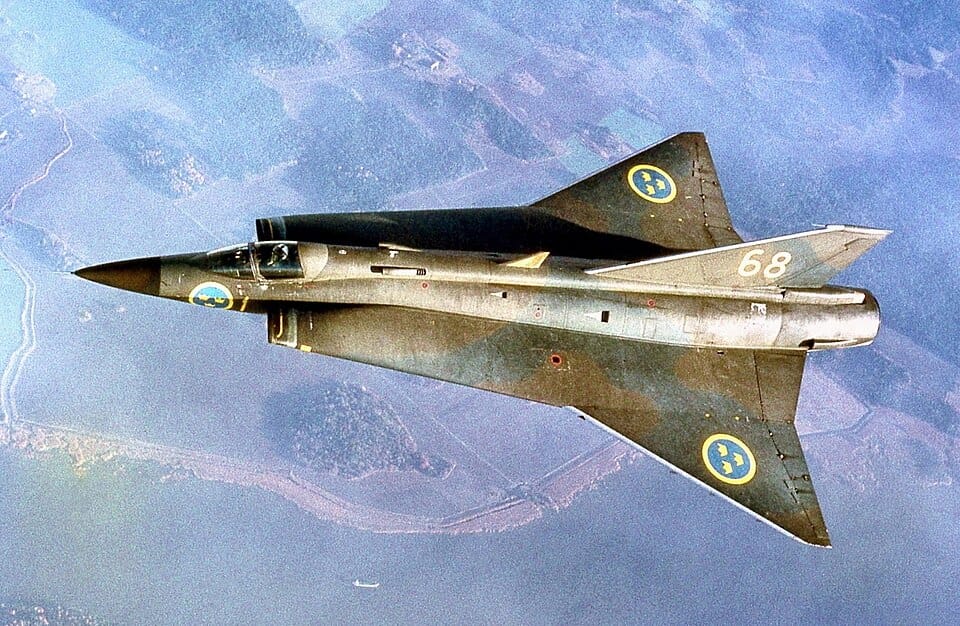
The Draken’s most distinctive feature was its wing. Chief designer Erik Bratt and his team at Saab realized that a conventional delta wing — like those being explored by Convair in the United States — offered excellent supersonic performance but terrible low-speed handling. A straight delta needed long runways and approached the ground at uncomfortably steep angles. For a fighter that had to land on roads, this was unacceptable.
Bratt’s solution was elegant: a double-delta, with a sharply swept inner section (80 degrees) blending into a moderately swept outer panel (57 degrees). The inner delta generated powerful vortices at high angles of attack, energizing airflow over the outer wing and delaying the stall. The result was an aircraft that could dash past Mach 2 at altitude yet approach for landing at manageable speeds — slow enough to stop on a two-lane road with arresting gear.
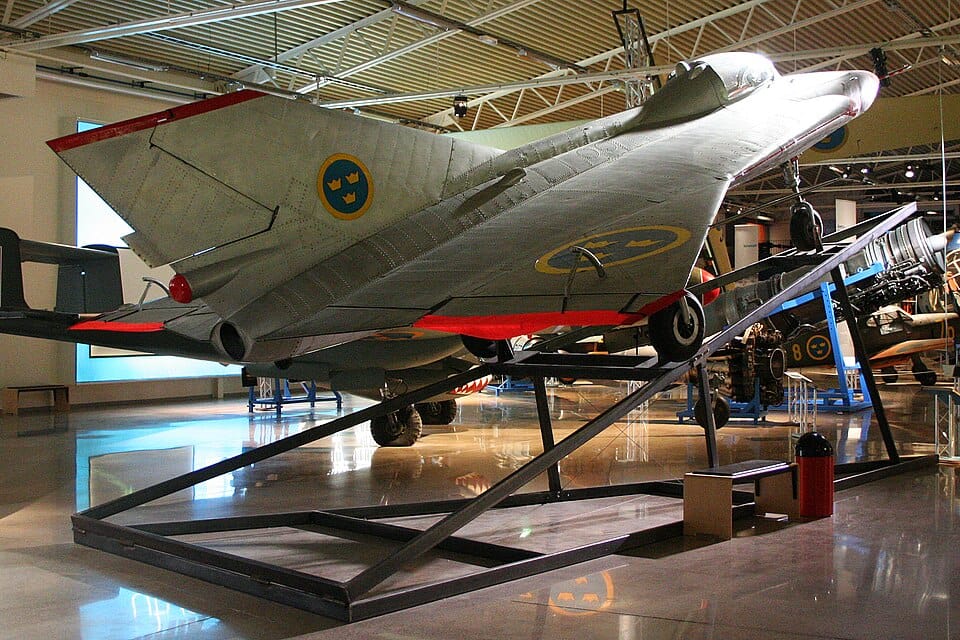
Before committing to full-scale production, Saab built a 70%-scale proof-of-concept aircraft, the Saab 210 “Lilldraken” (Little Dragon). This tiny testbed first flew in January 1952 and validated the double-delta concept, giving Saab’s engineers the confidence to proceed. The gamble paid off spectacularly.
Roads as Runways
Sweden’s wartime dispersal doctrine — known as Bas 60 — was one of the most sophisticated in the world. Rather than concentrate aircraft at a few large airfields where a single nuclear strike could destroy the entire air force, the Swedes planned to scatter their fighters across hundreds of road bases throughout the country. Straight stretches of highway were reinforced and widened, with pull-off areas concealed among the trees serving as improvised hardstands.
The Draken was designed from the outset for this environment. Its rugged landing gear could handle rough surfaces. Its engine could be started with a simple ground power cart. Refuelling and rearming followed a carefully choreographed sequence performed by conscript ground crews who practised until they could turn an aircraft around in under ten minutes. A Draken could land on a forest road, disappear under camouflage netting, and be back in the air before the enemy knew it was there.
Into Service and Beyond Mach 2
The first production Draken, the J 35A, entered service with the Swedish Air Force (Flygvapnet) in March 1960. It was an immediate success. Pilots praised its agility, its honest handling characteristics, and its sheer performance. In 1960, a Draken became the first Western European aircraft to exceed Mach 2 in level flight. The type was progressively upgraded through a series of variants — the J 35B with improved fire control, the J 35D with a more powerful engine, the J 35F with enhanced radar and missile capability, and finally the J 35J, which served until 1999.
Export Success
Although Sweden guarded its neutrality carefully, the Draken found export customers who valued its unique capabilities. Denmark operated the A-35XD and RF-35 from 1970 to 1993, using them in the strike and reconnaissance roles. Finland flew the Draken from 1972 to 2000, an extraordinary service life that testified to the soundness of the basic design. Austria was the last operator, retiring its J 35Ö fleet in 2005 — nearly fifty years after the type’s first flight.
Legacy: The Dragon’s Influence
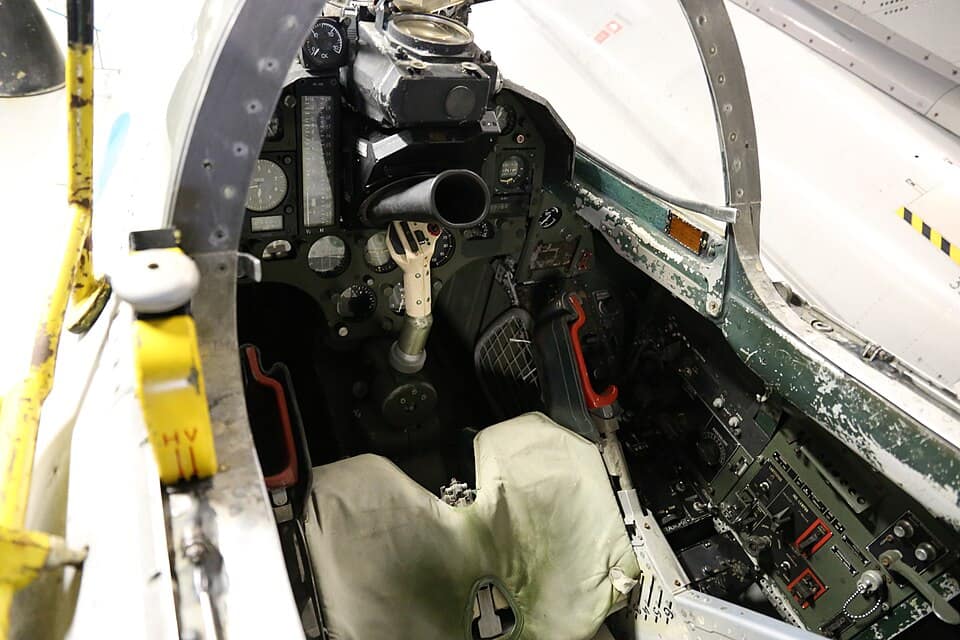
The Draken’s double-delta concept proved prophetic. The same aerodynamic principle — using vortex energy from a highly swept inner wing to improve outer-wing performance — would later appear in aircraft from the Eurofighter Typhoon to modern stealth designs. Saab itself refined the concept further with the Viggen and then the Gripen, each generation building on lessons learned from the Dragon.
But perhaps the Draken’s most enduring legacy is philosophical. It proved that a small, neutral country with limited resources could design and build a world-class combat aircraft — not by copying the superpowers, but by thinking more creatively about the problem. The Draken did not try to be everything to everyone. It was built to solve a very specific Swedish problem, and it solved it with an elegance that still turns heads on the ramp today.
Sources: Widfeldt, Bo — “The Saab 35 Draken” (1985); Andersson, Hans G. — “Saab Aircraft Since 1937” (1989); Swedish Air Force Museum archives; Flygvapennytt historical records.


 English
0 Comments