On August 3, 1954, a delta-winged jet fighter accelerated across the surface of San Diego Bay on twin retractable hydro-skis, lifted off the water, climbed to altitude, and exceeded Mach 1 in a shallow dive. No runway. No carrier deck. Just open water, two Westinghouse turbojets, and an idea so ambitious it bordered on the absurd.
The Convair F2Y Sea Dart remains the only seaplane in history to break the sound barrier. It was built to solve a problem that obsessed the US Navy in the early 1950s: how to operate supersonic interceptors without the enormous, vulnerable aircraft carriers that Soviet missiles could sink. The answer — a fighter that needed nothing but a sheltered harbour — was technically brilliant, operationally compelling, and ultimately killed by a tragedy that ended the programme three months later.
Quick Facts
Aircraft: Convair YF2Y-1 / F2Y-1 Sea Dart
Type: Waterborne supersonic interceptor
First flight: April 9, 1953
Supersonic flight: August 3, 1954 (Mach 1+ in shallow dive)
Takeoff method: Retractable twin hydro-skis on open water
Max speed: Mach 1.04 (recorded)
Built: 5 aircraft (2 prototypes + 3 service test)
Fatal crash: November 4, 1954 — test pilot Charles E. Richbourg killed
Surviving aircraft: 4 (in museums across the US)
The Problem: Carriers Are Targets
In the late 1940s, the US Navy faced an uncomfortable strategic reality. Aircraft carriers — the centrepiece of American naval power — were becoming increasingly vulnerable. Soviet submarine and missile technology was advancing rapidly. A single nuclear-tipped weapon could destroy a carrier and its entire air wing. The Navy’s capital ships were, in effect, becoming the highest-value targets on the ocean.
One radical solution was to eliminate the need for carriers altogether — at least for the air defence mission. If interceptors could launch from and land on water, they could be dispersed to harbours, bays, and sheltered anchorages around the world. No flight deck required. No single point of failure. A submarine or missile that sank a tender in a harbour would destroy one or two aircraft, not sixty.
The XF2Y-1 Sea Dart in flight over San Diego Bay — a delta-winged jet fighter that launched from and landed on open water using retractable hydro-skis. US Navy / Wikimedia Commons
In 1948, the Navy issued a specification for a supersonic waterborne fighter. Several companies submitted proposals. Convair, riding high on the success of its delta-winged F-102 programme, proposed a design that would become the Sea Dart: a delta-wing jet fighter equipped with retractable hydro-skis that would allow it to take off from and land on water like a ski boat.
The Engineering: Skis, Not Floats
The Sea Dart’s most distinctive feature was its undercarriage: two retractable hydro-skis mounted beneath the fuselage. During takeoff, the aircraft would accelerate on the water’s surface. At approximately 10 knots, the skis would extend and lift the fuselage clear of the water, reducing hydrodynamic drag dramatically. At flying speed — around 130 knots — the aircraft would lift off the skis entirely and retract them flush with the fuselage for clean supersonic flight.
The ski design went through multiple iterations. The initial single-ski configuration created dangerous porpoising — rhythmic bouncing on the water surface that could shake the aircraft apart. Convair switched to a twin-ski arrangement that proved more stable, though water takeoffs remained rough, noisy, and demanding for the pilot.
A Sea Dart rises from the water on its twin hydro-skis during takeoff. The spray pattern and ski geometry were among the programme’s most difficult engineering challenges. US Navy / Wikimedia Commons
The airframe itself was a conventional Convair delta wing with a mid-mounted configuration. Two Westinghouse J46 turbojets were mounted side by side in the fuselage, fed by a chin intake. The cockpit was sealed and pressurised — essential for an aircraft that would regularly submerge its lower fuselage in salt water. Corrosion protection was a constant concern throughout the programme.
Landing was, if anything, more challenging than takeoff. The pilot had to judge his descent to touch down skis-first on open water, with no runway markings, no VASI lights, and no second chances if the angle was wrong. A hard impact could damage the skis or the fuselage. Landing in anything but calm water was considered extremely hazardous.
Breaking the Sound Barrier on Water
The first Sea Dart prototype, the YF2Y-1, flew on April 9, 1953, from San Diego Bay. Initial flights used underpowered J34 engines as interim powerplants while the J46s were being developed. Performance was modest but the concept worked: the aircraft launched from water, flew, and landed on water again.
Three-view drawing of the Sea Dart showing the delta wing planform and the retractable hydro-ski undercarriage. Wikimedia Commons
When the more powerful J46 engines were finally fitted, performance improved dramatically. On August 3, 1954, the Sea Dart exceeded Mach 1 in a shallow dive — a moment that sent a jolt of excitement through the Navy. A water-based fighter that could go supersonic. The concept was viable.
The Navy had originally planned to order 100 Sea Darts. The aircraft was to be deployed to harbours along the US coast and at forward bases, providing supersonic air defence without the need for carrier battle groups.
November 4, 1954
Three months after that supersonic milestone, on November 4, 1954, Convair test pilot Charles E. Richbourg took the second Sea Dart prototype up for a demonstration flight over San Diego Bay. Naval officials and press were watching from the shore.
At speed and in level flight, the aircraft came apart. The airframe disintegrated in mid-air, scattering wreckage across the bay. Richbourg, a 31-year-old Navy veteran of World War II, was killed instantly.
The investigation determined that Richbourg had inadvertently exceeded the airframe’s structural limitations. The precise sequence of events was debated — some accounts point to a pitch-up instability common to early delta designs, others to the specific flight profile exceeding design loads. The result was the same: the aircraft’s structure failed catastrophically.
The End of a Concept
The crash did not immediately kill the Sea Dart programme, but it accelerated its decline. Even before Richbourg’s death, the strategic rationale for waterborne fighters was eroding. The Navy had solved the problem of operating high-performance aircraft from carrier decks — the angled flight deck, the steam catapult, and the mirror landing system all arrived in the early 1950s, making supersonic carrier operations practical.
If carriers could launch and recover supersonic fighters safely, the need for a water-based alternative diminished sharply. The Sea Dart’s operational limitations — it could only launch in calm water, it required extensive maintenance against salt corrosion, and its takeoff performance was inferior to a catapult launch — became liabilities rather than acceptable trade-offs.
The planned 100-aircraft production run was cancelled. Three remaining service-test aircraft were completed but used only for experimental work. The last Sea Dart flight occurred in 1957. The programme was officially closed, and the remaining aircraft were distributed to museums.
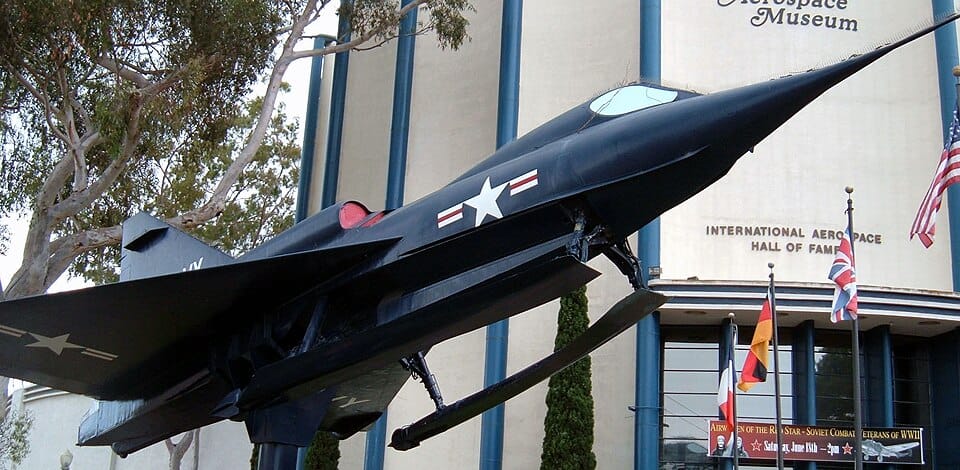
Four Sea Darts survive today — more than almost any other experimental fighter of the era. They sit in museums in San Diego, Willow Grove, Fort Lauderdale, and at the Wings of Freedom Aviation Museum, their delta wings and ski undercarriages a physical reminder of a moment when the Navy seriously considered abandoning runways and carrier decks for open water.
The Convair F2Y Sea Dart broke the sound barrier exactly once. It remains, to this day, the only seaplane ever to do so. That record will almost certainly stand forever.
Sources: Defense Media Network, Simple Flying, Flightline Weekly, Super Sabre Society
Every fighter pilot trains for it. Most pray they'll never experience it. The moment a jet engine — the machine that keeps you flying at 500 knots and 30,000 feet — stops working. Whether it's a compressor stall that sounds like a cannon going off behind your seat, a...
Luca Parmitano has lived two lives that most people only dream about. In the first, he was a fighter pilot — flying AMX Ghibli attack jets for the Italian Air Force, deployed to Afghanistan, trained to fly low and fast into hostile territory. In the second, he became...
Before the Rafale, before the Mirage 2000, before the Mirage F1 — there was the Mirage III. Dassault's first supersonic fighter was a revelation when it entered service in 1961: a sleek, tailless delta that could break Mach 2, carry a nuclear bomb, and outfight...



 English
0 Comments