
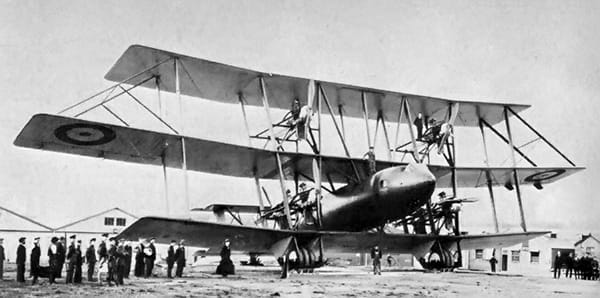
The plan was a knockout punch. Tarrant of Byfleet, Surrey — a firm of timber merchants — would build the largest aircraft in the world, fly it from England to Berlin, and bomb the Kaiser into submission. The aircraft would have three wings to spread the lift, six 450-horsepower Napier Lion engines arranged in tandem pairs, and a 131-foot wingspan that would carry it across continents.
The Tarrant Tabor took off for the first time on 26 May 1919, exactly 107 years ago this week. Its first flight attempt ended within seconds of the throttles going forward. Both test pilots died of their injuries. The aircraft never flew again.
Quick Facts
Designer: W. G. Tarrant Ltd, Byfleet, Surrey
First (and only) flight: 26 May 1919, RAF Farnborough
Wingspan: 131 ft 3 in (40.0 m) — largest in the world at the time
Wings: 3 (triplane)
Engines: 6× Napier Lion (2,700 hp total)
Crew lost: Capt. F. G. Dunn (pilot), Capt. P. T. Rawlings (co-pilot)
Duration of first flight: seconds — the Tabor nosed over during its take-off roll
A timber merchant's bomber
W. G. Tarrant of Byfleet was, in 1918, a successful timber and building materials supplier. He was also a patriot, and the war was not yet won. Tarrant, whose firm had been subcontracted to build aircraft components during the war, assembled his own design team — led by Walter Barling — to create a strategic bomber that could carry the war to Berlin, a role for which the Handley Page V/1500 had already been commissioned. The giant was assembled in a balloon shed at Farnborough.
The aircraft that emerged from Tarrant's drawing office was an extraordinary thing. It had a 131-foot wingspan, three identical wings stacked vertically, and a fuselage that ran the full length of the middle wing. The empty weight was 24,750 pounds. The all-up weight was meant to be 44,672 pounds — and before the first flight, 1,000 pounds of lead ballast was added in the nose to correct the balance, against Tarrant's wishes.
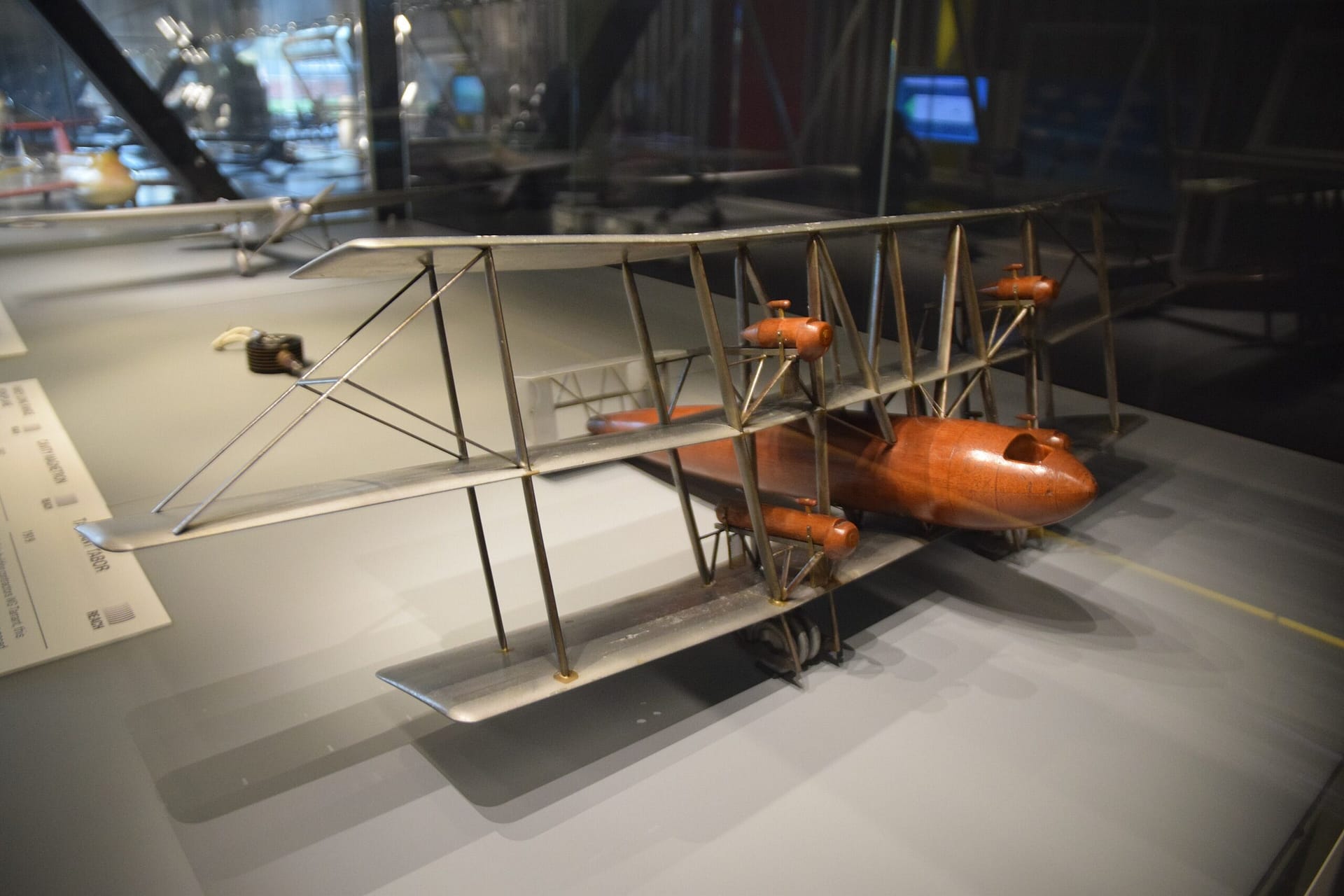
The engine arrangement was the killer. Of the six 450-hp Napier Lion engines, four were mounted in tandem push-pull pairs between the lower and middle wings. The other two were single tractor engines mounted in the gap between the middle and upper wings, well above the centreline of the aircraft.
26 May 1919 — twelve seconds
Captain F. G. Dunn was a senior test pilot at the Royal Aircraft Establishment at Farnborough. His co-pilot, Captain P. T. Rawlings, was a decorated former naval bomber pilot. On the morning of 26 May 1919 they taxied the Tabor around the Farnborough landing field in a wide circle on its four lower engines — and, satisfied with its behaviour, attempted the first flight.
Their procedure was to apply power gradually. The take-off roll began on the four lower engines. The aircraft accelerated, the tail came up, and the machine was intermittently lifting off its main wheels. Then the two upper engines were brought up to power. Their thrust line was far above the aircraft's centre of gravity, and the nose-down pitching moment they produced exceeded what the elevators could counteract.
What the Tabor taught aviation
Later analysis identified the cause: the thrust line of the upper engines was too far above the aircraft's centre of gravity. The Tabor became a textbook case of thrust-line geometry — the relationship between an engine's thrust vector and an aircraft's centre of mass — and designers of later multi-engine aircraft took care to keep thrust lines as close to the centre of gravity as practicable.
The Tabor itself was the end of a brief, glorious, mostly-doomed era of giant multi-engine biplanes and triplanes. The Caproni Ca.4, the Sikorsky Ilya Muromets, the Handley Page V/1500 and the Tabor were all attempts to do strategic bombing before the technology really existed. None survived the 1920s. The next time strategic bombers flew from Britain against Germany, in 1939–40, they would be all-metal monoplanes — two decades and an entire era of aircraft construction later.
Tarrant the firm closed its aviation division after the crash and went back to timber. The wreckage was carted off Farnborough in pieces. The Air Ministry quietly lost its appetite for giant wooden bombers. The Tabor remains, in 2026, one of the most spectacular single-flight disasters in aviation history — and the lesson it taught was absorbed so thoroughly that the mistake was rarely repeated.
Sources: Royal Aircraft Establishment, Imperial War Museum, Air Ministry archives.
Related Questions
What was the Tarrant Tabor?
The Tarrant Tabor was a giant British triplane bomber of 1919, briefly the largest aircraft in the world with a 131-foot wingspan and six engines. It crashed on its very first takeoff, killing both pilots — and never flew again.
Why did the Tarrant Tabor crash?
On its first takeoff in 1919, the towering triplane nosed over within seconds. Its upper engines, mounted high above the fuselage, pushed the nose down during the takeoff run, flipping the aircraft forward before it could ever get airborne.
How big was the Tarrant Tabor?
It had a wingspan of 131 feet 3 inches (40 m) — the largest in the world at the time — with three stacked wings and six Napier Lion engines producing 2,700 horsepower. It was an enormous machine built to bomb Germany at long range.
Who built the Tarrant Tabor?
It was built by W. G. Tarrant Ltd of Byfleet, Surrey — a timber and construction firm that had branched into aircraft late in World War I. The Tabor was its hugely ambitious attempt at a giant long-range bomber.
Did the Tarrant Tabor ever fly?
No. Its first and only flight attempt, on 26 May 1919 at Farnborough, lasted only seconds: the aircraft nosed over on the takeoff roll and crashed, killing pilots Captain F. G. Dunn and Captain P. T. Rawlings before it ever truly flew.
0 Comments