
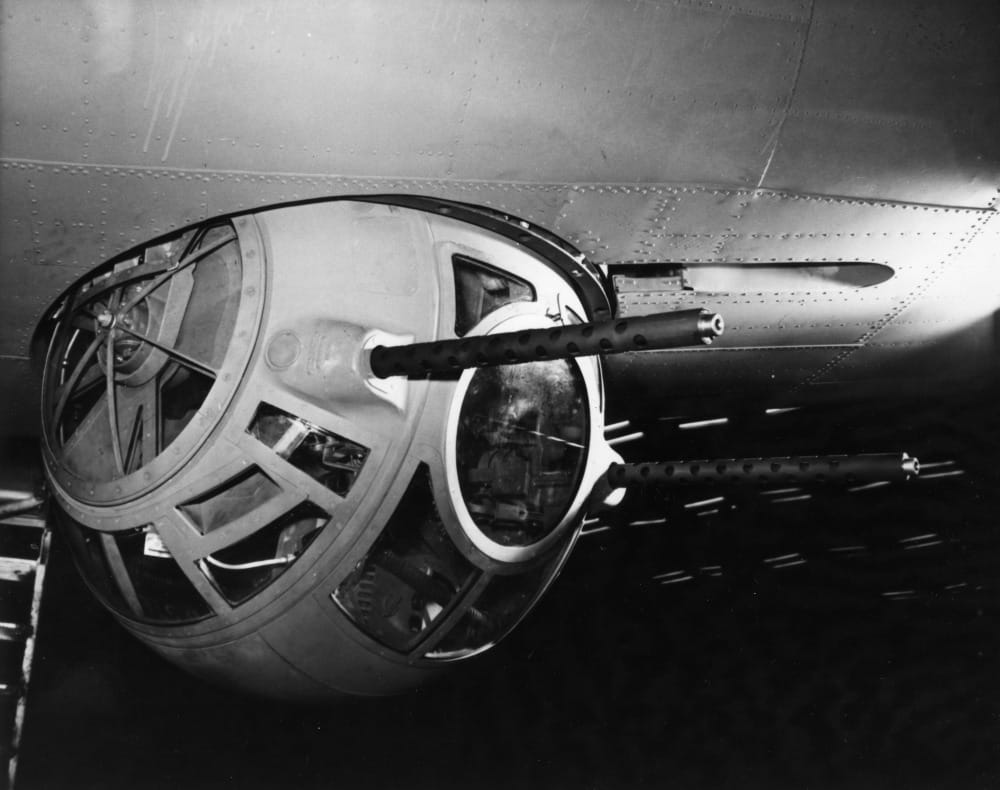
The sphere was forty-four inches across — barely wider than a dining room table. Inside it, a young man curled into the fetal position, his knees drawn to his chest, his back pressed against the curved Plexiglas wall that separated him from 25,000 feet of frozen sky. He had no room for a parachute. He could not exit without help. And he was hanging beneath the belly of a B-17 Flying Fortress, staring straight down at the flak-pocked landscape of occupied Europe through nothing but a pane of glass and his own two machine guns.
This was the Sperry ball turret — the most claustrophobic combat station in the history of aerial warfare, and the one that killed, maimed, and psychologically shattered more young Americans per cubic foot than any other position on any aircraft, in any war.
- Diameter: 44 inches (112 cm) — the gunner entered through a door just 15 inches off the ground
- Armament: Two .50-caliber M2 Browning machine guns, ~500 rounds per gun
- Rotation speed: Up to 45°/sec azimuth, 30°/sec elevation via electro-hydraulic controls
- Parachute: Most gunners could not fit one inside the turret
- Service ceiling: B-17 missions typically flown at 25,000–28,000 feet
- Operational period: 1943–1945 (Eighth Air Force, European Theater)
Getting In: A One-Way Ticket Until Someone Helped You Out
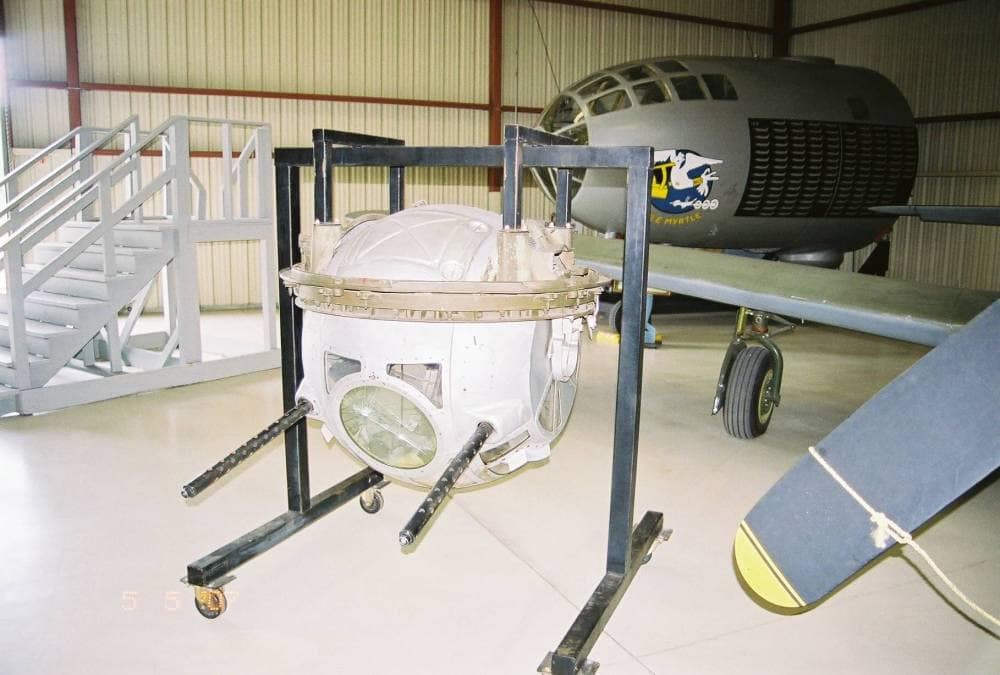
The ball turret could not be entered from inside the aircraft while it was on the ground — the guns pointed straight down, and the entry hatch faced the fuselage only when the turret was rotated to a specific position. Since the turret hung just 15 inches above the tarmac, climbing in from outside before takeoff meant riding through the entire takeoff run in a Plexiglas bubble with your face a foot from the concrete.
Most gunners waited. They entered after the bomber was airborne and the turret was rotated so its hatch aligned with the fuselage opening. They squeezed through, feet first, and folded themselves into a space designed for men no taller than 5’4″ and no heavier than 140 pounds. Their backs and heads pressed against the rear wall. Their feet rested on two small pedals on the front wall. Between their legs sat the computing gunsight. On either side, the breeches of the twin Brownings.
No Parachute, No Exit: The Gunner’s Bargain
The ball turret was the only crew station on a B-17 where the gunner routinely flew without a parachute within arm’s reach. The chest-type chute pack simply could not fit inside the sphere with the man wearing it. Instead, it hung on a hook inside the fuselage — reachable only after the turret was rotated to the exit position and someone inside the plane helped the gunner climb out.
If the hydraulic system was shot out, the turret could not rotate. If the electrical backup failed, the gunner was trapped. Crew members sometimes used hand cranks to manually reposition the turret, but under combat conditions — with the aircraft taking hits, on fire, or in an uncontrolled descent — there was often no time.
The Belly Landing Nightmare
Every ball turret gunner knew the scenario. If the B-17’s landing gear was shot away or failed to deploy, the bomber would have to make a belly landing — sliding along the runway on its fuselage. The ball turret protruded below that fuselage. The math was simple and terrible: the turret would be crushed on contact with the ground, and anyone inside it would die.
Andy Rooney, who served as a Stars and Stripes war correspondent and flew on bombing missions over Europe, later wrote about witnessing exactly this scenario — a crippled B-17 coming in with its gear up while the ball turret gunner was trapped inside, the turret unable to rotate. The crew above knew. The gunner below knew. There was nothing anyone could do. The stories of trapped gunners being killed in belly landings became one of the most feared realities of Eighth Air Force bomber operations.
“Six Inches From Death”: The Poem That Captured the Horror
Poet Randall Jarrell, who served as a celestial navigation instructor in the Army Air Forces during the war, distilled the ball turret gunner’s experience into five lines that became one of the most famous war poems ever written. Published in 1945, “The Death of the Ball Turret Gunner” compressed birth, combat, and death into a single devastating metaphor:
Jarrell later explained that the poem’s central image — the gunner curled in the turret like a fetus in the womb — was literal. When tracking an attacking fighter from below, the gunner revolved with the turret, and hunched upside-down in his little sphere, he looked exactly like an unborn child. The poem’s final line, in which the dead gunner’s remains are washed out of the turret with a hose, was not literary invention. It was standard operating procedure after a turret took a direct hit.
Legacy: The Smallest, Bravest Space in Aerial Warfare
Approximately 20,000 ball turret gunners served in the European and Pacific theaters during World War II. The Sperry ball turret was used on the B-17 Flying Fortress, B-24 Liberator, and several other bomber types. The men who manned them were always the smallest members of the crew — selected specifically because they were the only ones who could fit.
They fought in a space no larger than a clothes dryer, at altitudes where the temperature dropped to minus 60 degrees Fahrenheit, with no room for a flak vest, no room for a parachute, and no way to get out without help. The ball turret was retired after the war. No aircraft has used one since. The men who served in them are almost all gone now. But the 44-inch sphere they called home for hours at a time remains one of the most extraordinary testaments to human courage — and human expendability — in the history of warfare.
 English
0 Comments