
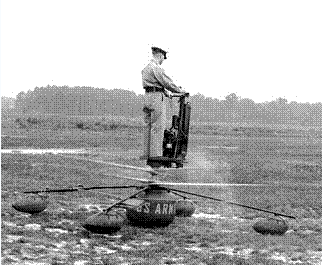
Imagine strapping yourself to a platform no larger than a manhole cover, powered by counter-rotating helicopter blades spinning beneath your feet, with nothing between you and the ground but air and optimism. Now imagine the U.S. Army telling you that any soldier could learn to fly it in 20 minutes.
That was the promise of the De Lackner HZ-1 Aerocycle — one of the most audacious and terrifying experimental aircraft of the Cold War era. Developed in the mid-1950s, this one-man flying platform was supposed to revolutionize battlefield reconnaissance. Instead, it became a cautionary tale about the gap between futuristic ambition and the unforgiving laws of physics.
Quick Facts: De Lackner HZ-1 Aerocycle
- Manufacturer: De Lackner Helicopters, Mount Vernon, New York
- Designer: Lewis C. McCarty Jr.
- First tethered flight: November 22, 1954
- First free flight: January 1955, Brooklyn Army Terminal
- Engine: ~40 hp Mercury Marine outboard motor
- Rotor diameter: 15 ft (4.6 m), contra-rotating
- Max speed: 75 mph (121 km/h)
- Range: ~15 miles; endurance ~45 min
- Ceiling: 5,000 ft (theoretical — never tested)
- Units ordered: 12 (serial numbers 56-6928 to 56-6939)
- Status: Cancelled after two crashes; one survivor at the U.S. Army Transportation Museum, Fort Eustis
Born from the Atomic Battlefield
The early 1950s were a time of extraordinary — and sometimes reckless — military innovation. The Cold War had introduced the terrifying possibility of nuclear combat, and military planners believed future battlefields would be irradiated wastelands where conventional vehicles couldn't survive. What they needed, they decided, was a personal flying machine: something small, cheap, and simple enough that an ordinary infantry soldier could fly it straight out of a foxhole.
Lewis C. McCarty Jr., an engineer at De Lackner Helicopters in Mount Vernon, New York, thought he had the answer. His concept — originally called the DH-4 Helivector — was radical in its simplicity. A cross-shaped frame. A standing platform for the pilot. Two counter-rotating blades spinning below, powered by a modified Mercury Marine outboard motor producing about 40 horsepower. The pilot would steer by simply leaning in the direction they wanted to go, the way you'd ride a Segway — except at altitude, at 75 mph, above spinning blades.
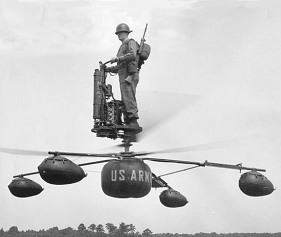
Twenty Minutes to Solo
The Army's vision was breathtaking in its optimism. According to the original specifications, the Aerocycle would require just 20 minutes of training before a soldier could fly it into combat. The prototype made its first tethered flight on November 22, 1954, and its first free flight followed in January 1955 at the Brooklyn Army Terminal. Early results looked promising — McCarty himself demonstrated the machine, and it seemed to fly with an almost magical ease.
Over 160 flights totaling more than 15 hours of flight time were logged during the initial test program. The results were encouraging enough that the Army ordered a dozen production models, assigned serial numbers 56-6928 through 56-6939, and officially designated the craft the YHO-2 — later redesignated HZ-1 Aerocycle.
The Fort Eustis Reckoning
In 1956, testing moved to Fort Eustis, Virginia, where Captain Selmer Sundby took over the flight evaluation. Sundby was an experienced test pilot — exactly the kind of skilled aviator the Aerocycle was supposed to not need. And yet, even he quickly realized the platform was dangerously unpredictable.
The fundamental problem was physics. The counter-rotating rotors were supposed to cancel out torque, but they were precariously close together. During aggressive maneuvering, the blades could intermesh — and when they did, the consequences were instant and catastrophic. The blades shattered on contact, and the platform dropped like a stone.
Two crashes ended the program. Both occurred under nearly identical conditions: the contra-rotating blades collided mid-flight, shattering instantly and sending the Aerocycle plummeting. In one incident at forty feet, Captain Sundby broke his leg. The dream of a flying infantryman died on the grass at Fort Eustis.
The Dream That Never Dies
The Aerocycle was far from the only attempt to give soldiers personal flight. The same era produced the Hiller VZ-1 Pawnee (a similar standing platform with ducted fans), the Bensen Gyro-Glider, and — decades later — the Williams X-Jet. None reached operational service. The human body, it turned out, was a terrible flight control system — at least with 1950s technology.
But the dream never died. Today, companies like Jetpack Aviation, Gravity Industries, and the U.S. military's own research programs are revisiting personal flight with modern materials, digital flight controls, and electric propulsion. The British Royal Marines have tested Gravity Industries' jet suit for ship-boarding operations. The U.S. Special Operations Command has evaluated several personal flight systems. The fundamental concept McCarty pursued in 1954 — one person, flying freely — is closer to reality than ever before.
Of the twelve HZ-1 Aerocycles the Army ordered, only one survives. It sits quietly in the U.S. Army Transportation Museum at Fort Eustis — the same base where Captain Sundby broke his leg trying to tame it. A monument to an era when military ambition outran engineering reality, and a reminder that the line between visionary and reckless is often drawn in hindsight.
Related Questions
What was the De Lackner HZ-1 Aerocycle?
The De Lackner HZ-1 Aerocycle was a one-man flying platform developed in the mid-1950s. The pilot stood on a small platform above two contra-rotating rotors powered by a roughly 40 hp Mercury Marine outboard motor, steering by leaning. It was meant to give infantry personal flight but was cancelled after crashes.
Who designed the De Lackner HZ-1 Aerocycle?
Lewis C. McCarty Jr., an engineer at De Lackner Helicopters in Mount Vernon, New York, designed it. He conceived it as a simple personal flying machine that an ordinary soldier could operate straight out of a foxhole.
How fast could the HZ-1 Aerocycle fly?
It had a top speed of about 75 mph (121 km/h), a range of roughly 15 miles, and an endurance of about 45 minutes. Its theoretical ceiling of 5,000 feet was never actually tested.
How did the pilot control the HZ-1 Aerocycle?
The pilot steered by leaning in the direction they wanted to travel, much like riding a Segway, while standing on a small platform above the spinning rotors. The Army optimistically claimed a soldier could learn to fly it with just 20 minutes of training.
Why was the HZ-1 Aerocycle developed?
Cold War planners expected future battlefields to be irradiated nuclear wastelands where conventional vehicles could not survive. They wanted a small, cheap personal flying machine that an ordinary infantryman could fly straight out of a foxhole for battlefield reconnaissance.
Why was the HZ-1 Aerocycle cancelled?
The program was cancelled after two crashes. Although it completed over 160 flights, the contra-rotating rotors posed a fatal risk and the leaning control method proved too dangerous for ordinary soldiers. One surviving example is preserved at the U.S. Army Transportation Museum at Fort Eustis.
When did the HZ-1 Aerocycle first fly?
Its first tethered flight took place on November 22, 1954, and its first free flight followed in January 1955 at the Brooklyn Army Terminal.
Sources
- De Lackner HZ-1 Aerocycle — Wikipedia
- Doomed from the Start — War History Online
- The HZ-1 Aerocycle: Ahead Of Its Time Or Just Dangerous? — AvGeekery
- Mind Your Step: The De Lackner HZ-1 Aerocycle — Military Matters
- U.S. Army Transportation Museum — Fort Eustis
- De Lackner HZ-1 Aerocycle: Redefining Mobility — PlaneHistoria
0 Comments