
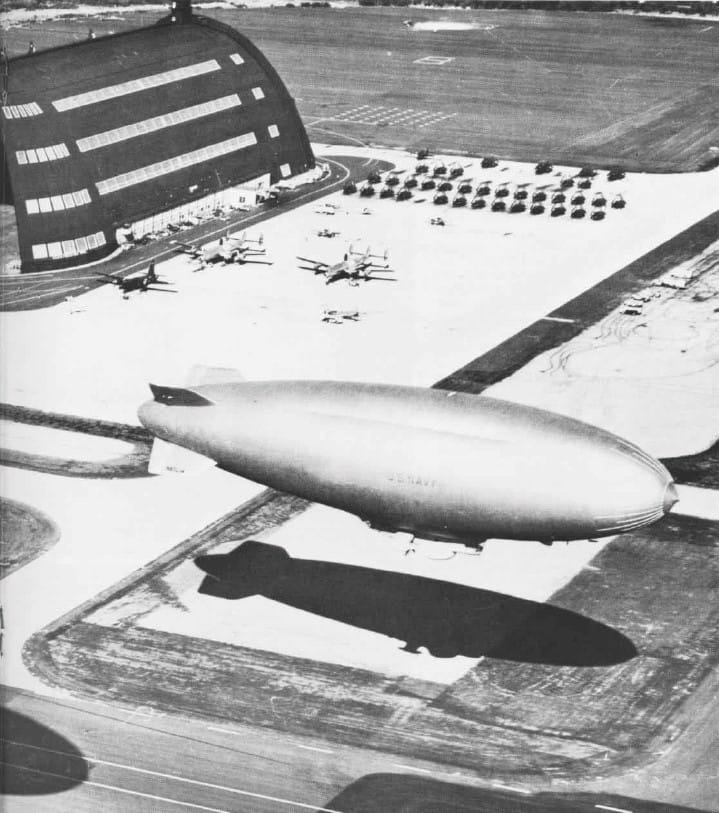
On the evening of 4 March 1957, a US Navy patrol blimp lifted off the apron at Naval Air Station South Weymouth, Massachusetts, and pointed itself east, towards the Atlantic Ocean. Its envelope was 343 feet long. Its registration was Bureau Number 141561 and its name, painted on the gondola, was Snow Bird. It belonged to Squadron ZP-1, one of the Navy’s last lighter-than-air patrol squadrons, and its commander was Jack Hunt — full title, Commander Jack R. Hunt, USN.
Eleven days later, Snow Bird touched down at Naval Air Station Key West, Florida. It had flown 9,448 miles — from Boston east across the Atlantic, down the coast of Portugal, south past Morocco and the Cape Verde Islands, picked up the easterly trade winds off West Africa, and then ridden them west across the South Atlantic to the Caribbean and home. It had been airborne, continuously, for 264 hours and 12 minutes. It had not refuelled. It had not even passed through any restricted airspace except its own. And in doing so, it set the world record for the longest unrefuelled flight ever made by a crewed aircraft.
That record has now stood for 69 years. As of 2026, it is still the longest non-stop, unrefuelled flight ever made by a crewed aircraft. No aeroplane, no airship, no piloted experimental vehicle has ever beaten it. The aircraft that holds it was a US Navy non-rigid airship of a class the Navy retired wholesale five years after the flight, in 1962. The man who flew it received the Harmon International Trophy from President Eisenhower. And then, within a generation, the entire achievement was largely forgotten.
Aircraft: Goodyear ZPG-2 patrol airship “Snow Bird”, BuNo 141561
Squadron: ZP-1, US Navy (lighter-than-air patrol)
Commanding officer: Cdr. Jack R. Hunt, USN
Co-pilots: Cdr. Ronald W. Hoel, Lt. Cdr. Robert S. Bowser
Takeoff: NAS South Weymouth, MA — 4 March 1957
Landing: NAS Key West, FL — 15 March 1957
Duration: 264 hours, 12 minutes (11 days)
Distance: 9,448 miles (15,205 km)
Route: Atlantic eastbound → Portugal → West Africa → Cape Verdes → Caribbean → Key West
Award: Harmon International Trophy (Aeronaut category), presented by President Eisenhower, 12 November 1958
Record status: Still the longest unrefuelled flight by any crewed aircraft — 69 years later
A Navy That Still Owned Blimps
To understand why a Navy blimp set the longest-flight record in 1957, you have to remember what kind of Navy that was. The US Navy in the mid-1950s still owned and operated a substantial fleet of lighter-than-air ships for anti-submarine patrol over the western Atlantic and eastern Pacific. The argument for blimps, against the helicopter and the fixed-wing maritime patrol aeroplane, was endurance. A blimp could loiter, slowly, over the same patch of ocean for days at a time. A submarine had to surface to recharge its batteries; sooner or later it would come up, and a patient airship overhead would see it. Endurance, in 1955, was a tactical asset.
The ZPG-2 was the workhorse of this strategy — a 343-foot Goodyear-built non-rigid (which is to say, the shape was held by internal gas pressure, not an internal frame), with two 800-horsepower Wright Cyclone radial engines, a four-blade variable-pitch propeller on each, and a crew compartment slung underneath. It could carry up to 14 people in shifts, mounted ASW sensors and depth charges, and was specifically rated for ten-day patrols. The fact that you could push one of them all the way across the Atlantic was, on paper, a known capability. What no-one had done was actually do it.
The Navy’s flight, had the official purpose of demonstrating that the ZPG-2 could conduct extended ASW operations far from its home base — theoretically, anywhere in the Atlantic. The unofficial purpose was to make a point. The fixed-wing community, the helicopter community, and the missile community had all spent the past few years arguing that the Navy’s lighter-than-air arm was obsolete and should be retired. Hunt and his crew were going to fly to Africa and back to prove otherwise.

Eleven Days in the Air
Snow Bird lifted off South Weymouth on the evening of 4 March in good weather. The crew of fourteen settled into watch rotations. The flight east across the Atlantic took roughly three days; by the evening of 7 March, the airship was passing south of the Azores and approaching the south-west tip of Portugal. They turned south. By the morning of 8 March, the Snow Bird was over Casablanca, Morocco. The Atlantic Ocean had been crossed.
From the African coast, the route turned southwest toward the Cape Verde Islands, picking up the easterly trade winds that have moved sailing ships and lighter-than-air vehicles across the South Atlantic for five hundred years. By 11 March they had cleared the Cape Verdes. By the 13th they were over the central Atlantic on the long downwind leg back to the Western Hemisphere. By the night of 15 March, just over eleven days after they had left Massachusetts, Snow Bird crossed the Florida Keys and touched down at NAS Key West. The crew, by all accounts, was exhausted but functional. The two Wright engines had run almost the entire eleven days. The fuel reserves at landing were nearly exhausted.
The flight beat the previous unrefuelled endurance record, then standing at roughly 200 hours, by a margin of more than two and a half days. It also smashed the lighter-than-air distance record — 6,980 miles, set by the Graf Zeppelin in 1929. It was the first — and to date, only — case of an airship making two ocean crossings in a single, unbroken flight. And the record, the genuinely jaw-dropping part, has never been broken by anything else. Not the U-2 (which can fly long but can’t run that long on internal fuel). Not the Voyager that Dick Rutan flew around the world non-stop in 1986 (which made it about 216 hours).
President Eisenhower, the Harmon Trophy, and Quiet Obscurity
The Snow Bird flight was front-page news for about four days in March 1957. The New York Times ran a full feature on it. Hunt received a flood of congratulatory telegrams. On 12 November 1958, in a ceremony at the White House, President Dwight Eisenhower personally presented him with the Harmon International Trophy in the Aeronaut category. Hunt was, in a quiet way, an aviation celebrity for about six months.
Then the Navy began winding down its blimp programme. The argument was familiar — faster, fixed-wing patrol aircraft like the P-3 Orion could cover more ocean in less time, and the helicopter-equipped destroyer could prosecute a submarine contact directly. In 1962, the Navy retired the last of its operational blimps. The ZP-1 squadron was decommissioned. Hunt himself left the Navy and went into academia, becoming the first president of Embry-Riddle Aeronautical University in 1963 — the institution that today trains more US airline pilots than any other.
And the Snow Bird itself? The airship was deflated in 1958, its envelope folded and stored, and its gondola eventually transferred to the National Naval Aviation Museum at Pensacola, Florida, where it is on display today. The two-seat cockpit you can walk past in Hangar Bay One is the same cockpit Hunt and Hoel and Bowser sat in for 264 hours. The instruments are still in place. The engine throttle quadrant is still bolted to the bulkhead. Snow Bird is the holder of a flight record nothing in the air has ever come close to beating — and you can walk up to it on a Tuesday afternoon in Pensacola, in 2026, and absolutely no-one else will be looking at it.
A Record That Won’t Be Broken
The strange thing about the Snow Bird record is how technically unbeatable it has turned out to be. The combination of factors that allowed it — a slow-flying lighter-than-air vehicle with diesel-thrifty piston engines, a 14-person crew rotating through round-the-clock shifts, and access to the easterly trade winds for a free downwind run home — isn’t replicable with any current military or civilian aircraft. The Voyager came close in 1986 in distance, but had to keep flying continuously around a fixed great-circle route at relatively high speed to make 216 hours. A modern endurance UAV like the Zephyr can stay aloft on solar power, but it isn’t really making an unrefuelled, single-tank flight in the conventional sense. The Snow Bird record sits, slightly absurd, slightly forgotten, like a high-water mark left on a wall in a flood that nobody remembers happening.
Hunt, who died in office in 1984, led Embry-Riddle for 21 years. He spent the rest of his career building one of the great aviation universities in the United States. Almost none of the students who graduate from Embry-Riddle today know that their founding president once flew, with two co-pilots and twelve crew, from Massachusetts to Florida via West Africa, in a blimp, in 1957, and that the record he set on that flight is still standing.
Sources: Naval History and Heritage Command (ZPG-2 Snowbird); National Naval Aviation Museum, Pensacola; This Day in Aviation; Smithsonian Air & Space Magazine (“The Unknown Aeronaut”); BlimpInfo.com; Wikipedia (N-class blimp).
Related Questions
What was the Snow Bird flight?
In March 1957, the US Navy airship Snow Bird, a Goodyear ZPG-2 patrol blimp, flew 9,448 miles from Massachusetts across the Atlantic and back to Key West, Florida. It stayed airborne continuously for 264 hours and 12 minutes without refueling, setting the record for the longest unrefuelled crewed flight.
What is the longest unrefuelled flight ever made?
The Snow Bird's 1957 voyage of 264 hours and 12 minutes, about 11 days, remains the longest non-stop, unrefuelled flight by any crewed aircraft. As of 2026 the record has stood for 69 years and has never been beaten by any aeroplane, airship, or piloted vehicle.
What aircraft set the longest unrefuelled flight record?
A US Navy ZPG-2 patrol airship, or blimp, named Snow Bird, Bureau Number 141561, of Squadron ZP-1. Its envelope was 343 feet long. The Navy retired this entire class of airships in 1962, five years after the record flight.
Who commanded the Snow Bird flight?
Commander Jack R. Hunt, USN, commanded the flight, with co-pilots Cdr. Ronald W. Hoel and Lt. Cdr. Robert S. Bowser. For the achievement, Hunt received the Harmon International Trophy, presented by President Eisenhower on 12 November 1958.
What route did the Snow Bird take?
It took off from NAS South Weymouth, Massachusetts, on 4 March 1957, flew east across the Atlantic past Portugal, Morocco and the Cape Verde Islands, picked up the easterly trade winds off West Africa, rode them west across the South Atlantic to the Caribbean, and landed at NAS Key West, Florida.
Why did the US Navy still operate blimps in the 1950s?
The Navy kept a fleet of lighter-than-air ships for anti-submarine patrol because of their endurance. A blimp could loiter slowly over the same patch of ocean for days, waiting for a submarine to surface and recharge its batteries, a valuable tactical asset in the mid-1950s.
Greetings,
Referencing this article about Jack Hunt.
The statement and opinion that ’almost none of the Embry-Riddle graduates know of his record.’
I am one!
But he was very quiet and humble about his record. His statement “We were all in that mission together!”
Met him in 1968 on my first day at Embry-Riddle Aeronautical Institute., later to be elevated to University.
“Son, Learn to fly Hot Air Balloons. We don’t teach that here but someday learn.” I did.
Thanks for sharing this Russell – that’s amazing!