
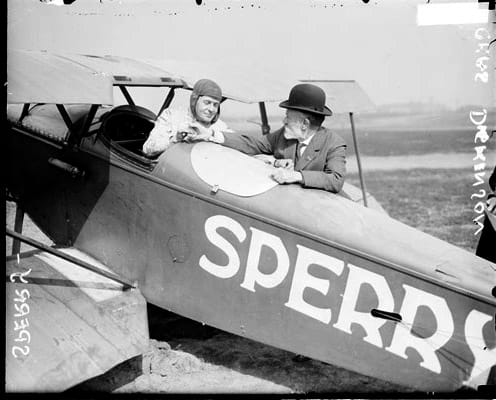
On the morning of 18 June 1914 — ten years and six months after Orville Wright lifted off Kitty Hawk — a 21-year-old American named Lawrence Burst Sperry flew a Curtiss C-2 biplane down the Seine at 50 feet above the water in front of a crowd of astonished Parisians. Halfway through the demonstration, he stood up in the cockpit and lifted both hands above his head. His mechanic, Émile Cachin, climbed out of the cockpit, walked along the lower wing, and balanced on the wingtip. The aircraft kept flying perfectly straight and level. The crowd, the French aviation press, and the panel of judges from the Aero-Club de France lost their minds.
The two men had just publicly demonstrated the world's first practical autopilot. They won the 50,000-franc Concours de la Sécurité prize. And they invented, almost as a side effect, the modern airliner.
| Inventor | Lawrence Burst Sperry (1892–1923), American aviator and engineer |
| Company | Sperry Gyroscope Company (founded 1910 by Elmer A. Sperry, Lawrence's father) |
| Device | Three-axis gyroscopic stabiliser ("Autopilot") |
| Public debut | 18 June 1914, Bezons, on the Seine northwest of Paris |
| First flight test | 1912, US Navy Curtiss F flying boat |
| Year of patent | US Patent 1,415,003, “Automatic Pilot for Aeroplanes” (filed 1916, granted 1922) |
| Lifetime patents | 23 aircraft-related patents at time of death (age 31) |
A teenager who solved straight-and-level
Lawrence Sperry was the son of Elmer Ambrose Sperry, the inventor of the marine gyrocompass and one of the foundational figures of American precision engineering. By the time Lawrence was fifteen, he had taught himself to fly on a Burgess-Wright biplane. By eighteen, he had earned his pilot's certificate. By twenty, he was an engineer at his father's company in Brooklyn — a company that was the world's leading authority on gyroscope-based stabilisation systems. The Sperry family's gyrocompasses were already installed on every major US Navy battleship of the day.
Lawrence's realisation was that the same gyroscope that kept a battleship pointing north could be made to keep an aircraft flying straight and level. Three gyroscopes — one for pitch, one for roll, one for yaw — could be connected through electric servomotors to the aircraft's control surfaces. If the aircraft deviated from straight-and-level flight, the gyroscopes would sense the deviation and the servomotors would move the controls to correct it. The pilot, theoretically, did nothing.

The Curtiss flying-boat tests
The first flight test of the Sperry stabiliser was conducted in late 1912 on a Curtiss F flying boat at Hammondsport, New York. The aircraft would take off, climb to a few hundred feet, and Lawrence would lock the gyroscopes — at which point the aircraft would fly itself, hands-off, for as long as fuel and patience permitted. The device worked. The problem was that nobody believed it.
So the Sperrys took it on the road. They demonstrated the device at private trials for the U.S. Army Signal Corps in 1913. Then, in the winter of 1913–1914, the French Aero-Club announced a competition for safety devices in aviation, with a grand prize of 50,000 francs (approximately $10,000 — a fortune at the time). The Sperrys shipped a Curtiss C-2 to Le Havre, fitted it with the autopilot, and arranged a public demonstration over the Seine on the day of the competition.

The Seine demonstration
On 18 June 1914, with Émile Cachin in the rear cockpit and thousands of Parisians along the river, Lawrence Sperry made his run. The first pass at 50 feet, both hands on the controls, was unremarkable. The second pass, Lawrence let go of the controls and stood up in the cockpit, waving at the crowd, while the aircraft flew level on autopilot. The third pass, Cachin climbed out of his cockpit, walked along the lower wing, and stood on the wingtip — deliberately introducing a massive asymmetric weight load that should have rolled the aircraft inverted. The autopilot compensated by deflecting the opposite aileron, and the aircraft kept flying straight.
The jury awarded the Concours de la Sécurité grand prize to Sperry and Cachin unanimously. The first international press headlines used the word "automatic pilot" — autopilot — for what they had seen. The First World War broke out six weeks later, and the autopilot disappeared into military development for the next decade. But the technology of every modern airliner traces back, directly, to that summer morning on the Seine.

The other thing Sperry invented
There is a single durable rumour about Lawrence Sperry that the engineering histories are reluctant to discuss. On 25 November 1916, his Curtiss flying-boat crashed into the Great South Bay off Long Island. He survived. His female passenger — a married Manhattan socialite named Mrs Waldo Polk — also survived. According to the story as it has been retold ever since, both were found naked in the wreckage — and the aircraft had been on autopilot. Sperry was widely credited with the practical invention of what would become known, much later, as the Mile-High Club. The aviation history community has spent a century arguing over whether the story is true. No fully verifiable contemporary account survives.
Sperry himself never confirmed the story. He died on 13 December 1923, ditching his Sperry Messenger in the English Channel during a flight from London to Brussels. His body was recovered weeks later. He was thirty-one years old. By the time of his death, every Allied military aviation agency had adopted variants of the Sperry stabiliser. By the early 1930s, no commercial passenger aircraft in production lacked one. From the 1980s onward, every fly-by-wire airliner in the world is, at its core, an industrial-scale evolution of what an American teenager built in his father's Brooklyn factory.
Sources: Smithsonian National Air and Space Museum, Sperry Gyroscope Company archives (Hagley Museum), HistoryNet, Simple Flying.
Related Questions
Who invented the autopilot?
Lawrence Burst Sperry, a young American aviator and engineer, invented the first practical aircraft autopilot. He publicly demonstrated his three-axis gyroscopic stabiliser on 18 June 1914 near Paris, just over ten years after the Wright brothers' first powered flight.
How did Sperry demonstrate his autopilot in 1914?
On 18 June 1914, Sperry flew a Curtiss biplane low over the Seine, then stood up and raised both hands while his mechanic climbed onto the wing, and the aircraft kept flying straight and level on its own. The stunt won the 50,000-franc Concours de la Sécurité safety prize.
How does a gyroscopic autopilot work?
Sperry's autopilot used spinning gyroscopes to sense the aircraft's attitude across three axes. When the plane drifted from level flight, the system automatically moved the controls to correct it, holding a steady heading and altitude without the pilot touching the controls.
How old was Lawrence Sperry when he invented the autopilot?
Sperry was 21 years old when he demonstrated his autopilot in 1914. A prodigy, he had taught himself to fly by age fifteen, earned his pilot's certificate by eighteen, and was working as an engineer at his father's company by twenty.
Who was Lawrence Sperry's father?
Lawrence Sperry was the son of Elmer Ambrose Sperry, inventor of the marine gyrocompass and founder of the Sperry Gyroscope Company in 1910. The elder Sperry was a foundational figure in American precision engineering, and the company led the world in gyroscope-based stabilisation.
When did Sperry patent the autopilot?
Sperry filed for his autopilot patent in 1916, and U.S. Patent 1,415,003, "Automatic Pilot for Aeroplanes," was granted in 1922. He held 23 aircraft-related patents by the time of his death at age 31 in 1923.

0 Comments