
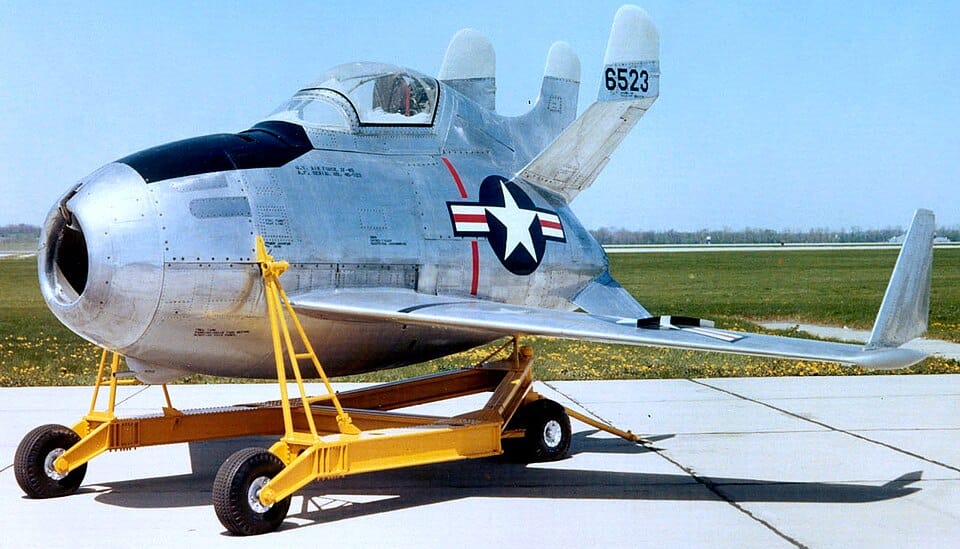
Picture, if you will, a jet fighter the size of a compact car. A fighter with no landing gear — because it was never supposed to land. A fighter designed to be stored in a bomb bay, dropped into combat, and then retrieved by flying back up to a moving bomber and hooking onto a trapeze dangling from its belly at 200 miles per hour. In turbulence. While both aircraft were flying. Now picture doing this in 1948, with 1948 avionics, and you start to understand why the McDonnell XF-85 Goblin is one of the most audaciously weird aircraft ever built — and why it failed.
The Goblin was not a joke. It emerged from a genuine and serious tactical problem: the Convair B-36 Peacemaker, America's primary strategic nuclear bomber, could fly nearly any target on earth but was slow, unmaneuverable, and desperately vulnerable to fighter interception. Escort fighters of the late 1940s lacked the range to accompany a B-36 on a 10,000-mile round trip to Moscow. So someone — many someones, apparently — thought: what if the B-36 carried its own escort fighters inside it? The concept was called a "parasite fighter," and the Goblin was the US Air Force's most ambitious attempt to make it work. It almost worked. Almost.
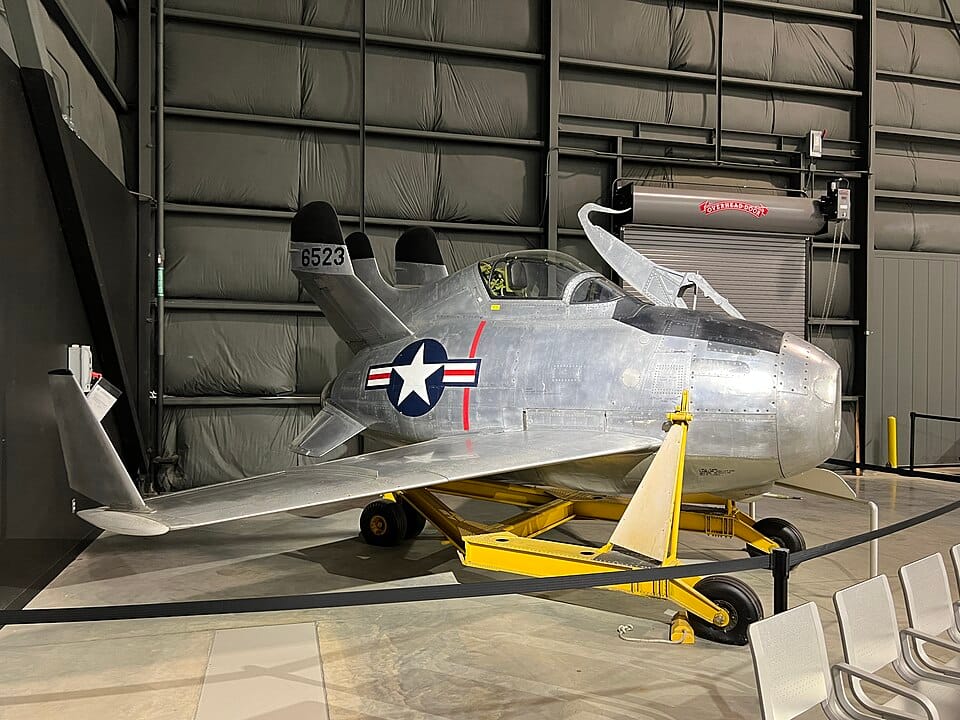
Today, one XF-85 Goblin sits in the National Museum of the United States Air Force in Dayton, Ohio. It is 14 feet and 10 inches long. Children stare at it. Adults laugh, then look closer, then stop laughing. Because the more you look at the Goblin, the more you realize that the men who built it were not crazy. They were just trying to solve an impossible problem, and they came disconcertingly close.
Quick Facts
Aircraft: McDonnell XF-85 Goblin
Role: Parasite fighter (carried inside B-36 bomb bay)
First flight: August 23, 1948 (from EB-29 mothership)
Engine: Westinghouse J34-WE-22 turbojet, 3,000 lb thrust
Top speed: 648 mph (estimated — never demonstrated in flight)
Length: 14 ft 10 in — the smallest American jet fighter ever built
Weight: 3,740 lb empty
Landing gear: None (designed to hook back onto mothership)
Test pilot: Edwin Schoch
Total built: 2 prototypes
Cancelled: October 24, 1949
Surviving example: NMUSAF, Dayton, Ohio
The Problem: A Bomber That Could Go Anywhere, Defended by Nothing
The Convair B-36 Peacemaker was, by any measure, an extraordinary machine. Powered by six piston engines plus four jet pods — "six turning, four burning" in the parlance of its crews — it could carry a nuclear weapon from bases in the continental United States to any point in the Soviet Union and return without refueling. Its service ceiling of 45,000 feet and its cruising altitude of 40,000-plus feet put it above most Soviet fighters of the late 1940s. It was the Air Force's primary deterrent, the weapon that kept the Cold War cold.
But the Korean War and the rapid improvement of Soviet jet fighter technology made it clear that the B-36's high altitude was not permanent protection. Soviet MiG-15s, appearing in Korea in late 1950, demonstrated performance that was genuinely alarming — a swept-wing jet with a service ceiling near 50,000 feet and a climb rate that could catch a B-36 before it reached its cruising altitude. B-36 crews needed escort fighters. But the distances involved — round trips of 8,000 to 12,000 miles — made conventional escort impossible. No fighter in 1949 had anything close to that range.
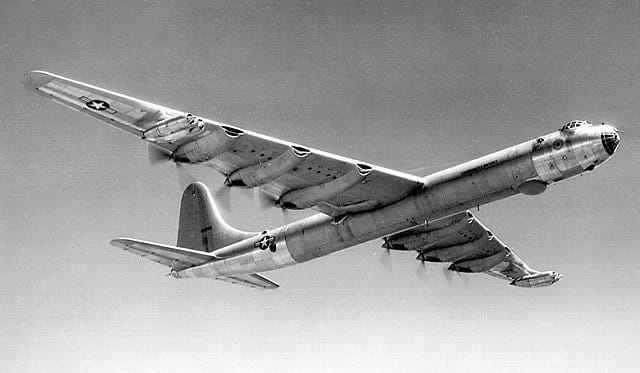
The parasite fighter concept was not new in 1948. The US Navy had experimented with airship-launched fighters in the 1930s, and the Soviets had briefly explored "Zveno" projects where biplane fighters were launched from and recovered to mothership bombers. What was new in the postwar era was the combination of jet propulsion and thermonuclear stakes: if a B-36 went down before delivering its weapon, the strategic mission failed. The Air Force wanted fighters that could go with the bombers all the way to the target. If the fighters had to live inside the bombers, so be it.
The Goblin: Engineering a Miracle in Miniature
McDonnell Aircraft Corporation received the contract in 1945, before the B-36 had even entered service. The specification was daunting: a jet fighter small enough to fit inside a B-36 bomb bay (roughly 33 feet long and 5 feet wide), capable of at least Mach 0.8, armed with four .50-caliber machine guns, and able to be deployed from and retrieved by the mothership in flight. It had to be a real fighter — not a missile, not a drone, not a toy — capable of engaging Soviet interceptors in a turning dogfight.
The design team at McDonnell, under chief engineer Herman Barkey, produced something that looks, in photographs, like a fever dream: a tiny egg-shaped fuselage with small swept-back folding wings, a nose intake for the single Westinghouse J34 turbojet, and a forked tail with an array of small fins arranged like fletching on an arrow. There was no landing gear — the Goblin was never expected to touch a runway. Instead, a retractable hook on the upper fuselage would catch the trapeze mechanism lowered from the mothership's bomb bay, allowing the Goblin to be winched back aboard while both aircraft flew in close formation. The hook was the Goblin's only way home.

The Goblin was quick. Its estimated top speed of 648 mph was respectable for 1948 — but it was never demonstrated in testing, though the MiG-15 it was designed to fight was faster. It handled reasonably well at cruise speeds. The swept X-wing configuration gave it adequate stability and sufficient lift for the performance envelope. On paper, as a pure performance exercise, the Goblin was a credible little interceptor. The problem was not the airplane. The problem was the hook.
Edwin Schoch and the Impossible Trapeze
Test pilot Edwin Schoch flew the XF-85 program, and his experience with the retrieval system is one of the great cautionary tales in aerospace history. The trapeze — a retractable boom and hook-catch assembly lowered from the mothership's bomb bay — seemed simple enough in ground testing. In the air, it was a different matter entirely.
The aerodynamic environment directly behind and below a large bomber at altitude is violent and chaotic. The B-36's wake — the turbulent air disrupted by its massive wing and fuselage — created a zone of unpredictable buffeting immediately below and aft of the aircraft. The EB-29 used for initial Goblin tests (the B-36 was not yet available) had similar wake characteristics at a smaller scale. Schoch described flying the Goblin in close proximity to the mothership as like trying to thread a needle while riding a mechanical bull. The Goblin was tossed by wake turbulence just as it needed to be positioned with millimeter precision to catch the trapeze hook.
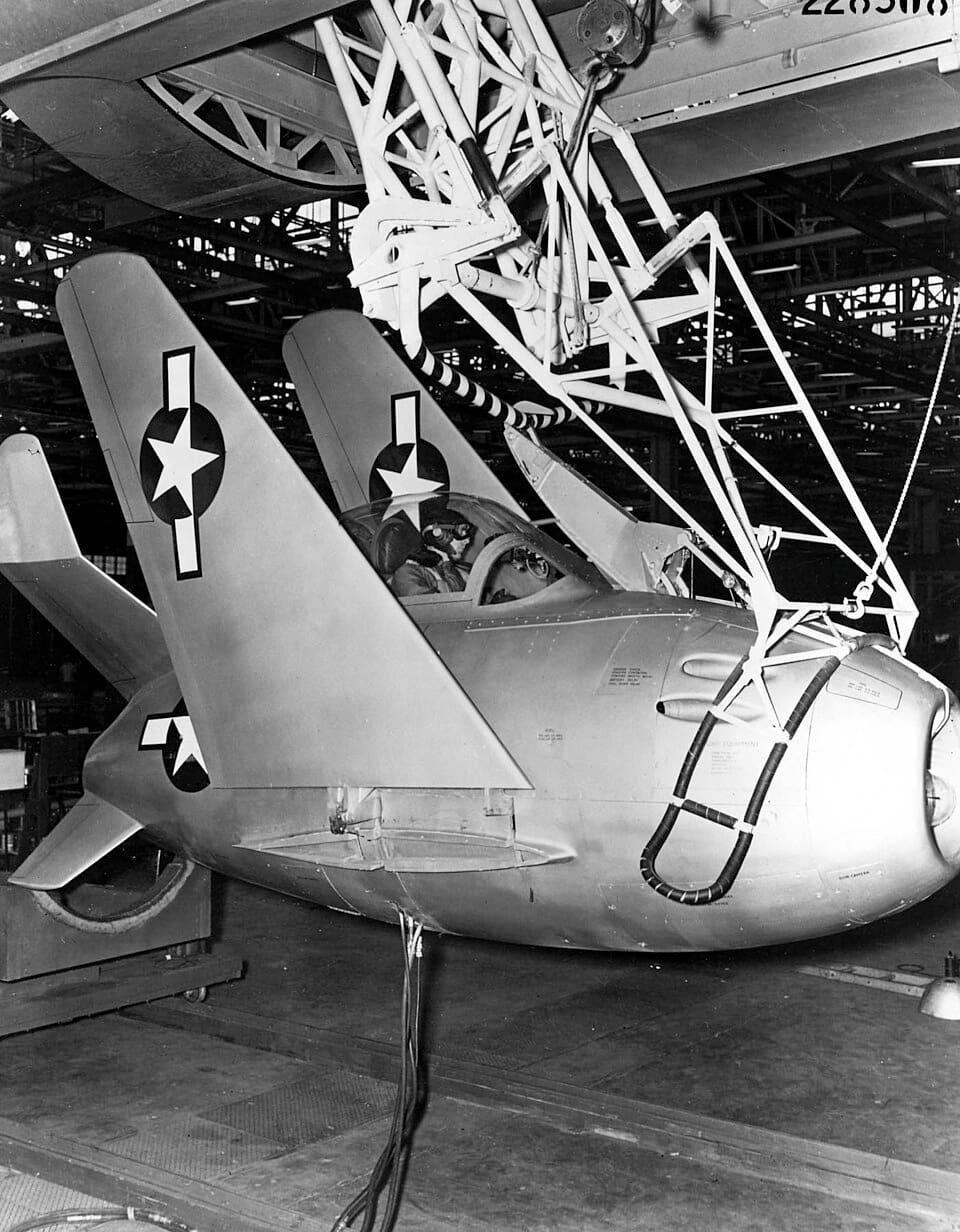
In seven free flights of the Goblin between August 1948 and April 1949, only three ended in a successful hookup — the rest ended in emergency belly landings on the dry lakebed. The other six attempts required multiple passes, with the Goblin bouncing and yawing in the bomber's wake while Schoch tried to coax the tiny aircraft into position. On one occasion, the Goblin struck the trapeze so hard during a retrieval attempt that the canopy was shattered and Schoch's helmet visor was cracked. He was lucky not to be killed. On another, the turbulence threw the Goblin so far off line that he had to break away and orbit for several minutes before attempting again.
It is worth pausing on this. The entire concept of the parasite fighter depended on retrieval. A fighter that could not reliably return to its mothership was a one-use weapon — a flying kamikaze with better-than-average aerodynamics. For the Goblin to function as intended, a pilot would need to accomplish in combat — possibly after a turning dogfight, possibly damaged, possibly in formation with Soviet fighters — what Schoch could barely accomplish in ideal test conditions. The retrieval problem was not a bug that could be engineered away. It was fundamental to the physics of the situation.
Cancellation, Consolation, and the Curse of the Parasite Fighter
The XF-85 program was cancelled on October 24, 1949. The official reasons were the retrieval problem and the Goblin's inadequate performance relative to the Soviet MiG-15, which had appeared that year and was demonstrably superior. But there was a third factor: aerial refueling. The development of practical airborne refueling for jet aircraft — the probe-and-drogue system that Boeing was perfecting — offered an alternative solution to the bomber escort problem that did not require carrying miniature fighters in bomb bays. A Republic F-84 Thunderjet that could be refueled in flight by a KC-97 tanker could escort a B-36 over far greater distances than any parasite fighter ever could.
The Air Force did not entirely abandon the parasite fighter concept, however. Two follow-on programs attempted to succeed where the Goblin had failed. The Republic RF-84K FICON (Fighter Conveyor) project mounted a modified F-84 below a GRB-36 bomber, which the fighter could dock with in flight via a retractable yoke. The F-84 was a larger, more capable aircraft than the Goblin — but the docking problem remained. And Project Tom-Tom, in 1953, attempted to carry F-84s on the wingtips of a B-36, tethered by flexible couplings. On one test flight, the wingtip F-84 began oscillating in the bomber's wake so severely that it nearly tore the B-36's wing off. The pilot emergency-released and landed separately. Tom-Tom was cancelled immediately.
Every parasite fighter program failed for essentially the same reason: the aerodynamic environment around a large bomber in flight is inherently hostile to precise formation flying by a smaller aircraft. The wake turbulence is violent, unpredictable, and unavoidable. What works in a wind tunnel does not always work in the sky behind 500,000 pounds of moving aluminum.
The surviving XF-85 — serial number 46-523, the first prototype — arrived at the NMUSAF in 1950 and has been on display ever since; the second prototype, 46-524, also survives, at the Strategic Air Command & Aerospace Museum in Ashland, Nebraska. It is, by any measure, a strange thing to look at: comically small, perched on a stand designed for a much larger aircraft, its four tiny wings folded like a dragonfly at rest. Visitors often mistake it for a scale model. When they realize it is full size, their expressions change.
There is something poignant about the Goblin. It represents an engineering team working with complete seriousness on a problem that turned out to be unsolvable — not because the concept was crazy, but because physics is inflexible. The hook worked in the hangar. The bomber's wake ruined it in the air. The gap between what you can build and what you can operate is often the most important engineering lesson of all, and the Goblin taught it with perfect clarity. In the 1948 test program over Muroc Air Force Base, Edwin Schoch proved something invaluable: some ideas that look brilliant on paper are simply, stubbornly impossible in the sky.
Sources: Jay Miller, "The McDonnell XF-85 Goblin"; National Museum of the United States Air Force; Peter Bowers, "United States Military Aircraft Since 1909"; Tony Buttler, "American Secret Projects: Fighters and Interceptors 1945–1978"; Wikipedia; Wikimedia Commons
Related Questions
What was the McDonnell XF-85 Goblin?
The McDonnell XF-85 Goblin was a tiny American "parasite" jet fighter designed to be carried inside the bomb bay of a Convair B-36 bomber, dropped in combat, and then retrieved in mid-air by hooking onto a trapeze. First flown in 1948, it was the smallest U.S. jet fighter ever built.
Why was the XF-85 Goblin built?
The Goblin was meant to solve the problem of defending the Convair B-36, a strategic bomber that could fly farther than any escort fighter. By carrying its own parasite fighter inside the bomb bay, the bomber could deploy fighter protection deep over enemy territory.
Why did the XF-85 Goblin fail?
The Goblin had no landing gear and depended on hooking back onto a trapeze beneath its mothership at around 200 mph, an extremely difficult maneuver, especially in turbulence. The mid-air retrieval proved too hard to perform reliably, and the program was cancelled in October 1949.
How big was the XF-85 Goblin?
The Goblin was just 14 feet 10 inches long and weighed about 3,740 lb empty, making it the smallest American jet fighter ever built, roughly the size of a compact car. Only two prototypes were ever constructed.
Does an XF-85 Goblin still exist?
Yes. A surviving XF-85 Goblin is preserved at the National Museum of the United States Air Force in Dayton, Ohio. Two prototypes were built before the program was cancelled in October 1949.
Related Posts
More History & Legends from the MiGFlug Blog

0 Comments