
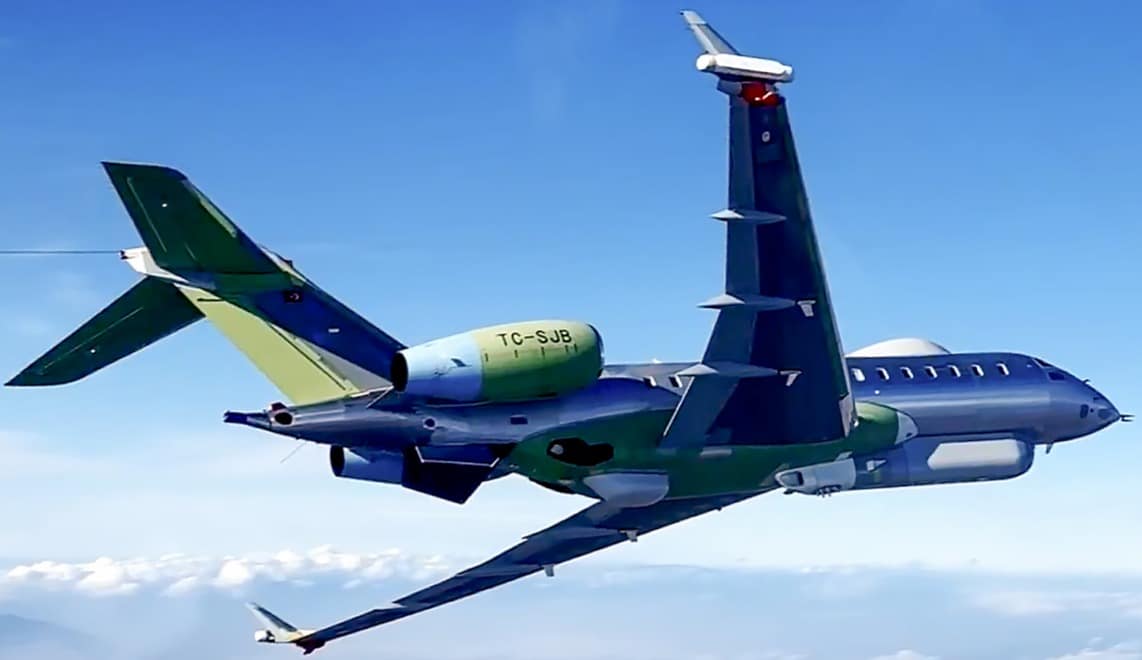
It looks, at a glance, like a rich man’s toy: a sleek Bombardier business jet, the kind that ferries executives between capitals. Then you notice the lumps. A long blade running down its spine, blisters under the belly, a fairing crowning the tail — and suddenly the executive jet looks like something that hunts radars.
This is Hava SOJ, and in early June it made its clearest public appearance yet, captured in a Turkish Ministry of National Defence video marking the 115th anniversary of the Turkish Air Force. It is Turkey’s first dedicated electronic-warfare aircraft — a machine built to go deaf and blind an enemy’s air defences from hundreds of kilometres away.
QUICK FACTS
| Aircraft | Hava SOJ (ASOJ 23-A) — Turkey’s first dedicated EW jet |
| Based on | Bombardier Global 6000 business jet |
| Built by | Turkish Aerospace (airframe) + ASELSAN (EW suite) |
| Job | Radar & comms jamming, plus signals intelligence |
| Reach | Effective jamming reportedly beyond 500 km |
| Ceiling | Around 51,000 ft |
| Fleet | 4 aircraft planned — first 2026, last by 2028 |
From boardroom to battlefield
The starting point is a Bombardier Global 6000, a long-range business jet that normally cruises high and quiet. Turkish Aerospace handles the airframe conversion; the defence electronics giant ASELSAN supplies the heart of the system — a suite that can jam radars and communications while gathering signals intelligence to measure whether the jamming is working.
The payoff is reach. Turkish sources put the aircraft’s effective jamming range beyond 500 kilometres, flown from an altitude of around 51,000 feet. That combination lets the jet loiter far outside the lethal envelope of enemy fighters and surface-to-air missiles, yet still reach in and scramble their sensors.

What a stand-off jammer actually does
The clue is in the name. An escort jammer flies into the fight alongside the strike package. A stand-off jammer does the opposite: it stays back — “stands off” — and projects its electronic noise across a great distance, blinding the radars that guide missiles and cueing fighters long before anyone gets close.
Done well, it tears holes in an integrated air-defence network through which strike jets, cruise missiles and drones can pour. The United States built a whole doctrine around aircraft like the EA-18G Growler and the EC-37B Compass Call to do exactly this. Until now, Turkey had to rely on ground-based jammers and a great deal of improvisation. Hava SOJ closes that gap.

Turkey’s growing electronic arsenal
Hava SOJ does not appear out of nowhere. Turkey has spent years building electronic-warfare expertise, from the ground-based KORAL system to the jammers carried by its drones. Lifting that capability into a high-flying jet is the logical next step for an air force that increasingly wants to fight — and fly — on its own technology.
Two airframes were already being tracked on test flights in February 2026, and four aircraft are planned in total, with the first due to enter service this year and the last around 2028. For a country that has made self-reliance the centrepiece of its defence policy, an indigenous radar-killer is more than a capability. It is a statement.
Sources: The Aviationist; Janes; The War Zone; Army Recognition; Aerospace Global News; Wikipedia (Hava SOJ).
Related Questions
What is the Hava SOJ?
The Hava SOJ (ASOJ 23-A) is Turkey’s first dedicated electronic-warfare aircraft. Based on a Bombardier Global 6000 business jet, it is built to jam enemy radars and communications and gather signals intelligence from hundreds of kilometres away, blinding air defences before they can react.
What aircraft is the Hava SOJ based on?
It is based on the Bombardier Global 6000, a long-range business jet. Turkish Aerospace converts the airframe while the electronics giant ASELSAN supplies the jamming and signals-intelligence suite — turning an executive jet into a flying electronic-attack platform.
How far can the Hava SOJ jam?
Turkish sources put its effective jamming range beyond 500 kilometres, flown from an altitude of around 51,000 feet. That lets it loiter far outside the reach of enemy fighters and missiles while still scrambling their sensors — a standoff approach to suppressing enemy air defenses.
What is electronic warfare in aviation?
Electronic warfare uses jamming and sensing to deny an enemy the use of radar and radio while protecting one’s own. Dedicated jets like the Hava SOJ do it at long range, and the role is increasingly handed to drones too, such as Europe’s new electronic-attack combat drones.
How many Hava SOJ aircraft will Turkey build?
Turkey plans a fleet of four Hava SOJ aircraft, with the first arriving in 2026 and the last by 2028. It is part of a broader Turkish push into advanced military aviation that also includes crewed-uncrewed drone teaming with Baykar.
Who builds the Hava SOJ?
Two Turkish firms: Turkish Aerospace handles the airframe conversion of the Bombardier Global 6000, and ASELSAN supplies the electronic-warfare suite that jams radars and communications while measuring whether the jamming is working.



0 Comments