
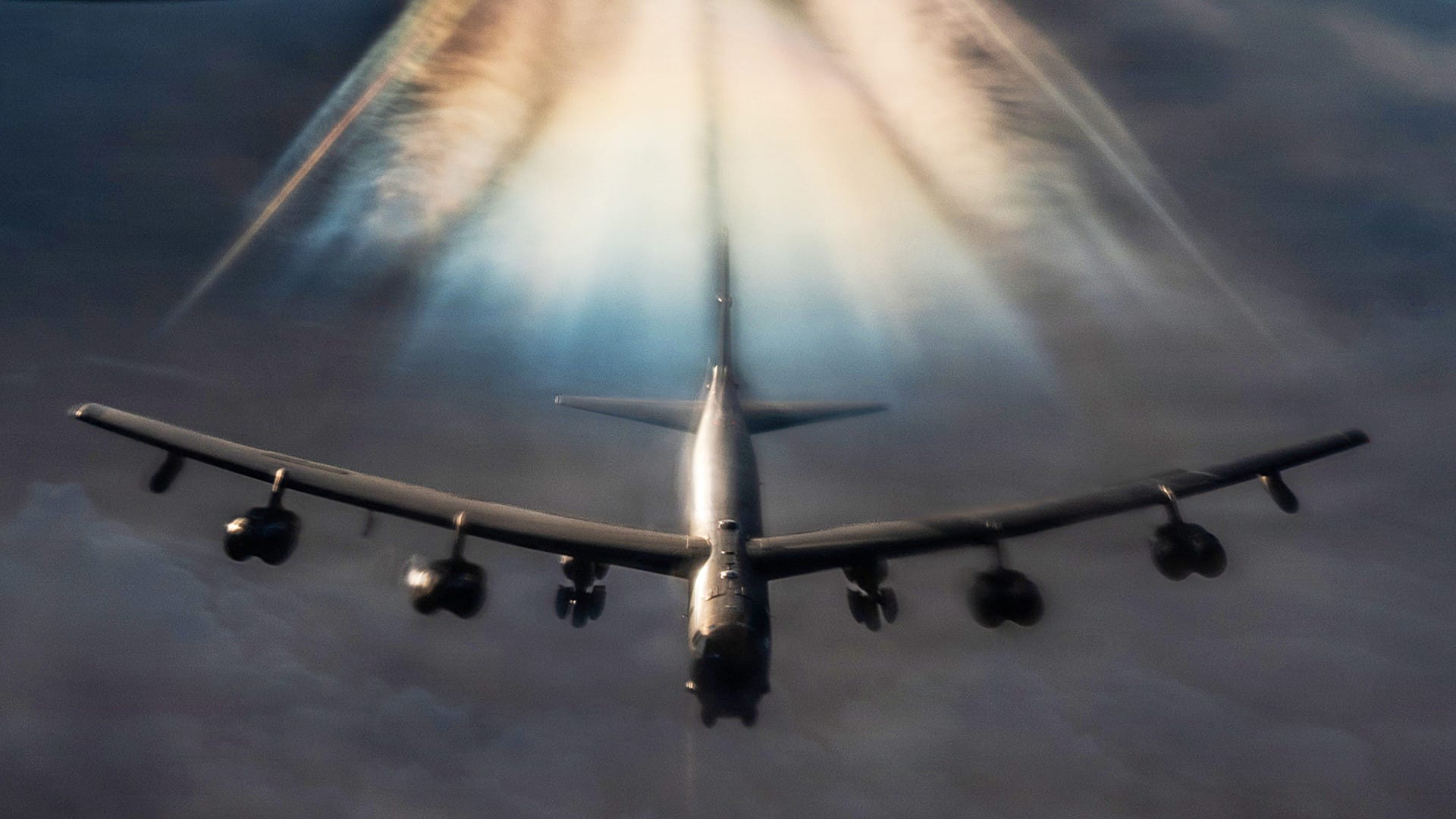
The U.S. Air Force has officially launched the paperwork to start looking for something — anything — to replace the B-52 Stratofortress. The BUFF has been flying since 1952, and the Air Force’s plan is apparently to keep flying it until the airframes are old enough to collect Social Security.
Buried in the FY2027 budget request is a line item requesting $1 million to conduct a New Heavy Bomber Analysis of Alternatives (AoA) — the formal first step toward figuring out what, if anything, should replace the iconic eight-engine bomber. It’s not a contract. It’s not a program. It’s a study. But after 70-plus years, even a study is news.
• The USAF has requested $1 million in FY2027 to fund a New Heavy Bomber Analysis of Alternatives
• The B-52 has been in service since 1955 — the youngest examples rolled off the line in 1962
• The Air Force plans to fly B-52s until at least 2050, when the airframes will be nearly 90 years old
• Options reportedly on the table include more B-21 Raiders, a cruise-missile truck, and a clean-sheet design
What Is an Analysis of Alternatives — and Why Does It Matter?
An AoA is Washington-speak for “we don’t know what we want yet, but we’re going to figure it out.” It’s the standard first step in the Pentagon’s acquisition process — a structured review of options, requirements, and trade-offs before anyone actually commits to building something. It typically precedes a fielding milestone by 10 to 15 years. Do that math: if the study kicks off in 2027 and takes the usual amount of time, a new heavy bomber wouldn’t show up until the 2040s at the earliest.
The study will focus on developing “key performance parameters, key system attributes, and additional performance attributes for a follow-on heavy bomber in the USAF,” according to Air Force budget documents. In plain English: they need to figure out what they actually need before they can ask anyone to build it.
The Options on the Table
More B-21 Raiders. Northrop Grumman’s stealthy flying wing is already in low-rate initial production. The Air Force is committed to at least 100 examples. One option is simply to keep building B-21s and let them fill the heavy-bomber role entirely. The problem: the B-21 is a penetrating strike aircraft designed for hardened targets, not a high-capacity standoff platform.
A cruise-missile truck. Think less fighter, more flying magazine. An aircraft optimized to carry dozens of standoff weapons at long range without needing to go near defended airspace. This is essentially what the B-52 does now, and a new design could do it better, cheaper, and without the airframe headaches.
A blended-wing-body (BWB) design. The Air Force is already exploring BWB aircraft for other missions, including next-generation tankers. A BWB bomber could offer significant internal payload capacity and major fuel efficiency gains.
More B-52J upgrades. The boring option — keep pouring money into the Stratofortress and defer the problem. Given that the re-engining and radar modernization programs are already facing delays and cost growth, this path has its own risks.

“I think it might be better characterized as saying, they’re taking a look at the stand-off strike mission area itself, and what’s the best solution for the distant future?”
The BUFF That Refused to Die
To understand why this AoA matters, you have to understand just how absurd the B-52’s longevity actually is. The YB-52 prototype first flew on April 15, 1952. The aircraft entered service in 1955. Boeing stopped building them in 1962. The 76 B-52Hs still flying today are older than most of the generals who command them.
And yet, here we are. The BUFF has flown in Vietnam, the Gulf War, the Balkans, Afghanistan, Iraq, and most recently in combat operations against Iran in early 2026. Its combination of massive payload capacity (up to 70,000 pounds), intercontinental range, and standoff strike capability has made it essentially irreplaceable.
Why Now? The B-1 Retirement and the Bomber Gap
The timing of this AoA isn’t accidental. The Air Force is planning to retire both the B-1B Lancer and the B-2A Spirit in the 2030s, leaving a two-type bomber fleet: the B-21 and the B-52J. That’s going to create some capability gaps that neither aircraft fills perfectly.
The B-1B, for all its maintenance headaches, is the fastest bomber in the inventory (Mach 1.2) and can carry more conventional weapons than any other platform — 75,000 pounds. Its retirement will remove a unique capability. The B-21, designed for stealth penetration, isn’t optimized for the high-volume standoff strike role the B-52 currently fills.
What Comes Next
One million dollars is a rounding error in defense procurement. This AoA is a first step, not a commitment. The Air Force hasn’t decided to build anything, hasn’t specified a requirement, and hasn’t told any contractors to start drawing. What it has done is formally acknowledged that the B-52 cannot fly forever — and that it’s time to start thinking seriously about what comes next.
The strategic logic is sound: if a new heavy bomber needs to be operational in the 2040s, the Air Force needs to start the AoA now. If it waits until the B-52J upgrades are complete in the mid-2030s, it will have maybe a decade to design, build, and field a replacement. That’s not enough time.
So the BUFF — the aircraft that has outlasted every prediction, every budget cut, every retirement proposal — may finally have an expiration date. It just won’t be visible for another decade or so. Only in aviation do you write a retirement study for something that’s already 70 years old and still has 25 more years on its calendar.
Sources: The War Zone | Air & Space Forces Magazine | U.S. Air Force FY2027 Budget Documents
• Experience a Fighter Jet Flight with MiGFlug

 English
0 Comments