The oldest aircraft carrier in the United States Navy is now the most politically charged vessel in the Western Hemisphere. USS Nimitz (CVN-68), with Carrier Air Wing 17 and the guided-missile destroyer USS Gridley in company, entered the Caribbean Sea in late May 2026 — and the timing is anything but routine.
Between 11 and 20 May, open-source flight trackers logged at least five Boeing P-8A Poseidon maritime patrol sorties and three Northrop Grumman MQ-4C Triton surveillance drone missions near Cuban airspace. Several flights approached to within about 50 miles (80 kilometres) of Cuban territory, threading the maritime corridors that connect Venezuela, the Yucatán Basin, and the western Caribbean shipping lanes. The message is not subtle.
The carrier deployment coincides with a sharp deterioration in U.S.-Cuba relations, including the indictment of former Cuban leader Raúl Castro in connection with the 1996 shootdown of two Brothers to the Rescue Cessnas over the Florida Straits — a case that has simmered for three decades.
Quick Facts
Carrier: USS Nimitz (CVN-68), Carrier Air Wing 17, USS Gridley (DDG-101), USNS Patuxent
Area of operations: Caribbean Sea, U.S. Southern Command AOR
Exercise: Southern Seas 2026 (deployed 23 March)
ISR activity: 5+ P-8A Poseidon sorties and 3+ MQ-4C Triton drone missions near Cuba (11–20 May)
Closest approach: About 50 miles (80 km) from Cuban territory
Total flights near Cuba since Feb: 25 tracked surveillance missions
Context: Indictment of Raúl Castro over 1996 Brothers to the Rescue shootdown
A Carrier Where Carriers Rarely Go
U.S. carrier strike groups do not routinely operate in the Caribbean. The Navy forward-deploys its assets to the Western Pacific, the Mediterranean, and the Arabian Gulf. Sending Nimitz around South America and into the Caribbean basin was a deliberate choice, framed around the Southern Seas 2026 exercise with South American allies.
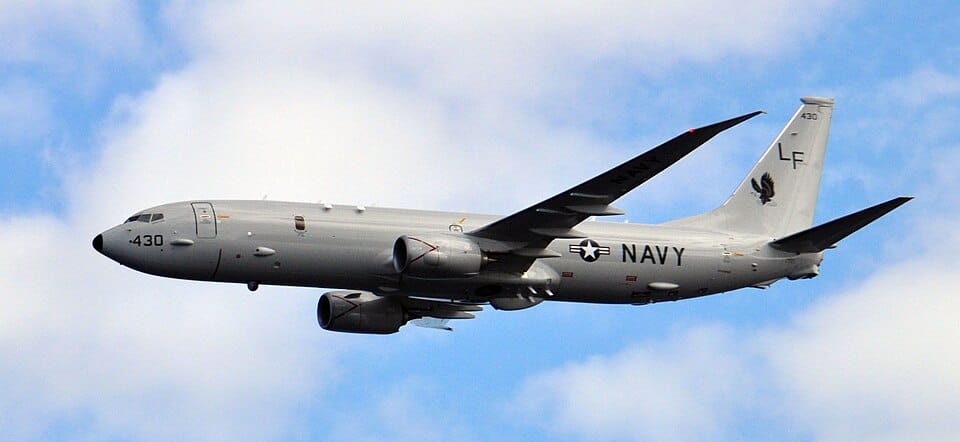
But the exercise rationale does not explain the intelligence-gathering surge off Cuba. Navy Times reported that the Nimitz deployment coincided with a major increase in ISR activity. P-8A Poseidons hunt submarines, track surface vessels, and collect signals intelligence. MQ-4C Tritons fly at 50,000 feet for 24 hours at a time, surveilling hundreds of thousands of square miles of ocean.
A US Navy P-8A Poseidon — at least five P-8A sorties were tracked near Cuban airspace between 11 and 20 May 2026. Wikimedia Commons
Twenty-five surveillance flights have been tracked near Cuba since 4 February alone. That is not routine. That is a campaign.
The 1996 Ghost
The diplomatic backdrop makes the military posture even more charged. In 1996, a Cuban MiG-29 shot down two unarmed Cessna 337 Skymasters flown by the exile group Brothers to the Rescue over international waters north of Havana, killing four people. The indictment of Raúl Castro over the shootdown has reignited one of the most painful episodes in Cuban-American history.
Whether it is a genuine pursuit of justice or a calculated escalation depends on whom you ask. Either way, it has put U.S.-Cuba relations at their tensest point in years.
“Deployments like this demonstrate our unwavering commitment to ensuring a secure and stable Western Hemisphere. This mission is a shining example of our dedication to strengthening maritime partnerships, building trust, and working together to counter shared threats.”
Rear Adm. Carlos Sardiello, U.S. Naval Forces Southern Command / 4th Fleet — Southern Seas 2026 deployment announcement
What Nimitz Brings
A Nimitz-class carrier strike group is not a diplomatic gesture. It is a self-contained air force. Carrier Air Wing 17 embarks six squadrons of aircraft — F/A-18E/F Super Hornets, EA-18G Growlers for electronic warfare, C-2A Greyhound logistics aircraft, and MH-60 Seahawk helicopters. The strike group can project power, enforce a blockade, conduct surveillance, and dominate the electromagnetic spectrum across the entire western Caribbean from a single floating runway.
The USS Gridley adds Aegis air defence and Tomahawk cruise missile capability. Together, they constitute the most potent naval force to operate in the Caribbean basin since the Cold War.
For Cuba, which operates a handful of aging MiG-29s and coastal patrol boats, the disparity is not a matter of degree. It is a matter of category.
A Slow-Burning Confrontation
Washington has not issued any public ultimatum. Havana has not scrambled its fighters. The surveillance flights continue at a pace that suggests systematic intelligence collection rather than crisis response. But the combination of a carrier strike group, a surge in ISR activity, and a politically explosive legal action against Cuba creates a pressure gradient that did not exist six months ago.
The Caribbean is warm, blue, and — for the moment — quiet. The Nimitz sits at its centre, its flight deck pointed south, its air wing armed, its radar sweeping 360 degrees. Whatever comes next, the United States has made sure it has options.
Sources: Navy Times, The War Zone, USNI News, Army Recognition
It reads like the plot of a heist film. Smuggle swarms of attack drones thousands of kilometres into the enemy’s heartland, hidden inside ordinary cargo trucks. Park them, unremarked, beside the most valuable aircraft in the arsenal. Then, at a chosen moment,...
You step onto a parked airliner and everything just works. The cabin lights are on, the air is cool, screens are glowing — and yet the two great engines on the wings are stone-cold silent. Somewhere behind you, a faint high-pitched whine is the only clue to what...
Launching a torpedo is the easy part. The hard part is what happens next: keeping a one-tonne self-propelled bomb running dead straight and at exactly the right depth, through the chaos of the sea, toward a ship that is moving and may be more than a mile away. There...



 English
0 Comments