

It is technically a ballroom. It is officially a venue for state dinners and gala receptions. It is what Donald Trump calls “a gift to the country.” And it is — by the President’s own admission, standing in front of an excavated foundation on 19 May 2026 with construction noise filling the air — a six-story-deep military installation crowned with what he described as “the greatest drone empire you’ve ever seen.”
What was announced as a $400 million, donor-funded social venue now comes with a $1 billion request to Congress for U.S. Secret Service security funding. And after Trump’s extended on-camera monologue this week, we know why: the East Wing is gone, and what is being built in its place is not a ballroom with a bunker — it is a bunker with a ballroom on top.
Quick Facts
Location: Site of the demolished East Wing of the White House
Depth: Six stories underground (confirmed by President Trump, 19 May 2026)
Above-ground footprint: 90,000 square feet
Total cost (estimated): At least $400 million; security additions push request toward $1 billion
Underground features (per Trump): Military hospital, research facilities, command-and-control, meeting rooms “for the military”
Rooftop features: Counter-drone systems, sniper positions, 360-degree view of Washington DC, possible Marine One alternative landing pad
Last major WH bunker upgrade: Obama administration, c. 2010 — a five-story facility under the North Lawn
Replaced facility: Presidential Emergency Operations Center (PEOC) — built under the East Wing during WWII, made famous on 9/11
What Trump said out loud
For months, the working assumption among defence analysts was that the ballroom would include a bunker. It always was going to. Demolishing an entire wing of the White House represents the single biggest opportunity in two generations to install hardened modern infrastructure at the most important building in America. Nobody was going to fill the hole with party space and call it done.
What surprised observers this week was the level of detail Trump offered, unprompted. Standing on the foundation, he confirmed the structure goes “about six stories deep.” He went further: “the underneath is far more complex than the upper.” He listed the features — a military hospital, research facilities, meeting rooms “for the military, hand in hand.”
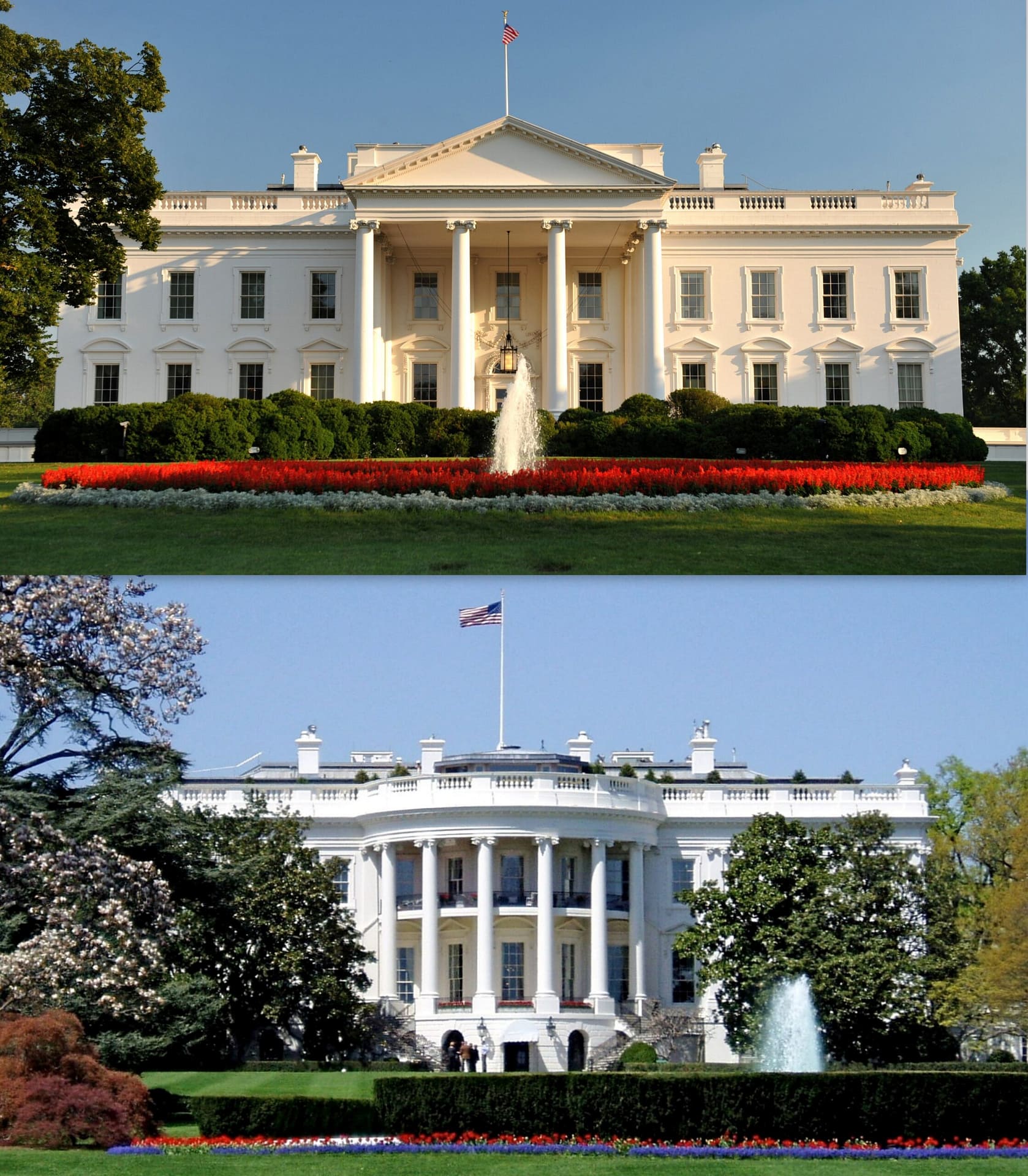
Then he got to the part nobody expected him to say out loud: “on top of the roof, we’re going to have the greatest drone empire you’ve ever seen that’s going to protect Washington.” Trump described systems being stored deep below the ballroom that could be moved up to the roof on demand — implying some kind of lift mechanism — to reconfigure rooftop air defences based on the threat picture at any given hour.
What a “drone empire” on the White House roof actually means
Strip away the Trumpian phrasing and you are left with a serious operational concept. Modern air defence around Washington is built around the NASAMS launchers ringing the capital and a single rooftop Avenger turret near the White House left over from the post-9/11 panic. That is a thin shield against what Ukraine and Israel have spent the past three years learning the hard way: cheap one-way attack drones launched in mass volleys can saturate any traditional air defence.
The answer everyone is converging on is drone-on-drone. Small interceptor drones — fast, cheap, expendable — that physically slam into incoming Shahed-class kamikaze drones or zap them with electronic effects. The U.S. Army’s Coyote interceptor has racked up more than 170 combat kills in this role. Ukraine has built an entire interceptor-drone industry around the same idea.
The ballroom roof, sitting higher than most of the surrounding architecture and giving a clean 360-degree view across the National Mall, is a natural mount point. It can host interceptor drones in launch racks, jamming systems, directed-energy weapons, and — when threats spike, additional systems stored below can reportedly be brought up to the roof.
The PEOC that 9/11 made famous is now gone
One thing the new construction quietly buries — literally — is the original Presidential Emergency Operations Center. Built beneath the East Wing during World War II and upgraded piecemeal across the Cold War, the PEOC became permanently fixed in American memory on 11 September 2001 when Vice President Dick Cheney, Condoleezza Rice, and a handful of senior officials gathered there to coordinate the federal response to the attacks. Photos taken inside that day became iconic.
With the East Wing demolished, that historic PEOC is gone with it. What replaces it will be vastly larger and vastly deeper — and, if Trump’s description is accurate, integrated with research, medical, and military command-and-control facilities at a scale never previously assembled beneath the White House. If the six underground stories each used most of the building’s 90,000-square-foot footprint, that would work out to roughly half a million square feet of subterranean space. That is not a bunker. That is an underground office tower.
The Marine One question
One detail that nobody at the White House will directly confirm: the rooftop may double as a helicopter landing site. The new VH-92A Patriot, taking over Marine One duties from the venerable VH-3D Sea King, has been plagued by landing-area problems on the South Lawn since its first test flights. Its exhaust heat and downwash have repeatedly damaged the landing zone. The new helicopter is heavier, hotter, and noisier than the one it replaces, and the White House grounds were never designed for it.
An elevated, reinforced, purpose-built helipad on the ballroom roof — invisible from the street, surrounded by counter-drone defences, and connected to the underground complex by elevator — would solve all of those problems at once. The White House has not confirmed this is the plan. It has not denied it either.
What it cannot do
One thing the new structure explicitly is not: a nuclear bunker. The depth and engineering required to survive a direct hit from a modern strategic warhead are orders of magnitude beyond anything being built under the East Wing. The classified Pentagon Command Bunker reportedly under design for the deep continuity-of-government mission is supposed to sit 3,500 feet down — roughly ten times deeper than the ballroom. That facility, if it is ever built, is a very different kind of project — one reportedly envisioned deep beneath the Washington area itself.
The ballroom complex is something else: a hardened, drone-resistant, missile-resistant administrative and defensive node where the day-to-day business of the White House can carry on through conventional threats — drone swarms, small arms, hostile aircraft, and the kind of asymmetric attacks that have become the dominant security concern of the 2020s. It is, in defence-architecture terms, a citadel rather than a survival vault.
And it is being paid for, depending on which estimate you believe, by some combination of private donors, the U.S. Secret Service appropriations, and an additional $1 billion the administration is asking Congress to send across this summer. The Senate parliamentarian has already ruled that the $1 billion cannot be slipped through reconciliation, which means it goes to a regular vote — and that will be its own theatre.
Watch: President Trump describes the White House ballroom complex as “a gift” during his 19 May 2026 press conference at the construction site.
Sources: The War Zone (Tyler Rogoway, 20 May 2026); CNBC; The Hill; White House press conference transcripts.



 English
0 Comments