
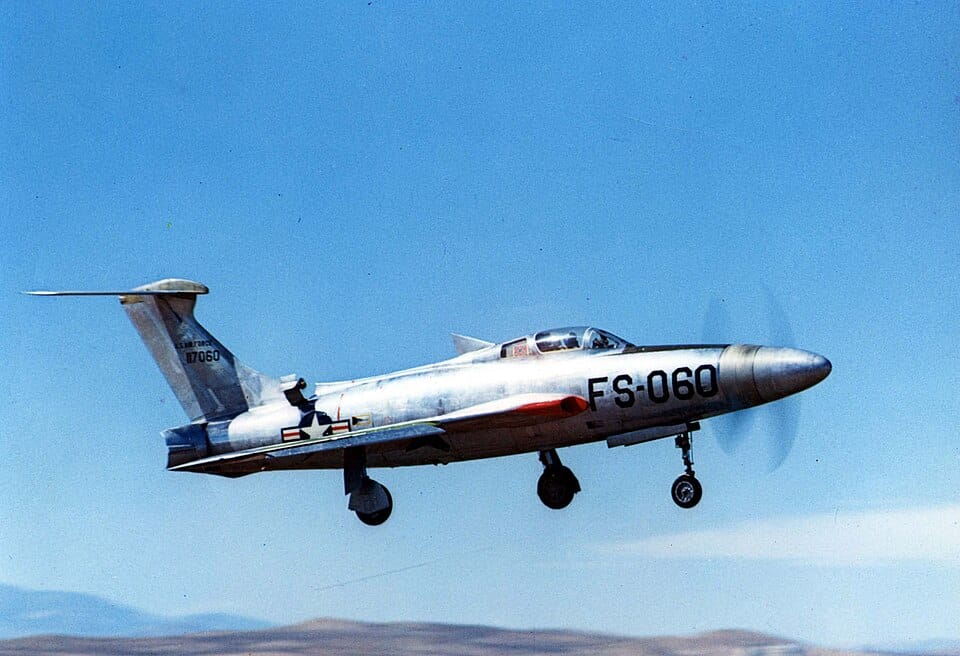
✈ Quick Facts
- Designation: XF-84H (experimental)
- Manufacturer: Republic Aviation
- Powerplant: Allison XT40-A-1 turboprop (5,850 shp) driving a supersonic propeller
- Propeller tip speed: Mach 1.18 (continuously supersonic)
- Designed top speed: 670 mph (Mach 0.9) — never achieved
- Built: 2 prototypes (FS-059 and FS-060)
- Test flights: 12 total (11 in FS-059 by test pilot Hank Beaird; the remainder in FS-060)
- Test period: 1955–1956, Edwards AFB
Why Build a Supersonic Propeller?
The XF-84H was born from a reasonable question: could a turboprop aircraft match the speed of early jet fighters while retaining the superior low-speed handling and shorter takeoff runs of propeller-driven planes? In the mid-1950s, this was not an absurd idea. Turboprops were efficient, and carrier operations in particular would benefit from an aircraft that did not need the long takeoff rolls that early jets demanded. Republic Aviation, builder of the legendary P-47 Thunderbolt and the F-84 Thunderjet family, was contracted to test the concept. They took an F-84F Thunderstreak fuselage and mated it to an Allison XT40-A-1 turboprop engine — essentially two T38 turbines geared together to produce 5,850 shaft horsepower — driving a three-bladed supersonic propeller through a long extension shaft. The propeller was the key. At 12 feet in diameter, its tips exceeded Mach 1 continuously during operation. This was not a transient phenomenon at high RPM — the propeller was designed to operate with supersonic tips as its normal condition. The theory was that a supersonic propeller could convert the engine's enormous shaft power into thrust efficiently enough to push the aircraft to near-transonic speeds. The theory was wrong.The Loudest Thing on Earth
A conventional propeller generates noise primarily from its blade tips. When those tips exceed the speed of sound, each blade produces a continuous sonic boom on every rotation. The XF-84H's propeller turned at roughly 2,100 RPM with three blades — meaning the prop generated approximately 6,300 sonic shockwaves per minute, or 105 per second. This was not a periodic noise event. It was a continuous, unbroken wall of sonic booms. The acoustic output was extraordinary. Ground crews at Edwards Air Force Base reported nausea, disorientation, and severe headaches when working near the running aircraft. One widely repeated account describes a crew member being knocked unconscious by the sound pressure. Maintenance personnel assigned to the XF-84H reportedly bid for transfers to avoid working on the aircraft.Ground crews described it as the most appalling noise they had ever heard from an aircraft — audible from up to 25 miles away, with a pressure wave intense enough to be felt in the chest by anyone standing behind it.
— Accounts from Edwards AFB ground crews, XF-84H test program
Twelve Flights to Nowhere
The XF-84H's problems went far beyond noise. The aircraft was aerodynamically unstable. The massive torque from the propeller created severe asymmetric forces that the airframe — originally designed for a jet engine with no propeller torque — could not adequately compensate for. Test pilot Henry "Hank" Beaird flew 11 of the 12 test flights in the first prototype (FS-059). He later described the aircraft as one of the most difficult he had ever flown. The single-rotation propeller produced enormous torque-induced yaw and roll that the control surfaces could barely manage. On several flights, the aircraft experienced uncommanded pitch and yaw oscillations that made sustained flight dangerous. The engine was unreliable — the T40 coupled-turbine powerplant had a poor service record across multiple programs — and the gearbox and propeller shaft were sources of constant mechanical problems. The second prototype (FS-060) made only four flights before the program was terminated. Test pilot Lin Hendrix reportedly told Republic that he would never fly the aircraft again.Why It Failed
The supersonic propeller concept was fundamentally flawed. When a propeller blade tip exceeds Mach 1, the shockwaves it generates create massive drag increases and energy losses. The acoustic energy alone — the noise that made the aircraft infamous — represented wasted power that was not being converted into thrust. At supersonic tip speeds, propeller efficiency drops catastrophically. The XF-84H never came close to its design speed of Mach 0.9. In testing, it barely exceeded the performance of a conventional F-84F with a standard jet engine — while being louder, more dangerous, less reliable, and far more difficult to fly. By 1956, the program was cancelled. Only one prototype survived. FS-059 — which spent years mounted on a pole outside Meadows Field Airport in Bakersfield, California — is now on display at the National Museum of the United States Air Force at Wright-Patterson AFB. FS-060 made only a handful of flights and was scrapped after the program was cancelled in 1956.The Right Idea at the Wrong Time (or Vice Versa)
The XF-84H is remembered as a failure, and it was. But it answered a question that needed answering: can supersonic propellers power a practical combat aircraft? The answer — decisively no — closed off a technological dead end and confirmed that the future of high-speed flight belonged to pure jet propulsion. Modern turboprops like the C-130J's Dowty R391 operate well below Mach 1 at the blade tips, precisely because the XF-84H's generation of test programs proved what happens when you cross that boundary. The Thunderscreech's contribution to aviation was teaching everyone what not to do — at a volume that made the lesson impossible to ignore. Sources: National Museum of the USAF, "Republic's T-Bolt to Thunderchief" by Warren Thompson, Edwards AFB flight test records, AIAA historical papers on propeller aeroacousticsRelated Questions
What was the loudest aircraft ever built?
The Republic XF-84H Thunderscreech is widely regarded as the loudest aircraft ever built. Its turboprop spun a propeller whose blade tips were permanently supersonic, generating a relentless, brutal noise reportedly heard 25 miles away that could make ground crews physically ill.
Why was the XF-84H so loud?
Its propeller tips spun continuously at supersonic speed — Mach 1.18 — producing a constant series of shock waves. Unlike a normal prop, the Thunderscreech's blades never stopped going supersonic, creating an unbearable, droning roar that earned it its nickname.
What was the XF-84H Thunderscreech?
The XF-84H was an experimental American turboprop fighter built by Republic Aviation in the mid-1950s. It used a powerful Allison turboprop driving a supersonic propeller, an attempt to combine propeller efficiency with near-jet speed — but it became infamous mainly for its catastrophic noise.
How fast was the XF-84H meant to fly?
It was designed to reach about 670 mph (Mach 0.9), which would have made it one of the fastest propeller aircraft ever. In practice it never achieved that speed, plagued by vibration, instability and its overwhelming noise across just 12 test flights.
How many XF-84H Thunderscreech were built?
Only two prototypes were built, flying a combined total of 12 test flights in 1955–1956 at Edwards Air Force Base. The programme was abandoned, leaving the Thunderscreech as a legendary aviation curiosity.
0 Comments