
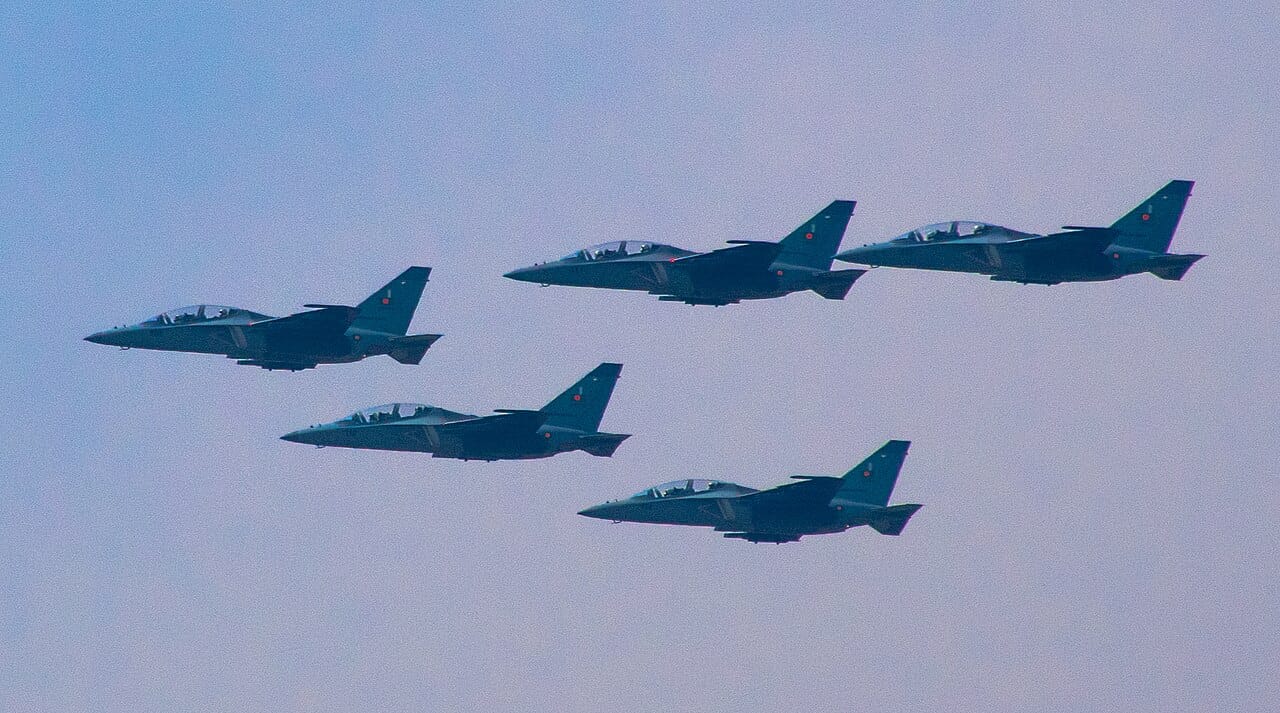
At the Irkutsk Aviation Plant on 25 June 2026, a two-seat jet that has spent two decades teaching student pilots how to fly lifted off on a roughly 50-minute sortie, climbed no higher than 2,000 metres (about 6,600 ft) and held its speed below 600 km/h (around 370 mph). On paper, an unremarkable test hop. In intent, something quite different: this was the first flight of the Yak-130M, the variant Russia hopes will turn a familiar trainer into a budget light combat aircraft.
Rostec, the state corporation that owns the Yakovlev design bureau through United Aircraft Corporation (UAC), announced the flight and reported that the crew — 1st Class Test Pilot Alexander Guskov and Distinguished Test Pilot Andrey Voropayev — completed the planned profile in full, with no technical issues. Two more prototypes are due to fly before the end of 2026, and the flight-test programme is scheduled to run until 2028.
The interesting part is not the airframe, which is largely the same Yak-130 that first flew in the 1990s. It is the sensor and weapons suite Russia says it has bolted on — and the gap, common to every Russian programme, between what the manufacturer claims and what has actually been demonstrated.
Quick Facts — Yak-130M Maiden Flight
- Date & place: 25 June 2026, Irkutsk Aviation Plant (a Yakovlev/UAC site under Rostec)
- First sortie: ~50 minutes, up to 2,000 m (~6,600 ft), up to 600 km/h (~370 mph)
- Crew: Test pilots Alexander Guskov and Andrey Voropayev
- Base aircraft: Yak-130 advanced trainer, twin Ivchenko-Progress AI-222-25 turbofans
- Claimed new kit (Rostec): new radar (described as AESA), electro-optical/laser targeting, self-protection suite, new datalink
- Claimed weapons: expanded loadout including the R-77 air-to-air missile; counter-drone role
- Programme: 2 more prototypes to fly in 2026; flight test to 2028
- Export: Russian estimate of demand for ~40 aircraft, interest cited in Asia and Africa
A trainer that was always half a combat jet
The Yak-130 was never a pure schoolhouse aircraft. It entered Russian service as an advanced jet trainer designed to replicate the handling of modern fourth- and fifth-generation fighters, but it shipped with nine hardpoints and a secondary light-strike role from the outset. The baseline aircraft is a subsonic, twin-engined design powered by two Ivchenko-Progress AI-222-25 turbofans, each rated at roughly 24.5 kN (about 5,500 lbf) of dry thrust. It is agile, cheap to operate by fast-jet standards, and stressed for combat-relevant manoeuvring.
That dual character matters, because it explains why the Yak-130M is an upgrade rather than a clean-sheet aircraft. Russia is not building a new fighter; it is taking an airframe it already produces and exports, and pushing the “light combat aircraft” half of the design forward. Notably, the M prototype flew on the same AI-222-25 engines as the trainer — the changes are in avionics and weapons, not propulsion.
What Rostec says it carries — and the AESA question
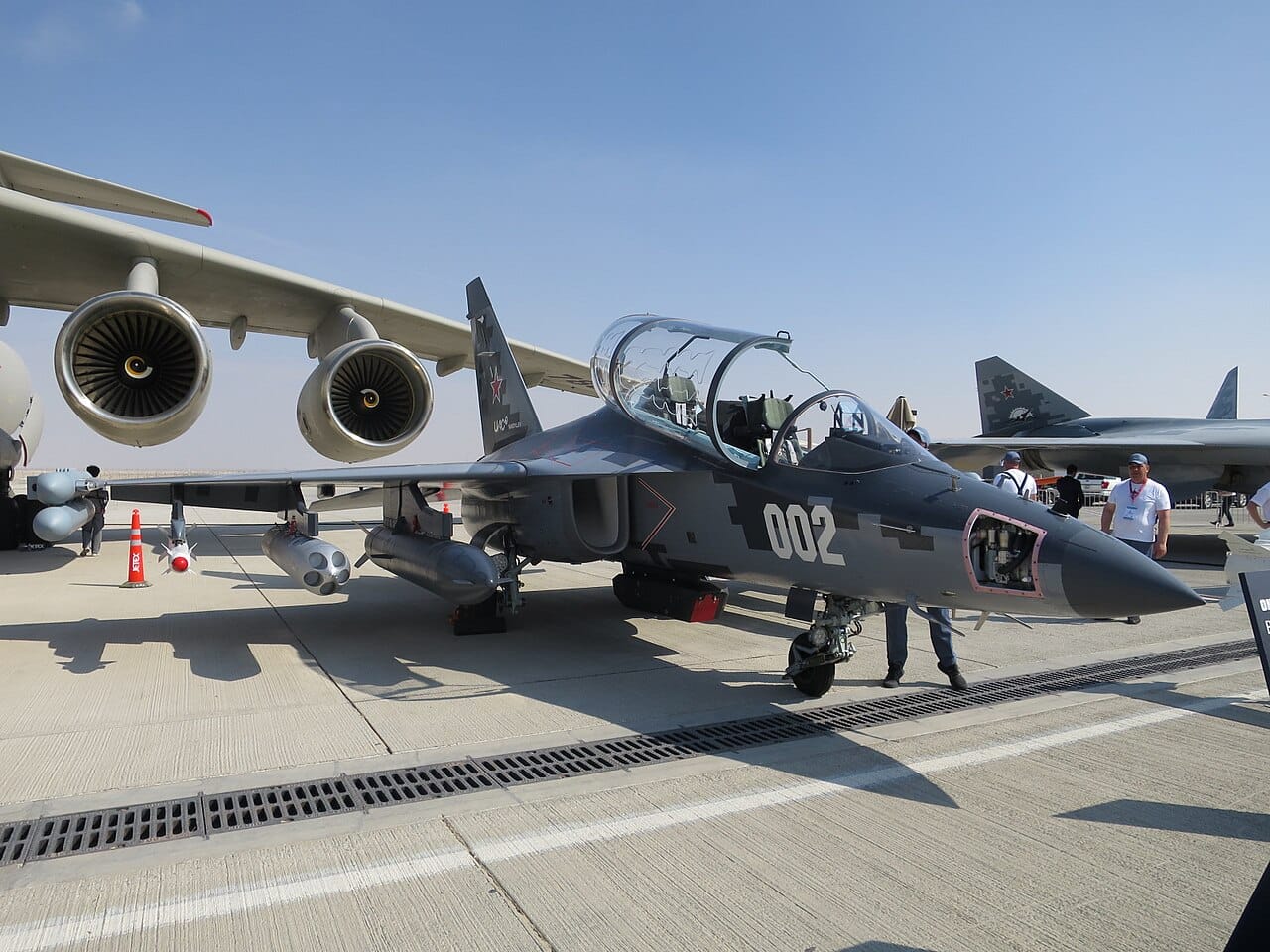
According to Rostec, the Yak-130M adds a new radar, an electro-optical targeting system with a laser designator, an updated self-protection suite and a new communications complex, configured for round-the-clock, all-weather operation. Russian reporting has named the radar the BRLS-130R and described it as an active electronically scanned array (AESA), with the electro-optical system identified as the SOLT-130K and the defensive suite as a President-S derivative.
This is where precision matters. An AESA radar on a light Russian jet is a manufacturer claim, not a demonstrated fact. Quoted detection figures vary between sources — some cite a range on the order of 100 km, others 160–180 km against a fighter-sized target — which is itself a sign that these numbers come from promotional material rather than verified test data. Russia has struggled to field AESA radars even on its frontline types, so the burden of proof here is high. The honest summary: Rostec claims an AESA-class radar; the maiden flight does not prove one is installed, let alone working.
The weapons: R-77 and the counter-drone pitch
On weapons, Russia says the Yak-130M’s expanded loadout includes the R-77 active-radar-guided air-to-air missile — the weapon that, more than any sensor, would let the aircraft engage targets beyond visual range rather than merely lob bombs at static positions. UAC CEO Vadim Badekha framed the aircraft’s combat objectives as engaging both ground and aerial targets, “including large-class drones.”
That last phrase is the real selling point. Russia has spent two years absorbing long-range Ukrainian drone strikes against airfields, refineries and infrastructure deep inside its territory. Using a supersonic interceptor or a scarce fighter to chase a slow propeller drone is expensive and wasteful. A cheap, manoeuvrable jet with a radar, an electro-optical sensor and a gun or short-range missile is, in principle, a far better fit for that mission — a light interceptor for the drone age. Whether the Yak-130M actually delivers that capability is a question for the test programme, not the press release.
Why a budget light fighter fits Russia’s needs
Strip away the marketing and the logic is coherent. Russia needs three things the Yak-130M plausibly addresses at once. It needs to keep training pilots for its Su-30, Su-35 and Su-57 fleets, which the trainer already does. It needs an affordable counter-drone and light-strike platform to relieve pressure on its frontline fighters. And it needs export products that sanctions-hit Russian industry can still build and sell.
The base Yak-130 has already been exported to eight countries, and the M made its international debut at the Dubai Airshow in November 2025. Russian officials and reporting put potential export demand at around 40 aircraft, with interest cited from customers in Asia and Africa — figures that should be read as a sales estimate rather than firm orders. For air forces that cannot afford or politically cannot buy Western light combat jets, a trainer that doubles as a light fighter is an attractive proposition, exactly the niche South Korea’s FA-50 and Italy’s M-346FA already compete for.
The verdict: promising concept, unproven hardware
The Yak-130M’s first flight is a genuine milestone, but it is the beginning of a development programme, not the arrival of a finished weapon. The airframe is mature and the concept — a trainer that earns its keep as a light combat aircraft and drone-hunter — is sound. The radar, the electro-optical suite, the missile integration and the all-weather combat capability are, for now, claims awaiting demonstration through 2028.
For a country that needs cheap combat mass and exportable hardware, that may be enough. The Yak-130M does not have to beat a Rafale. It only has to be good enough, cheap enough and available enough — and on those terms, a trainer growing into a budget fighter is a sensible bet. The test data will tell us how much of the brochure is real.
India’s Times of India covered the maiden flight and the aircraft’s claimed combat role:
Sources: Aerotime; Army Recognition; Military Watch Magazine; Defense Express; TASS; Xinhua; Izvestia. Radar, sensor and weapons capabilities are manufacturer (Rostec/UAC) claims and are attributed as such.
Related Questions
What is the Yak-130M?
The Yak-130M is an upgraded version of Russia’s Yak-130 advanced jet trainer, reworked into a light combat aircraft. It completed its first flight on 25 June 2026 at the Irkutsk Aviation Plant. Rostec says it adds a new radar, an electro-optical/laser targeting system, a self-protection suite and expanded weapons, including the R-77 air-to-air missile.
When did the Yak-130M make its first flight?
The Yak-130M made its maiden flight on 25 June 2026 at the Irkutsk Aviation Plant in Russia. According to Rostec, the sortie lasted about 50 minutes, reached up to 2,000 metres (around 6,600 ft) and stayed below 600 km/h (around 370 mph). Two more prototypes are due to fly in 2026, with testing running to 2028.
What engines does the Yak-130 use?
The Yak-130 is a twin-engined aircraft powered by two Ivchenko-Progress AI-222-25 turbofans, each producing roughly 24.5 kN (about 5,500 lbf) of dry thrust. The Yak-130M prototype flew on the same AI-222-25 engines; its upgrades are in avionics and weapons rather than propulsion.
Does the Yak-130M really have an AESA radar?
Rostec describes the Yak-130M’s new radar, reported as the BRLS-130R, as an active electronically scanned array (AESA). This is a manufacturer claim, not an independently verified fact, and quoted detection ranges differ between sources. The maiden flight does not confirm the radar is installed or operational.
What weapons can the Yak-130M carry?
Russia says the Yak-130M’s expanded loadout includes the R-77 air-to-air missile alongside the trainer’s existing ability to carry bombs and rockets across multiple hardpoints. UAC has described its combat tasks as engaging ground and aerial targets, including large drones. These weapons claims remain to be demonstrated in the flight-test programme.
Why is Russia turning a trainer into a light fighter?
A trainer-derived light fighter is cheap to build and operate, which suits three Russian needs at once: training pilots for its fighter fleets, providing an affordable counter-drone and light-strike platform, and offering an exportable product despite sanctions. Russia estimates export demand at around 40 aircraft, citing interest in Asia and Africa.
0 Comments