
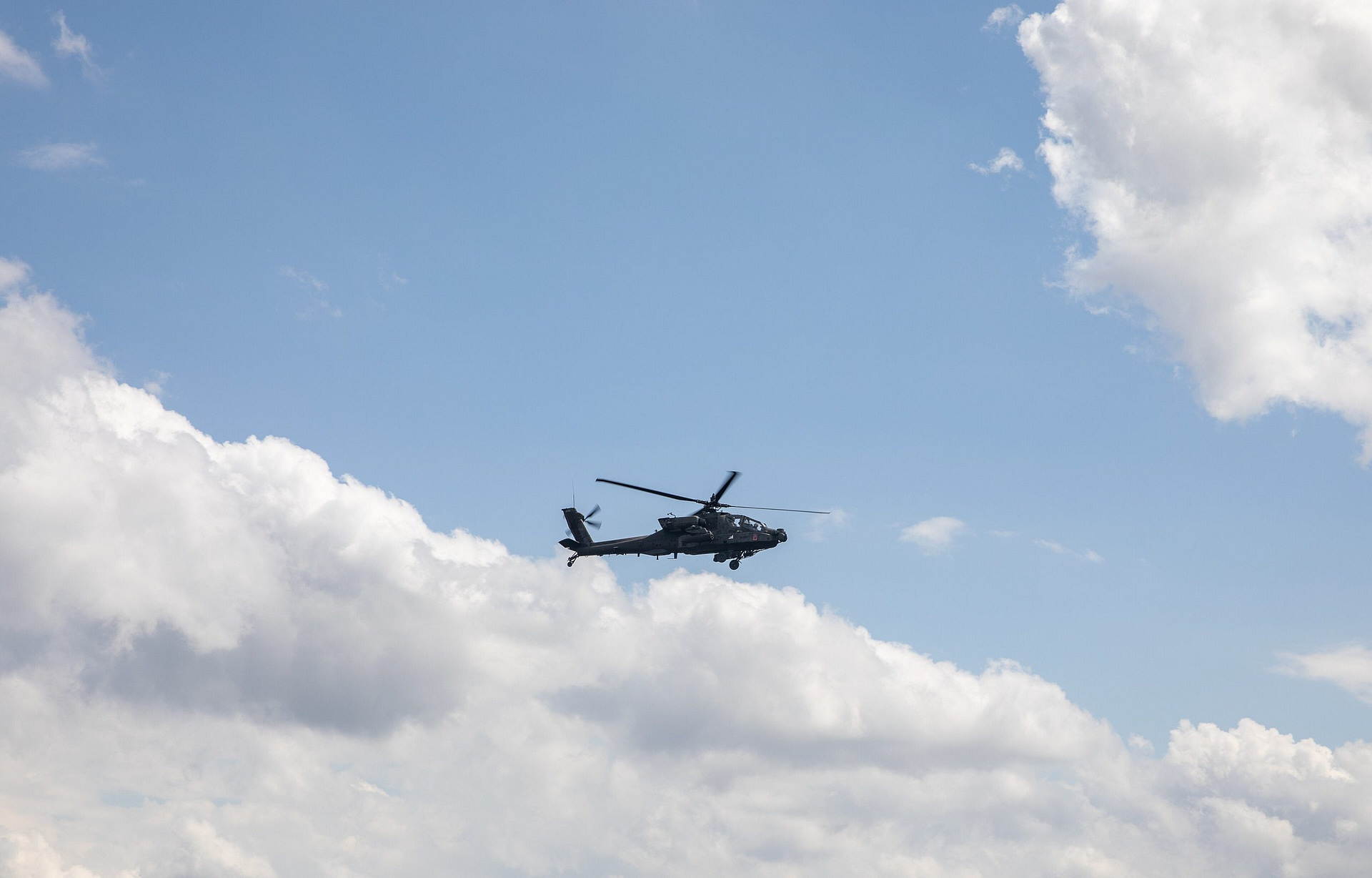
Boeing AH-64 Apache
“The definitive attack helicopter”
The Western benchmark for the attack helicopter: a two-seat tank-killer built around a 30 mm chain gun, Hydra rockets and the Hellfire missile — blooded from the 1991 Gulf War to Iraq and Afghanistan, and flown today by roughly two dozen air arms.
The AH-64 Apache: how the U.S. Army built the helicopter that hunts tanks
The Apache was born from a failure. When the U.S. Army cancelled its complex, expensive AH-56 Cheyenne in 1972, it launched the Advanced Attack Helicopter (AAH) competition for something simpler and more survivable: a machine that could kill Soviet armour on a European battlefield, at night, in bad weather, while absorbing battle damage and flying home. Hughes Helicopters and Bell each built prototypes, and on 30 September 1975 the Hughes Model 77 — the YAH-64 — made its first flight.
In 1976 the Army chose the Hughes design. What followed was a decade of development to turn a promising airframe into a weapons system: the Target Acquisition and Designation Sight / Pilot Night Vision Sensor in the nose, the laser-guided AGM-114 Hellfire, the 30 mm M230 chain gun slaved to the crew’s helmets, and two General Electric T700 turboshafts chosen for power and resilience. The first production AH-64A was delivered in 1984, and the Apache entered U.S. Army service in 1986.
It did not stay a Cold War tank-killer for long. In the 1991 Gulf War, Apaches fired the opening shots of the air campaign; in the decades since, the type has been rebuilt around a mast-mounted radar (the AH-64D Longbow) and then digitised and re-engined (the AH-64E Guardian). Built in more than 2,875 examples and exported to some 17 to 19 nations, the Apache has become the aircraft other attack helicopters are measured against.
01Why the AH-64 Apache exists: the AH-56 Cheyenne and the Advanced Attack Helicopter program
The Army’s previous attack helicopter, Lockheed’s AH-56 Cheyenne, was fast and sophisticated but troubled and costly, and it was cancelled in 1972. The Advanced Attack Helicopter requirement that replaced it deliberately asked for less exotic performance and more survivability, night capability and anti-armour punch.
Hughes’ YAH-64 beat Bell’s YAH-63 in a 1976 fly-off. The winning formula — tandem cockpit, four-blade rotor, twin turboshafts, nose sensors and a chin gun — has defined Western attack-helicopter design ever since.
02The AH-64 Apache’s name and markings: a note on the “Apache” designation
Like other U.S. Army helicopters (Huey, Chinook, Kiowa, Black Hawk), the Apache is named after a Native American people, following a long-standing Army aviation naming tradition. British Army examples were designated Apache AH Mk1 (originally WAH-64), and the latest common standard for the U.S. and export customers is the AH-64E Guardian.
How the AH-64 Apache works: sensors, survivability and firepower
A tandem cockpit slaved to the crew’s helmets
The co-pilot/gunner sits in front, the pilot behind and above. The IHADSS helmet display lets either crew member aim the M230 chain gun simply by looking — the gun follows the head. Sensors and flight symbology are shared between both stations.
Two T700 turboshafts, built to take damage
Two General Electric T700 engines drive a four-blade main rotor. The airframe is designed to keep flying after hits, with a crashworthy structure, redundant systems and armour around the crew — the Apache was built on the assumption it would be shot at.
The Longbow radar and the Hellfire missile
The nose TADS/PNVS sight finds and lasers targets day or night; the AH-64D/E can add a mast-mounted Longbow radar that detects, classifies and prioritises targets, feeding radar-guided fire-and-forget Hellfire missiles.
03How the AH-64 Apache kills tanks: the Hellfire and Longbow chain
The Apache’s primary anti-armour weapon is the AGM-114 Hellfire, a precision missile that can be laser-guided (by the launching helicopter, another aircraft or a ground observer) or, in the radar-guided Longbow version, fired and forgotten.
The AH-64D and AH-64E can carry the AN/APG-78 Longbow mast-mounted millimetre-wave radar, which can detect and classify scores of targets in seconds while the helicopter stays largely hidden behind terrain. A single Apache can carry up to 16 Hellfire missiles, and a flight of Apaches can engage many targets in a single pass. Figures for how many vehicles Apaches destroyed in the 1991 Gulf War vary by source and should be treated as estimates.
04The AH-64 Apache’s armour and survivability: designed to be shot at
Survivability was a founding requirement. The crew sit in an armoured, blast-resistant cockpit with a boron-carbide-and-Kevlar shield between the two seats so a single hit cannot disable both crew. Rotor blades, fuel system and structure are designed to keep working after damage, and the landing gear and airframe are built to absorb a hard crash and protect the crew.
The design goal, widely quoted from the program, was to survive hits from rounds up to 23 mm and to bring the crew home — a philosophy shaped by the vulnerability of helicopters in Vietnam.
05From Hughes to Boeing: who actually built the AH-64 Apache
The Apache was designed by Hughes Helicopters, which won the AAH contest in 1976. Hughes Helicopters was bought by McDonnell Douglas in 1984, the year the first production Apache was delivered. When Boeing merged with McDonnell Douglas in 1997, the Apache line became a Boeing product, and it is built today at Boeing’s Mesa, Arizona plant.
AH-64 Apache specifications: dimensions, performance and armament
Baseline note: the figures below describe the AH-64E Apache Guardian — the T700-GE-701D-engined, face-gear-transmission model delivered from November 2011 and the only Apache Boeing still builds. Deltas for the 1984 AH-64A and the 1998 AH-64D Longbow are in grey. One widely reprinted figure is corrected here rather than repeated: several references give the main-rotor disc area as 1,908.5 sq ft, which is a digit transposition — a 48 ft rotor sweeps 1,809.5 sq ft, and the US Army’s own disc loading of 9.8 lb/sq ft at mission weight only works with the smaller number.
Dimensions & weights
- Экипаж
- 2 — co-pilot/gunner in front, pilot behind and 483 mm (19 in) higher, in separate cockpits divided by a transparent blast shield. Both stations have full flight controls and both can fight the aircraft; the pilot can fire the gun, and the gunner can fly home
- Fuselage length
- 15.06 m (49 ft 5 in)
- Length, rotors turning
- 17.73 m (58 ft 2 in)
- Main rotor diameter
- 14.63 m (48 ft 0 in), four blades, fully articulated
- Main rotor disc area
- 168.1 m² (1,809.5 sq ft)
- Tail rotor
- 2.79 m (9 ft 2 in) diameter, four blades arranged as two offset pairs at 55° rather than the usual 90°. The asymmetry smears the acoustic signature across a wider band instead of concentrating it in one blade-passing tone, which is why an Apache sounds less like a helicopter and more like a saw
- Высота
- 4.72 m (15 ft 6 in) over the tail fin. Jane’s publishes 3.87 m (12 ft 8 in), measured to the top of the main rotor head; the two figures are not in conflict, they measure different things. The Longbow radome sits higher again
- Stub wing span
- 5.23 m (17 ft 2 in), four pylons. AH-64D/E and most export aircraft add a rail at each wingtip for a twin Stinger pack
- Пустой вес
- 5,165 kg (11,387 lb) as published for the A and D; the E runs several hundred kilogrammes heavier once the -701D engines, the uprated transmission and the Guardian avionics are in
- Mission gross weight
- 8,006 kg (17,650 lb)
- Максимальная взлетная масса
- 10,433 kg (23,000 lb); the British Apache AH.1 was cleared to 9,525 kg (21,000 lb)
- Внутреннее топливо
- ~1,420 litres (~375 US gal; ~312 imp gal) in two crashworthy, self-sealing cells fore and aft of the ammunition magazine
- External fuel
- Up to four 871-litre (230 US gal) auxiliary tanks on the pylons for self-deployment, which is how an Apache crosses an ocean on a ship’s deck and then flies inland
- Disc loading
- 47.6 kg/m² (9.8 lb/sq ft) at mission weight — high for a helicopter, and the price of hanging sixteen missiles and 1,200 rounds off a machine this size
Performance
- Never-exceed speed
- 365 km/h (227 mph; 197 kn)
- Maximum level speed
- 293 km/h (182 mph; 158 kn)
- Крейсерская скорость
- 265 km/h (165 mph; 143 kn)
- Vertical rate of climb
- 9.0 m/s (1,775 ft/min) on a standard 15 °C day
- Rate of climb, loaded
- 5.0 m/s (990 ft/min) in the sixteen-Hellfire anti-armour fit, falling to 4.1 m/s (800 ft/min) with 76 rockets aboard. The Army publishes climb rate by mission fit rather than as a single number, which is the honest way to do it
- Hover ceiling, in ground effect
- 4,570 m (15,000 ft)
- Hover ceiling, out of ground effect
- 3,505 m (11,500 ft). Both hover figures are standard-day, mission-weight numbers and collapse quickly in heat and at weight; the -701D engines of the E were bought largely to buy back hot-and-high hover margin lost in Afghanistan
- Служебный потолок
- 6,400 m (21,000 ft); some references publish 6,100 m (20,000 ft)
- Range, internal fuel
- 476 km (296 mi; 257 nmi) with the Longbow mast fitted
- Боевой радиус
- ~480 km (~300 mi; ~260 nmi)
- Ferry range
- 1,900 km (1,180 mi; 1,024 nmi) with auxiliary tanks
- Endurance
- 2 hours 30 minutes on internal fuel across all three published mission fits
- Load factor
- +3.5 / −0.5 g
Propulsion & systems
- Engines
- 2 × General Electric T700-GE-701D turboshaft, 1,487 kW (1,994 shp) each, with infrared-suppressing Black Hole exhausts that mix cool air into the efflux and dump it over the tail boom. AH-64A: T700-GE-701, 1,265 kW (1,696 shp), replaced by the 1,410 kW (1,890 shp) -701C from 1990 and retro-fitted to the D. British Apache AH.1: two Rolls-Royce Turbomeca RTM322, 1,693 kW (2,270 shp)
- Transmission
- Roughly 2,535 kW (~3,400 shp) through the E’s split-torque face-gear main transmission, against roughly 2,110 kW (~2,830 shp) on the A and D. This, not the engine change, is the reason the E can actually use its extra power; a gearbox that cannot pass the torque makes a bigger engine an ornament
- Rotor system
- Four-blade fully articulated main rotor with stainless-steel spars, glass-fibre skins and a trailing edge designed to survive a 23 mm hit and keep turning; composite blades qualified from 2004 on the E. The original steel-and-composite blades were the Apache’s worst early scandal: specified for 1,500 flight hours, they were being replaced at 146, and it took six redesigns and until early 1991 to reach 1,400
- Fire-control radar
- Lockheed Martin/Northrop Grumman AN/APG-78 Longbow, a 35 GHz millimetre-wave set in a mast-mounted radome above the rotor, with the AN/APR-48 Radar Frequency Interferometer beside it. It classifies up to 128 targets, prioritises 16 and can begin an attack within 30 seconds; the mast lets the aircraft look while the fuselage stays behind a ridge. Not fitted to the AH-64A. On the D the radars were bought in smaller numbers than the airframes and were moved between aircraft, so a great many "Longbows" flew without one
- Sights
- Lockheed Martin M-TADS/PNVS Arrowhead — a Target Acquisition and Designation Sight (day television, thermal imager, laser designator and rangefinder) stacked under a separate Pilot Night Vision Sensor whose only job is to fly the aircraft. The original AN/ASQ-170 TADS and AN/AAQ-11 PNVS of 1984 were replaced from 2005; a colour, higher-resolution day sensor was ordered in 2016
- Helmet sight
- Integrated Helmet and Display Sighting System (IHADSS): a monocle over the right eye displaying the PNVS image and symbology, with the head position tracked so the gun follows the wearer’s look. It was the first fielded helmet-slaved weapon sight of its kind and it defined how Western attack helicopters are flown; it also takes months to learn, because the pilot flies at night on one eye’s worth of monochrome infra-red while the other eye looks at the cockpit
- Datalinks and teaming
- L3 MUMT-X datalink on C, D, L and Ku bands; Joint Tactical Information Distribution System; Link 16 on later lots. The E crew can take sensor video from an RQ-7 Shadow or MQ-1C Grey Eagle, and at the highest of the four interoperability levels fly the aircraft and release its weapons — the capability the US Army used to justify retiring the OH-58 Kiowa scout altogether
- Defensive aids
- AN/APR-39 radar warning, AN/AVR-2 laser warning, AN/ALQ-136 radar jammer, AN/ALQ-144 or the Common Missile Warning System with directional infrared countermeasures, M130 chaff and flare dispensers. A Ground Fire Acquisition System, two sensor pods that locate muzzle flashes across a 120° field in any light, was fitted to 24 US aircraft in Afghanistan from 2012 — a direct answer to the fact that most Apaches are hit by things nobody saw fire
- Crashworthiness
- Designed to MIL-STD-1290: energy-absorbing landing gear, stroking crew seats, a self-sealing fuel system and roughly 1,130 kg (~2,500 lb) of boron-carbide and Kevlar protection, with crew compartment and rotor blades rated against 23 mm fire. The canopy and windows are not ballistically rated; the blast shield between the cockpits exists so that a hit which kills one crewman does not necessarily kill both
- First flight
- 30 September 1975 (Hughes YAH-64, winner of the Advanced Attack Helicopter competition against the Bell YAH-63); AH-64D Longbow 15 April 1992; first AH-64E delivered November 2011
- Service entry
- January 1984 (first production AH-64A accepted; first operational unit, 7-17th Cavalry, trained from April 1986)
- Number built
- ~2,700 delivered worldwide by the mid-2020s (937 AH-64A, then D and E production and remanufacture; the US Army had taken 500 AH-64E by April 2020 and plans a fleet of 812)
- Unit cost
- ~US$35–52 million flyaway per AH-64E depending on lot and whether the airframe is new or remanufactured. Foreign military sales are quoted far higher — often US$100 million or more per aircraft — because those figures bundle munitions, spares, simulators and years of support
06AH-64 Apache variants: from the AH-64A to the AH-64D Longbow and AH-64E Guardian
AH-64A — the original production Apache (service from 1986).
AH-64D Longbow — introduced from the late 1990s, adding the mast-mounted fire-control radar, upgraded avionics and radar-guided Hellfire.
AH-64E Guardian — the current standard, with more powerful engines, improved rotor blades, better sensors, and the ability to control unmanned aircraft (manned-unmanned teaming). Boeing states the Apache will remain in production into the 2030s and in service into the 2060s.
07The AH-64 Apache’s operating costs: what an Apache costs to buy and fly
Costs vary enormously with variant, contract and customer. Recent AH-64E export deals are frequently reported in the tens of millions of dollars per aircraft once training, spares and support are included; the bare flyaway price is usually quoted lower.
Cost per flight hour is commonly estimated at roughly USD 3,000–5,500, but published figures differ widely depending on what is counted (fuel only, or fuel plus maintenance, overhaul and support). Treat any single number as an estimate. Boeing states the worldwide Apache fleet has flown over 5.3 million hours, more than 1.3 million of them in combat.
Armament & payload
The Apache carries one gun, one missile family and a radar that lets it shoot at things nobody aboard has looked at
Everything on an Apache is arranged around the Hellfire. Four pylons, 1,200 rounds of 30 mm and a mast-mounted radar exist to get sixteen missiles onto sixteen armoured vehicles, and the aircraft’s whole design logic follows from that. The gun is a close-in and infantry weapon slaved to the gunner’s head; the rockets are for area targets and, since APKWS, for cheap precision against things not worth a Hellfire; the wing tanks are for getting the whole arrangement somewhere distant.
What the AN/APG-78 Longbow actually changed was not detection but employment. The laser-guided AGM-114K requires someone to hold a designator on the target until impact, which keeps the designating aircraft exposed and limits how many engagements can run at once. The millimetre-wave AGM-114L takes a target handoff from the radar and flies itself, so a Longbow aircraft can fire a ripple from behind a ridge, drop below the skyline and be gone before the missiles arrive. That is the single largest capability step in the type’s history, and the AGM-179 JAGM — which puts both a semi-active laser and a millimetre-wave seeker in one nose — is the admission that operators want to stop choosing.
It is also worth being blunt about where the weapons could not help. On 24 March 2003, 31 Apaches of the 11th Attack Helicopter Regiment flew a deep attack against the Republican Guard Medina Division near Karbala. The suppression strikes had gone in on the original timetable and the helicopters arrived three hours late and unescorted; Iraqi observers flagged their approach by mobile telephone, the city’s power was cut as a firing signal, and 90 tanks and several hundred vehicles worth of massed small arms, ZU-23-2 and S-60 fire came up out of a flak trap. One Apache went down intact and its two crew were captured. One had already crashed on take-off. Of the 29 that returned, all but one was damaged — on average 15 to 20 bullet holes each, one aircraft with 29 — and sixteen main rotor blades, six tail blades, six engines and five driveshafts were written off. The regiment needed a month to be fit to fight. The Army’s conclusion was doctrinal rather than technical: the independent deep attack by massed attack helicopters, the mission the Apache had been built for in the Fulda Gap, was quietly abandoned by 2006, and attack helicopters were folded back into the combined-arms fight as sensors and shooters working with artillery and fixed-wing air. Weapon fits vary sharply by operator: US Army aircraft normally carry no air-to-air missile at all, export Apaches routinely do, and the Spike NLOS and JAGM fits described below are on some fleets and not others.
Gun
- 1 × 30 mm M230E1 Chain Gun in an under-nose turret as part of the Area Weapon Subsystem, with 1,200 rounds; roughly 625 rounds per minute, electrically driven rather than gas-operated so a dud round cannot stop it
- Primary natures are M789 high-explosive dual-purpose, which will defeat light armour and is what the Apache actually shoots at people and vehicles, and M788 target practice
- Slaved to IHADSS: either crewman can make the gun track his head. It can also be locked forward or driven by the TADS. The US Army’s gunnery standard is at least one hit per 30 rounds against a wheeled vehicle at 800–1,200 m
- The turret and its ammunition bay are designed to collapse downwards, away from the crew, in a survivable crash — a detail that says more about the design philosophy than any brochure
Air-to-air
- AIM-92 ATAS (Air-to-Air Stinger) in twin packs on wingtip rails — the only air-to-air missile in general service on the type
- It is largely an export fit. Operators without an air force able to guarantee air superiority buy it; the US Army generally does not carry it, and the AH-64E initially deleted the capability to make room for self-protection equipment before South Korea insisted it be restored
- The Starstreak was evaluated for the British Apache and the AIM-9 Sidewinder and AGM-122 Sidearm were trialled in the 1980s. None entered service
- In practice the Apache’s air-to-air weapon is the M230. Against another helicopter or a slow aircraft the gun, slaved to a head that is already looking at the target, is a serious threat
Air-to-surface guided
- AGM-114K Hellfire II — semi-active laser, tandem shaped charge, effective past 8 km. The standard anti-armour round and the one most fleets still carry
- AGM-114L Longbow Hellfire — millimetre-wave active seeker, fire-and-forget, cued by the AN/APG-78. The missile that justified the radar
- AGM-114N metal-augmented (thermobaric) charge for buildings and caves, in service since 2005, and the multi-purpose AGM-114R Romeo with a selectable-effect warhead that replaced several earlier variants; AGM-114R-9X substitutes deployable blades for explosive
- AGM-179 JAGM — dual-mode laser and millimetre-wave seeker on a Hellfire body, tested from AH-64s at Yuma and now entering the fleet
- Spike NLOS (Rafael) fielded on US Army AH-64Es from January 2020 as an interim long-range stand-off weapon, with an operator-in-the-loop fibre or radio datalink out past 25 km; also carried by several export fleets. MBDA Brimstone was fired successfully from an Apache in July 2016 but is not a US fit
Bombs
- None carried, and none ever have been. The AH-64 has no bomb rack, no ejector unit and no clearance for free-fall stores of any kind
- The four pylon stations are missile, rocket-launcher and fuel-tank positions. There is no bay, no centreline station and no provision to add one
- The omission is deliberate rather than an oversight. A weapon that must be released from above the target puts the aircraft where an attack helicopter is least survivable; the whole point of the Hellfire is to attack from a hover behind terrain
- Where an Apache needs an effect larger than a Hellfire, the answer in current doctrine is to designate for somebody else’s bomb, or to hand the target to artillery — precisely the lesson taken out of Karbala
Rockets
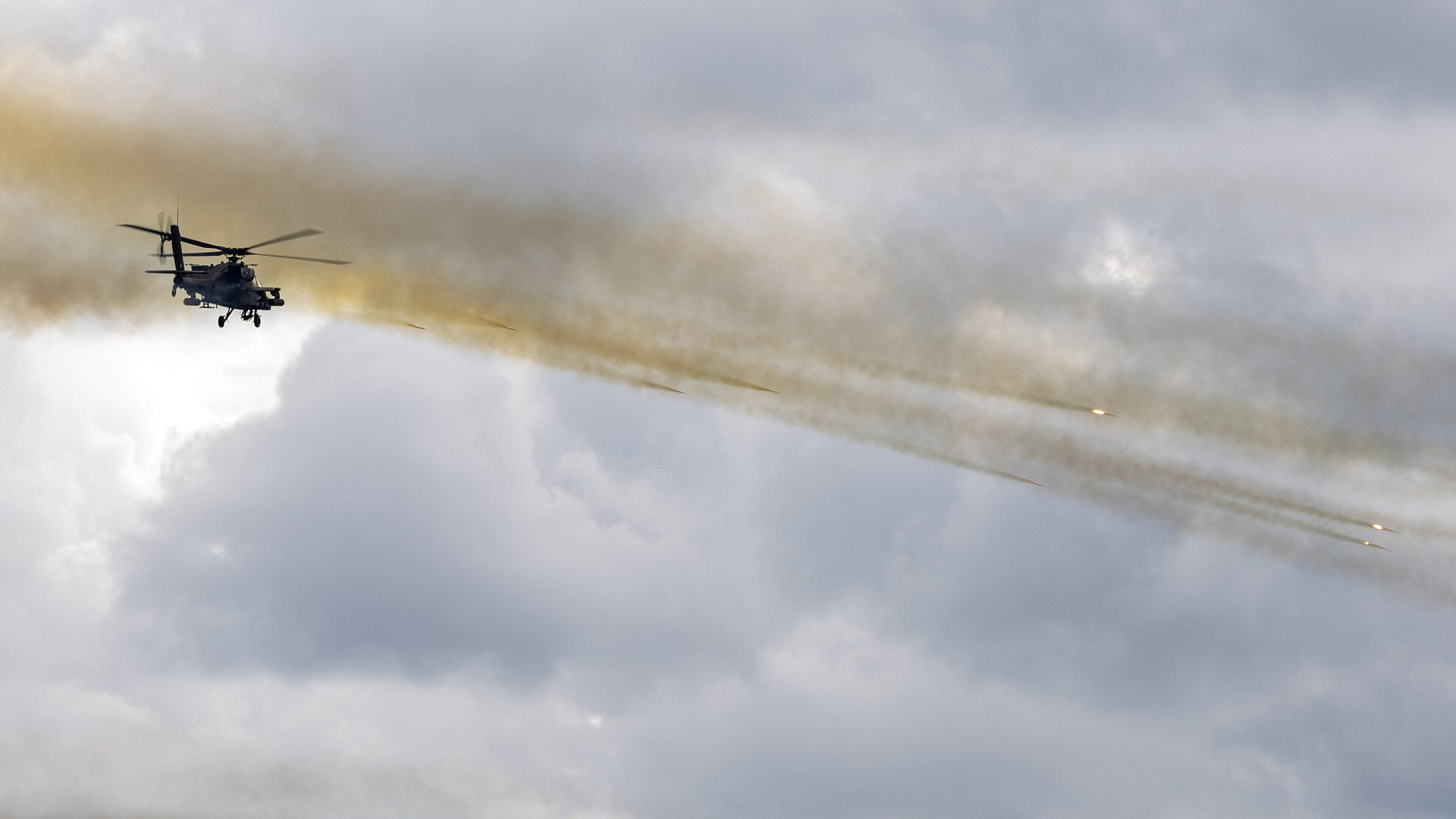
- Hydra 70 70 mm folding-fin rockets in M261 nineteen-tube launchers, up to four launchers for 76 rockets
- Warheads include M151 high-explosive, M229 heavyweight HE, M255 flechette for area targets and personnel, and M257/M278 illumination and infra-red flare rounds
- APKWS II laser-guided 70 mm, ordered for the Apache by the US Army in October 2015. It bolts a guidance section into an existing Hydra 70 and turns a saturation weapon into a precision one at a fraction of a Hellfire’s cost — the most useful cheap upgrade the type has had in twenty years
- CRV7 70 mm with flechette or high-explosive incendiary semi-armour-piercing heads on British and Canadian-supplied stocks; the British Apache also carried a multi-purpose sub-munition round until 2008
Pods & other stores
- 871-litre (230 US gal) auxiliary fuel tanks on the pylons, up to four for self-deployment; extended-range internal tanks have been studied since 2015
- AN/APG-78 Longbow mast assembly — strictly a store in the sense that on AH-64Ds it was moved between airframes, because the US Army bought fewer radars than aircraft
- Ground Fire Acquisition System sensor pods, fitted to a small number of US aircraft in Afghanistan from 2012 to locate muzzle flashes
- Wingtip Stinger rails on D and E airframes, and the maintenance mounting points on the stub-wing pylons, which crews have twice used to strap men to the outside of the aircraft for emergency extraction — most famously at Jugroom Fort in Helmand in January 2007
- Boeing has flown a directed-energy concept, a 2–10 kW laser aimed through a high-resolution telescope for use against small unmanned aircraft. It is not in service
Three typical loadouts
- Anti-armour
- 16 × AGM-114 Hellfire on four four-rail launchers, 1,200 rounds of 30 mm, no rockets. Maximum speed 148 kn, climb 990 ft/min, endurance 2 h 30 min. The configuration the aircraft was designed around and the one it flew in Desert Storm.
- Covering force
- 8 × Hellfire on the outboard pylons, 38 × Hydra 70 in two nineteen-tube launchers inboard, 1,200 rounds. Maximum speed 150 kn, climb 860 ft/min. The general-purpose fit, and the one most crews actually fly.
- Escort
- 76 × Hydra 70 in four nineteen-tube launchers, 1,200 rounds, no missiles. Maximum speed 153 kn, climb 800 ft/min. Written for screening air-assault columns; in Afghanistan and Iraq the same idea reappeared with APKWS in place of unguided rockets.
Sourcing caveat: the mission loadouts and their associated speeds, climb rates and endurance figures come from the US Department of the Army’s own attack-helicopter publication and describe a standard day; real fits are mixed and asymmetric, and Desert Storm aircraft flew with Hellfires, rockets and a fuel tank all at once. Munition availability varies enormously by operator — JAGM, Spike NLOS and APKWS are cleared on some fleets and not others, and several export customers have integrated national weapons that are not listed here.
Variants
Boeing has built one airframe for fifty years and changed almost everything inside it three times
The Apache’s external shape has barely moved since Hughes flew the YAH-64 in 1975. What has changed is the sensor, the radar, the transmission and the network, and the designation changes track those rather than the airframe. The A was an analogue night-attack helicopter with a superb sight; the D added a millimetre-wave radar and a glass cockpit; the E added the power, the gearbox and the datalinks to be useful in a networked force. Most aircraft in every fleet are rebuilds of earlier ones rather than new-builds.
Two lines of development were pursued and dropped. A navalised Sea Apache was studied for the US Marine Corps and Navy through the 1980s and never funded, though British Apaches have operated from HMS Ocean since 2004 and flew combat sorties from her over Libya in 2011. And the AH-64F, a 2014 proposal for a faster Apache with a 3,000 shp engine, retractable gear and a vectoring tail rotor, was abandoned in October 2016 so that money could go to Future Vertical Lift instead. The compromise is version-block upgrades to the E, which is what v6 and v6.5 are.
- YAH-64 (1975–1981, 2 prototypes and 3 pre-production)
- Hughes Model 77, first flown 30 September 1975, selected over the Bell YAH-63 in the Advanced Attack Helicopter competition. A 1985 Defense Department engineering review still listed 101 outstanding action items, and the rotor blade life problem ran until 1991.
- AH-64A (1984–1996, 937 built)
- The original: TADS/PNVS, IHADSS, T700-701 engines (-701C from 1990), no radar. Flew the opening shot of Desert Storm on 17 January 1991, when eight AH-64As led by MH-53J Pave Lows destroyed Iraqi early-warning radars. Withdrawn from US service in July 2012, most airframes converted to AH-64D.
- AH-64B and AH-64C (1991–1993, none built)
- Two cancelled upgrade programmes. The B would have given 254 A-models new blades, GPS and radios and was killed in 1992; the C was to be a D without the mast radar, and was abandoned once it became clear the radar could simply be moved between airframes.
- AH-64D Apache Longbow (1997–2013)
- AN/APG-78 mast-mounted fire-control radar, AN/APR-48 interferometer, glass cockpit, widened forward fuselage avionics bays, -701C engines and a radio modem that lets one aircraft hand targets to others. Block II from February 2003 added the digital communications fit.
- AH-64E Apache Guardian (from 2011, formerly Block III)
- T700-701D engines, face-gear transmission, composite blades, full instrument-flight capability, better landing gear, and the MUMT-X datalink that lets the crew control an RQ-7 or MQ-1C. Version 6 and 6.5 upgrades followed from 2021, the latter first flown in October 2023. Maritime radar modes and Link 16 were added for the Pacific.
- WAH-64D Apache AH.1 (1998–2004, 67 built)
- Assembled by Westland from Boeing kits with Rolls-Royce Turbomeca RTM322 engines, folding blades and shipboard modifications. Rebuilt to AH-64E standard from 2020; the fiftieth and last British AH-64E was handed over in March 2025.
- AH-64DJP (2006–2013, 13 built)
- Licence assembly by Fuji Heavy Industries for the Japan Ground Self-Defense Force, Stinger-capable. Japan planned 62 and stopped at 13 when unit costs rose after production ended, which produced years of litigation and stands as a warning about small licence runs.
- Export AH-64A/D/E (from 1990)
- Israeli Peten (A) and Saraph (D), Egyptian, Saudi, Emirati, Greek, Dutch, Singaporean, Kuwaiti, Qatari, Korean, Taiwanese, Indian, Indonesian, Australian, Moroccan and Polish aircraft. Most differ in defensive aids and in whether the wingtip Stinger rails are fitted and used.
- Sea Apache, AH-64F, Compound Apache (1980s–2019, none built)
- Three roads not taken: a navalised Apache studied for the Marines and never funded; a 3,000 shp high-speed F-model cancelled in 2016; and a wing-and-pusher-propeller compound demonstrator wind-tunnelled in 2018–19 for 185 kn and 460 nmi. All lost to Future Vertical Lift.
- Block modification (continuous)
- Not a variant but the mechanism by which the fleet actually changes: modification work orders are bundled and applied together at depot, so two aircraft wearing the same designation can differ substantially in fit.
Closing caveat: production and conversion totals for the Apache are unusually slippery because most "new" aircraft are remanufactured older ones, and different sources count the same airframe once, twice or three times. Boeing’s figure of more than 2,700 delivered is the most defensible single number, but it is a delivery count, not a count of distinct airframes.
The AH-64 Apache: a timeline from the AAH program to the AH-64E
Cheyenne cancelled, AAH launched
The Army cancels the AH-56 Cheyenne and launches the Advanced Attack Helicopter (AAH) competition for a simpler, more survivable gunship.
YAH-64 first flight
The Hughes YAH-64 prototype makes its first flight on 30 September 1975.
Hughes wins the fly-off
The Army selects the Hughes design over Bell’s YAH-63 after a competitive fly-off.
First AH-64A delivered
The first production AH-64A is delivered; Hughes Helicopters is acquired by McDonnell Douglas.
Apache enters Army service
The Apache enters operational service with the U.S. Army.
Opening shots of Desert Storm
Apaches of Task Force Normandy fire the opening shots of Operation Desert Storm, destroying Iraqi early-warning radars.
AH-64D Longbow and Boeing
The AH-64D Longbow, with its mast-mounted radar, is introduced; Boeing merges with McDonnell Douglas and takes over the Apache line.
AH-64E Guardian and beyond
The AH-64E Guardian enters service, re-engined and digitised with manned-unmanned teaming; production and upgrades continue for the U.S. Army and export customers.
The AH-64 Apache in action: notable missions and episodes
Task Force Normandy opens the Gulf War
In the first minutes of Operation Desert Storm, a small team of Apaches struck deep into Iraq.
Read the full account
A cannon that follows the gunner’s eyes
The M230 chain gun is slaved to the crew’s helmets through the IHADSS sight.
Read the full account
Fire, forget, and stay hidden
The Longbow radar and radar-guided Hellfire let an Apache shoot without exposing itself.
Read the full account
Karbala, 2003: a deep attack meets a wall of fire
An early Iraq-war deep strike ran into intense ground fire and forced a rethink.
Read the full account
Jugroom Fort: riding on the wings to bring a Marine home
In Afghanistan in 2007, British Apaches flew Royal Marines strapped to the airframe on a rescue.
Read the full account
Apaches over Libya from HMS Ocean
In 2011, British Apaches flew strike missions from a ship off the Libyan coast.
Read the full account
Re-engined for the mountains
Afghanistan pushed the Apache’s engines and rotors to their limits.
Read the full account
Built to be shot at — and to fly home
The Apache’s armour and redundancy reflect hard Vietnam-era lessons.
Read the full account
A helicopter that flies with drones
The AH-64E can see through, and control, unmanned aircraft.
Read the full account
The attack helicopter everyone else measures against
From Israel to Japan, the Apache has become the Western standard.
Read the full account
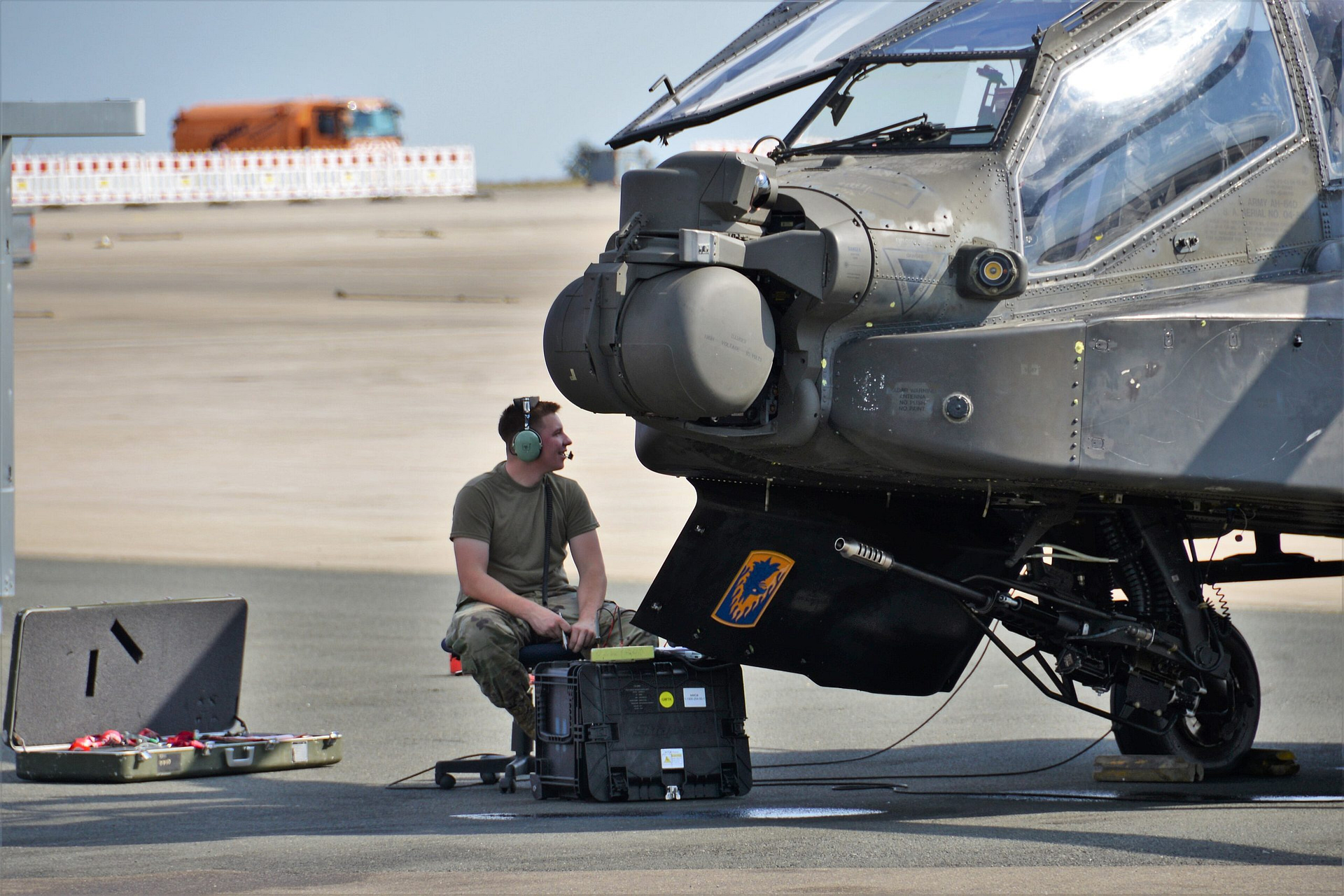
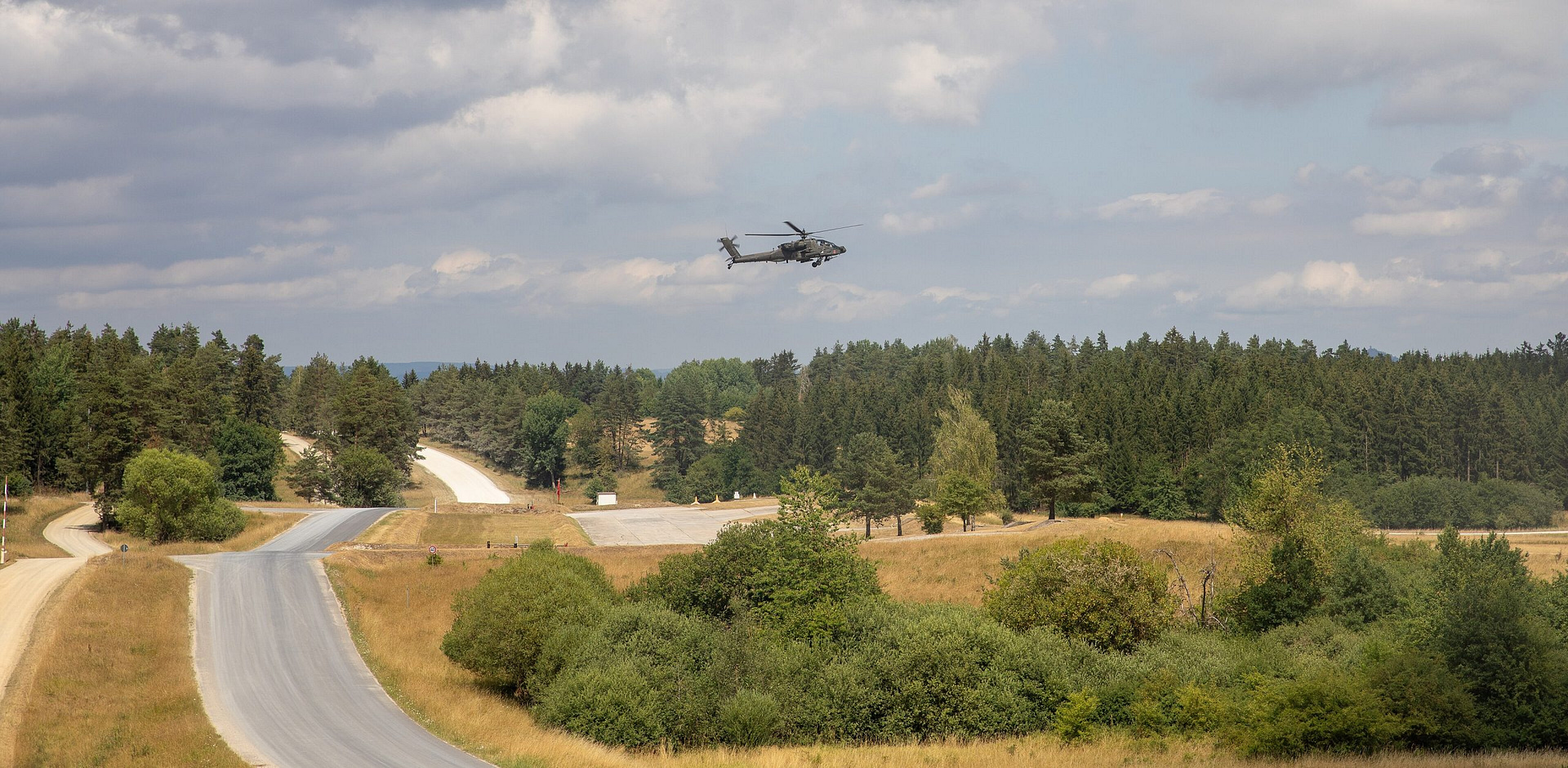
AH-64 Apache photos: the attack helicopter up close
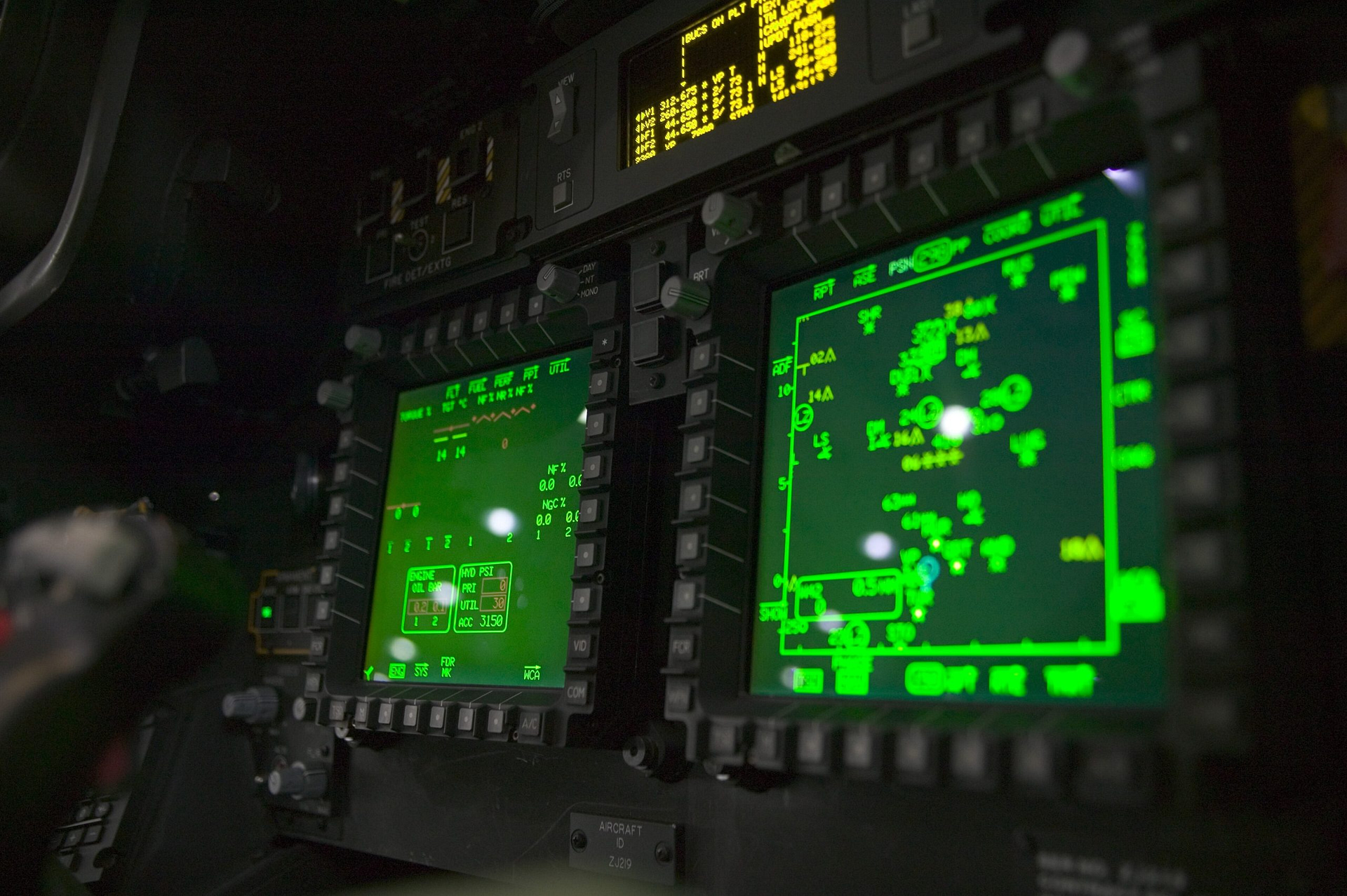
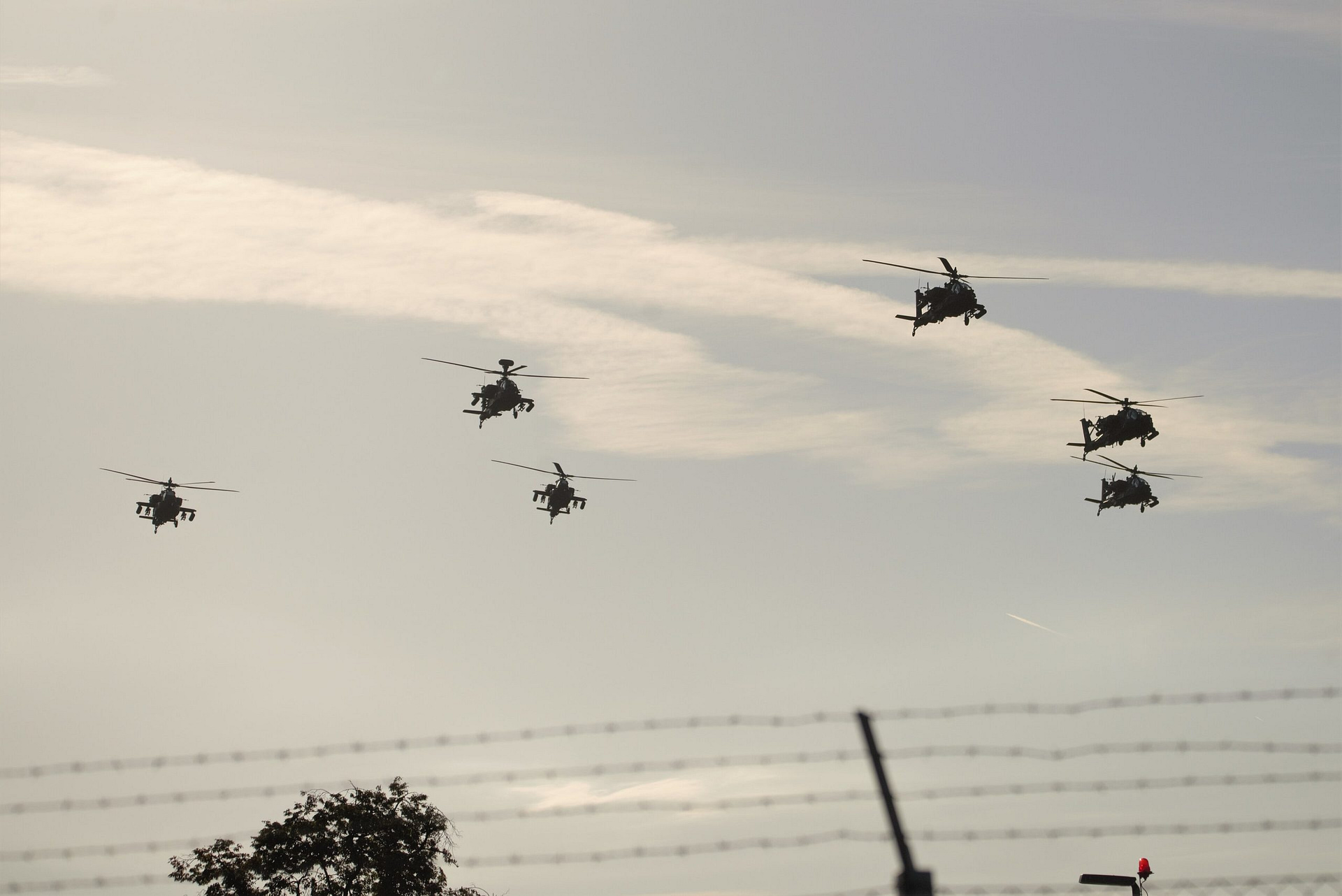
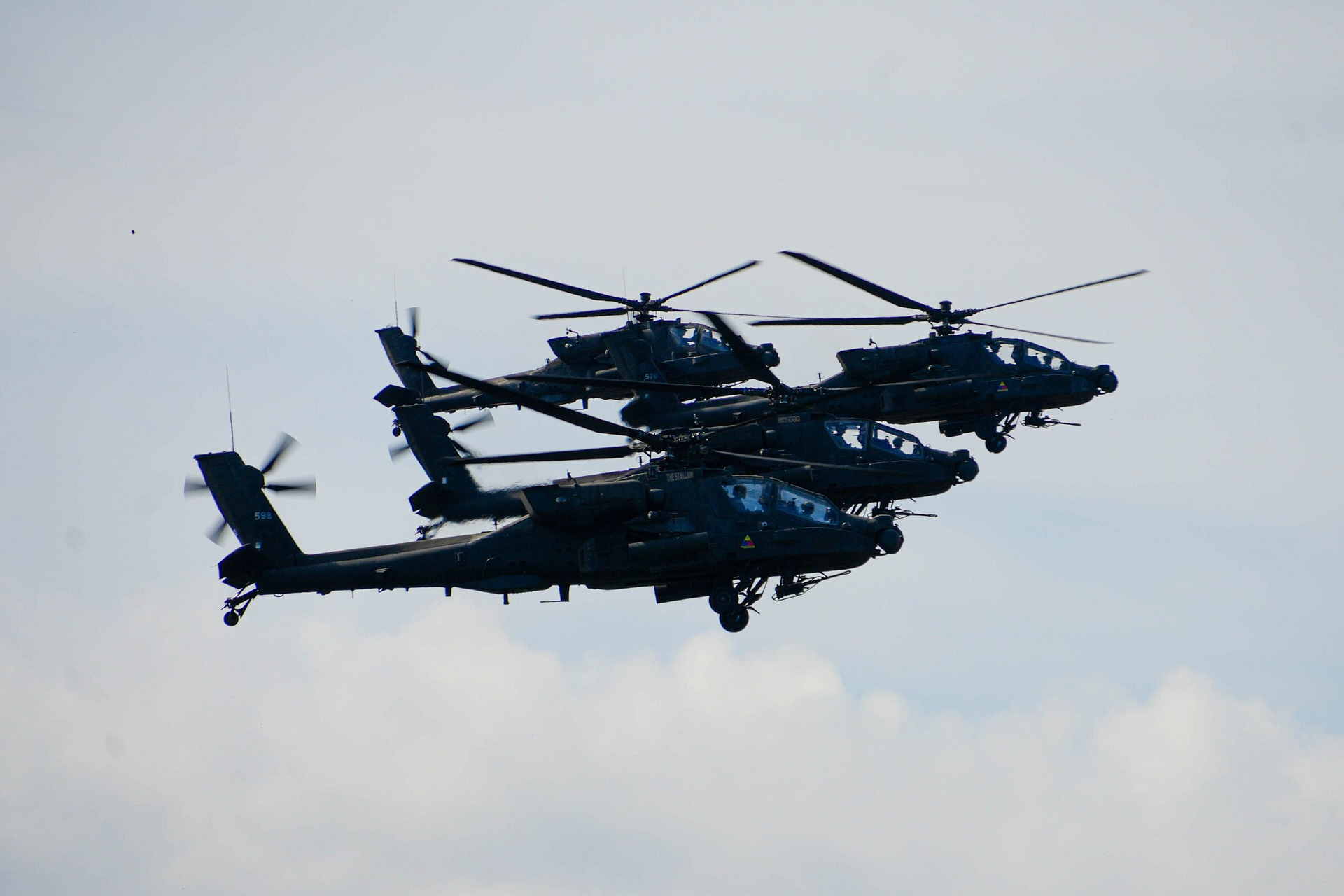
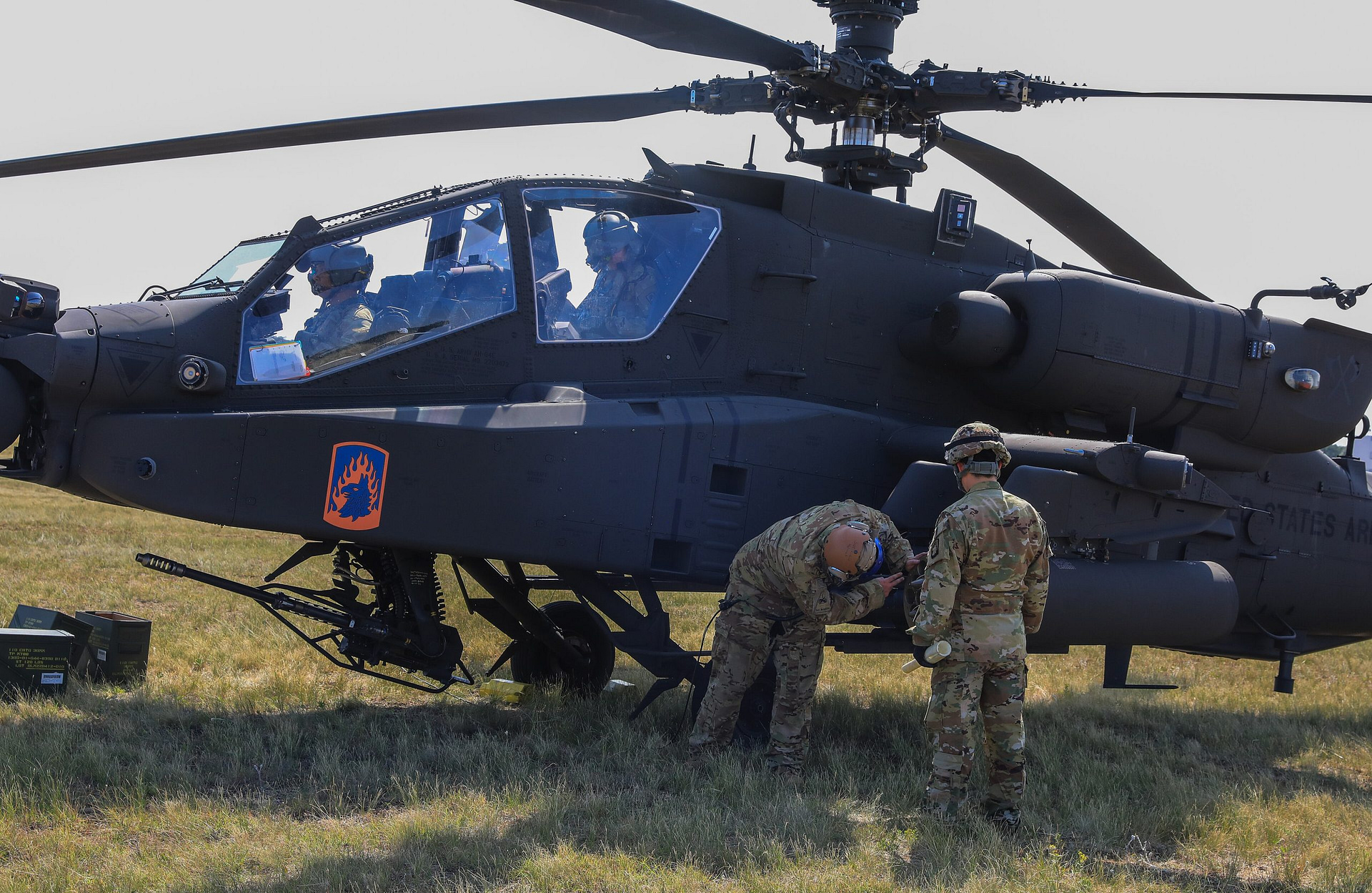
The AH-64 Apache on screen: how the attack helicopter works
AiTelly · “Apache Helicopter How it Works” — a widely-viewed animated technical breakdown of the AH-64 and its systems.
Where the AH-64 Apache flies: origin, combat use and operators
Operators today
The US Army owns more Apaches than every other operator on earth combined, and the gap is not close
Sixteen countries fly the AH-64, and the distribution is extreme: roughly 750 of them wear US Army markings, and the next largest fleet is one-fifteenth that size. The export pattern is Middle Eastern and East Asian rather than European, and it has been shaped by sequential arms deals — Saudi Arabia bought in 1992, Israel was offered aircraft to offset that sale, and both the Emirati and Egyptian fleets followed the same Gulf War logic. Europe’s picture is about to change: Poland has contracted for 96 AH-64E, which would make it the largest operator outside the United States.
These are estimates of delivered aircraft on charge and several need qualifying. The US figure is roughly 160 AH-64D and 590 AH-64E as of January 2025, against a programme of record of 812. Saudi Arabia’s total combines about 47 aircraft of the Royal Saudi Land Forces with 12 National Guard AH-64Es. The British 50 are all AH-64E, the last handed over in March 2025, and the WAH-64D Apache AH.1 is gone. Israel does not publish numbers; the figure covers surviving Peten и Saraph airframes, with 30 AH-64Es reported on order. Greece’s AH-64A/D total is a delivery count and a meaningful proportion has been unserviceable for spares reasons. India’s 28 splits into 22 Indian Air Force and six Indian Army aircraft. Ordered but not counted here: Poland, which has taken delivery of eight AH-64D leased from the US Army for training and contracted in November 2025 for 96 new AH-64E — the largest Apache order outside the United States, with deliveries still ahead; Australia, six of 29 AH-64E delivered from September 2025; Morocco, 12 of 36 delivered; and a second South Korean batch of 36. Omitted for space or corroboration: Kuwait (about 24), Singapore (19), Japan (12 AH-64DJP) and Indonesia (8). Sources: IISS The Military Balance, FlightGlobal World Air Forces, US Army aviation inventory returns, DSCA notifications and national announcements; entries that could not be corroborated are omitted.
The AH-64 Apache in combat: from Desert Storm to today
The Apache is one of the most combat-tested aircraft of the modern era. Boeing states the worldwide fleet has flown over 5.3 million hours, more than 1.3 million of them in combat. Specific tallies of vehicles destroyed vary between sources and should be treated as estimates.
Compare the Explore the combat record of every military aircraft. Data as of July 2026.
AH-64 Apache: frequently asked questions
Can I fly in an AH-64 Apache?
What is the AH-64 Apache?
Who makes the AH-64 Apache?
What weapons does the Apache carry?
What is the difference between the AH-64D Longbow and the AH-64E Guardian?
How fast is the Apache and how far can it fly?
Has the Apache seen combat?
How much does an AH-64 Apache cost?
Which countries operate the Apache?
You can’t fly the AH-64 Apache.
These, you can.
Some legends only live in museums — others are fuelled and waiting. MiGFlug has put civilians in real military jet cockpits since 2004.
 Fly the L-39 AlbatrosThe world’s most-flown jet trainer — aerobatics included
 Fly the F-104 Starfighter“The missile with a man in it”
 Fly the MiG-21The Cold War’s most-produced jet
 Управляйте самолетом T-33 Shooting Star.America’s first jet trainer
 Fly the DH VampireA piece of early jet history
 Fly the S.211Agile Italian jet trainer
 Fly the MB-326The classic Aermacchi jet
 Fly the MiG-15The Soviet legend of the Korean War
More from the Military Aircraft Encyclopedia
AH-64 Apache: sources & further reading
- BoeingBoeing — official AH-64 Apache overview, production totals, fleet hours and specifications.
- Army TechnologyArmy Technology — detailed Apache dimensions, powerplant, performance and armament.
- U.S. ArmyU.S. Army — service history, doctrine and operational use of the Apache.
- Imperial War MuseumsImperial War Museums — British Army Apache operations in Afghanistan and Libya.
- National Army Museum (UK)National Army Museum (UK) — the Apache in British Army service.
- Federation of American ScientistsFederation of American Scientists — technical background on the AH-64 and its weapons.
- GlobalSecurity.orgGlobalSecurity.org — variant histories and program background for the Apache.
- Smithsonian National Air and Space MuseumSmithsonian National Air and Space Museum — context on U.S. Army rotary-wing aviation.
- MiGFlug AfterburnerMiGFlug Afterburner — the magazine behind this encyclopedia, on military aviation and jet flights.
Hero and gallery photography: U.S. Air Force / NASA, public domain. Combat statistics as of July 2026. Spotted an error? Every page in the Aircraft Museum is fact-checked before publication — write to us and we’ll correct it.