
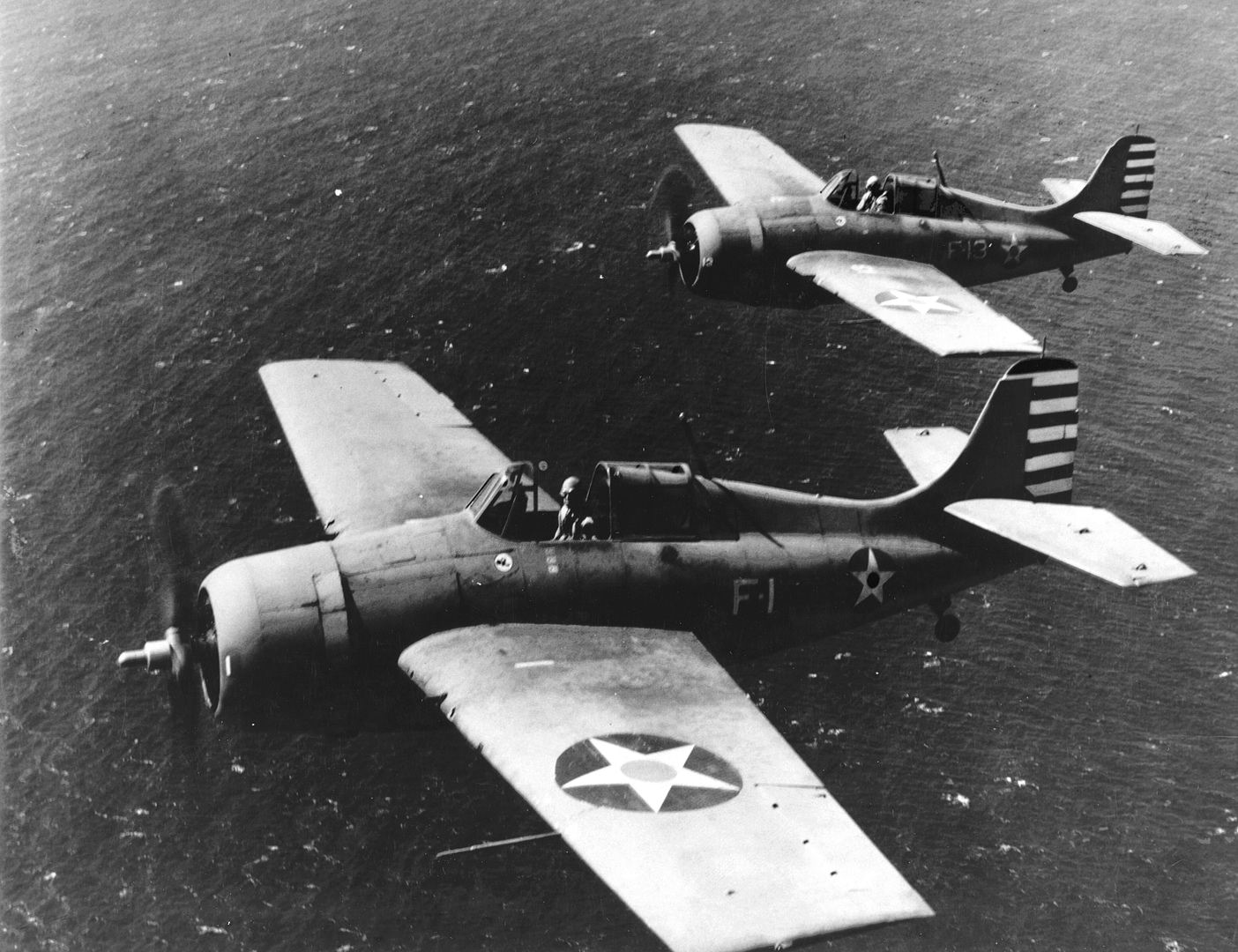
Grumman F4F
Wildcat
Stubby, rugged and hand-cranked, the US Navy’s early-war carrier fighter was outclassed on paper by the nimble A6M Zero — yet its pilots held the line through 1942 and, as the GM-built FM-2, it fought on to the last day of the war.
How the Grumman F4F Wildcat held the line
The Wildcat began life as a biplane. When Grumman’s XF4F-1 lost a 1936 US Navy fighter competition to the Brewster Buffalo, the company redesigned it into a stubby, barrel-nosed monoplane. The prototype XF4F-2 first flew on 2 September 1937, and after further development the F4F-3 entered US Navy and Marine Corps service in 1940. It was not elegant: a mid-wing tub of a fighter with a narrow, hand-cranked undercarriage that folded into the fuselage after some thirty turns of a crank. But it was tough.
When the Pacific War opened, the Wildcat was the US Navy’s front-line carrier fighter, and on paper it was outclassed. The Japanese A6M Zero climbed faster, turned tighter and out-ranged it. What the Wildcat had was armour plate, self-sealing fuel tanks, a sturdy airframe and six heavy machine guns — it could absorb punishment that tore a Zero apart, and it could hit hard. Marine pilots at Wake Island in December 1941, Navy squadrons at Coral Sea и Midway, and the ragged “Cactus Air Force” over Guadalcanal all fought the early battles on the Wildcat’s broad shoulders.
The answer to the Zero’s agility was not a better turn but better teamwork. Lieutenant Commander John “Jimmy” Thach devised a mutual-defence weave that let a pair of Wildcats cover each other’s tails, blunting the Zero’s advantage. The British flew the type too — as the Martlet in Fleet Air Arm service, it scored the first kill by an American-built fighter in British hands in December 1940. And when carrier decks grew short, General Motors built a lighter, more powerful version, the FM-2 “Wilder Wildcat,” that flew from tiny escort carriers to the end of the war. Nearly 7,885 were built, and the type is generally credited with a positive overall kill ratio — the fighter that bought the US Navy time until the Hellcat and Corsair arrived.
01The Grumman F4F Wildcat vs the A6M Zero: why toughness beat agility
On raw performance the Zero should have swept the Wildcat from the sky: it was lighter, climbed and turned better and had far greater range. But the Zero bought that agility by leaving out armour and self-sealing tanks, so a short burst from the Wildcat’s six .50-calibre Brownings could set it ablaze. The Wildcat, by contrast, was built to come home — armour behind the pilot, protected tanks and a rugged structure meant it soaked up hits that would have destroyed a lighter fighter.
US pilots learned not to dogfight the Zero on its own terms. They dived, used height and speed, fought in pairs and refused the turning duel — and above all used the Thach Weave (see below). The result, by the end of 1942, was a claimed kill ratio the US Navy put as high as roughly nine to one in some accounts; across the whole war the type is commonly credited with a positive overall ratio near 6.9 : 1. Treat the precise figures as claims — wartime tallies are always contested — but the direction is not in doubt.
What makes it special
A rugged, survivable carrier fighter
The Wildcat was built to take a beating and bring its pilot home. It carried armour plate around the cockpit, self-sealing fuel tanks and a stout airframe — luxuries the lightweight A6M Zero went without. Combined with six 0.50-calibre Browning machine guns, that durability turned it from an underdog into a fighter the Japanese found genuinely hard to shoot down. The narrow, hand-cranked landing gear was awkward, but the aircraft was famously tough.
Teamwork over agility: the Thach Weave
Unable to out-turn the Zero, US Navy pilots out-thought it. Lieutenant Commander John “Jimmy” Thach worked out a “beam-defence” manoeuvre — a scissoring weave in which two Wildcats turned toward each other so that any Zero on one’s tail flew into the other’s guns. First used in combat at Midway in June 1942, the Thach Weave let inferior aircraft fight superior ones on even terms, and the tactic outlived the Wildcat itself.
The FM-2 “Wilder Wildcat” and escort-carrier longevity
As Grumman moved to the bigger Hellcat, General Motors’ Eastern Aircraft Division kept the Wildcat in production. Its FM-2 was lighter, with a more powerful Wright R-1820 radial (~1,350 hp) and a taller tail — the “Wilder Wildcat.” Small enough to fly from tiny escort carriers, the FM-2 served to the war’s end, including the desperate defence at the Battle off Samar in October 1944.
02The Grumman F4F Wildcat’s hand-cranked landing gear: 30 turns of the crank
The Wildcat inherited a narrow-track main undercarriage that retracted into the fuselage — and in the F4F it was raised and lowered by hand. The pilot cranked a wheel roughly thirty turns after take-off, a chore that could make the aircraft porpoise as he worked, and a slip of the hand could spin the crank back painfully. The narrow track also made the Wildcat a handful on deck and prone to ground loops. It was a genuine weakness — but hydraulic gear of the day was seen as more vulnerable to battle damage, and the manual system was simple and hard to knock out.
03The Grumman F4F Wildcat’s Sto-Wing folding wings: doubling a carrier’s fighters
From the F4F-4, Leroy Grumman’s engineers gave the Wildcat the Sto-Wing — a clever skewed-axis hinge that let the wings rotate and fold flat back along the fuselage, “like a bird’s wing.” Folded Wildcats took up far less deck and hangar space, roughly doubling the number of fighters a carrier could embark. The same folding principle was carried into the later Hellcat and survives today on the Navy’s E-2 Hawkeye. The F4F-4 also added a sixth gun and armour, at some cost in agility — a trade-off many pilots grumbled about.
Full specifications
Figures below are for the F4F-4, the main carrier version of 1942; the FM-2 and F4F-3 differed in engine, weight and gun count.
Airframe & Performance
- Экипаж
- 1
- Длина
- ~8.8 m (28 ft 9 in)
- Размах крыльев
- 11.58 m (38 ft 0 in)
- Высота
- ~2.81 m (9 ft 2 in)
- Пустой вес
- ~2,610 kg (5,760 lb)
- Max takeoff weight
- ~3,600 kg (7,975 lb)
- Max speed
- ~515 km/h (320 mph) at altitude
- Служебный потолок
- ~10,360 m (34,000 ft)
- Диапазон
- ~1,240 km (770 mi) combat
Propulsion, Armament & Programme
- Двигатель
- 1 × P&W R-1830-86 Twin Wasp radial
- Power
- ~1,200 hp (FM-2: Wright R-1820, ~1,350 hp)
- Вооружение
- 6 × 0.50 in Browning M2 (F4F-4)
- First flight
- 2 September 1937 (XF4F-2)
- Service entry
- 1940
- Built
- ~7,885 (Grumman & GM Eastern, 1940–45)
- Unit cost
- ~US$35,000 (WWII, estimate)
- Cost per flight hour
- No meaningful modern figure
04The Grumman F4F Wildcat’s operating costs: what a wartime fighter was worth
The Wildcat was a mass-produced wartime aircraft, not an item sold on any open market, so a precise flyaway price is elusive. Contemporary US Navy fighters of its class were procured for very roughly US$30,000–40,000 apiece in early-1940s dollars — an order-of-magnitude figure, not an audited unit cost, and one that fell as production scaled up. No meaningful modern cost-per-flight-hour figure exists for an out-of-service piston fighter; today only a handful of airworthy FM-2 and F4F warbirds fly, at collector-aircraft running costs. Treat any exact dollar figure attached to the Wildcat as an estimate.
From losing biplane to war-winning workhorse
Beaten, then reborn
Grumman’s biplane XF4F-1 loses a US Navy contest to the Brewster Buffalo; the company redesigns it as a stubby monoplane.
First flight
The prototype XF4F-2 flies on 2 September, beginning the line that becomes the F4F Wildcat.
Into service
The F4F-3 enters US Navy and Marine Corps squadrons; Britain orders the type, which it names the Martlet.
First British kill
Two Martlets of 804 Naval Air Squadron down a Junkers Ju 88 over Scapa Flow — the first victory by an American-built fighter in British service.
The Wake Island stand
Marine Wildcats of VMF-211 fight a doomed defence of Wake, sinking the Japanese destroyer Kisaragi before the island falls.
O’Hare’s Medal of Honor
Lt Edward “Butch” O’Hare, flying from USS Lexington, breaks up a bomber attack and becomes the Navy’s first WWII ace and Medal of Honor airman.
Midway and the Thach Weave
At Coral Sea and Midway the Wildcat carries the fight; Jimmy Thach debuts his mutual-support weave against the Zero.
The Cactus Air Force
Marine and Navy Wildcats fly from Guadalcanal’s Henderson Field, holding the island through months of attrition.
The Wilder Wildcat
General Motors puts the lighter, more powerful FM-2 into production for the growing fleet of small escort carriers.
Battle off Samar
FM-2s from escort carriers help fend off a far larger Japanese surface fleet in one of the war’s great last stands.
End of the line
Production ends with roughly 7,885 built; the Wildcat serves to the last day of the war and passes into history.
From the flight deck: twelve Wildcat stories
The biplane that lost
Grumman’s XF4F-1 lost a 1936 contest — so it was reborn as a monoplane.
Read the full story
The last stand of VMF-211
A dozen Marine Wildcats fought a hopeless defence of Wake — and sank a destroyer.
Read the full story
Five bombers in minutes
On 20 February 1942 Butch O’Hare broke up a bomber formation almost single-handed.
Read the full story
First blood for the Martlet
British Martlets scored the first kill by an American-built fighter in UK service.
Read the full story
The Thach Weave
Jimmy Thach invented a weave that let two Wildcats guard each other from the Zero.
Read the full story
Proving the weave
At Midway, Thach used his own tactic against swarming Zeros — and it worked.
Read the full story
The Cactus Air Force
From a muddy island strip, Wildcats held Guadalcanal through months of attrition.
Read the full story
Built to come home
Armour and self-sealing tanks made the Wildcat brutally hard to kill.
Read the full story
Thirty turns of the crank
The F4F’s landing gear was raised by hand — a workout after every take-off.
Read the full story
Joe Foss, ace of aces
A Marine scored all 26 of his kills in the Wildcat — matching WWI’s top American ace.
Read the full story
The Wilder Wildcat at Samar
Lightened FM-2s from escort carriers charged a Japanese battle fleet off Samar.
Read the full story
Martlet becomes Wildcat
In 1944 the Royal Navy dropped “Martlet” and adopted the American name.
Read the full story
The Wildcat in pictures
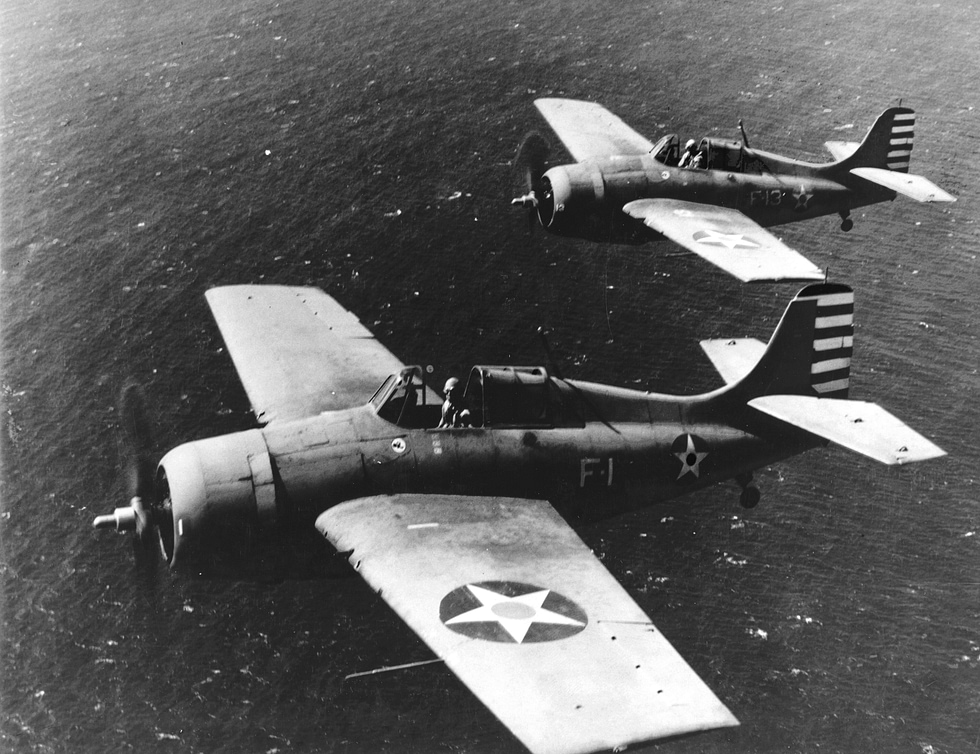
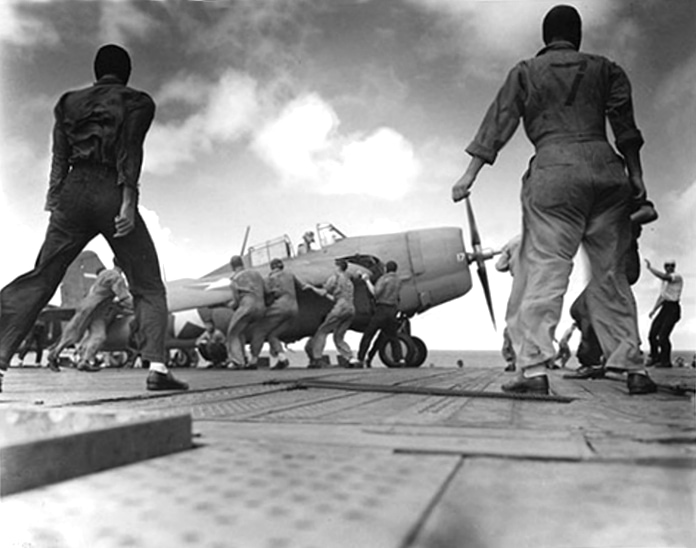
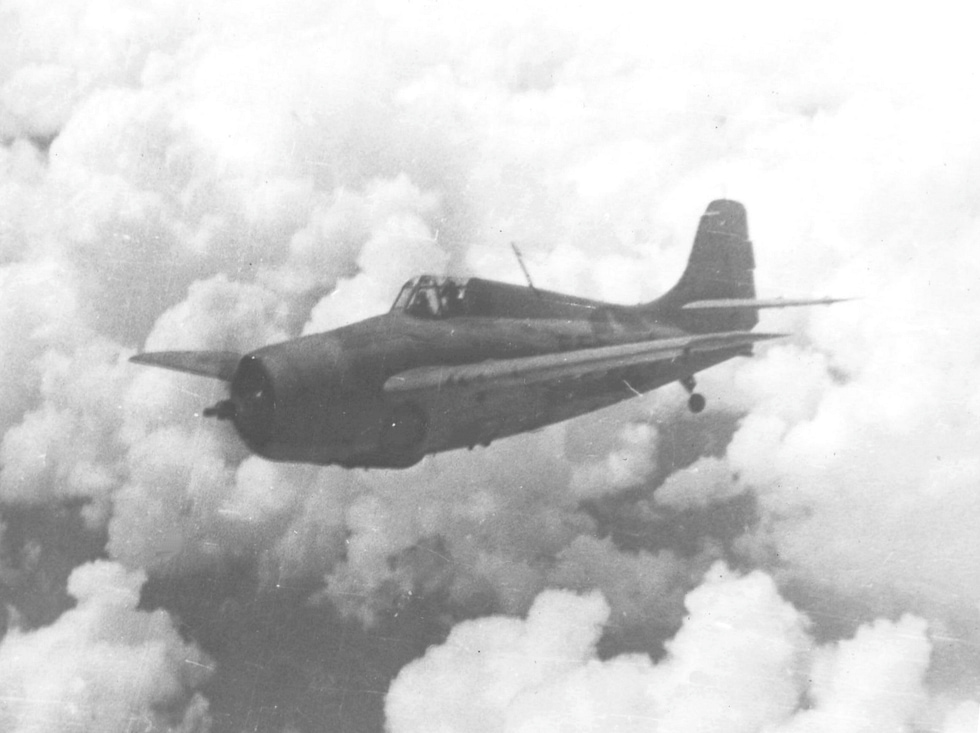
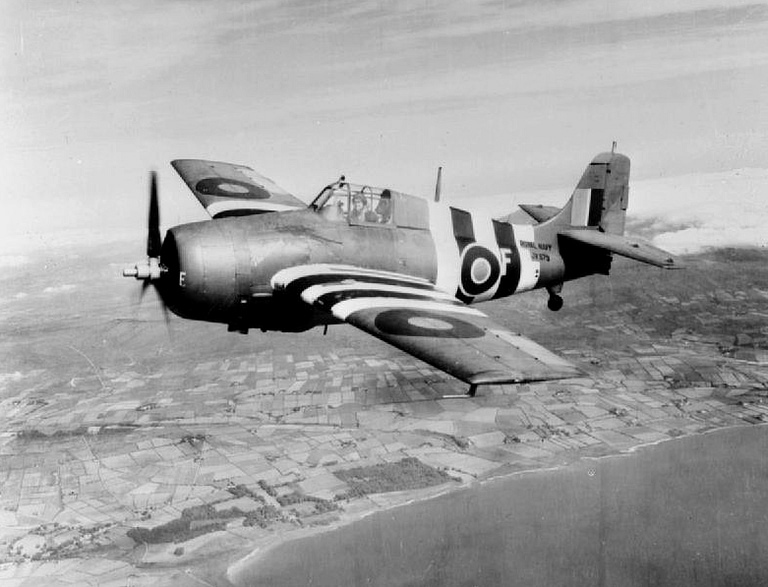
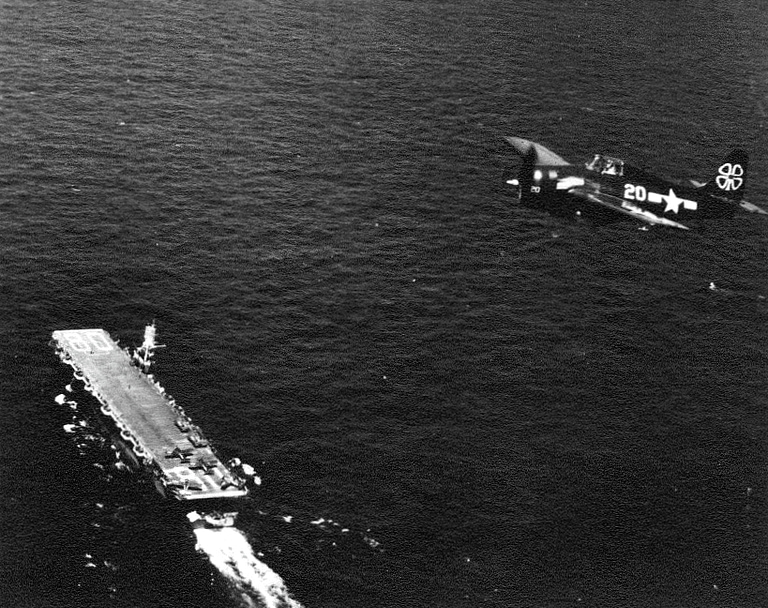
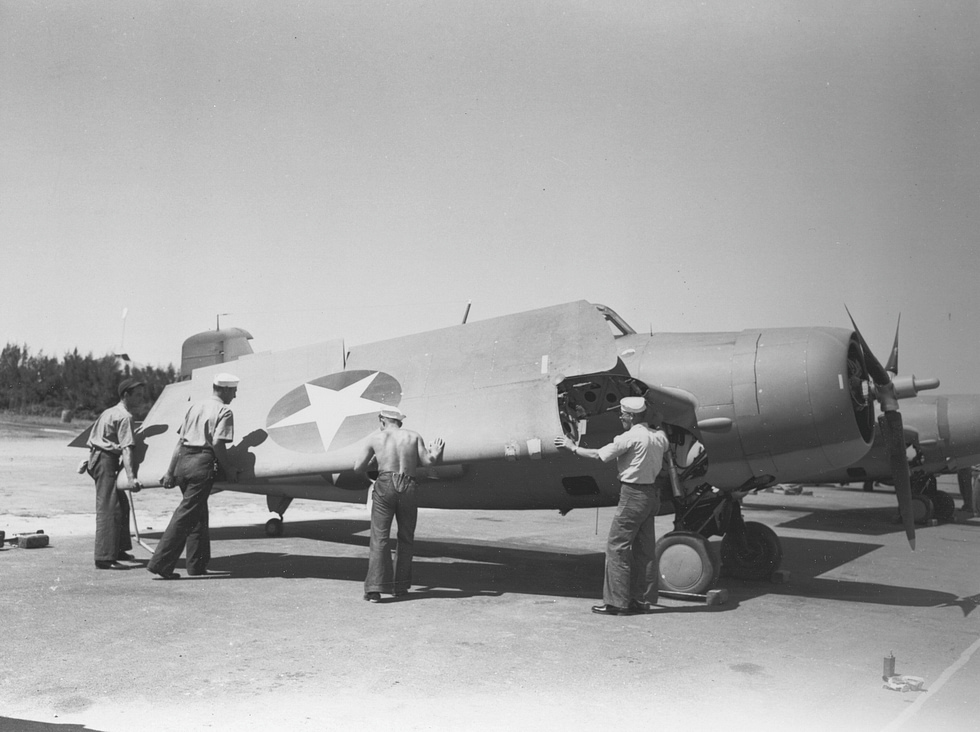
The Wildcat in motion
A featured documentary film on the Grumman F4F Wildcat is coming soon to this exhibit. In the meantime, explore the stories, gallery and operations map above and below.
Where the Wildcat flew
The score that defines it
The Wildcat entered the war as an underdog and left it credited with a positive kill ratio — a rare achievement for a fighter its rivals out-performed on paper. Its record was written in defensive battles won, carriers protected and better aircraft bought time to arrive. Wartime tallies are always contested, so the figures below are best read as widely cited claims rather than audited totals.
Compare the combat record of every military aircraft. Figures as of July 2026.
Everything people ask about the F4F Wildcat
Can I fly in an F4F Wildcat?
Why was the Wildcat successful against the faster A6M Zero?
What is the Thach Weave?
Who was Butch O’Hare?
What is the difference between the F4F, the FM-2 and the Martlet?
How many Wildcats were built?
Is the Wildcat still flying?
You can’t fly the Wildcat.
These, you can.
Some legends only live in museums — others are fuelled and waiting. MiGFlug has put civilians in real military jet cockpits since 2004.
 Fly the L-39 AlbatrosThe world’s most-flown jet trainer — aerobatics included
 Fly the F-104 Starfighter“The missile with a man in it”
 Fly the MiG-21The Cold War’s most-produced jet
 Управляйте самолетом T-33 Shooting Star.America’s first jet trainer
 Fly the DH VampireA piece of early jet history
 Fly the S.211Agile Italian jet trainer
 Fly the MB-326The classic Aermacchi jet
 Fly the MiG-15The Soviet legend of the Korean War
Continue the tour
Every fact, checked
- Naval History and Heritage Command — F4F WildcatUS Navy reference for the type, its kill ratio and its aces.
- Smithsonian Magazine — “How the Rugged F4F Wildcat Held the Line”NASM curator on the Wildcat’s toughness, the Sto-Wing and Joe Foss.
- Congressional Medal of Honor Society — Edward “Butch” O’HarePrimary citation for O’Hare’s 20 February 1942 action.
- History of War — Grumman MartletBritish Fleet Air Arm service, the first Scapa Flow kill and the 1944 renaming.
- General Aviation News — “The Wilder Wildcat”The GM-built FM-2, its Wright engine, taller tail and escort-carrier role.
- This Day in Aviation — 2 September 1937First-flight date and detailed early-Wildcat specifications.
- Naval Encyclopedia — Grumman F4F WildcatProduction totals, the hand-cranked gear and the claimed 6.9:1 ratio.
- War History Online — O’Hare, first naval MoHContext for O’Hare as the Navy’s first ace and MoH aviator.