
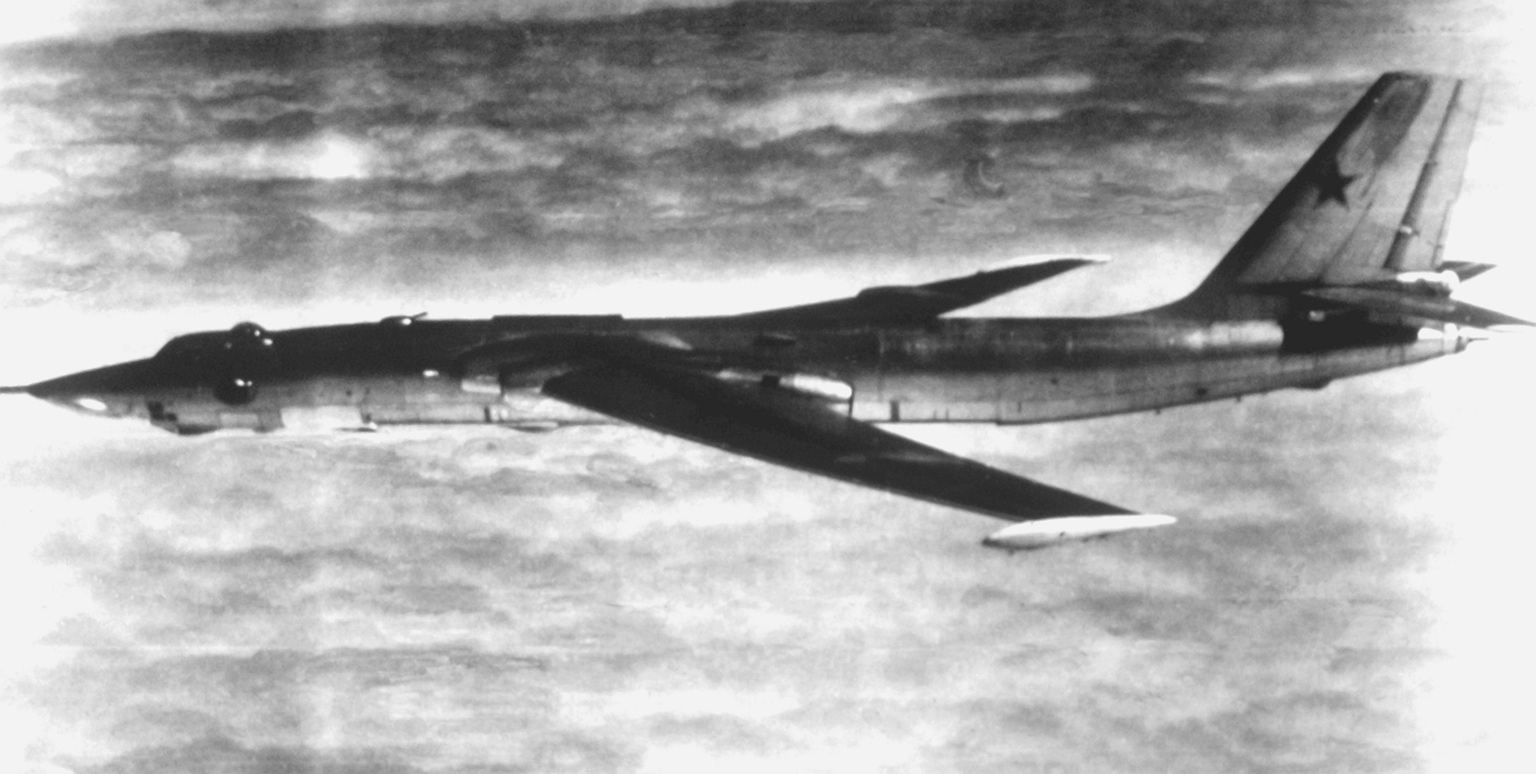
Myasishchev M-4 / 3M
“Bison”
The Soviet Union’s first four-jet strategic bomber — built to reach the United States, yet it fell short of true intercontinental range. Most were rebuilt as aerial tankers, and a handful were later modified to carry the Buran space shuttle on their backs.
The bomber built to reach America — that couldn’t quite
In the early 1950s the Soviet Union had no aircraft able to strike the continental United States and return. The task fell to a design bureau newly re-formed under Vladimir Myasishchev, which was ordered to build a four-jet strategic bomber on a famously short timescale. The prototype, known in the West as the M-4 “Bison,” first flew on 20 January 1953 and entered service in 1955 — making it the Soviet Union’s first four-engined jet strategic bomber, roughly contemporary with America’s Boeing B-52.
Its central problem became apparent almost at once. The M-4 was designed for an intercontinental radius of action, but in practice its range fell well short of what was needed to reach American targets and come home — figures commonly cited put its range at around 8,000–9,500 km against a requirement of 11,000–12,000 km. As a pure nuclear bomber aimed at the United States it was, by most accounts, a strategic disappointment. The improved 3M variant (Soviet designation Molot, “Hammer”), re-engined and fitted for aerial refuelling, closed much of the gap but never fully solved it.
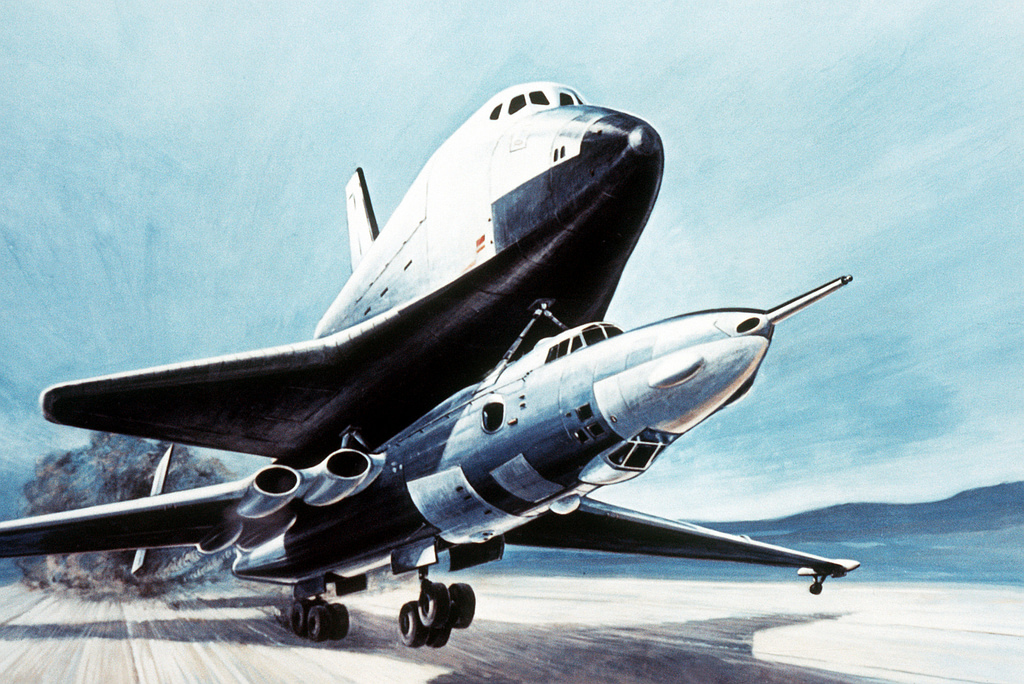
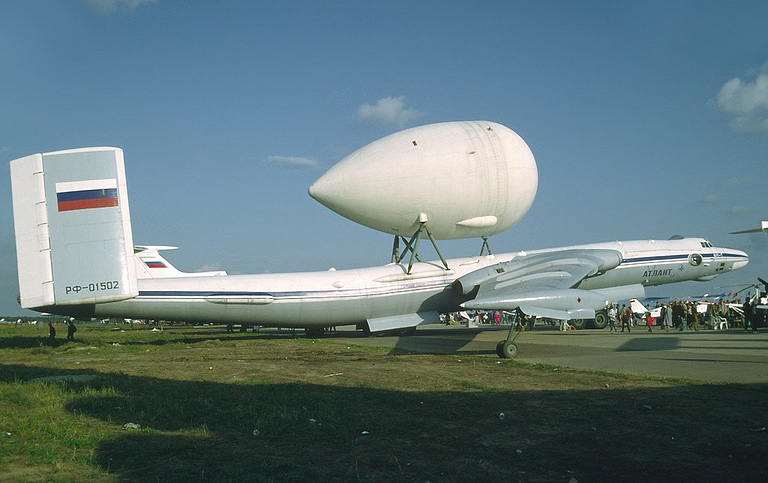
So the type found its lasting value elsewhere. Large numbers were converted into aerial tankers to refuel other aircraft, including other Bisons, and into reconnaissance platforms. The design also earned a strange place in aviation history twice over: in 1955 a flypast of Bisons helped convince Western observers that the USSR was mass-producing long-range bombers — feeding the “bomber gap” scare — and decades later a small number of rebuilt airframes, the VM-T Atlant, ferried Buran space-shuttle and Energia rocket components across the Soviet Union on their backs.
01The Myasishchev M-4 Bison and the “bomber gap”: how a 1955 flypast fooled the West
On 3 July 1955, at the Soviet Aviation Day display at Tushino near Moscow, Western military attachés watched a stream of M-4 Bisons pass overhead and concluded the USSR was already fielding long-range jet bombers in quantity. By the most widely repeated account, the impression of numbers was exaggerated: a group of aircraft flew past, circled out of sight, and passed over again, so the same machines were counted more than once. Whether this was a deliberate deception or a misreading by observers is still debated, but the effect was real.
Combined with later intelligence, the display helped drive the American perception of a “bomber gap” — a belief that the Soviet Union was out-producing the United States in strategic bombers. That perception influenced US defence spending and bomber procurement in the mid-1950s. In reality the Bison was built only in modest numbers — on the order of ninety aircraft — and the gap, as later reconnaissance including U-2 flights showed, did not exist in the form feared.
What makes the M-4 Bison special
The USSR’s first four-jet strategic bomber
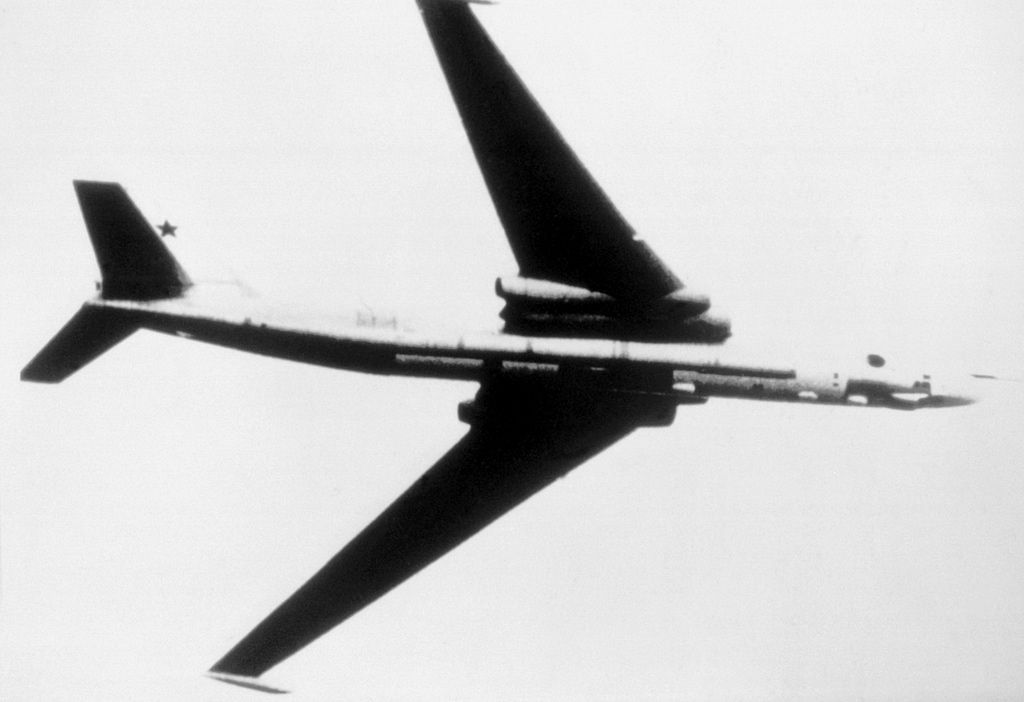
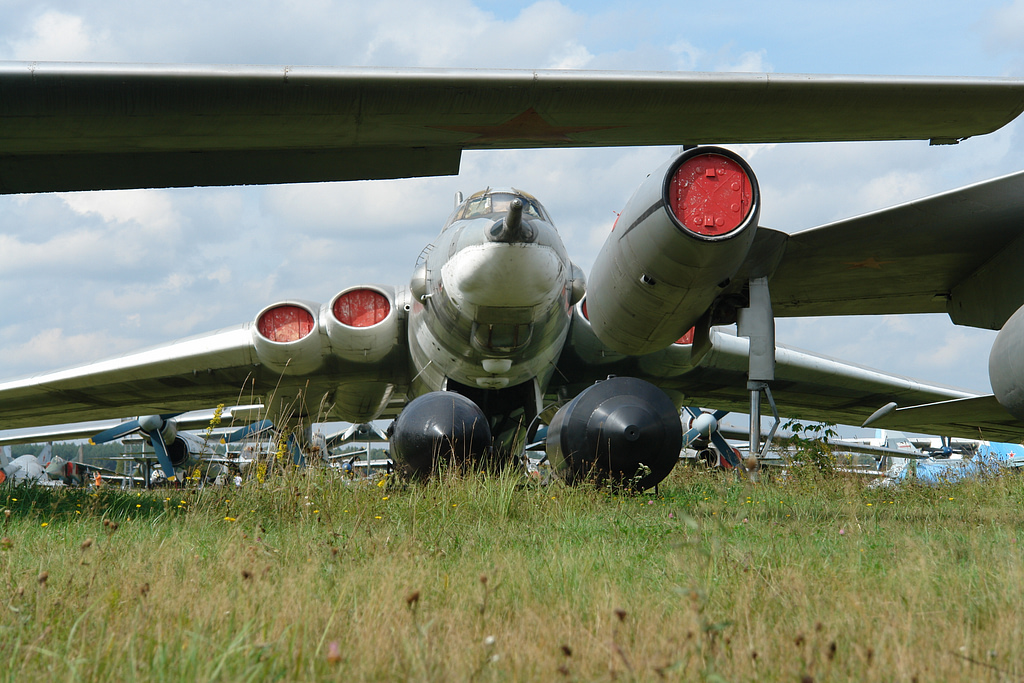
The M-4 paired a high, swept wing with four large turbojets buried in the wing roots, close to the fuselage — the same basic layout later seen on the British Victor and, in spirit, the American B-52. Early M-4s used four Mikulin AM-3 engines; the improved 3M switched to more efficient Dobrynin VD-7 units. It was the first Soviet aircraft to bring a genuine four-engined jet bomber into service.
Bicycle landing gear
To keep the thin, fuel-filled wing clear of heavy undercarriage, Myasishchev used a bicycle (tandem) main gear — two main units in line under the fuselage, with small outrigger wheels near the wingtips for balance. The forward truck was designed to help the aircraft rotate for take-off. It was an elegant solution to a hard packaging problem, but it demanded long, wide runways.
The range shortfall — and the refuelling fix
The Bison never reached the range its strategic mission required. The response was an aerial-refuelling programme: bombers were fitted to take on fuel in flight, and many airframes were rebuilt as dedicated tankers with identical performance so they could refuel one another. This tanker role, more than the bomber role, is what kept the type in service for four decades.
02The M-4 Bison’s range problem: why it never became a true intercontinental bomber
The requirement was blunt: reach the United States, deliver a nuclear weapon, and return — an unrefuelled radius that implied a total range of roughly 11,000–12,000 km. The M-4’s thirsty early engines and aerodynamics fell short, with cited ranges commonly around 8,000–9,500 km. That was enough to threaten parts of the globe but not to carry out the round-trip mission against American targets it had been designed for. The re-engined 3M improved fuel efficiency and, with in-flight refuelling, extended reach considerably — but the type is still generally regarded as having under-delivered on its original intercontinental promise, which is precisely why so many were converted to other roles.
03The Myasishchev VM-T Atlant: how a failed bomber ended up carrying the Buran space shuttle
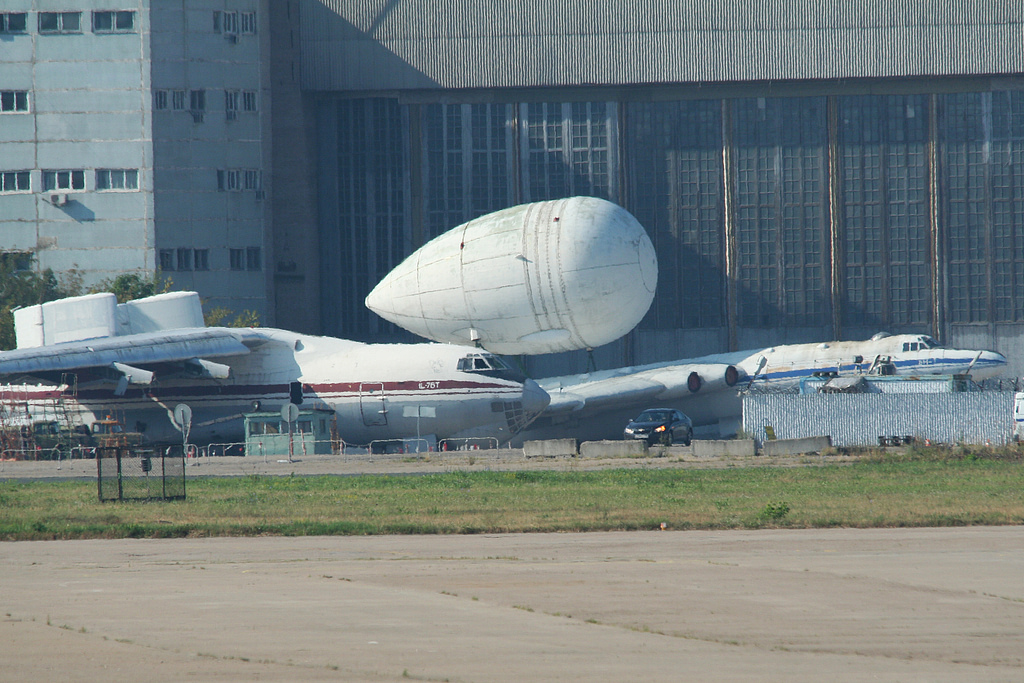
In the late 1970s the Soviet space programme needed a way to move oversized Energia rocket stages and the Buran orbiter from their factories to the Baikonur Cosmodrome. The answer was to rebuild a small number of surplus 3M airframes into the VM-T Atlant, a heavy-lift transport that carried its cargo on top of the fuselage on struts. The conversion added a distinctive twin tail to cope with the turbulence of the external load and extended the rear fuselage. Sources differ on the exact count — commonly given as two operational aircraft (a third airframe was also modified) — and together they are reported to have flown more than 150 delivery flights, carrying loads including the roughly 45-tonne Buran orbiter with its fin removed. It was an improbable second career for a Cold War bomber.
Myasishchev 3M Bison full specifications
Figures below are for the improved 3M; the earlier M-4 was slightly smaller and lighter. Many published values vary between sources and should be read as representative.
Airframe & Performance (3M)
- Экипаж
- ~7
- Длина
- ~48.8 m
- Размах крыльев
- ~53.1 m
- Max takeoff weight
- ~193,000 kg
- Max speed
- ~930 km/h (about Mach 0.87)
- Диапазон
- ~9,500–12,000 km (with refuelling)
- Служебный потолок
- ~12,000–15,000 m
- First flight (M-4)
- 20 January 1953
- M-4 length / span
- ~47.2 m / ~50.5 m
- M-4 max takeoff weight
- ~181,500 kg
Propulsion, Armament & Programme
- Engines (M-4)
- 4 × Mikulin AM-3 turbojet
- Engines (3M)
- 4 × Dobrynin VD-7 turbojet
- Defensive guns
- Multiple 23 mm cannon in turrets
- Payload
- Free-fall nuclear & conventional bombs
- Operators
- Soviet Union only
- Built
- ~93 (M-4 and 3M, 1955–1963)
- Retired
- Bombers by ~1987; tankers by ~1994
- Unit cost
- No reliable public figure (Soviet state product)
- Cost per flight hour
- No reliable public figure
04The M-4 Bison’s operating costs: why no reliable price exists
The M-4 and 3M were Soviet state products, built at Moscow’s Plant 23 and never sold on an open market, so no meaningful flyaway unit price or cost-per-flight-hour figure exists in the public record. The type’s real cost story is one of value rather than dollars: a bomber that did not fully meet its strategic mission but was cheap to keep useful once rebuilt as a tanker, extending the service life of a fleet the Soviet air forces had already paid for. Any precise dollar figure attached to the Bison should be treated as guesswork.
From intercontinental hope to shuttle-carrier
Bureau re-formed
Vladimir Myasishchev’s design bureau is re-established and tasked with a four-jet strategic bomber able to reach the United States.
First flight
The M-4 prototype makes its maiden flight on 20 January 1953, reaching about 947 km/h in testing.
Enters service & the flypast
Series production begins at Plant 23; on 3 July a Tushino flypast of Bisons feeds the Western “bomber gap” scare.
The 3M / Molot
The re-engined 3M, with VD-7 engines and aerial refuelling, enters service to address the M-4’s range shortfall.
Production ends
Around 93 aircraft have been built across the M-4 and 3M variants before the line closes.
The tanker years
Many airframes are converted to aerial tankers and reconnaissance aircraft — the roles that keep the type in service.
Atlant and Buran
Rebuilt 3M airframes, the VM-T Atlant, ferry Energia rocket stages and the Buran orbiter to Baikonur on their backs.
Retirement
Bomber versions are withdrawn or scrapped under arms-control agreements; the last tankers serve into the mid-1990s.
Twelve stories about the M-4 Bison
A bomber against the clock
Myasishchev’s bureau was ordered to build an intercontinental jet bomber on a famously tight schedule.
Read the full story
“Bison” and “Molot”
The West called it Bison; the Soviets called the improved version Molot, the Hammer.
Read the full story
The flypast that fooled the West
A 1955 Tushino display convinced Western observers the USSR had a large bomber fleet it did not have.
Read the full story
The range that never came
The Bison could not reliably reach American targets and return — its central strategic weakness.
Read the full story
Turning bombers into tankers
Unable to fix the range in the airframe alone, the Soviets turned many Bisons into flying fuel stations.
Read the full story
Weight-lifting records
Bisons set a series of payload-to-altitude records in the late 1950s and 1960s.
Read the full story
The Atlant is born
In the late 1970s, surplus 3M airframes were rebuilt to carry rockets and a space shuttle.
Read the full story
A shuttle on its back
The VM-T Atlant carried the Buran orbiter, fin removed, slung above its fuselage.
Read the full story
Why the Atlant grew a second fin
The huge external loads forced a complete redesign of the aircraft’s tail.
Read the full story
How many delivery flights
The small Atlant fleet flew more than 150 missions to Baikonur.
Read the full story
Four decades in Soviet skies
Though a strategic disappointment, the Bison served the USSR for around forty years.
Read the full story
What the Bison left behind
A bomber that missed its mission still shaped the Cold War and the Space Age.
Read the full story
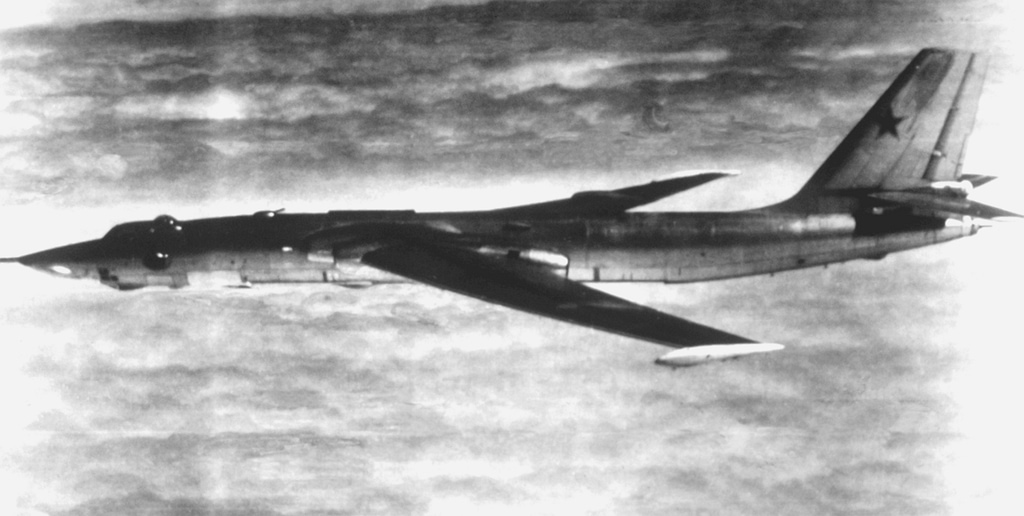
The Bison in pictures
Where the Bison flew
The record that defines it
The M-4 Bison never dropped a bomb in anger. It was a strategic-deterrent aircraft, and its story is one of capability and perception rather than air-to-air combat. Its significance lies in three things: it was the Soviet Union’s first four-jet strategic bomber; it fell short of the intercontinental range its mission demanded, and so was largely re-tasked as a tanker; and it briefly frightened the West into believing in a bomber fleet that did not exist. Every one of its roughly 93 airframes served a single operator — the USSR.
Compare the combat record of every military aircraft. Figures as of July 2026.
Everything people ask about the M-4 Bison
Can I fly in an M-4 Bison?
Why is the M-4 Bison considered a disappointment?
What was the “bomber gap”?
Did the M-4 Bison really carry the Buran space shuttle?
How fast was the M-4 Bison?
Who operated the M-4 Bison?
Is the M-4 Bison still in service?
You can’t fly the M-4.
These, you can.
Some legends only live in museums — others are fuelled and waiting. MiGFlug has put civilians in real military jet cockpits since 2004.
 Fly the L-39 AlbatrosThe world’s most-flown jet trainer — aerobatics included
 Fly the F-104 Starfighter“The missile with a man in it”
 Fly the MiG-21The Cold War’s most-produced jet
 Управляйте самолетом T-33 Shooting Star.America’s first jet trainer
 Fly the DH VampireA piece of early jet history
 Fly the S.211Agile Italian jet trainer
 Fly the MB-326The classic Aermacchi jet
 Fly the MiG-15The Soviet legend of the Korean War
Continue the tour
Every fact, checked
- GlobalSecurity.org — Myasishchev M-4 / 3M MolotDevelopment, range shortfall, tanker conversion and production numbers.
- GlobalSecurity.org — 3M-T / VM-T AtlantThe Buran and Energia transport role, twin-tail conversion and flight tally.
- Buran-Energia.com — VM-T Atlant descriptionDetailed account of the shuttle-carrier conversion and its delivery flights.
- The Aviation Geek Club — The 1955 Bison flypastThe Tushino deception and the American “bomber gap” response.
- Plane Historia — Myasishchev M-4Service history, variants and the four decades of Bison operations.
- MilitaryFactory — Myasishchev M-4 (Bison)Specification baseline, dimensions and engine data.
- The National Interest — The M-4 BisonThe strategic-disappointment narrative and the bomber-gap context.
- National Museum of the US Air ForceReference for Cold War Soviet strategic bomber context.