
Curtiss P-40 Warhawk
“Tomahawk & Kittyhawk”
Not the fastest or the highest-flying fighter of World War II — but rugged, cheap and available in numbers when the Allies had almost nothing else. The shark-mouthed workhorse of the Flying Tigers, the desert, the Pacific and the Eastern Front.
The Curtiss P-40 Warhawk: the fighter that was simply there
The P-40 was never the best fighter of the Second World War, and everyone who flew it knew it. It could not climb with a Messerschmitt, could not turn with a Zero, and ran out of breath above about 15,000 feet. What it could do was be built by the thousand, delivered on time, and take a beating that would have destroyed a more delicate machine — and in 1941 and 1942, when the Allies were losing almost everywhere, that mattered more than elegance.
It grew out of the radial-engined Curtiss P-36 Hawk. Curtiss engineers bolted a liquid-cooled Allison V-1710 V-12 to the P-36 airframe, and the prototype XP-40 first flew in 1938. Orders followed quickly — the US Army Air Corps and, through direct purchase and later Lend-Lease, Britain and France. In April 1939 the Army placed what was then the largest US fighter order ever. The RAF called its early examples the Tomahawk; later, more heavily armed models became the Kittyhawk; to the Americans they were all Warhawks.
The Allison engine was the aircraft’s defining strength and its defining weakness. It was reliable, robust and made good power low down, but its single-stage, single-speed supercharger meant performance fell away sharply at height. So the P-40 was flown the way its engine wanted to be flown: low and fast, in the ground-attack and dive-and-zoom roles, never as a high-altitude interceptor.
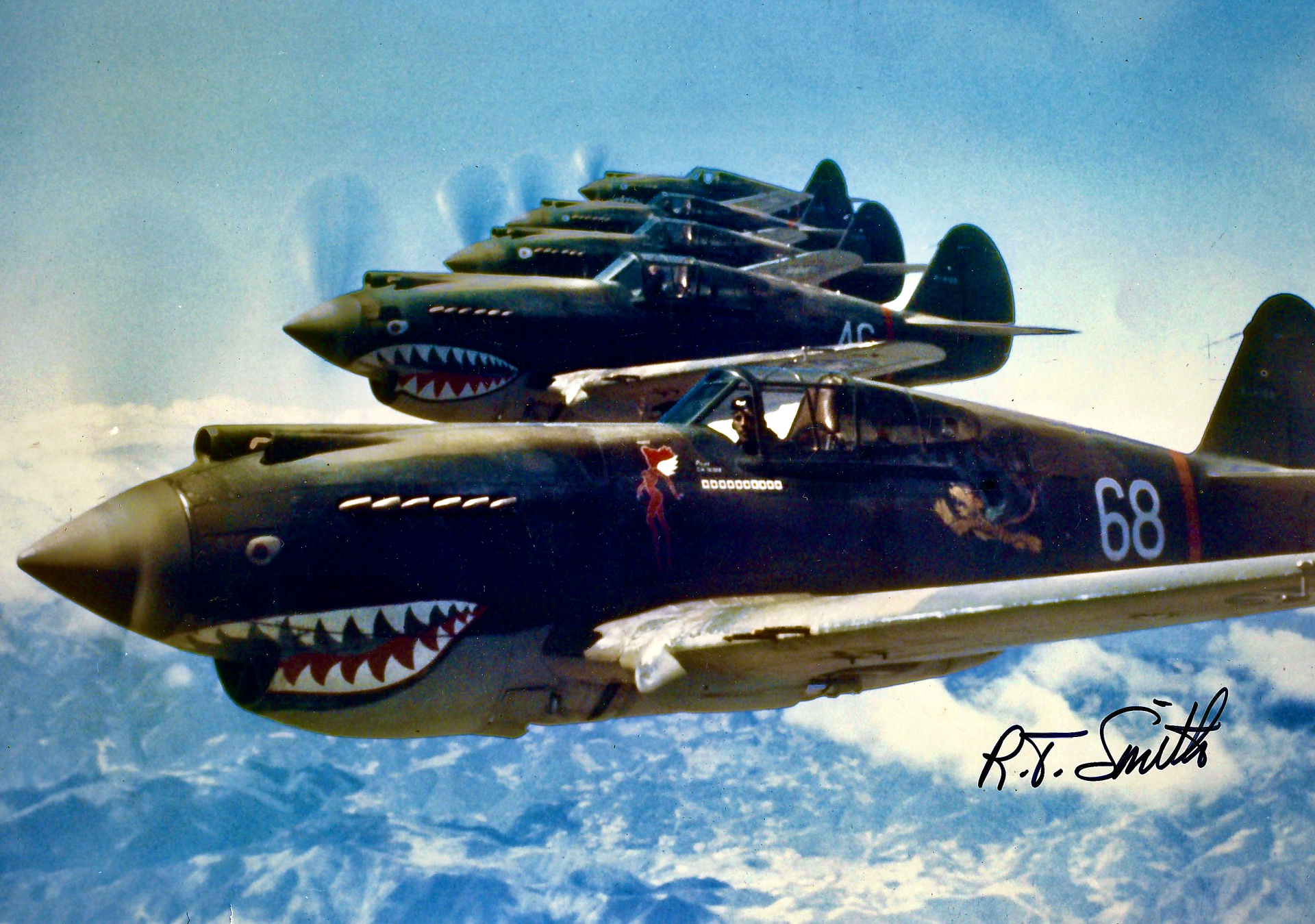
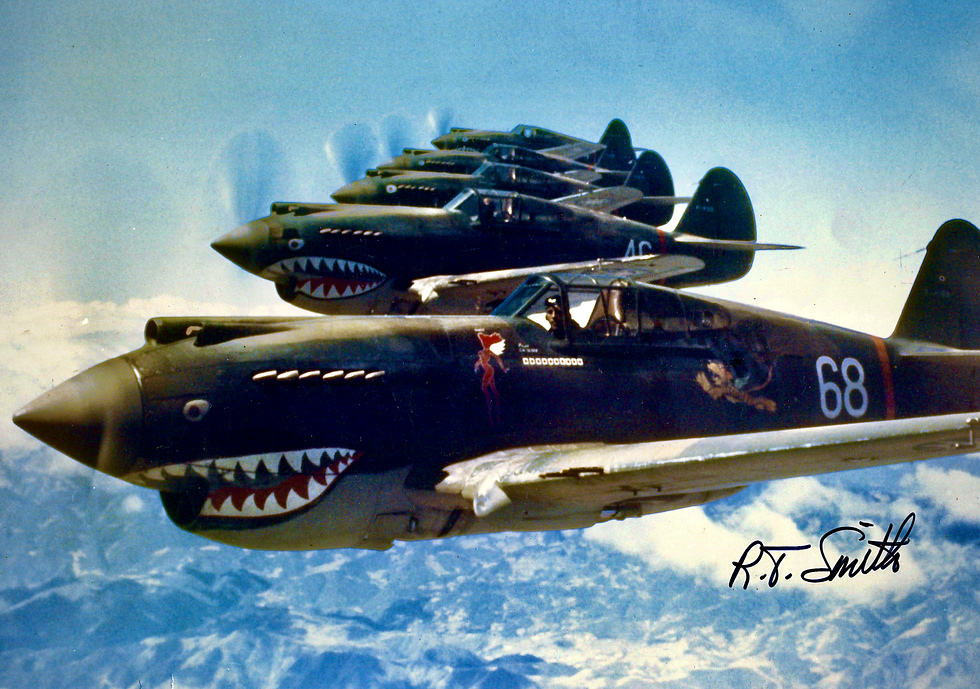
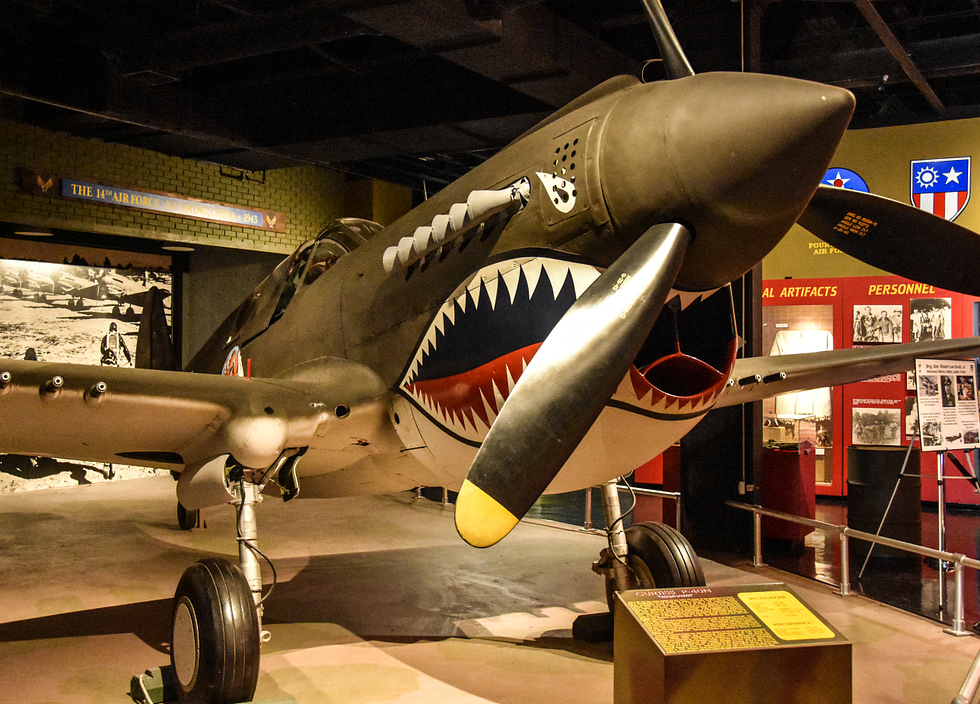
Its fame was made in China. The American Volunteer Group — the “Flying Tigers” under Claire Chennault — flew Tomahawks against the Japanese over China and Burma from late 1941. Chennault forbade his pilots to dogfight the nimble Japanese fighters; instead they used the P-40’s strengths: dive from height, fire a heavy burst, and zoom away, protected by an early-warning net of ground spotters. The tactic worked, and the group’s shark-mouthed fighters became one of the most recognisable images of the war.
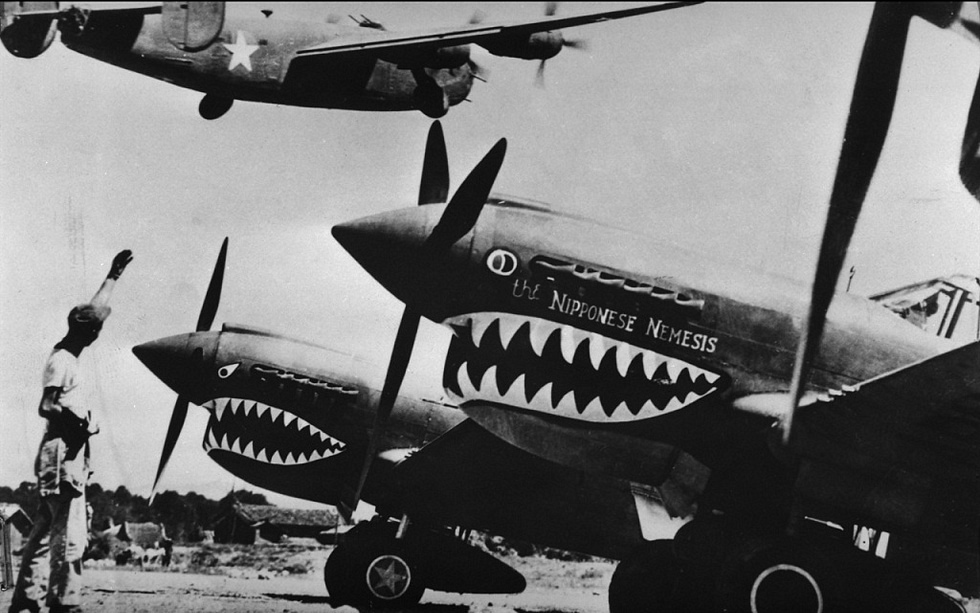
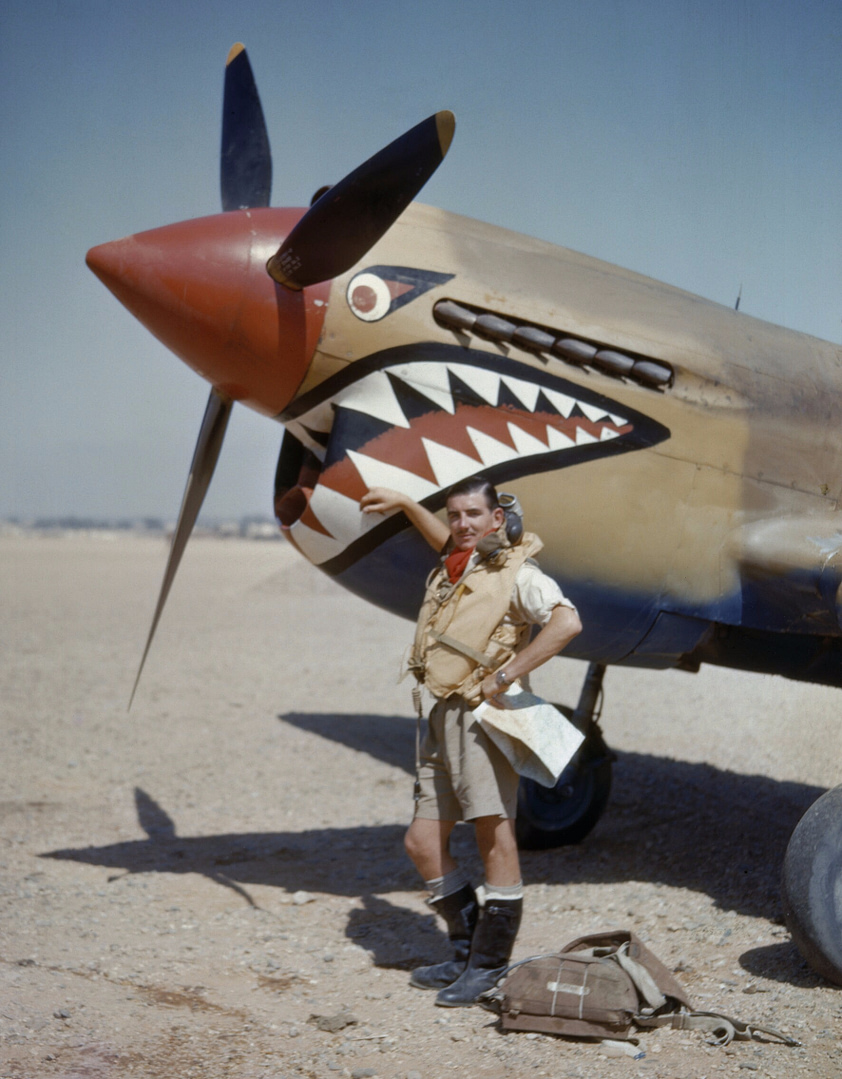
That shark-mouth was not originally American. It had first appeared on the desert Tomahawks of RAF No. 112 Squadron in North Africa; the Flying Tigers copied it after seeing a photograph in a magazine. And North Africa is where the type did some of its hardest work — the Desert Air Force’s Kittyhawks flew relentless ground-attack and fighter sweeps over the Western Desert, where ruggedness and a heavy battery of guns counted for more than altitude.
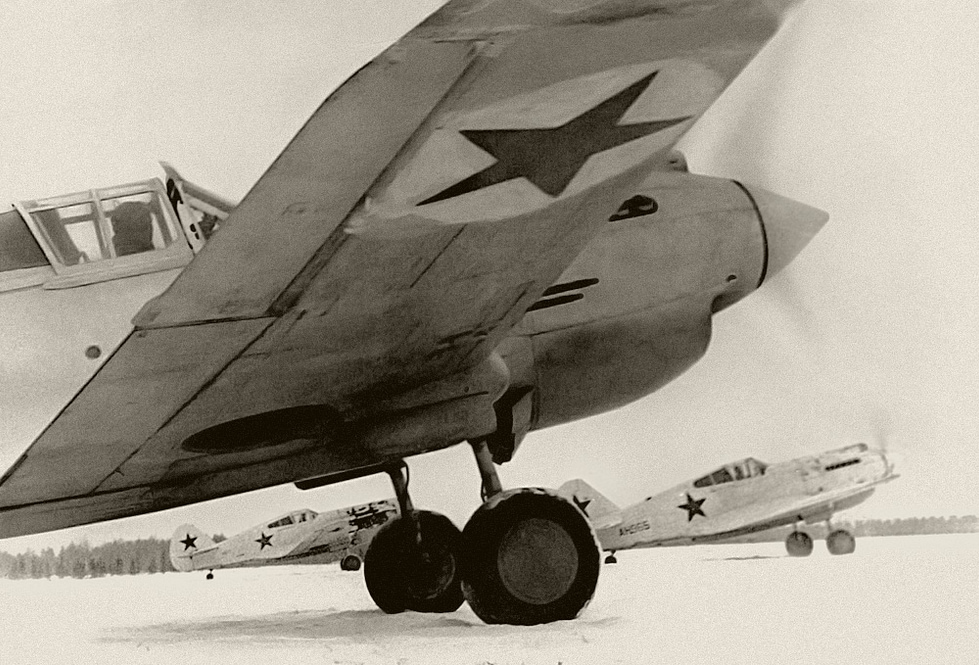
The Warhawk fought almost everywhere: at Pearl Harbor and in the Philippines in December 1941, through the Pacific and the Aleutians, over Italy, and in huge numbers on the Eastern Front, where thousands were shipped to the Soviet Union under Lend-Lease. When production ended in 1944, roughly 13,700 had been built — making it, by numbers, one of the most-produced American fighters of the war. It was obsolescent long before the end, but it had held the line when nothing better was available.
01The Curtiss P-40 Warhawk’s altitude problem: why it fought low and fast
Every account of the P-40 comes back to the same limitation: the Allison V-1710 was fitted with only a single-stage, single-speed supercharger. Below about 12,000–15,000 feet it made solid power and the aircraft was fast and manoeuvrable enough to fight; above that, thrust bled away and the P-40 was left slow and sluggish exactly where high-altitude interceptors and escort fighters needed to operate.
The Merlin-engined P-40F tried to fix this by swapping in a Packard-built Rolls-Royce Merlin, and it did fly better at altitude — but Merlins were needed for the Spitfire and the emerging P-51 Mustang, so most Warhawks kept the Allison. The practical answer was doctrine, not engineering: commanders used the P-40 for what it was good at — low-level ground attack, fighter-bombing, and dive-and-zoom tactics — and sent Spitfires, Mustangs and Thunderbolts up high.
What makes the P-40 Warhawk special
Rugged enough to bring you home
The P-40’s single most praised quality was toughness. Its structure and liquid-cooled engine could absorb battle damage, rough desert strips and hard handling that would have grounded a lighter fighter. Pilots repeatedly brought back Warhawks streaming coolant or riddled with holes. In a war of attrition on primitive airfields, an aircraft that could be flown hard, patched up and flown again was worth more than a few knots of top speed.
The Allison V-1710 — strong low, breathless high
Power came from a single Allison V-1710 V-12 of around 1,150 hp. It was dependable and made good power at low level, but its single-stage supercharger left it gasping above ~15,000 ft. That one design choice shaped the whole career of the aircraft: fast and competitive down low, outclassed up high, and therefore committed to ground attack and low-altitude fighting.
Six .50-cals and a good dive
Later Warhawks carried six 0.50-inch (12.7 mm) Browning machine guns — a heavy, hard-hitting battery ideal for the slashing dive-and-zoom attacks Chennault taught. The airframe was strong and dived well, letting pilots convert height into speed, fire one devastating pass and extend away before a more agile enemy could react. It could not out-turn a Zero, so it was flown never to try.
02The Curtiss P-40 Warhawk’s dive-and-zoom tactics: how the Flying Tigers beat a better fighter
The Japanese A6M Zero and Ki-43 could out-turn and out-climb the P-40 easily. Claire Chennault’s answer, drilled into the American Volunteer Group, was to refuse the dogfight entirely. Tomahawks used ground spotters and radio to get advance warning, climbed above the incoming raid, then dived through it in pairs — one firing, one covering — using the P-40’s superior dive speed and heavy guns to destroy a target in a single pass before zooming back up to repeat. Turning to mix it up with a Zero was a good way to die; using speed and altitude was how the Tigers ran up their score. The same energy tactics later served P-40 units in the desert and the Pacific.
03Tomahawk, Kittyhawk, Warhawk: the P-40’s confusing family of names
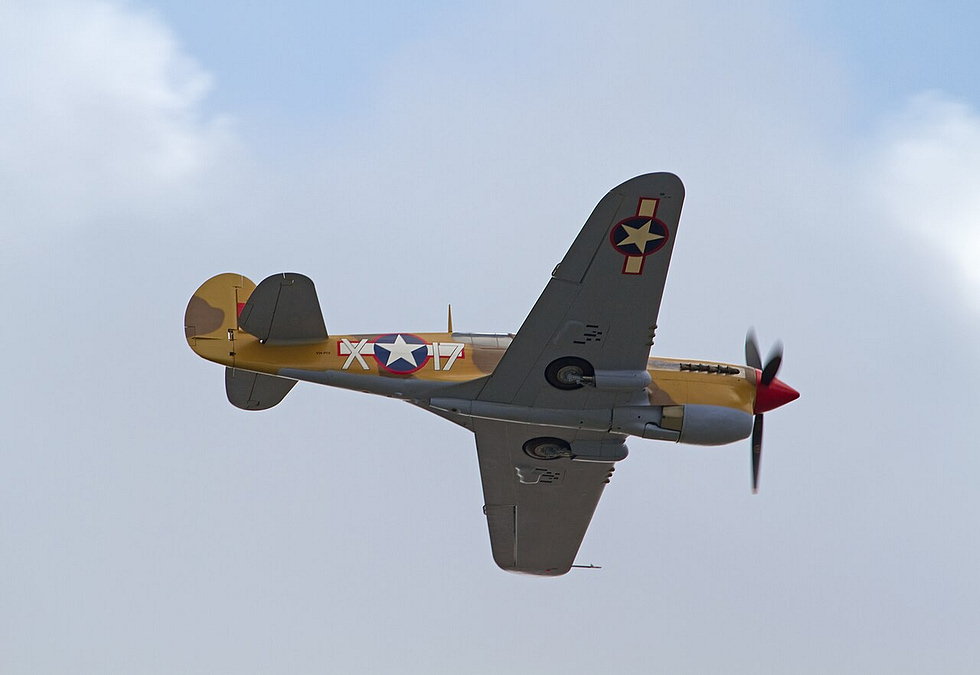
The names track the variants and the customer. To the US Army every version was the Warhawk. The RAF called the early, lightly armed models (P-40B/C) Tomahawk, and the later, more powerful and better-armed models (P-40D onward, with the six-gun wing) Kittyhawk. The most-produced single model was the late-war P-40N. Under the skin they are all the same basic Curtiss design, progressively up-engined and up-gunned across roughly a dozen major variants.
Curtiss P-40E Warhawk: full specifications
Airframe & Performance
- Экипаж
- 1
- Длина
- 9.66 m (31 ft 9 in)
- Размах крыльев
- 11.38 m (37 ft 4 in)
- Высота
- 3.76 m (12 ft 4 in)
- Loaded weight
- ~4,000 kg (~8,800 lb)
- Max speed
- ~580 km/h (362 mph) at altitude
- Крейсерская скорость
- ~380 km/h (235 mph)
- Служебный потолок
- ~8,800–9,100 m (29,000–30,000 ft)
- Диапазон
- ~1,100–1,370 km (700–850 mi)
Propulsion, Armament & Programme
- Двигатель
- 1 × Allison V-1710-39 V-12
- Power
- ~1,150 hp (858 kW)
- Вооружение
- 6 × 0.50 in (12.7 mm) M2 Browning
- Bomb load
- Up to ~700 lb (320 kg)
- First flight
- 1938 (XP-40 prototype)
- Introduced
- 1939–1940
- Built
- ~13,700 (all variants, 1939–1944)
- Unit cost
- ~US$45,000–60,000 (1940s, estimate)
- Cost per flight hour
- No wartime figure; warbirds ~US$2,000–3,000/hr (estimate)
04The Curtiss P-40 Warhawk’s cost: cheap to build, expensive to keep flying today
Part of the P-40’s value to the Allies was simply that it was affordable and available. Period figures put a wartime Warhawk in the region of US$45,000–60,000 apiece (roughly a million or so in today’s money) — cheaper than the more sophisticated fighters that eventually replaced it, and buildable in enormous quantity. Exact per-aircraft prices varied by variant and contract, so treat any single figure as an estimate.
There is no meaningful wartime “cost per flight hour” in the modern sense. Today, keeping one of the few dozen airworthy P-40s flying is a different matter: warbird operators commonly cite operating costs in the low thousands of dollars per flight hour, driven by the rarity of the Allison engine, spares and skilled maintenance. Those figures are indicative, not official.
The Curtiss P-40 Warhawk: from stopgap to workhorse
XP-40 first flight
Curtiss mates the liquid-cooled Allison V-1710 to the radial-engined P-36 Hawk airframe; the prototype XP-40 flies for the first time.
Into production
The US Army places a then-record fighter order; deliveries begin and Britain and France order the type, the RAF naming its examples the Tomahawk.
The Flying Tigers form
Claire Chennault’s American Volunteer Group takes its shark-mouthed Tomahawks into action over China and Burma from late 1941.
Pearl Harbor and the Philippines
P-40s are among the few US fighters to get airborne against the Japanese attacks; a handful of pilots score the first American aerial victories of the war.
The Western Desert
Desert Air Force Tomahawks and Kittyhawks fly relentless ground-attack and fighter sweeps over North Africa, carrying the shark-mouth first worn by RAF No. 112 Squadron.
Lend-Lease to the USSR
Thousands of Warhawks are shipped to the Soviet Union, where they serve widely on the Eastern Front as fighters and ground-attack aircraft.
The Tuskegee Airmen fly the P-40
The 99th Fighter Squadron — the first African American US fighter unit — flies the Warhawk in combat over North Africa and Italy.
Production ends
The last of roughly 13,700 P-40s leaves the Curtiss line as newer fighters take over frontline duties; the type soldiers on in secondary theatres.
The warbird afterlife
A few dozen P-40s remain airworthy, their shark-mouths a fixture of airshows and museums worldwide.
From the cockpit: twelve Warhawk stories
From Hawk to Warhawk
The P-40 was a radial-engined biplane-era design given a modern liquid-cooled V-12.
Read the full story
Borrowed from the desert
The Flying Tigers’ famous jaws were copied from RAF Tomahawks in North Africa.
Read the full story
Chennault’s rulebook
Never dogfight the Japanese — dive, fire, and run.
Read the full story
A contested scoreboard
The AVG was credited with hundreds of Japanese aircraft — the exact number is debated.
Read the full story
First blood, 7 December 1941
A few P-40 pilots got airborne into the Japanese attack and scored early kills.
Read the full story
Kittyhawks over the sand
In North Africa the P-40 became a workhorse fighter-bomber.
Read the full story
The cold war before the Cold War
P-40s fought Japan in the fog and ice of the Aleutian Islands.
Read the full story
The Soviet Warhawk
Thousands of P-40s served on the Eastern Front in Soviet hands.
Read the full story
The 99th takes the P-40 to war
America’s first Black fighter squadron flew the Warhawk in combat.
Read the full story
Home on a wing and a prayer
P-40 pilots routinely brought back aircraft that should not have flown.
Read the full story
The most-built Warhawk
The lightweight P-40N was the final and most-produced version.
Read the full story
Shark-mouths that never faded
Decades on, the P-40 remains one of the most recognisable warbirds alive.
Read the full story
The Warhawk in pictures
The Warhawk in motion
A hand-picked, high-authority P-40 Warhawk video will be featured here soon. Video coming soon. In the meantime, explore the photo gallery above and the eyewitness stories for the full picture of the shark-mouthed fighter.
Where the Warhawk flew
The score that defines the Warhawk
The P-40’s record is not written in kill ratios — against the best Axis fighters it was usually the underdog. It is written in ubiquity and endurance: the aircraft that was there in numbers, in every theatre, when the Allies needed something to fight with. Its most famous exploits came from flying to its strengths and refusing the enemy’s game.
Compare the combat record of every military aircraft. Figures as of July 2026 and, where wartime, hedged as estimates.
Everything people ask about the P-40 Warhawk
Can I fly in a P-40 Warhawk?
Was the P-40 a good fighter?
Why does the P-40 have a shark mouth painted on it?
What is the difference between the Tomahawk, Kittyhawk and Warhawk?
How many P-40s were built?
Who were the Flying Tigers?
Are any P-40 Warhawks still flying?
You can’t fly the Warhawk.
These, you can.
Some legends only live in museums — others are fuelled and waiting. MiGFlug has put civilians in real military jet cockpits since 2004.
 Fly the L-39 AlbatrosThe world’s most-flown jet trainer — aerobatics included
 Fly the F-104 Starfighter“The missile with a man in it”
 Fly the MiG-21The Cold War’s most-produced jet
 Управляйте самолетом T-33 Shooting Star.America’s first jet trainer
 Fly the DH VampireA piece of early jet history
 Fly the S.211Agile Italian jet trainer
 Fly the MB-326The classic Aermacchi jet
 Fly the MiG-15The Soviet legend of the Korean War
Continue the tour
Every fact, checked
- National Museum of the US Air Force — Curtiss P-40E WarhawkOfficial fact sheet: specifications, history and service.
- The National WWII MuseumThe P-40 in the Aleutians and the “Aleutian Tigers.”
- Planes of Fame Air MuseumP-40N history, variants and airworthy warbird notes.
- World War II DatabaseProduction numbers, variants and operator list.
- Hartzell Propeller — Historic Aircraft SpotlightDesign origins from the P-36 and the Allison engine.
- AcePilots — P-40 WarhawkFlying Tigers, the shark-mouth and combat tactics.
- Royal Canadian Air Force — Curtiss KittyhawkCommonwealth Kittyhawk service and home defence.
- MiGFlug Afterburner — The P-40 and the Flying TigersMiGFlug’s own feature on the Warhawk and the AVG.