
Curtiss P-40 Warhawk
“Tomahawk & Kittyhawk”
Not the fastest or the highest-flying fighter of World War II — but rugged, cheap and available in numbers when the Allies had almost nothing else. The shark-mouthed workhorse of the Flying Tigers, the desert, the Pacific and the Eastern Front.
The Curtiss P-40 Warhawk: the fighter that was simply there
The P-40 was never the best fighter of the Second World War, and everyone who flew it knew it. It could not climb with a Messerschmitt, could not turn with a Zero, and ran out of breath above about 15,000 feet. What it could do was be built by the thousand, delivered on time, and take a beating that would have destroyed a more delicate machine — and in 1941 and 1942, when the Allies were losing almost everywhere, that mattered more than elegance.
It grew out of the radial-engined Curtiss P-36 Hawk. Curtiss engineers bolted a liquid-cooled Allison V-1710 V-12 to the P-36 airframe, and the prototype XP-40 first flew in 1938. Orders followed quickly — the US Army Air Corps and, through direct purchase and later Lend-Lease, Britain and France. In April 1939 the Army placed what was then the largest US fighter order ever. The RAF called its early examples the Tomahawk; later, more heavily armed models became the Kittyhawk; to the Americans they were all Warhawks.
The Allison engine was the aircraft’s defining strength and its defining weakness. It was reliable, robust and made good power low down, but its single-stage, single-speed supercharger meant performance fell away sharply at height. So the P-40 was flown the way its engine wanted to be flown: low and fast, in the ground-attack and dive-and-zoom roles, never as a high-altitude interceptor.
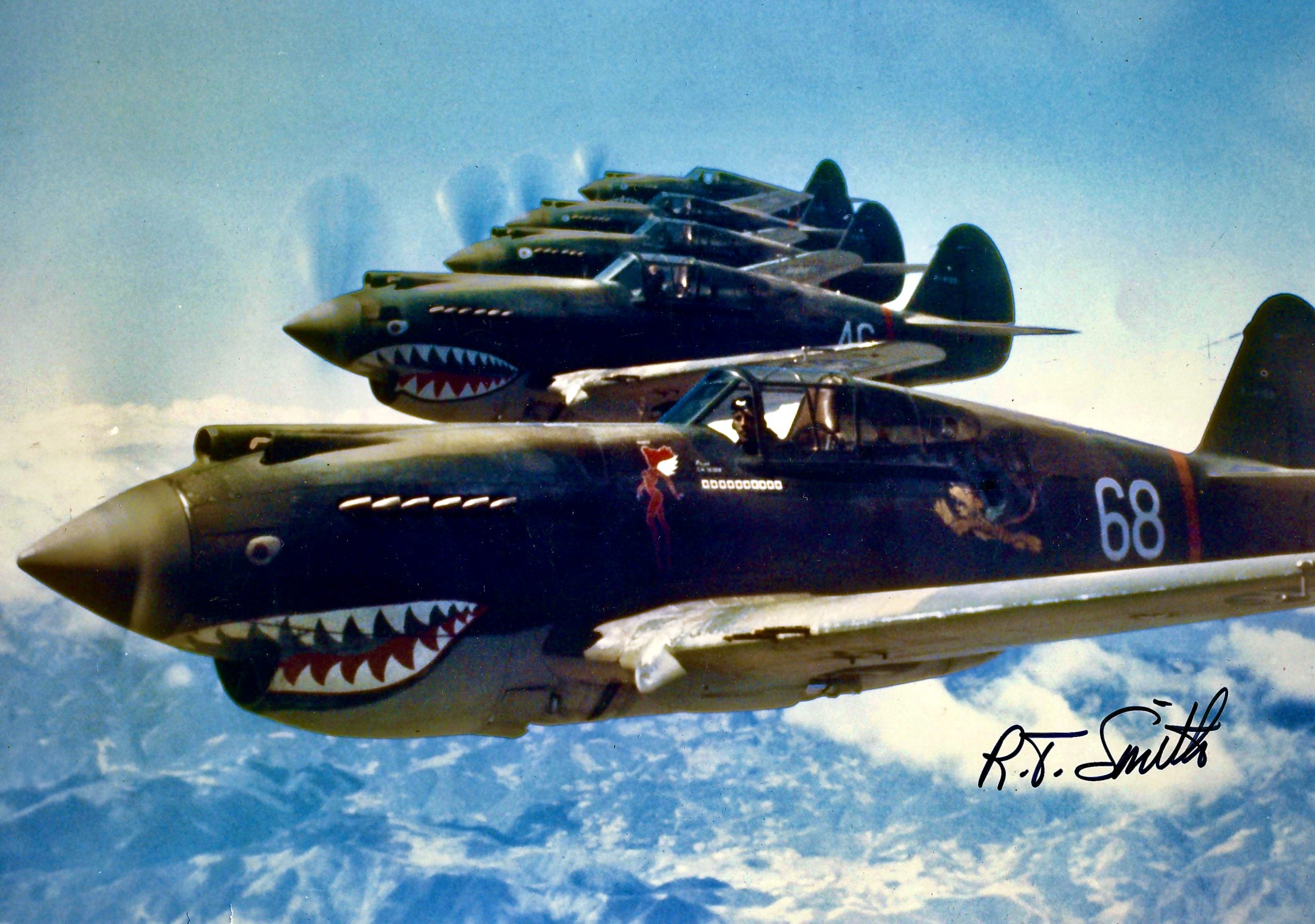
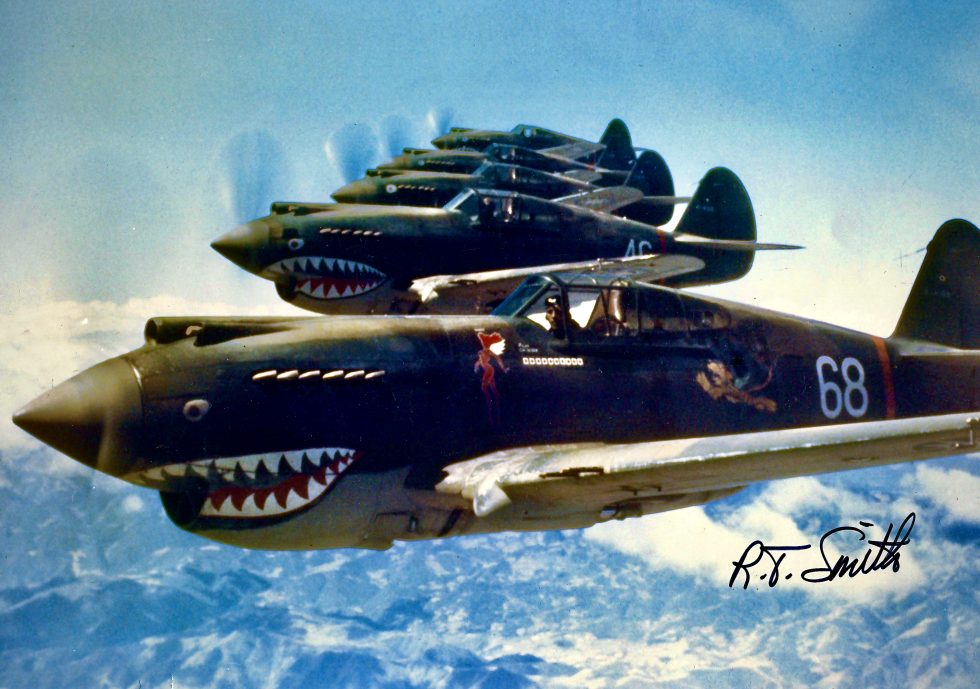
Its fame was made in China. The American Volunteer Group — the “Flying Tigers” under Claire Chennault — flew Tomahawks against the Japanese over China and Burma from late 1941. Chennault forbade his pilots to dogfight the nimble Japanese fighters; instead they used the P-40’s strengths: dive from height, fire a heavy burst, and zoom away, protected by an early-warning net of ground spotters. The tactic worked, and the group’s shark-mouthed fighters became one of the most recognisable images of the war.
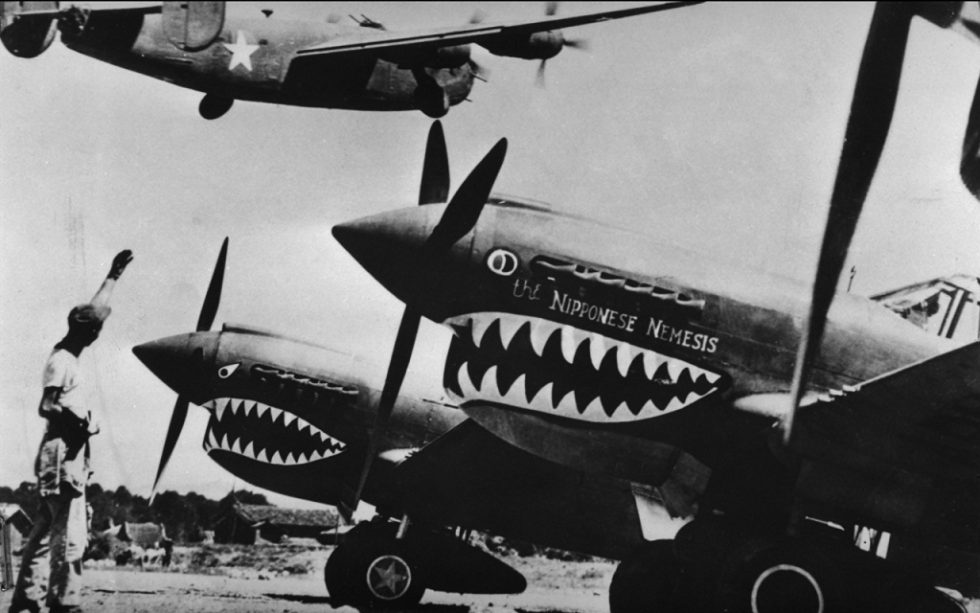
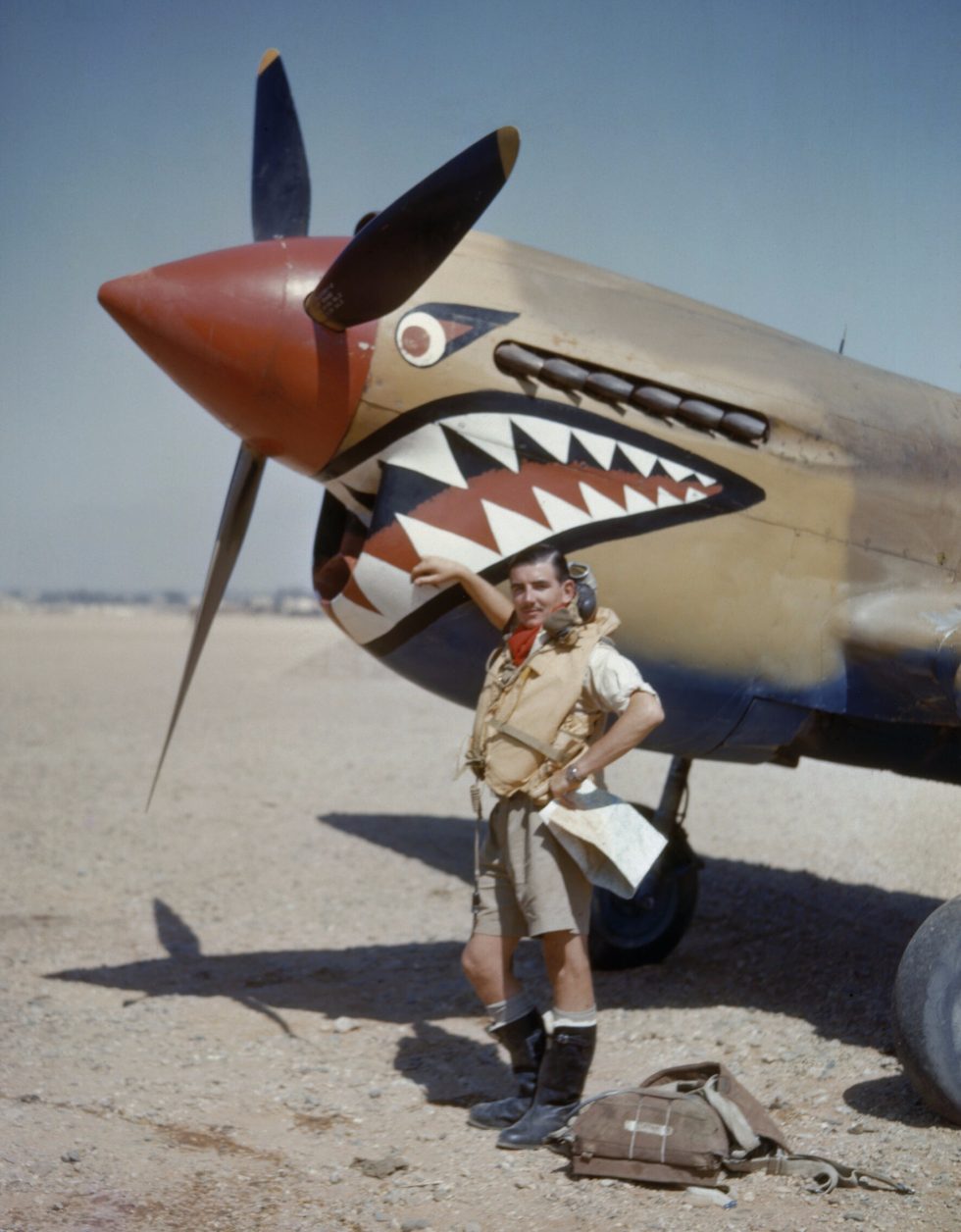
That shark-mouth was not originally American. It had first appeared on the desert Tomahawks of RAF No. 112 Squadron in North Africa; the Flying Tigers copied it after seeing a photograph in a magazine. And North Africa is where the type did some of its hardest work — the Desert Air Force’s Kittyhawks flew relentless ground-attack and fighter sweeps over the Western Desert, where ruggedness and a heavy battery of guns counted for more than altitude.
The Warhawk fought almost everywhere: at Pearl Harbor and in the Philippines in December 1941, through the Pacific and the Aleutians, over Italy, and in huge numbers on the Eastern Front, where thousands were shipped to the Soviet Union under Lend-Lease. When production ended in 1944, roughly 13,700 had been built — making it, by numbers, one of the most-produced American fighters of the war. It was obsolescent long before the end, but it had held the line when nothing better was available.
01The Curtiss P-40 Warhawk’s altitude problem: why it fought low and fast
Every account of the P-40 comes back to the same limitation: the Allison V-1710 was fitted with only a single-stage, single-speed supercharger. Below about 12,000–15,000 feet it made solid power and the aircraft was fast and manoeuvrable enough to fight; above that, thrust bled away and the P-40 was left slow and sluggish exactly where high-altitude interceptors and escort fighters needed to operate.
The Merlin-engined P-40F tried to fix this by swapping in a Packard-built Rolls-Royce Merlin, and it did fly better at altitude — but Merlins were needed for the Spitfire and the emerging P-51 Mustang, so most Warhawks kept the Allison. The practical answer was doctrine, not engineering: commanders used the P-40 for what it was good at — low-level ground attack, fighter-bombing, and dive-and-zoom tactics — and sent Spitfires, Mustangs and Thunderbolts up high.
What makes the P-40 Warhawk special
Rugged enough to bring you home
The P-40’s single most praised quality was toughness. Its structure and liquid-cooled engine could absorb battle damage, rough desert strips and hard handling that would have grounded a lighter fighter. Pilots repeatedly brought back Warhawks streaming coolant or riddled with holes. In a war of attrition on primitive airfields, an aircraft that could be flown hard, patched up and flown again was worth more than a few knots of top speed.
The Allison V-1710 — strong low, breathless high
Power came from a single Allison V-1710 V-12 of around 1,150 hp. It was dependable and made good power at low level, but its single-stage supercharger left it gasping above ~15,000 ft. That one design choice shaped the whole career of the aircraft: fast and competitive down low, outclassed up high, and therefore committed to ground attack and low-altitude fighting.
Six .50-cals and a good dive
Later Warhawks carried six 0.50-inch (12.7 mm) Browning machine guns — a heavy, hard-hitting battery ideal for the slashing dive-and-zoom attacks Chennault taught. The airframe was strong and dived well, letting pilots convert height into speed, fire one devastating pass and extend away before a more agile enemy could react. It could not out-turn a Zero, so it was flown never to try.
02The Curtiss P-40 Warhawk’s dive-and-zoom tactics: how the Flying Tigers beat a better fighter
The Japanese A6M Zero and Ki-43 could out-turn and out-climb the P-40 easily. Claire Chennault’s answer, drilled into the American Volunteer Group, was to refuse the dogfight entirely. Tomahawks used ground spotters and radio to get advance warning, climbed above the incoming raid, then dived through it in pairs — one firing, one covering — using the P-40’s superior dive speed and heavy guns to destroy a target in a single pass before zooming back up to repeat. Turning to mix it up with a Zero was a good way to die; using speed and altitude was how the Tigers ran up their score. The same energy tactics later served P-40 units in the desert and the Pacific.
03Tomahawk, Kittyhawk, Warhawk: the P-40’s confusing family of names
The names track the variants and the customer. To the US Army every version was the Warhawk. The RAF called the early, lightly armed models (P-40B/C) Tomahawk, and the later, more powerful and better-armed models (P-40D onward, with the six-gun wing) Kittyhawk. The most-produced single model was the late-war P-40N. Under the skin they are all the same basic Curtiss design, progressively up-engined and up-gunned across roughly a dozen major variants.
Curtiss P-40E Warhawk: full specifications
Baseline note: the figures below describe the P-40E (Kittyhawk Mk IA to the Commonwealth), the six-gun Allison-engined mark that carried the type through its hardest year — Milne Bay, New Guinea, the Aleutians, the desert after the Tomahawks were withdrawn, and the first USAAF squadrons in China. It is the fairest single column because it sits in the middle of the family: later marks were lighter and a little faster, earlier ones slower and more lightly armed. Deltas for the XP-40, the Tomahawk marks, the Packard Merlin P-40F and P-40L, the P-40K and P-40M and the mass-production P-40N are in grey. One number below explains the whole aeroplane and deserves reading first: the supercharger’s critical altitude. Two cautions. Published P-40E performance varies by several miles an hour between compilations because manufacturer figures, Wright Field test reports and squadron experience with tropical filters and worn engines disagree; the 361 mph quoted here is the book figure, and the December 1941 Wright Field report on aircraft 40-405 recorded 354 mph. And weights depend heavily on what was fitted, since desert and Pacific units routinely stripped or added equipment in the field.
Dimensions & weights
- Crew
- 1 (two P-40Es were rebuilt as side-by-side P-40ES trainers, and about 30 TP-40Ns were built or converted with a second seat; three of the surviving airworthy machines are two-seaters today)
- Length
- 9.66 m (31 ft 8.5 in). From the P-40F-5 onwards the rear fuselage was stretched about 51 cm (20 in) to hold the extra torque of the Merlin, giving 10.16 m (33 ft 4 in); that long tail became standard from the P-40K-10 and stayed to the end of production
- Wingspan
- 11.38 m (37 ft 3.5 in) — identical on every mark from the XP-40 to the last P-40N, and identical to the P-36 Hawk from which the wing was taken
- Height
- 3.25 m (10 ft 8 in), tail down. Early P-40Ks carried a taller fin before the long fuselage solved the same problem more elegantly
- Wing area
- 21.92 m² (236 sq ft) — against 22.44 m² (241.5 sq ft) on the A6M2 Zero, which weighed roughly a third less and is the whole argument about turning fights in one line
- Aspect ratio
- 5.89 — a conventional mid-1930s planform, neither short and stubby nor long and efficient
- Aerofoil
- NACA 2215 at the root, NACA 2209 at the tip — a thick, docile, high-lift section chosen in 1934 for the P-36, and one reason the P-40 turned well at speed and stalled honestly
- Wing structure
- five-spar all-metal wing — the single most important structural fact about the type. It let pilots hold turns that buckled lighter opponents, survived mid-air collisions, and made deliberate ramming a survivable tactic in Soviet and Desert Air Force hands
- Empty weight
- 2,686 kg (5,922 lb). The Tomahawk IIB was some 250 kg lighter; the "lightweight" P-40N-1, stripped to four guns with aluminium radiators and smaller wheels, was about 180 kg lighter again
- Gross weight
- 3,862 kg (8,515 lb)
- Maximum take-off weight
- 4,173 kg (9,200 lb) with external stores. The P-40K, the heaviest of the family, went beyond this
- Wing loading
- 171 kg/m² (35.1 lb/sq ft) at gross weight — roughly 40 per cent higher than the A6M2 Zero and comparable to the Bf 109F
- Power-to-mass
- 0.23 kW/kg (0.14 hp/lb) — mediocre in 1942 and the reason the climb figures below are what they are
Performance
- Maximum speed
- 581 km/h (361 mph; 314 kn) at 4,570 m (15,000 ft)
- Maximum speed, fastest mark
- 608 km/h (378 mph) below 3,660 m (12,000 ft) for the stripped four-gun P-40N-1, the quickest production Warhawk. The one-off XP-40Q, with a two-speed supercharger and a bubble canopy, reached 679 km/h (422 mph) and was still not worth building
- Cruising speed
- 496 km/h (308 mph; 268 kn)
- Rate of climb
- 10.7 m/s (2,100 ft/min) at sea level — against roughly 17 m/s for a Bf 109F and 15.7 m/s for a Spitfire Mk V. Almost everything the P-40 met could out-climb it, and this is the figure that decided how it had to be flown
- Time to altitude
- 4,570 m (15,000 ft) in 6 minutes 15 seconds — and the curve flattens badly thereafter
- Service ceiling
- 8,870 m (29,100 ft) on paper. In practice a fully loaded P-40E was a spent force well below that, and RAF trials in Britain judged the Tomahawk unfit for a theatre where Spitfires fought at 9,000 m (30,000 ft)
- Supercharger critical altitude
- 3,570 m (11,700 ft). Above this the single-stage, single-speed Allison simply ran out of air and power fell away steadily. The common shorthand that the P-40 was poor above 15,000 ft is generous: the decline begins nearer 12,000 ft, and by 20,000 ft the aeroplane was a target
- Placarded dive limit
- 772 km/h (480 mph) indicated — among the highest of any early-war fighter, and the number the type’s entire tactical doctrine was built on. Clive Caldwell, its highest-scoring pilot, said it had "almost no vices" except being "a little difficult to control in terminal velocity"
- Range
- 1,152 km (716 miles; 622 nmi) at 70 per cent power on internal fuel — roughly double a Spitfire or Bf 109 and a large part of why the type was useful in Africa, Russia and the Pacific
- Range with drop tank
- ~1,370 km (~850 miles) with a 197-litre (52 US gal) belly tank; ferry ranges beyond 2,400 km were flown with the 643-litre (170 US gal) tank
- Combat radius
- ~320 km (~200 miles) on a fighter-bomber sortie with a 227 kg (500 lb) bomb — an estimate from squadron practice rather than a published figure, and heavily dependent on the reserve a pilot wanted over a desert or a jungle
Propulsion & systems
- Engine
- 1 × Allison V-1710-39 (F3R), liquid-cooled 60° V-12 of 28.0 litres (1,710 cu in)
- Power
- 858 kW (1,150 hp) for take-off and 858 kW at 3,570 m (11,700 ft) — some compilations quote 925 kW (1,240 hp) as a military rating. Later Allisons went further: 988 kW (1,325 hp) in the P-40K’s V-1710-73 and 1,014 kW (1,360 hp) in the -81 and -115 of the P-40M and late P-40N
- Supercharger
- single-stage, single-speed engine-driven centrifugal, 8.8:1 gear ratio — the type’s defining defect. No two-stage or two-speed drive was ever fitted to a production P-40. The turbo-supercharged P-40J was cancelled in May 1942 because the turbocharger would not fit the airframe and the engines were reserved for the P-38
- Merlin marks
- Packard V-1650-1 (licence-built Rolls-Royce Merlin 28) in the P-40F and P-40L, 969 kW (1,300 hp) for take-off with a two-speed single-stage supercharger raising the critical altitude to about 5,600 m (18,500 ft) — a genuine improvement above 15,000 ft, and identifiable at a glance by the absence of the carburettor scoop on top of the cowling. Some sources give 1,036 kW (1,390 hp). Merlins were needed elsewhere, so at least 70 P-40Fs and 53 P-40Ls were later re-engined with Allisons as the P-40R
- Propeller
- Curtiss Electric constant-speed, three blades, 3.35 m (11 ft 0 in) diameter — electrically actuated pitch change, reliable in the desert but disliked in Soviet winters. The XP-40Q used four blades
- Cooling
- ethylene glycol, with the radiator and oil cooler sharing the deep chin duct that gives the type its face — and its worst vulnerability. Chennault objected to the liquid-cooled engine precisely because one rifle bullet through the coolant system meant an overheated engine within minutes
- Fuel
- ~560 litres (~148 US gal) internal in three tanks — some sources give 594 litres (157 US gal). The P-40L-5 cut internal fuel to 454 litres (120 US gal) as part of its weight-saving programme, which is a curious way to lighten a fighter valued for its range
- Undercarriage
- rearward-retracting mainwheels that rotated 90° to lie flat in the wing, plus a tailwheel — inherited directly from the P-36 and a genuine liability. The track was narrow, the legs weaker than a Hurricane’s, and pilots trained on British types had to unlearn the three-point landing in favour of a flat wheels-first approach. Ground losses were heavy throughout the type’s service
- Protection
- armour plate ahead of and behind the pilot, bullet-proof windscreen, self-sealing tanks — fitted progressively. The first Tomahawk Is arrived in Egypt with none of it; AVG aircraft had two heavy steel plates behind the pilot’s head and back but external rather than internal self-sealing coatings, and no armour glass forward
- Sight and radio
- N-3A or N-3B reflector gunsight and an SCR-274N command set on USAAF marks — but the AVG’s aircraft were bought without "government-furnished equipment" and arrived with no sights, no radios and no wing guns, so the Flying Tigers flew the first weeks of the Pacific war behind ring-and-bead sights and a Piper Cub’s RCA-7-H transceiver
- Unit cost
- ~US$45,000 in 1944 (roughly US$800,000 today). The April 1939 order for 524 aircraft, then the largest fighter contract the US Army had ever placed, was worth about US$13 million
04The Curtiss P-40 Warhawk’s cost: cheap to build, expensive to keep flying today
Part of the P-40’s value to the Allies was simply that it was affordable and available. Period figures put a wartime Warhawk in the region of US$45,000–60,000 apiece (roughly a million or so in today’s money) — cheaper than the more sophisticated fighters that eventually replaced it, and buildable in enormous quantity. Exact per-aircraft prices varied by variant and contract, so treat any single figure as an estimate.
There is no meaningful wartime “cost per flight hour” in the modern sense. Today, keeping one of the few dozen airworthy P-40s flying is a different matter: warbird operators commonly cite operating costs in the low thousands of dollars per flight hour, driven by the rarity of the Allison engine, spares and skilled maintenance. Those figures are indicative, not official.
Armament & payload
The P-40 could not climb to the fight, so Curtiss gave it enough guns to finish one
The Warhawk’s armament history is a story of a design office slowly accepting what its customers had been telling it. The first P-40s carried two 0.50 in Brownings in the nose and one rifle-calibre gun in each wing, a 1937 answer that Clive Caldwell, flying Tomahawks in the desert, called flatly inadequate. The P-40D of 1941 threw away the synchronised nose guns altogether and put two 0.50 in guns in each wing; the P-40E added a third pair. Six half-inch Brownings with 281 rounds apiece was, for 1942, a heavy and entirely conventional American battery — the same weapon fit as an F4F-4 Wildcat, and roughly twice the throw-weight of a Bf 109F.
That mattered more than it might sound, because the P-40 usually got one pass. Unable to climb with anything and unable to turn with a Zero or an Oscar, it fought by diving from whatever height it had, firing, and keeping the speed. A battery that could break a Ki-27 or a Ki-43 in a two-second burst made that single pass worth flying. Against bombers — CANT Z.1007s over Egypt, Ki-21s over Rangoon, He 111s over the Kalinin front — it was better than adequate.
What that produced, in the record, needs care. The American Volunteer Group was officially credited with 297 Japanese aircraft destroyed, 229 of them in the air, in six and a half months of combat, and fourteen AVG pilots were killed, captured or lost on combat missions, with two more dying of wounds from bombing raids and six in accidents. The famous shorthand — 297 destroyed for the loss of four — sets aircraft destroyed against pilots lost in air-to-air combat alone, two different units of account, and quietly omits the P-40s written off on the ground, in accidents and in the retreat from Burma, which ran into dozens out of the 99 Tomahawks the group ever had airworthy. Daniel Ford’s cross-check of Japanese unit records in his history of the group concluded that the true number destroyed was a fraction of the credited total, as postwar checks have concluded for every air force in the war. The Desert Air Force numbers are better behaved and more instructive: No. 3 Squadron RAAF claimed 115.5 for 34 P-40s lost, No. 112 Squadron RAF 118.5 for 38, No. 450 Squadron RAAF 49 for 28. Forty-six British Commonwealth pilots became aces on the type and seven became double aces. None of this diminishes what the AVG did; it simply says that the P-40 was a competitive fighter flown well, not a wonder weapon.
One detail of the legend runs the wrong way round. The shark mouth was not an AVG invention that spread to the RAF. No. 112 Squadron RAF was painting it on Tomahawks in North Africa first, having copied it from the Messerschmitt Bf 110s of the Luftwaffe’s ZG 76 over the Aegean; AVG pilots saw a photograph of a 112 Squadron machine in an illustrated magazine and adopted it in Burma. The design that the world now reads as American was German first and British second.
The second half of the story is the bomb rack. From 26 May 1942 the Desert Air Force flew its Kittyhawks primarily as fighter-bombers, and the nickname "Kittybomber" stuck to the type for the rest of the war. This was not an upgrade so much as a redeployment of an aeroplane that had been outclassed as a pure fighter, and it cost lives: squadrons flying low and slow with bombs were exactly what marauding Bf 109s wanted to find. Fits varied more than on almost any other Allied fighter. The P-40N-1 went back to four guns and field units complained until the sixth pair returned on the N-5; the Merlin-engined P-40L-5 was stripped to four; Soviet workshops removed the wing guns from P-40B/Cs entirely; and the AVG’s Tomahawks were delivered without wing guns at all, which the group had to source locally.
Gun
- P-40, P-40B, P-40C and the Tomahawk marks: two 12.7 mm Browning AN/M2 in the upper cowling, synchronised through the propeller, plus two 7.62 mm (US) or 7.7 mm (British .303) Brownings in each wing
- P-40D and Kittyhawk I: nose guns deleted, two 12.7 mm Browning M2 in each wing — the rearrangement that made the type a serious gun platform
- P-40E and all later marks: six 12.7 mm Browning M2 in the wings, 281 rounds per gun, about 15 seconds of fire — roughly 3.7 kg per second of projectiles
- P-40L-5 and P-40N-1: four guns, adopted to save weight and reversed on the P-40N-5 after squadrons objected. The XP-40Q flew with four, and a proposed production P-40Q with four 20 mm cannon was never built
- Early P-40D and P-40E wing installations jammed under high g because of how the belts were stowed — a fault common to American wing-gun fighters of 1941–42, cured in later production by revised ammunition boxes
Air-to-air
- No guided air-to-air weapon existed for this aeroplane at any point. Its air-to-air armament is the gun card above; its air-to-air weapon was a set of tactics built around a dive limit and a five-spar wing
- Chennault’s standing instruction to the AVG was never to dogfight a Japanese fighter, because turning bled speed and speed was the only advantage a P-40 had. Dive, fire, keep going, climb back with the energy: boom-and-zoom, taught before the AVG had met the enemy
- Desert Air Force units learned the same lesson the expensive way. Lufbery circles and tight vics were slaughtered by Bf 109s; Werner Schröer called the weaving squadron formations "bunches of grapes" because they were so easy to pick off. Fluid pairs and the Thach Weave replaced them
- Head-on attack became doctrine in the Pacific once the P-40D onwards had armour and six guns: a Zero or an Oscar could not absorb the exchange and a P-40 usually could
- Deliberate ramming was recorded as a victory by both Soviet and Desert Air Force pilots, which is less a tactic than a comment on the airframe. One No. 75 Squadron RAAF P-40N flew more than 320 km home in 1944 having lost an aileron and a quarter of one wing in a collision, and was repaired and returned to service
Air-to-surface guided
- None, on any P-40, in any air force, at any time. The card is kept because the emptiness is the point: this was a 1938 airframe soldiering on into 1945, and precision meant a pilot in a 45-degree dive with a bomb and six machine guns
- The nearest approach to a guided weapon was the type’s own gunnery. Half-inch strafing against soft targets — barges, lorry columns, parked aircraft, railway stock — was where late-war P-40 squadrons in New Guinea, Burma and Italy did most of their damage
- American squadrons in Europe nicknamed the ground-attack P-40N the "B-40", which tells you exactly what the type had become by 1944
- Bombing accuracy was a matter of the pilot’s eye and the standard gunsight; no bombsight of any kind was fitted to a single-seat P-40
Bombs
- One 227 kg (500 lb) bomb on the centreline shackle, the standard Kittybomber load from mid-1942; a 454 kg (1,000 lb) bomb could be carried on later marks
- P-40N-5 and later added a rack under each wing, giving a quoted maximum of about 907 kg (2,000 lb) across three stations — a figure rarely used operationally because it left almost nothing for fuel
- Six 113 kg (250 lb) bombs were a common Desert Air Force fit, as flown by No. 450 Squadron RAAF in Tunisia in 1943
- The AVG improvised: 16 kg (35 lb) fragmentation bombs on the P-40Es delivered in early 1942, and racks made up by Chennault’s armourer for 259 kg (570 lb) Russian bombs, of which the Chinese had a surplus. These were used in the Salween Gorge attacks of late May 1942 that stopped the Japanese advance into China from Burma
- RNZAF squadrons in the Solomons hung naval depth charges under P-40s as improvised high-capacity bombs from late 1943 — effective, and entirely unofficial
Rockets
- Rockets came late and never became standard. USAAF P-40Ns in the China-Burma-India theatre carried 4.5 in M8 rockets in triple tubes under the wings from 1944, by which time better aircraft were replacing them
- Soviet units fitted rails for RS-82 rockets to some Lend-Lease P-40s, part of a wider pattern of Soviet re-arming and re-engining of the type
- No rocket installation was ever a factory fit on a production P-40, and photographs of armed P-40s far outnumber the documented sorties
- Sources on P-40 rocket fits are thin and often conflate field trials with operational use; treat any specific figure with caution
Pods & other stores
- Belly drop tanks of 197 litres (52 US gal) and 284 litres (75 US gal) from the P-40C onwards, and a 643 litre (170 US gal) tank for ferrying — the fitting the AVG’s Tomahawks conspicuously lacked
- Camera installations: the one-off P-40A, the field-modified P-40N-6 and P-40N-16, the RP-40 conversions, and the Soviet two-seat "P-40EF" photo-reconnaissance rebuilds — the F standing for foto
- Tropical air filters on the carburettor intake, standard on desert aircraft and worth several miles an hour off the top speed
- Wing bomb racks doubled as tank pylons on the P-40N-5, which is why a Kittyhawk IV could be a fighter or a bomber but rarely both at useful radius
- No gun pod, no cannon pack and no external sensor of any kind was ever adopted for the type
Three typical loadouts
- Rangoon air defence, AVG, December 1941
- Tomahawk IIB with two nose 0.50 in and four wing .303 in guns, no drop tank, no bomb rack, a ring-and-bead sight and a Piper Cub radio. Scramble on a ground observer’s telephone warning, climb to whatever height the warning allowed, dive on the bombers, do not turn with the escort.
- Kittybomber close support, Desert Air Force, 1943
- Kittyhawk III with six 0.50 in guns, six 250 lb bombs, tropical filter, no drop tank. Low-level run against motor transport or a landing ground, bomb release in a shallow dive, then strafe out. The mission the type flew more than any other, and the one that cost it most.
- Bomber escort and sweep, 23rd Fighter Group, China, 1943
- P-40K or P-40N with six 0.50 in guns, 281 rounds per gun and a 75 US gal belly tank. Positioned above and behind the bombers, drop tank away on contact, one diving pass through the interceptors, reform, repeat. Nothing about it was elegant; it held the line in China for two years.
Sourcing caveat: ammunition capacities, bomb loads and rocket fits varied by sub-block, theatre and squadron, and field modification was the norm rather than the exception. The 281 rounds per gun figure and the 2,000 lb maximum bomb load are book values from the standard references; the AVG and Soviet fits described above rest on unit accounts rather than on factory documents.
Variants
Curtiss built a new fighter in eleven months by putting a V-12 on a P-36, and then spent six years failing to replace it
The P-40 exists because Curtiss took the tenth production P-36A Hawk off the line, removed its Pratt & Whitney radial and bolted on an Allison V-1710. That was chief engineer Don Berlin’s answer to a problem every American manufacturer faced in 1937: the Army wanted an inline-engined fighter and nobody had a proven one. The XP-40 first flew at Buffalo on 14 October 1938, less than fifteen months after the conversion was ordered. When the Army held its fighter competition in January 1939, the XP-40 beat the Bell XP-39 and the Seversky AP-4 not because it was the best design on offer — it was not — but because it was the only one that could be built in quantity immediately. The April 1939 order for 524 aircraft was the largest fighter contract the US Army had ever placed.
The cost of that speed was that the P-40 inherited a 1934 wing, a 1935 undercarriage layout and an engine with no high-altitude supercharger, and Curtiss never escaped any of them. The XP-46 successor offered too little to be worth the production disruption. The turbocharged P-40J would not fit. The P-60 was cancelled. The Merlin-engined P-40F and P-40L cured the altitude problem and were then starved of engines that Mustangs and Spitfires needed more. By the time the XP-40Q reached 422 mph in 1944, P-51Ds and P-47Ds were coming off lines by the thousand and there was no reason to build it. So Curtiss went on making the same aeroplane, lighter and heavier by turns, until November 1944 — not because it was good, but because it was there, it worked, and stopping the line would have meant building nothing at all.
The operator list follows from that. The Soviet Union took 247 P-40B/Cs and 2,178 P-40E, K, L and N models between 1941 and 1944, making the Tomahawk the first Allied fighter delivered under Lend-Lease; Soviet pilots liked its range, endurance and cockpit, disliked its climb, burned out Allisons in weeks by flying permanently at war emergency power, cracked radiator cores in the winter of 1941, and eventually re-engined a number of worn-out airframes with Klimov M-105s for rear-area work. The RAAF took 841 Kittyhawks of its own plus 67 for the Dutch-Australian No. 120 Squadron, flew them at Milne Bay and through New Guinea and Borneo, and used the type in greater numbers than the Spitfire; eighteen RAAF pilots became aces on it. The RNZAF was allocated 301, claimed about 100 victories for 20 aircraft lost in combat, and replaced them with Corsairs in 1944. The Desert Air Force ran 18 RAF, four RCAF, three SAAF and two RAAF squadrons on the type. Brazil kept P-40s in service until 1954, a decade after the last one was built.
That is also why the P-40 outlasted its own obsolescence in service. It was available when Australia had no fighters, available when the Soviet Union needed anything that flew, available when China had nothing, and available in North Africa when Spitfires were still committed to Britain. Availability, not merit, is the honest explanation for the third-largest American fighter production run of the war.
- XP-40 (1938–39, 1 conversion)
- The tenth production P-36A with a 1,160 hp Allison V-1710-19 in place of its radial. Radiator first behind the wing, moved to the chin after NACA wind-tunnel work in spring 1939 — the change that gave the type its face and its performance.
- P-40 and Hawk 81A-1 / Tomahawk I (1940, 199–200 USAAF plus 140 ordered by France)
- Two nose 0.50 in guns and one rifle-calibre gun per wing. No armour, no self-sealing tanks. The French order was overtaken by the armistice and went to the RAF, some aircraft still carrying metric instruments.
- P-40B and P-40C / Tomahawk IIA and IIB (1941, 131 and 193 USAAF, 930 Hawk 81A-3 for the RAF)
- Armour behind the cockpit, extra wing guns, partial then full self-sealing tanks, and on the C a belly shackle for a drop tank or bomb. Each addition cost performance. This is the mark the Flying Tigers flew, in a hybrid B/C configuration built from leftover components.
- P-40D and Hawk 87A-1 / Kittyhawk I (1941, 23 USAAF and 560 for the RAF)
- A visibly different aeroplane: shorter, deeper nose for the larger V-1710-39, a bigger chin scoop, a redesigned canopy, no nose guns and two 0.50 in guns in each wing. The first mark that could be called well armed.
- P-40E and Hawk 87A-2 / Kittyhawk IA (1941–42, 820 USAAF plus 1,500 P-40E-1 under Lend-Lease)
- Six wing guns and a marginally stronger engine. The mark that fought Milne Bay, the New Guinea campaign, the Aleutians and most of the RNZAF’s air combat, and that replaced the AVG’s Tomahawks in China.
- P-40F and P-40L / Kittyhawk II and IIA (1942–43, 1,311 and 700)
- Packard V-1650-1 Merlin, no carburettor scoop on the cowling, and from the F-5 a lengthened rear fuselage. Genuinely better above 15,000 ft. The L was a stripped-down F — less armour, less fuel, four guns — nicknamed "Gypsy Rose Lee". Used mainly by USAAF groups in the Mediterranean; 330 Kittyhawk IIs went to the Commonwealth.
- P-40K / Kittyhawk III (1942–43, 1,300)
- The Allison answer to the Merlin shortage: a 1,325 hp V-1710-73, the best low-altitude performance of the family, and the heaviest airframe. Early aircraft had an enlarged fin to hold the torque; from the K-10 the long fuselage took over. Widely used in China and Burma.
- P-40M / Kittyhawk III (1943, 600)
- A K airframe with the 1,360 hp V-1710-81 and small scoops ahead of the exhaust stubs, built mostly for export to Britain and the Soviet Union. Sharing the Kittyhawk III name with the P-40K causes endless confusion in unit records.
- P-40N and Hawk 87V/87W / Kittyhawk IV (1943–44, 5,220 — the most-built mark)
- Lightweight structure, aluminium radiators, smaller wheels, a cut-down rear deck and a new canopy that finally gave a P-40 pilot a rearward view. The N-1 was the fastest production Warhawk at 378 mph; later blocks put the weight back on and became fighter-bombers and trainers. 553 went to the RAAF, making it the commonest Australian mark.
- P-40R, TP-40N, XP-40Q and the might-have-beens (1942–44, roughly 123 R, about 30 TP, 3 XP-40Q)
- P-40Fs and Ls re-engined with Allisons for logistical sanity; two-seat trainers; and the XP-40Q with a four-blade propeller, bubble canopy, clipped wings and a two-speed supercharger, which at 422 mph proved that the airframe had nothing left to give. The P-40J, the P-40P and the production P-40Q were all cancelled before metal was cut.
Production and survivors. 13,738 P-40s were built at Buffalo between 1940 and November 1944, the third-largest American fighter run of the war after the P-47 and the P-51. Survival is unusually well documented and unusually complicated. A widely cited 2004 census counted 28 airworthy, about 13 on static display and 36 airframes under restoration; current listings name closer to 40 as airworthy, though some of those are long-term projects, and perhaps 85 to 90 airframes exist worldwide in some state. All are original airframes rather than reproductions, but very few are original in the sense a purist would accept: the flying population comes from three waves of recovery — 35 ex-RCAF machines sold for US$50 each in 1947, South Pacific wreck recoveries from the 1970s and 1980s, and Russian battlefield recoveries near Murmansk after 1991 — and most flying examples are composites rebuilt around a recovered data plate. Several airworthy P-40Es were licensed as P-40Ns for regulatory convenience, which muddies the mark counts further. The single most significant survivor is P-40B 41-13297, the only airworthy example of its mark and the only flying aircraft to have been present at Pearl Harbor, now at the American Heritage Museum in Massachusetts. No P-40 flown by the American Volunteer Group survives intact; the wreckage of William McGarry’s Tomahawk, shot down over Thailand on 24 March 1942, is displayed at Chiang Mai, and the Tomahawk IIB in AVG markings at the National Museum of Naval Aviation never served with the group. Homebuilt scale replicas — the Jurca Pee-40, the W.A.R. P-40E and others — are numerous and are not counted here.
The Curtiss P-40 Warhawk: from stopgap to workhorse
XP-40 first flight
Curtiss mates the liquid-cooled Allison V-1710 to the radial-engined P-36 Hawk airframe; the prototype XP-40 flies for the first time.
Into production
The US Army places a then-record fighter order; deliveries begin and Britain and France order the type, the RAF naming its examples the Tomahawk.
The Flying Tigers form
Claire Chennault’s American Volunteer Group takes its shark-mouthed Tomahawks into action over China and Burma from late 1941.
Pearl Harbor and the Philippines
P-40s are among the few US fighters to get airborne against the Japanese attacks; a handful of pilots score the first American aerial victories of the war.
The Western Desert
Desert Air Force Tomahawks and Kittyhawks fly relentless ground-attack and fighter sweeps over North Africa, carrying the shark-mouth first worn by RAF No. 112 Squadron.
Lend-Lease to the USSR
Thousands of Warhawks are shipped to the Soviet Union, where they serve widely on the Eastern Front as fighters and ground-attack aircraft.
The Tuskegee Airmen fly the P-40
The 99th Fighter Squadron — the first African American US fighter unit — flies the Warhawk in combat over North Africa and Italy.
Production ends
The last of roughly 13,700 P-40s leaves the Curtiss line as newer fighters take over frontline duties; the type soldiers on in secondary theatres.
The warbird afterlife
A few dozen P-40s remain airworthy, their shark-mouths a fixture of airshows and museums worldwide.
From the cockpit: twelve Warhawk stories
From Hawk to Warhawk
The P-40 was a radial-engined biplane-era design given a modern liquid-cooled V-12.
Read the full story
Borrowed from the desert
The Flying Tigers’ famous jaws were copied from RAF Tomahawks in North Africa.
Read the full story
Chennault’s rulebook
Never dogfight the Japanese — dive, fire, and run.
Read the full story
A contested scoreboard
The AVG was credited with hundreds of Japanese aircraft — the exact number is debated.
Read the full story
First blood, 7 December 1941
A few P-40 pilots got airborne into the Japanese attack and scored early kills.
Read the full story
Kittyhawks over the sand
In North Africa the P-40 became a workhorse fighter-bomber.
Read the full story
The cold war before the Cold War
P-40s fought Japan in the fog and ice of the Aleutian Islands.
Read the full story
The Soviet Warhawk
Thousands of P-40s served on the Eastern Front in Soviet hands.
Read the full story
The 99th takes the P-40 to war
America’s first Black fighter squadron flew the Warhawk in combat.
Read the full story
Home on a wing and a prayer
P-40 pilots routinely brought back aircraft that should not have flown.
Read the full story
The most-built Warhawk
The lightweight P-40N was the final and most-produced version.
Read the full story
Shark-mouths that never faded
Decades on, the P-40 remains one of the most recognisable warbirds alive.
Read the full story
The Warhawk in pictures
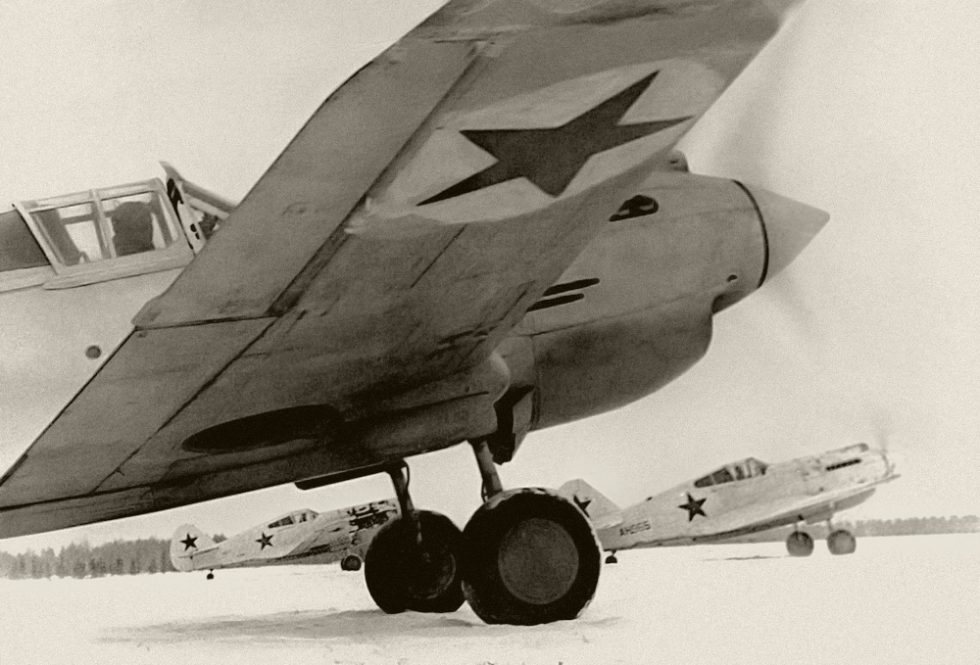
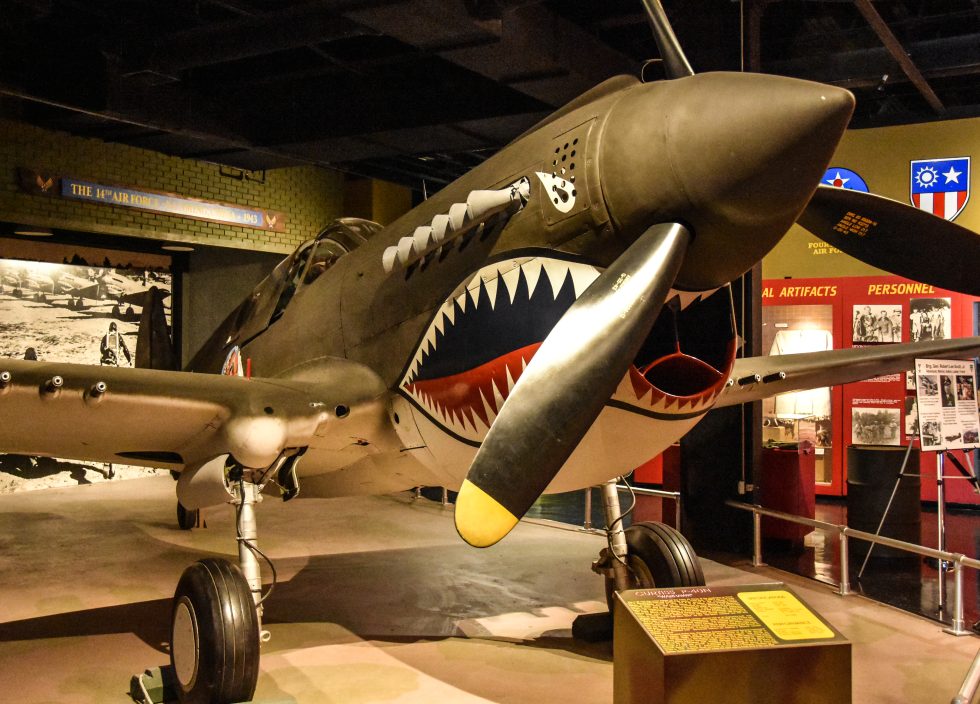
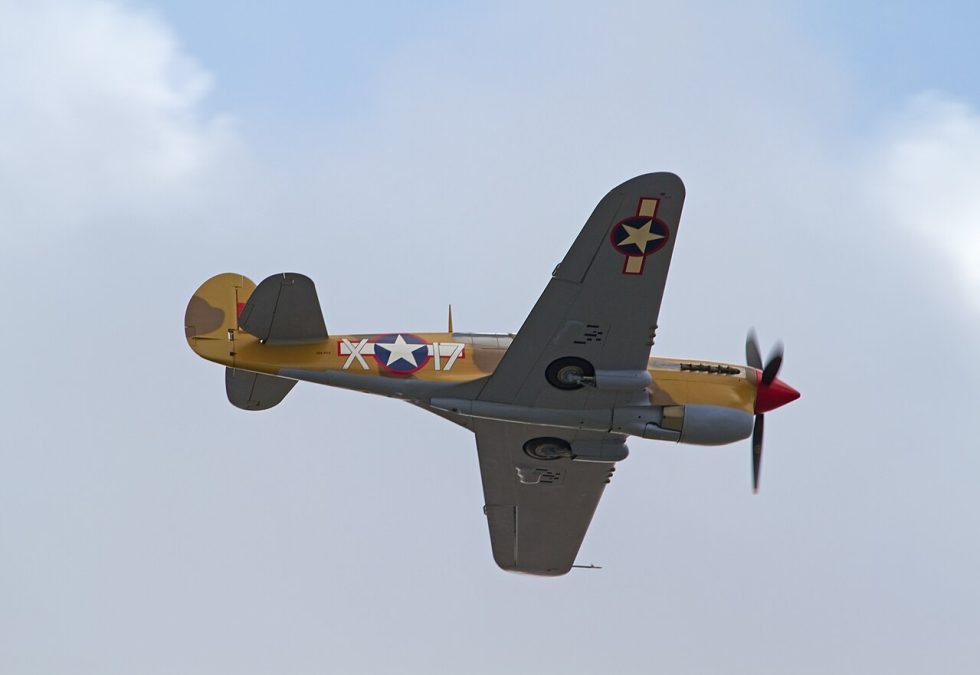
The Warhawk in motion
A hand-picked, high-authority P-40 Warhawk video will be featured here soon. Video coming soon. In the meantime, explore the photo gallery above and the eyewitness stories for the full picture of the shark-mouthed fighter.
Where the Warhawk flew
The score that defines the Warhawk
The P-40’s record is not written in kill ratios — against the best Axis fighters it was usually the underdog. It is written in ubiquity and endurance: the aircraft that was there in numbers, in every theatre, when the Allies needed something to fight with. Its most famous exploits came from flying to its strengths and refusing the enemy’s game.
Compare the combat record of every military aircraft. Figures as of July 2026 and, where wartime, hedged as estimates.
Everything people ask about the P-40 Warhawk
Can I fly in a P-40 Warhawk?
Was the P-40 a good fighter?
Why does the P-40 have a shark mouth painted on it?
What is the difference between the Tomahawk, Kittyhawk and Warhawk?
How many P-40s were built?
Who were the Flying Tigers?
Are any P-40 Warhawks still flying?
You can’t fly the Warhawk.
These, you can.
Some legends only live in museums — others are fuelled and waiting. MiGFlug has put civilians in real military jet cockpits since 2004.
 Fly the L-39 AlbatrosThe world’s most-flown jet trainer — aerobatics included
 Fly the F-104 Starfighter“The missile with a man in it”
 Fly the MiG-21The Cold War’s most-produced jet
 Fly the T-33 Shooting StarAmerica’s first jet trainer
 Fly the DH VampireA piece of early jet history
 Fly the S.211Agile Italian jet trainer
 Fly the MB-326The classic Aermacchi jet
 Fly the MiG-15The Soviet legend of the Korean War
Continue the tour
Every fact, checked
- National Museum of the US Air Force — Curtiss P-40E WarhawkOfficial fact sheet: specifications, history and service.
- The National WWII MuseumThe P-40 in the Aleutians and the “Aleutian Tigers.”
- Planes of Fame Air MuseumP-40N history, variants and airworthy warbird notes.
- World War II DatabaseProduction numbers, variants and operator list.
- Hartzell Propeller — Historic Aircraft SpotlightDesign origins from the P-36 and the Allison engine.
- AcePilots — P-40 WarhawkFlying Tigers, the shark-mouth and combat tactics.
- Royal Canadian Air Force — Curtiss KittyhawkCommonwealth Kittyhawk service and home defence.
- MiGFlug Afterburner — The P-40 and the Flying TigersMiGFlug’s own feature on the Warhawk and the AVG.