
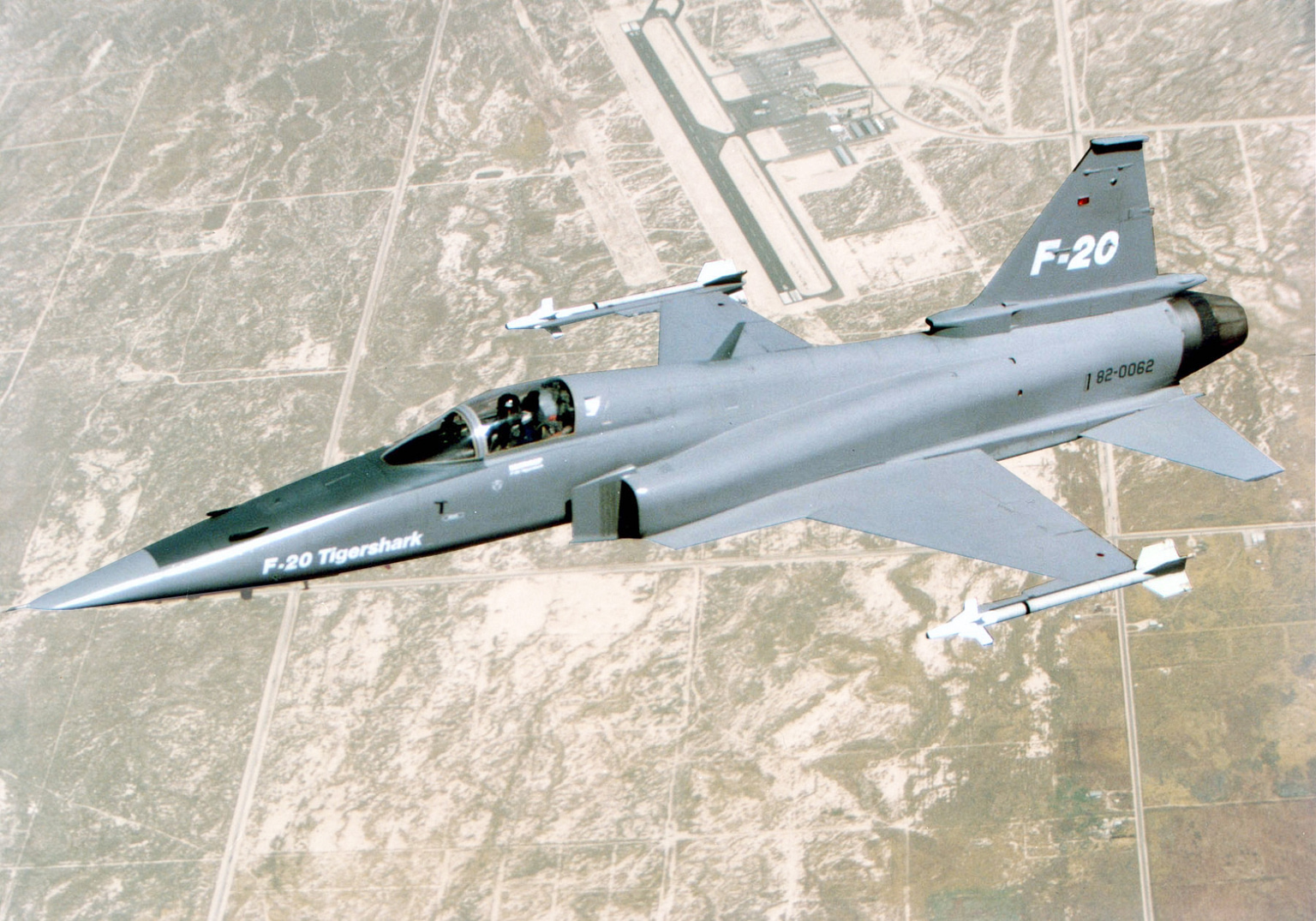
Northrop F-20 Tigershark
“The great fighter nobody bought”
A privately funded, much-improved single-engine development of the F-5 — a new GE F404 engine and modern radar giving roughly 80% of an F-16’s capability at a fraction of the cost. It flew superbly. It never won a single order.
The Northrop F-20 Tigershark: a superb fighter the world was not allowed to buy
By the late 1970s Northrop had sold thousands of its cheap, rugged F-5 family to America’s allies. The company reasoned that the same customers would want a modern successor — something with far more thrust, a real radar and true beyond-visual-range punch, but still a fraction of the price and complexity of a frontline US fighter. So Northrop did something almost unheard-of in modern aerospace: it decided to build that aircraft as a private venture, funding development itself rather than waiting for a government contract.
The result, first designated F-5G and later redesignated F-20 Tigershark, was a dramatic re-engineering of the F-5. Out went the two small J85 turbojets; in went a single General Electric F404 turbofan — the same engine class as the F/A-18 — giving roughly a 60% thrust increase. Northrop added a modern APG-67 multi-mode radar, an updated cockpit and the ability to carry radar-guided missiles. The company’s brief to its engineers was blunt: build an aircraft with about 80% of an F-16’s capability at half the cost.
On paper and in the air, it worked. The first Tigershark flew on 30 August 1982, and it was genuinely outstanding: it could scramble from a cold cockpit and be at altitude in well under three minutes, needed a fraction of the maintenance hours of an F-16, and handled beautifully. Northrop recruited high-profile advocates — among them the legendary test pilot Chuck Yeager — and toured the aircraft around the globe on sales demonstrations.
And then it ran headlong into politics. The Tigershark had been conceived for an export niche created under President Carter, whose policy steered US allies toward a deliberately downgraded “FX” export fighter rather than frontline American types. But under the Reagan administration that logic collapsed: allies were increasingly allowed to buy the F-16 Fighting Falcon itself. Faced with a choice between a brand-new Northrop aircraft with no other users, and the same F-16 the US Air Force flew — often on attractive terms — foreign governments chose the Falcon. The Tigershark had no home air force to anchor it and no allies willing to be the first buyer.
Two of the three prototypes were then lost in fatal crashes during overseas sales demonstrations — at Suwon, South Korea in October 1984, and at Goose Bay, Canada in May 1985. In both cases investigators concluded the aircraft had not failed; the pilots had lost consciousness under sustained high-G manoeuvring. The accidents were not the cause of the programme’s failure, but they darkened an already fading sales campaign. In 1986, after roughly $1.2 billion of its own money and not one order, Northrop cancelled the F-20. It remains the classic story of a great aircraft that arrived at exactly the wrong moment.
01The Northrop F-20 Tigershark’s origins: how the F-5G export upgrade became a private-venture gamble
The F-20 began as a modest idea: re-engine the successful F-5E Tiger II to keep Northrop’s export line competitive into the 1980s. Northrop studied new powerplants from the mid-1970s and settled on a single General Electric F404, the design that would define the aircraft. Under President Carter’s 1977 arms-transfer policy, the United States wanted to sell allies a purpose-built, deliberately limited “FX” export fighter instead of frontline types — and the re-engined Northrop, initially called the F-5G, was the leading candidate for that role.
Crucially, Washington would not pay for it. So Northrop financed the aircraft itself, betting that export demand would repay the investment. When the US military assigned it the out-of-sequence designation F-20 in 1982 — a deliberate signal that it was a genuinely new aircraft, not just a modified F-5 — the company had already committed to one of the boldest private gambles in Cold War aviation. The bet depended entirely on the export door staying the shape Carter had cut. It did not.
What makes it special
One F404 in place of two J85s
The single most important change from the F-5 was the powerplant. The twin J85 turbojets were replaced by one General Electric F404-GE-100 turbofan of roughly 17,000 lbf (~76 kN) in reheat — about a 60% thrust increase and the same engine family as the F/A-18 Hornet. The Tigershark gained a genuinely high thrust-to-weight ratio, blistering acceleration and a famous ability to go from a cold cockpit to 40,000 ft in well under three minutes.
A real radar and true BVR capability
Where the F-5 was essentially a clear-weather dogfighter, the F-20 carried the General Electric AN/APG-67 multi-mode radar — a modern set giving look-up and look-down search, tracking and the ability to guide radar-guided AIM-7 Sparrow missiles as well as heat-seeking Sidewinders. Combined with an updated cockpit and HUD, it turned a lightweight day-fighter airframe into a credible all-weather multirole aircraft.
Built to be cheap to own, not just to buy
Northrop engineered the Tigershark around low operating cost and high readiness. In testing it reportedly needed around 15 maintenance man-hours per flight hour against roughly 34 for the F-16 of the day, flew more hours between failures, and could be turned around fast. The pitch was not merely a low sticker price but a fighter a smaller air force could actually afford to keep flying — the “80% of an F-16 at half the cost” promise made concrete.
02The Northrop F-20 Tigershark versus the F-16: why “80% at half the cost” still lost
On its own numbers the Tigershark was a bargain. Northrop offered it at roughly $15 million a copy, with dramatically lower running costs than an F-16 and performance close enough that many pilots who flew it came away impressed. For a small air force that only needed air defence and light strike, it was arguably the more sensible buy.
But defence procurement is rarely decided on the airframe alone. The F-16 had the decisive advantages of scale and politics: it was already in mass production, flown by the US Air Force and a growing club of allies, backed by an enormous spares and upgrade ecosystem, and — once Washington allowed it — available for export on competitive terms. Buying the F-16 meant joining a huge, well-supported user base with a clear upgrade path; buying the F-20 meant being the lone customer for an orphan aircraft. Against that, 80% of the capability at half the cost was not enough.
03The Northrop F-20 Tigershark’s two fatal crashes: what really happened at Suwon and Goose Bay
Two of the three Tigersharks were lost during overseas sales tours. On 10 October 1984, the first prototype crashed at Suwon Air Base, South Korea, killing Northrop test pilot Darrell Cornell. On 14 May 1985, a second aircraft crashed at Goose Bay, Canada, killing pilot David Barnes. Both were demonstration flights involving sustained high-G aerobatic sequences.
The investigations reached the same sober conclusion in each case: there was no evidence of any aircraft or system failure. Instead, both pilots were assessed to have suffered G-induced loss of consciousness (G-LOC) during demanding manoeuvres flown to impress prospective customers. The findings cleared the airframe, but the loss of two of three demonstrators — and two respected pilots — was a heavy blow to a campaign that was already struggling to convert admiration into orders.
Full specifications
Figures are for the F-20A as flown by the three prototypes. As the aircraft never entered production, some values are manufacturer or demonstration figures and are given as commonly cited numbers.
Airframe & Performance
- Mürettebat
- 1 (pilot)
- Uzunluk
- ~14.2 m (46 ft 6 in)
- Kanat açıklığı
- ~8.13 m (26 ft 8 in); ~8.53 m over wingtip missiles
- Yükseklik
- ~4.2 m (13 ft 10 in)
- Boş ağırlık
- ~5,090 kg (~11,220 lb)
- Max takeoff weight
- ~11,920 kg (~26,290 lb)
- Max speed
- ~Mach 2 (~2,120 km/h); Mach 2.1 demonstrated
- Servis tavanı
- ~16,800 m (~55,000 ft)
- Tırmanma hızı
- ~50,000+ ft/min (~250+ m/s)
- Ferry range
- ~2,760 km (~1,715 mi) with external fuel
Propulsion, Armament & Cost
- Motor
- 1 × General Electric F404-GE-100 afterburning turbofan
- Thrust
- ~76 kN (~17,000 lbf) with afterburner
- Radar
- General Electric AN/APG-67 multi-mode
- Guns
- 2 × 20 mm Pontiac M39A2 cannon (280 rounds each)
- Missiles / stores
- AIM-9 Sidewinder & AIM-7 Sparrow; up to ~4,000 kg external
- First flight
- 30 August 1982
- Built
- 3 prototypes (none sold)
- Offered unit cost
- ~$15 million (1980s), as marketed
- Cost per flight hour
- No reliable public figure (never in service)
04The Northrop F-20 Tigershark’s cost: a ~$1.2 billion private bet that returned nothing
The Tigershark’s economics were its entire selling point — and, ultimately, its tragedy. Northrop marketed the aircraft at roughly $15 million per airframe, undercutting the F-16 while promising far lower operating costs: fewer maintenance man-hours per flight hour, higher availability and quicker turnaround. For a small nation it was pitched as a fighter you could not only buy but genuinely afford to run.
Because the F-20 never entered service, there is no reliable published cost-per-flight-hour figure for it — any number quoted is a manufacturer projection rather than fleet experience. The one hard financial fact is the one that sank the company’s ambitions: Northrop is reported to have spent on the order of $1.2 billion of its own money developing and marketing the Tigershark, and recovered essentially none of it, having sold zero aircraft. It was among the largest private-venture losses in the industry’s history.
From F-5 upgrade to cancelled dream
Engine studies
Northrop studies re-engining the F-5, selecting a single General Electric F404 turbofan to replace the twin J85s — the change that defines the aircraft.
The FX export niche
President Carter’s arms-transfer policy calls for a purpose-built, downgraded “FX” export fighter for allies. The re-engined Northrop, as the F-5G, becomes the leading candidate.
Redesignated F-20 & first flight
The aircraft is redesignated F-20 to mark it as genuinely new. The first prototype flies on 30 August 1982 with test pilot Russell Scott.
“Tigershark” and the world tour
The name Tigershark is adopted and Northrop tours the aircraft worldwide, enlisting advocates including Chuck Yeager for its global sales campaign.
Suwon crash
The first prototype is lost at Suwon, South Korea on 10 October, killing test pilot Darrell Cornell; investigators find no aircraft fault, citing G-induced loss of consciousness.
Goose Bay crash
A second Tigershark crashes at Goose Bay, Canada on 14 May, killing pilot David Barnes — again attributed to G-LOC, not a design flaw.
No orders — cancelled
With allies permitted to buy the F-16 instead and not one Tigershark sold, Northrop ends the programme after some $1.2 billion of its own investment.
The survivor
The sole remaining airframe, the third prototype, is preserved and displayed at the California Science Center in Los Angeles.
Twelve Northrop F-20 Tigershark stories
Betting the company’s own money
Northrop funded the F-20 itself — a rare and risky move in modern aerospace.
Read the full story
Two turbojets become one turbofan
Swapping twin J85s for a single F404 transformed the F-5 into something new.
Read the full story
Why it became the F-20
A jump from F-5 to F-20 was a deliberate marketing signal.
Read the full story
80% of an F-16 at half the cost
Northrop’s founding brief for the F-20 was a single, blunt sentence.
Read the full story
A legend on the sales team
The first man to break the sound barrier became a Tigershark salesman.
Read the full story
The F-16 that ate its lunch
The Tigershark’s doom was a jet the US had decided to export.
Read the full story
Cold cockpit to combat in minutes
The F-20 was engineered to be ready faster and cheaper than its rivals.
Read the full story
The first demonstrator lost
A sales flight in South Korea ended in tragedy.
Read the full story
A second identical loss
Seven months later, the pattern repeated in Canada.
Read the full story
A superb performer on paper
Every serious pilot report on the F-20 was glowing.
Read the full story
Beaten by policy, not by physics
The Tigershark lost a contest that had almost nothing to do with flying.
Read the full story
Where to meet a Tigershark today
One of three ever built still exists — and you can go see it.
Read the full story
The Tigershark in pictures


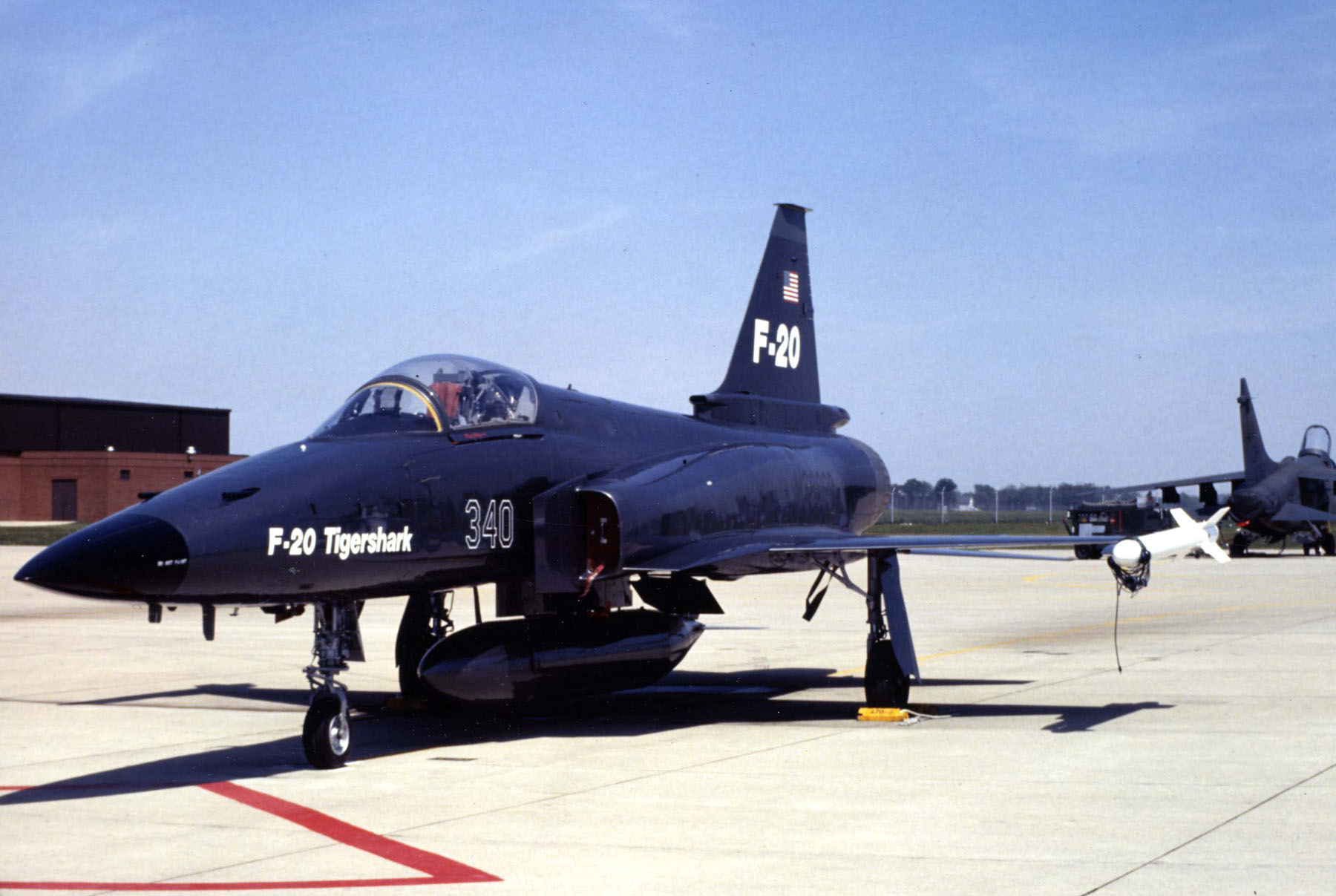

The Tigershark in motion
A curated video feature for the Northrop F-20 Tigershark is coming soon. In the meantime, explore the photo gallery above and the operator map below.
Where the Tigershark flew
Where the record stands
The F-20 Tigershark has no combat record, because it never entered service with any air force. Its story is measured not in kills but in a paradox: an aircraft that performed superbly in the air yet failed completely in the marketplace. Three prototypes flew roughly 1,500 sorties in testing and on demonstration tours; two were lost in fatal accidents attributed to G-induced loss of consciousness, not to any fault of the design. Not one order was ever placed, and the programme was cancelled in 1986. Its true significance is as the definitive example of a “great aircraft nobody bought.”
Compare the combat record of every military aircraft. Figures as of July 2026.
Everything people ask about the F-20 Tigershark
Can I fly in an F-20 Tigershark?
Why did the F-20 Tigershark fail to sell?
How was the F-20 different from the F-5?
What happened in the two F-20 crashes?
How good was the F-20 Tigershark?
Does any F-20 Tigershark still exist?
You can’t fly the F-20.
These, you can.
Some legends only live in museums — others are fuelled and waiting. MiGFlug has put civilians in real military jet cockpits since 2004.
 Fly the L-39 AlbatrosThe world’s most-flown jet trainer — aerobatics included
 Fly the F-104 Starfighter“The missile with a man in it”
 Fly the MiG-21The Cold War’s most-produced jet
 T-33 Shooting Star'ı uçurunAmerica’s first jet trainer
 Fly the DH VampireA piece of early jet history
 Fly the S.211Agile Italian jet trainer
 Fly the MB-326The classic Aermacchi jet
 Fly the MiG-15The Soviet legend of the Korean War
Continue the tour
Every fact, checked
- Vintage Aviation News — Grounded Dreams: F-20 TigersharkDevelopment, the F404 re-engining, cost and readiness figures, and the F-16 competition.
- PlaneHistoria — The Extinct Tigershark’s Untold TaleF-5G origins, APG-67 radar, performance figures and the export-policy story.
- This Day in Aviation — Northrop F-20AFirst-flight date and pilot, the two fatal crashes, dates, pilots and the surviving airframe.
- The Armory Life — Right Plane, Wrong TimeThe private-venture gamble, the “80% at half the cost” brief and why it failed.
- Defense Media Network — What Might Have BeenThe FX export-fighter policy, the Reagan-era shift and the F-16 decision.
- Hush-Kit — I Flew the F-20 TigersharkFirst-hand pilot impressions of the aircraft’s handling and performance.
- The National Interest — The Greatest Fighter That Never FlewAnalysis of the programme’s commercial failure and legacy.
- California Science Center — Air & SpaceThe museum preserving the sole surviving F-20 prototype.