
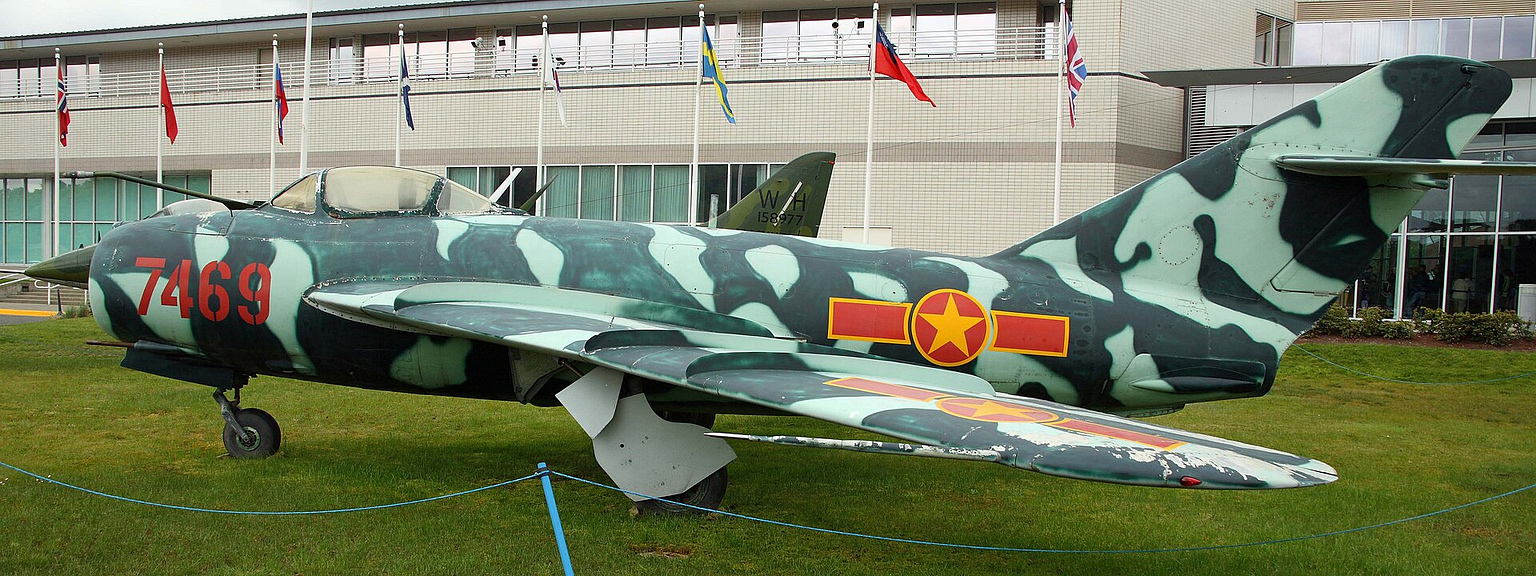
Mikoyan-Gurevich MiG-17
“Fresco”
The subsonic Soviet gun-fighter that humbled Mach-2 American jets over Hanoi, armed dozens of air forces across three continents, and — more than any other aircraft — is the reason the U.S. Navy founded “Top Gun.”
The gun-fighter that outlived the missile age it warned against
The MiG-17 was Mikoyan-Gurevich’s answer to the shortcomings its own MiG-15 exposed over Korea. Where the MiG-15 was a revolutionary but twitchy transonic fighter that could snake and depart controlled flight near its limit, the MiG-17 (bureau designation I-330 / SI) was a refinement rather than a revolution: a new, thinner and more sharply swept wing, a longer fuselage and a redesigned tail meant to tame transonic handling and push the useful speed envelope closer to Mach 1.
The prototype first flew on 1 February 1950, serial production was ordered in August 1951, and the type entered Soviet service in October 1952 — too late for the war it was born from. The definitive day-fighter MiG-17F added the afterburning Klimov VK-1F; radar variants (PF, then the missile-armed PFU) followed. Total production is usually cited at ~10,000+ (commonly 10,367) across the USSR and licensees, making it one of the most widely built jet fighters in history.
Its legend was made over Vietnam. Subsonic, radar-less and armed only with cannon, the little Fresco dragged Mach-2 F-4 Phantoms and F-105 Thunderchiefs down into slow turning fights where speed meant nothing and guns meant everything — a humiliation that drove the U.S. Navy to found its Fighter Weapons School, “Top Gun,” in 1969. China built it as the Shenyang J-5 and Poland as the Lim-5; today it survives in North Korean inventories and thrives on the civilian warbird circuit.
01How many MiG-17s were built — and why the total is so hard to pin down
The MiG-17’s production total is usually given as ~10,000+, with 10,367 the most-cited round figure — but the number varies by source. Roughly 8,000 were Soviet-built, with several thousand more produced under licence: China’s Shenyang J-5 (export F-5) and its two-seat JJ-5/FT-5 trainer, and Poland’s Lim-5 (plus locally developed Lim-6 attack derivatives).
That scale is why the Fresco ended up in the service of dozens of air forces from the 1950s well into the 1980s. Simple, rugged and cheap to keep flying from rough strips, it became a backbone of Soviet-aligned air arms and a Cold-War workhorse across Asia, the Middle East and Africa — present as a range, not a precise figure, because the licensed lines blur the count.
What makes the MiG-17 special
The refined swept wing — with fences
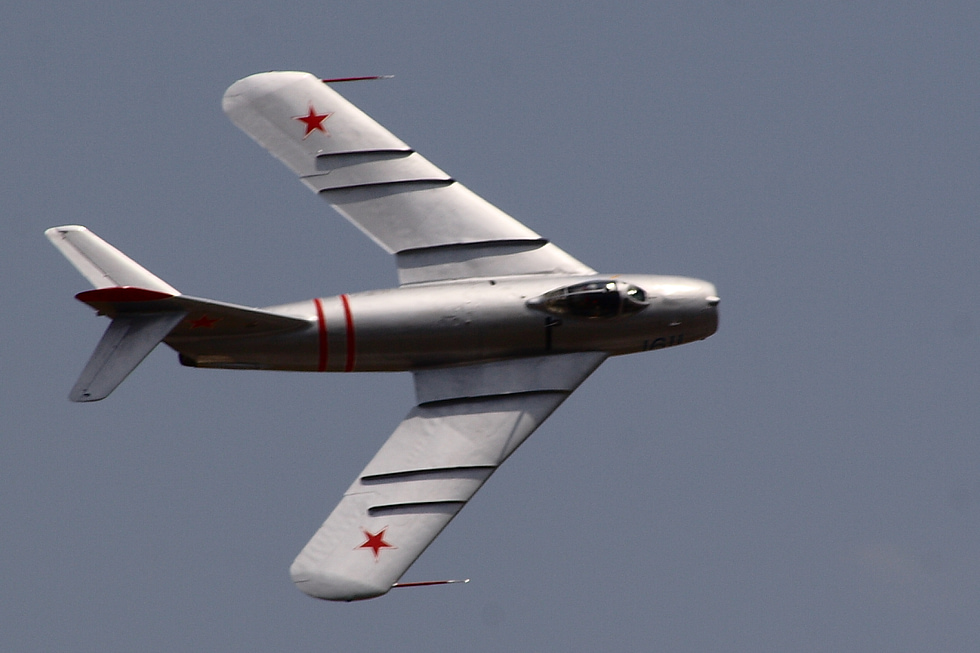
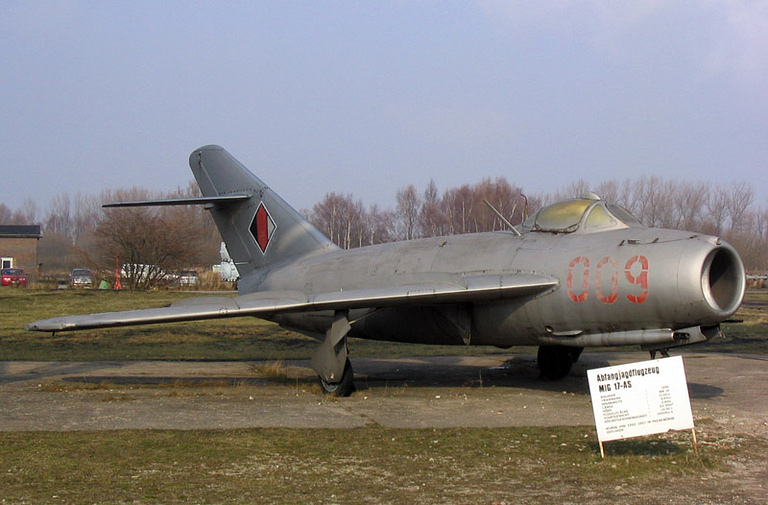
The MiG-17’s thinner, more sharply swept wing (a distinctive compound-sweep planform) carried prominent boundary-layer fences that checked spanwise airflow, delaying tip stall and improving handling right up to the transonic edge. They cured much of the MiG-15’s high-speed misbehaviour — and they are the quickest way to tell a Fresco from its predecessor at a glance.
The rugged Klimov VK-1F
A centrifugal-flow turbojet descended from the British Nene, the VK-1F added a straightforward afterburner — about 26.5 kN dry and 33.8 kN in reheat. It was tolerant of rough fields and unsophisticated maintenance, a decisive virtue for the developing-world air forces that flew the type for decades.
A heavy close-range nose battery
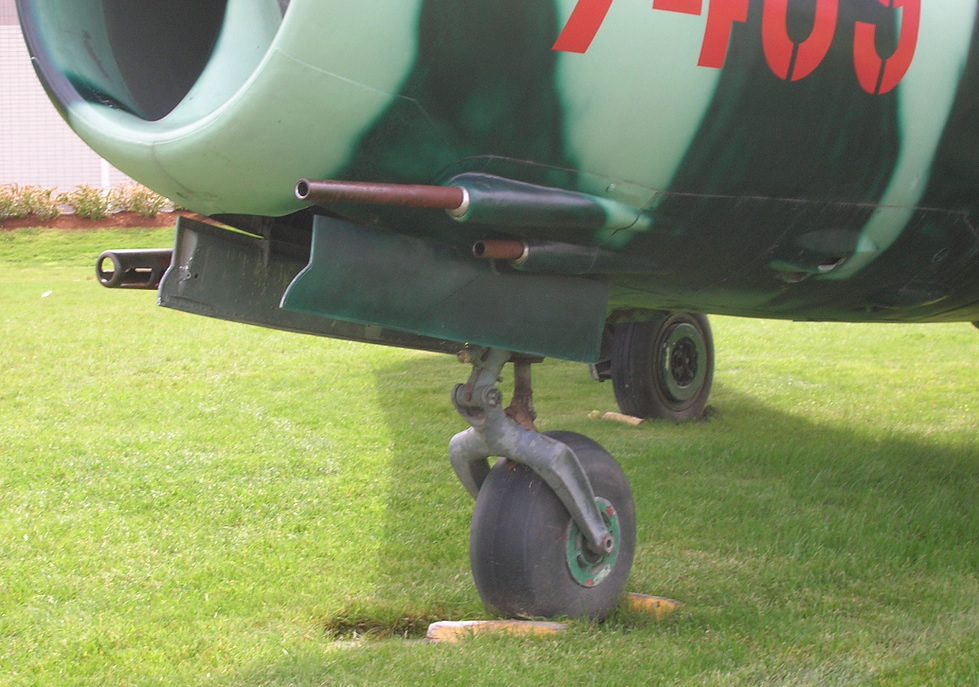
The concentrated one 37 mm N-37 plus two 23 mm NR-23 cannon package, tightly grouped in the nose, delivered a devastating short-burst punch. Slow-firing but heavy-hitting, it out-classed the gun-less early F-4 Phantom — and, dragged into a slow turning fight over Vietnam, it proved lethal against fighters twice its size.
02The MiG-17’s wing fences: little fins that fixed a dangerous habit
Those small metal fins running fore-and-aft along the MiG-17’s wing are not decoration. On a swept wing, air tends to slide outward toward the tips, thickening the boundary layer there and triggering an early, asymmetric tip stall — exactly the kind of vicious high-speed behaviour that made the MiG-15 twitchy near its limit. The fences act as dams, stopping that spanwise flow and keeping the outer wing flying longer. The result is crisper control and a more forgiving transonic edge, from an elegantly cheap piece of sheet metal rather than a costly redesign. Some sources describe the whole wing as an all-new design, others as a heavily reworked MiG-15 wing; either framing is defensible.
03The MiG-17’s guns vs. the missile age: why the Fresco was right
By the early 1960s Western doctrine had declared the dogfight obsolete: the future was radar and beyond-visual-range missiles, and the first F-4 Phantoms carried no gun at all. The MiG-17 was built on the opposite bet — a slow-firing but hard-hitting three-cannon nose for close-range work. Over Vietnam that bet paid off. Early U.S. missiles were unreliable in a low, slow turning fight, and a Phantom with empty missile rails and no cannon was defenceless against a Fresco that had slid inside its turn. The lesson forced the U.S. to bolt gun pods onto Phantoms, build the internal-gun F-4E, and rethink air-combat training from the ground up.
Full MiG-17F specifications
Airframe & Performance
- Mürettebat
- 1
- Uzunluk
- ~11.3 m (36.9 ft)
- Kanat açıklığı
- ~9.6 m (31.6 ft)
- Max speed
- ~1,100 km/h (~684 mph) at altitude
- Speed regime
- ~Mach 0.9–1.0 · supersonic only in a dive
- Servis tavanı
- ~16,600 m (~54,500 ft)
- First flight
- 1 February 1950 (prototype)
- Into service
- October 1952
- Built
- ~10,000+ (commonly cited 10,367)
Propulsion & Armament
- Motor
- 1 × Klimov VK-1F afterburning turbojet
- Thrust
- ~26.5 kN dry / ~33.8 kN reheat
- Cannon
- 1 × 37 mm N-37 + 2 × 23 mm NR-23
- Sert noktalar
- Underwing racks for bombs, rockets & tanks
- Missiles (PFU)
- 4 × AA-1 “Alkali” (guns deleted)
- Licence builds
- Shenyang J-5 (China), Lim-5 (Poland)
- Unit cost
- Not reliably documented (Soviet state economy)
- Cost per flight hour
- No reliable public figure
04The MiG-17’s cost: why there is no honest price tag
Ask what a MiG-17 cost and you hit a wall. It was a product of the Soviet planned economy, where aircraft were not really “priced” the way Western jets were, and export deals were bartered, subsidised or bundled into political packages that varied wildly by year and buyer. No credible unit-cost figure exists in open sources, and no reliable cost-per-flight-hour number either. What is certain is the design intent: the Fresco was built to be cheap, simple and mass-producible — a fighter sold and sustained more like a rifle than a luxury weapon system, which is precisely how a jet designed in 1950 ended up flying for developing-world air forces into the 21st century. The specs above are for the MiG-17F day fighter; the radar PF and missile PFU variants differ in weight, intake and armament.
From drawing board to warbird: the MiG-17 story
Design begins
Work starts on an improved swept-wing successor to the MiG-15, the I-330/SI, aimed at curing the earlier jet’s transonic handling.
Prototype first flight
The SI prototype flies; development is slowed by a fatal prototype loss and MiG-15 wartime production demands.
Serial production ordered
The refined fighter is cleared for mass production after the handling improvements are proven.
Enters Soviet service
The MiG-17 joins the Soviet Air Force — too late for the Korean War it was designed to fight.
The definitive MiG-17F
The afterburning VK-1F and prominent wing fences make the F the definitive day-fighter version.
Radar and missile variants
The MiG-17PF adds Izumrud radar; the MiG-17PFU trades all guns for four AA-1 “Alkali” missiles.
Licensed abroad
China builds the Shenyang J-5 and Poland the Lim-5/6, spreading the type across the Soviet-aligned world.
Peak over Vietnam
North Vietnamese MiG-17s drag U.S. supersonic fighters into low, slow turning fights and score cannon kills.
“Top Gun” is founded
Embarrassed by its kill ratios, the U.S. Navy establishes its Fighter Weapons School in direct response.
Retirement and afterlife
Widely withdrawn from front-line service; survives in North Korea and thrives as a civilian warbird worldwide.
From the flight line: twelve Fresco stories
The subsonic giant-killer
How a pre-Korea design beat Mach-2 jets over Hanoi.
Read the full story
Why Top Gun exists
The Fresco, more than any jet, is the reason the school — and the movie — exist.
Read the full story
Fresco on the airshow circuit
Dozens of MiG-17s and Polish Lim-5s fly today in private hands.
Read the full story
The last airworthy MiG-17PF
The rare radar-nosed interceptor is far scarcer in flying condition than the F.
Read the full story
The Chinese copy that outlived the original
China’s Shenyang J-5 kept the airframe in service long after Soviet lines closed.
Read the full story
Gulf of Tonkin era
The Fresco was the fighter North Vietnam scrambled as the escalation began.
Read the full story
The gun the F-4 forgot
Early Phantoms carried missiles but no cannon. The MiG-17 proved that wrong.
Read the full story
Fences on the wing
Those little metal fins fixed the MiG-15’s nastiest transonic habits.
Read the full story
Desert Frescos
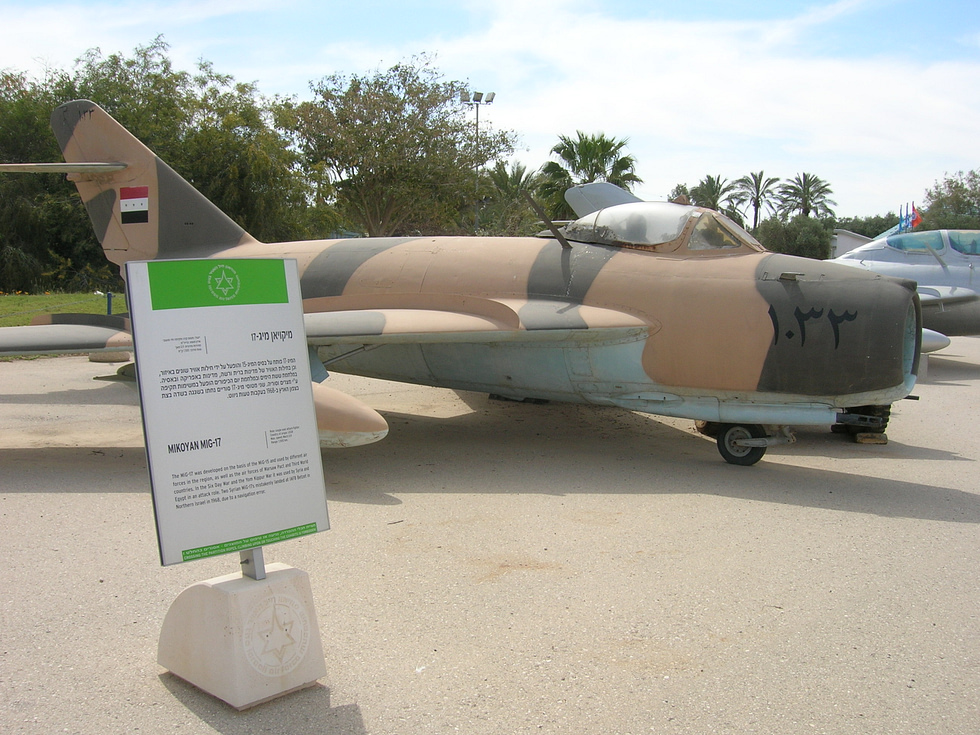
Egyptian and Syrian MiG-17s fought Israel from 1956 to 1973.
Read the full story
Africa’s Cold-War workhorse
Cheap and rugged, the Fresco armed a dozen newly independent air forces.
Read the full story
The ace who never was
“Colonel Tomb,” the 13-kill red-star ace, was almost certainly propaganda.
Read the full story
The gunless PFU experiment
The MiG-17PFU deleted all cannon for four AA-1 “Alkali” missiles.
Read the full story
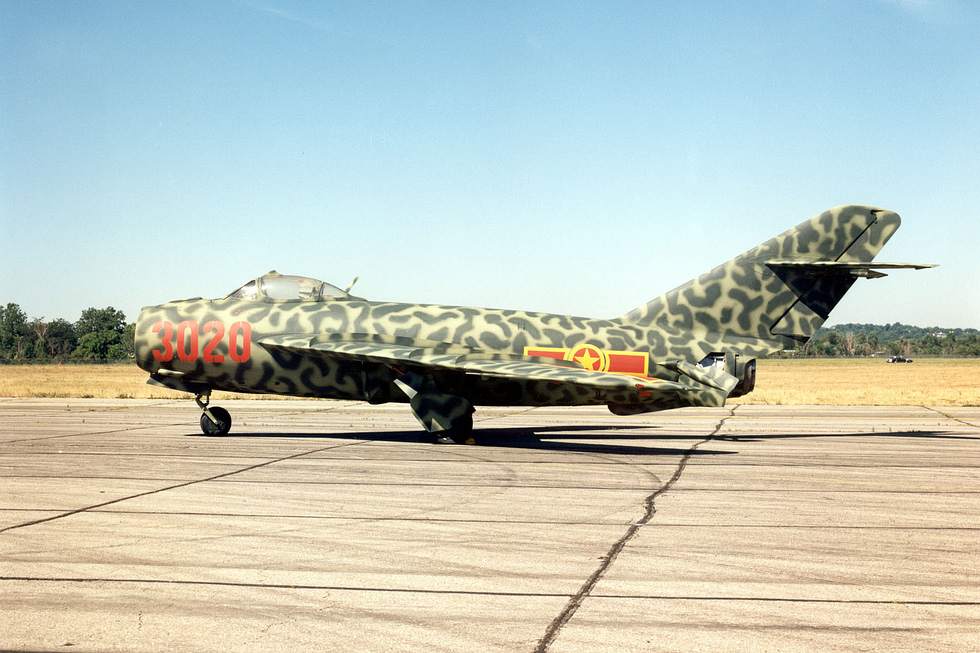
The Fresco in pictures
The Fresco in motion
A flying, afterburning privately-owned MiG-17 warbird clip is being verified for embedding — the type is a spectacular airshow performer.
The MiG-17 Fresco in motion
Not A Pound For Air To Ground — one of the most-watched MiG-17 Fresco films on YouTube.
Where the Fresco flew
The jet that humbled the missile age
The MiG-17 fought from Vietnam to the Middle East to Africa, and its published kill/loss records are among aviation’s most politically contested — always cite them as claims, not settled scores. Over Vietnam between 10 July 1965 and 14 February 1968, USAF F-105s and F-4s downed 61 MiG-17s; across the war U.S. forces claimed about 196 MiG kills of all types against roughly 83 U.S. aircraft lost to MiGs (an overall ~2.36:1 U.S. exchange ratio). Vietnamese and Soviet accounts claim a far more favourable balance for the MiG-17 in specific periods; the tallies are disputed.
Compare the combat record of every military aircraft. Figures as of July 2026 and widely contested.
Everything people ask about the MiG-17
Can I fly in a MiG-17?
Is the MiG-17 fast?
Is the MiG-17 still flying?
MiG-17 vs. F-4 in Vietnam — who won?
How many MiG-17s were built?
How does the J-5 relate to the MiG-17?
Why is the MiG-17 linked to “Top Gun”?
What were the MiG-17’s weapons?
You can’t fly the MiG-17.
These, you can.
Some legends only live in museums — others are fuelled and waiting. MiGFlug has put civilians in real military jet cockpits since 2004.
 Fly the L-39 AlbatrosThe world’s most-flown jet trainer — aerobatics included
 Fly the F-104 Starfighter“The missile with a man in it”
 Fly the MiG-21The Cold War’s most-produced jet
 T-33 Shooting Star'ı uçurunAmerica’s first jet trainer
 Fly the DH VampireA piece of early jet history
 Fly the S.211Agile Italian jet trainer
 Fly the MB-326The classic Aermacchi jet
 Fly the MiG-15The Soviet legend of the Korean War
Continue the tour
Every fact, checked
- Military Factory — Mikoyan-Gurevich MiG-17 (Fresco)Development history, variants and specification overview.
- PlaneHistoria — MiG-17 FrescoHigh-subsonic performance, wing design and service background.
- GlobalSecurity.org — MiG-17 in ActionCombat use and operator overview.
- Air & Space Forces Magazine — Against the MiGs in VietnamVietnam air-combat context and the contested kill tallies.
- National Museum of the U.S. Air Force — MiG-17F fact sheetAirframe details and the public-domain museum photographs.
- Smithsonian (Air & Space) — Return of the MiG-17Warbird restoration and the civilian survivors.
- Skies Magazine — The last airworthy MiG-17PF for saleThe rarity of flying radar-nosed PF examples.
- Britannica — MiG-17Concise reference summary of the type.